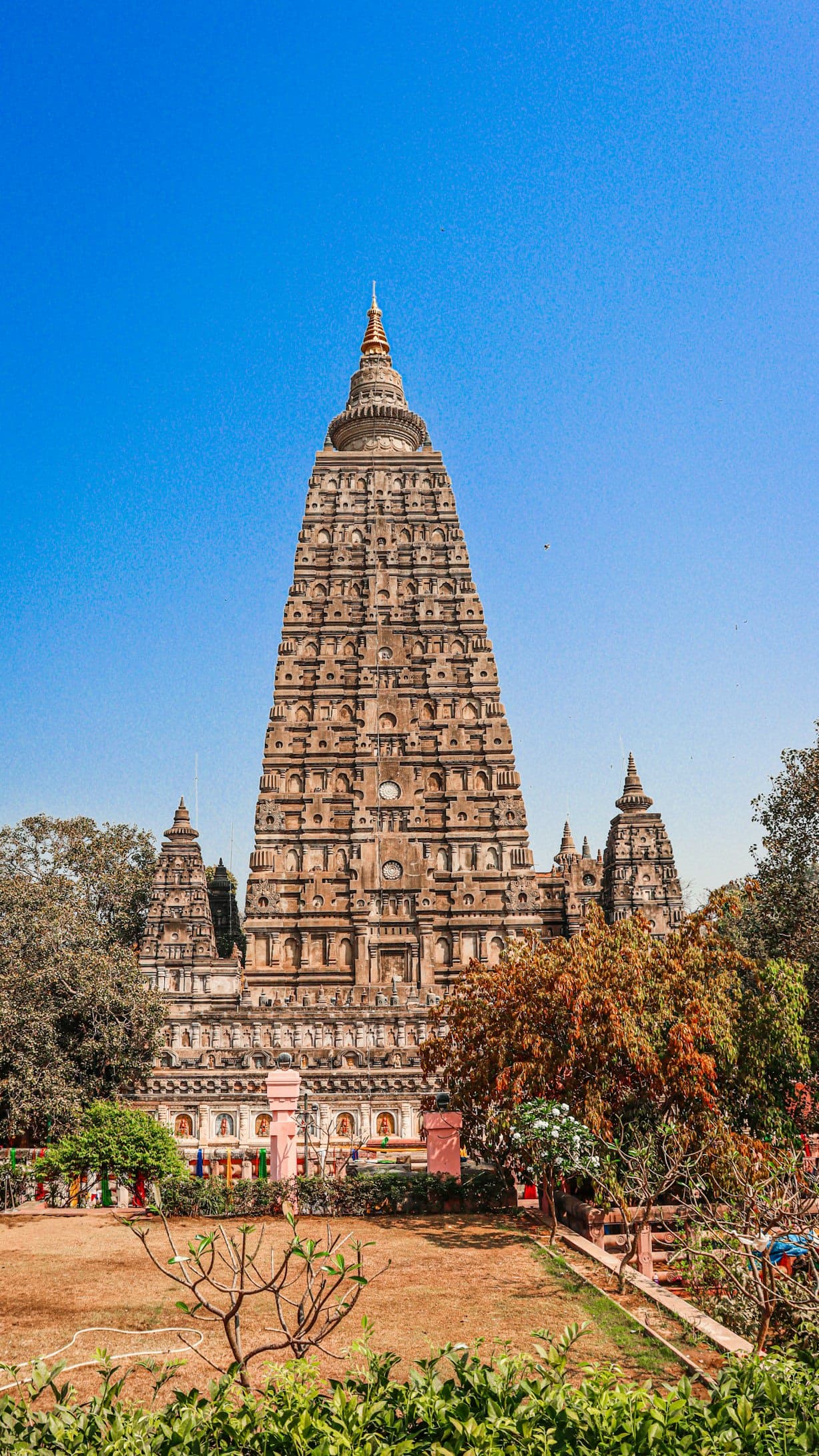
Mahabodhi Temple and Bodhi Tree, Bodh Gaya, Bihar
Where Siddhartha became the Buddha beneath a tree whose descendant still shelters pilgrims
Bodh Gaya, Bihar, India
At A Glance
- Coordinates
- 24.6959, 84.9914
- Suggested Duration
- The temple complex itself takes 2-3 hours for a thorough visit. To visit the international monasteries surrounding the temple, add another half to full day. Many pilgrims spend multiple days in Bodh Gaya, attending meditation sessions, exploring the monasteries, and returning to the temple at different times. Serious meditation retreats at centers like Root Institute extend to weeks or months.
- Access
- Gaya Airport (GAY) has connections to major Indian cities including Delhi, Kolkata, and Mumbai. Gaya Junction railway station connects to Kolkata, Delhi, Varanasi, and other major destinations. Bodh Gaya is 16 km from Gaya city, accessible by auto-rickshaw (₹200-300) or taxi. The IRCTC Buddhist Circuit train connects major Buddhist pilgrimage sites. Many pilgrims combine Bodh Gaya with Sarnath (first sermon), Rajgir (Vulture's Peak), and Nalanda (ancient university).
Pilgrim Tips
- Gaya Airport (GAY) has connections to major Indian cities including Delhi, Kolkata, and Mumbai. Gaya Junction railway station connects to Kolkata, Delhi, Varanasi, and other major destinations. Bodh Gaya is 16 km from Gaya city, accessible by auto-rickshaw (₹200-300) or taxi. The IRCTC Buddhist Circuit train connects major Buddhist pilgrimage sites. Many pilgrims combine Bodh Gaya with Sarnath (first sermon), Rajgir (Vulture's Peak), and Nalanda (ancient university).
- Modest dress with shoulders and knees covered. Light, breathable fabrics are practical given the heat. Layers may be useful for early morning or evening visits when temperatures drop. Shoes will be removed frequently; sandals or slip-on shoes are practical.
- Photography is generally permitted throughout the complex but may be restricted in specific areas. Do not photograph monks, nuns, or other practitioners without explicit permission. No flash photography in interior temple spaces. Be mindful not to obstruct others' practice or movement to compose a photograph.
- The complexity of the site can be overwhelming on first visit. The heat, especially March-May, can be intense. The crowds during Buddha Purnima and Kalachakra can be challenging for contemplative practice. Some visitors find the commercial activity surrounding the temple compound (vendors, guides, beggars) jarring in contrast to the sacred atmosphere within. Stomach issues are common among travelers to India; take standard precautions with food and water.
Overview
The Mahabodhi Temple marks where it happened—where a man sat down beneath a pipal tree and, after forty-nine days of meditation, achieved complete liberation from suffering. The tree still grows. A descendant of the original Bodhi Tree shelters pilgrims who come from every Buddhist tradition on earth: Theravada monks in saffron, Tibetan nuns in maroon, Zen practitioners in black, laypeople from everywhere. This is where Buddhism began. For 2,500 years, people have come here to sit where the Buddha sat.
Bodh Gaya is the holiest site in Buddhism. Here, approximately 2,500 years ago, Prince Siddhartha Gautama sat beneath a pipal tree on the banks of the Phalgu River and achieved enlightenment—complete understanding of the nature of suffering, its cause, its cessation, and the path leading to its end. He became the Buddha, the Awakened One. The religion that would spread across Asia and eventually the world began at this precise spot.
The Mahabodhi Temple Complex marks the location. The 50-meter pyramidal tower rises above a descendant of the original Bodhi Tree. The Vajrasana—the Diamond Throne—is the stone slab where tradition says the Buddha sat. According to Buddhist cosmology, this is the navel of the earth, the only place capable of supporting the weight of a Buddha's enlightenment without breaking apart.
What distinguishes Bodh Gaya from other ancient sacred sites is its continuous life. This is not a ruin to be contemplated but a living pilgrimage destination where practice never stops. Dawn to dusk, monks and nuns from every Buddhist tradition circumambulate the temple, prostrate before the Bodhi Tree, chant sutras, and sit in meditation. Thai and Sri Lankan monasteries neighbor Tibetan and Japanese ones. The Dalai Lama leads annual ceremonies drawing tens of thousands. During Buddha Purnima, the celebration of Buddha's birth, enlightenment, and death, the temple grounds overflow with pilgrims lighting butter lamps through the night.
The temple complex was inscribed as a UNESCO World Heritage Site in 2002, recognized for its exceptional testimony to Buddhist civilization and its direct association with the foundational event of the tradition. But for the pilgrims who come here, the designation is secondary. What matters is that this is where it happened, where the possibility of awakening was demonstrated, where a human being showed what human beings can become.
Context And Lineage
The Buddha attained enlightenment at this site around the 6th-5th century BCE. Emperor Ashoka built the first temple in the 3rd century BCE. The present structure dates from the Gupta period (5th-6th century CE). After centuries of decline following Turkic conquests, restoration began in the 19th century. UNESCO inscribed the site in 2002.
Prince Siddhartha Gautama was born into a royal family in what is now Nepal. Sheltered from suffering by his father, he nonetheless encountered old age, sickness, and death during excursions from the palace. Recognizing that no wealth or pleasure could protect him from these realities, he renounced his royal life at age 29 to seek the end of suffering.
For six years he practiced extreme asceticism, nearly starving himself, but found this path inadequate. Accepting food from a village girl named Sujata, he recovered his strength and sat beneath a pipal tree on the banks of the Phalgu River near Gaya. There, tradition says, he was assailed by Mara, the tempter, who sent his armies and his daughters to distract Siddhartha from his goal. Siddhartha remained unmoved. He touched the earth, calling it to witness his determination, a gesture still represented in countless Buddha images as the bhumisparsha (earth-touching) mudra.
At dawn on the full moon of Vaisakha—a date now celebrated as Buddha Purnima, usually in May—after forty-nine days of meditation, he achieved enlightenment: complete understanding of the Four Noble Truths and the path leading to the cessation of suffering. He became the Buddha, the Awakened One. He was approximately 35 years old.
He spent the following seven weeks at seven different spots in the vicinity, meditating on his experience. Then he traveled to Sarnath, near Varanasi, to deliver his first teaching to five former companions, setting in motion the wheel of dharma that would spread across Asia and eventually the world.
Bodh Gaya represents the origin point of Buddhism, acknowledged by all traditions. From here, Buddhism spread first across India, then to Sri Lanka, Southeast Asia, Central Asia, China, Korea, Japan, and Tibet. Different schools developed different practices and emphases, but all trace their origin to this site. The convergence of monasteries from every Buddhist tradition around the temple complex today reflects this shared heritage. The site is also the only living Buddhist pilgrimage site on India's UNESCO World Heritage list, maintaining continuous practice through the 21st century.
Siddhartha Gautama (The Buddha)
Founder of Buddhism
Emperor Ashoka
Builder of the first temple
Xuanzang
Chinese pilgrim and chronicler
Why This Place Is Sacred
Bodh Gaya is thin because this is where the central event of Buddhism occurred—the achievement of enlightenment by a human being. The site functions as Buddhism's axis mundi, the earth's navel, the only place capable of supporting such an event. The tree that sheltered the Buddha still grows, and pilgrims still come to sit where he sat.
What makes Bodh Gaya thin? The Buddhist answer is uncompromising: this is where enlightenment happened. Not a place that commemorates enlightenment but the actual location where a human being achieved complete liberation from suffering. The event that made Buddhism possible occurred here.
The metaphysics reflect this uniqueness. According to Buddhist cosmology, the Vajrasana—the Diamond Throne where the Buddha sat—marks the navel of the earth, the only point on the planet strong enough to support a Buddha attaining full enlightenment without the ground breaking apart. Every Buddha in every cosmic cycle, according to tradition, achieves enlightenment at this exact spot. The location is not arbitrary but necessary.
The Bodhi Tree intensifies this thinness. A descendant of the original tree under which the Buddha meditated still grows here, a living link to the founding moment. The tree has been destroyed and renewed multiple times over the centuries—cut down by hostile rulers, struck by storms—but saplings from earlier generations always survived to continue the lineage. Pilgrims sit in its shade as the Buddha did, meditating in the same species of tree, perhaps even in the genetic descendants of the same tree.
The continuity of practice adds another dimension. For 2,500 years, with interruptions during periods of conquest and decline, pilgrims have come to this site to do what the Buddha did: sit in meditation seeking awakening. The accumulated weight of this intention—millions of practitioners over millennia, all pointing toward the same goal—creates what many visitors describe as a palpable atmosphere. The thinness is not only historical but accumulated.
The convergence of all Buddhist traditions at this one site further distinguishes it. Theravada, Mahayana, Vajrayana—schools that developed different practices, different cosmologies, different emphases—all recognize Bodh Gaya as the supreme pilgrimage site. Whatever distinctions developed later, this is where it began for all of them. The navel of the earth draws the entire Buddhist world back to a single point.
Bodh Gaya has functioned as a pilgrimage destination since shortly after the Buddha's enlightenment. Emperor Ashoka built the first temple and the Vajrasana in the 3rd century BCE, formalizing what was already a site of veneration. The present temple structure dates from the Gupta period (5th-6th century CE). Throughout its history, the site has served as the primary destination for Buddhist pilgrims from across Asia, a place where enlightenment is not merely remembered but actively sought.
The site has passed through cycles of patronage and neglect. Ashoka's constructions established it as a major pilgrimage center. The Gupta period (4th-6th century CE) saw the construction of the current temple. Chinese pilgrims Faxian (5th century) and Xuanzang (7th century) documented thriving Buddhist communities. Turkic conquests in the 13th century led to decline, with the site eventually coming under partial Hindu management. Burmese missions attempted restoration in the 11th century and again in the 19th century. The Archaeological Survey of India undertook major excavation and reconstruction beginning in 1878. The 1949 Bodh Gaya Temple Act established joint Hindu-Buddhist management. Since the mid-20th century, monasteries representing Buddhist traditions from across Asia have been established around the temple, creating an international Buddhist community. UNESCO inscription came in 2002.
Traditions And Practice
Pilgrims circumambulate the temple, prostrate before the Bodhi Tree and Vajrasana, offer flowers and incense, chant sutras, and practice meditation. Multiple Buddhist traditions maintain active presence, with practices ranging from Theravada vipassana to Tibetan prostrations to Zen sitting. Major annual events include Buddha Purnima and the Kalachakra ceremony led by the Dalai Lama.
Traditional practices at Bodh Gaya span the full range of Buddhist devotion. Circumambulation—walking clockwise around the temple and Bodhi Tree—is practiced by pilgrims from all traditions, a walking meditation that accumulates merit while maintaining focus on the sacred center. Prostrations, particularly the full-body prostrations of Tibetan Buddhism, mark the devotion of pilgrims who may complete thousands during their visit. Offerings of flowers, incense, butter lamps, and candles create the sensory environment of worship. Chanting of sutras in Pali, Sanskrit, Tibetan, Chinese, and Japanese creates a continuous soundscape of devotion.
Meditation beneath the Bodhi Tree is the practice most directly connected to the Buddha's own activity. Pilgrims sit in the same posture the Buddha took—legs crossed, spine straight, hands in meditation mudra—seeking to replicate not just the physical form but the inner concentration that led to enlightenment. Some pilgrims maintain intensive practice for days or weeks, sitting through the night under the tree.
The seven sacred spots offer a pilgrimage circuit within the complex, each marking a location associated with the Buddha's seven weeks of post-enlightenment meditation. Visiting each site in sequence connects pilgrims to the narrative of the Buddha's experience.
Contemporary practice at Bodh Gaya reflects the global diversity of Buddhism. Theravada monks from Sri Lanka, Myanmar, Thailand, and Cambodia maintain vipassana meditation traditions. Tibetan monasteries representing all four major schools—Nyingma, Kagyu, Sakya, and Gelug—offer teachings and empowerments. Japanese Zen, Korean Son, and Chinese Chan practitioners bring their distinctive meditation approaches. Western students attend courses at centers like Root Institute, studying with teachers from various traditions.
The Kalachakra initiation, led by the Dalai Lama at Bodh Gaya, is one of the largest regular gatherings in the Buddhist world, drawing tens of thousands of participants for the multi-day ceremony. Buddha Purnima brings enormous crowds for day-long celebrations, with the temple lit by thousands of butter lamps through the night. The Kathina ceremony (October-November) marks the end of the rainy season retreat for Theravada monastics.
Meditation courses and retreats are available through multiple centers for visitors of any background. Drop-in sessions offer introduction to various meditation techniques. The Root Institute, in the Tibetan tradition, offers courses ranging from weekend introductions to month-long retreats.
Begin with circumambulation, joining the flow of pilgrims walking clockwise around the temple. Move slowly; let the practice be meditative rather than touristic. When you reach the Bodhi Tree, find a spot to sit in meditation—even fifteen minutes beneath the tree's branches connects you to the central act of the tradition. Visit the Vajrasana and consider the weight of what tradition says happened here. If you're drawn to deeper practice, attend a drop-in meditation session at one of the monasteries or centers. Consider returning to the temple at different times—the atmosphere at dawn differs from evening—and if possible, spend multiple days letting the site's rhythm become familiar.
Theravada Buddhism
ActiveBodh Gaya is the most important of the four main pilgrimage sites in the Buddha's life, representing the core event of Buddhist history: the moment Siddhartha Gautama attained enlightenment. Theravada Buddhism, the 'Way of the Elders,' traces its lineage directly to the Buddha's original teaching and particularly reveres this site. Sri Lanka has maintained historical influence here, and monks from Sri Lanka, Myanmar, Thailand, and Cambodia maintain continuous presence.
Theravada pilgrims practice circumambulation, prostration before the Bodhi Tree and Vajrasana, offerings of flowers and incense, chanting of Pali sutras, and vipassana (insight) meditation. The Kathina Ceremony, marking the end of the rainy season retreat, is a significant annual event. Many Theravada practitioners undertake intensive meditation retreats during their pilgrimage.
Mahayana Buddhism
ActiveMahayana Buddhism reveres Bodh Gaya as the site of Shakyamuni Buddha's supreme enlightenment. The tradition emphasizes that the Buddha's awakening demonstrated the potential inherent in all beings. Great Mahayana scholars including Nagarjuna and Asanga practiced at or near this site. Chinese pilgrims Faxian and Xuanzang documented their pilgrimages, preserving crucial historical information. Chinese, Japanese, Korean, Vietnamese, and Taiwanese monasteries now operate in Bodh Gaya.
Mahayana pilgrims engage in meditation, sutra chanting, prostrations, and offerings. Many take bodhisattva vows at the site—committing to attain enlightenment for the benefit of all beings. The 80-foot Great Buddha Statue, erected in 1989, is a focal point for Mahayana devotion. Japanese, Korean, and Chinese temples offer services in their respective traditions. Some pilgrims engage in intensive sutra copying or recitation practices.
Vajrayana/Tibetan Buddhism
ActiveThe Vajrasana (Diamond Throne) resonates particularly with Vajrayana Buddhism's emphasis on the indestructible, diamond-like nature of enlightened mind. Bodh Gaya was crucial during the 10th-13th century Tibetan Buddhist renaissance, when Tibetans traveled to India seeking texts and teachers. Models of the Mahabodhi Temple brought back to Tibet influenced Tibetan sacred architecture. The Dalai Lama leads annual Kalachakra initiations at the site.
Tibetan Buddhist pilgrims practice full-body prostrations (some completing hundreds of thousands), circumambulation with mantra recitation, butter lamp offerings, and meditation. The Kalachakra initiation draws tens of thousands for a multi-day ceremony of empowerment. All four major Tibetan schools—Nyingma, Kagyu, Sakya, and Gelug—maintain monasteries in Bodh Gaya offering teachings and retreats. Many pilgrims engage in intensive ngöndro (preliminary) practices during their visit.
Hinduism
ActiveBodh Gaya exists within complex Hindu sacred geography. Buddha is sometimes considered an avatar of Vishnu in Hindu tradition. The Mahabodhi Temple was historically managed partly by Hindu Shaivite priests, leading to disputes resolved by the 1949 Bodh Gaya Temple Act establishing joint Hindu-Buddhist management. The nearby Vishnupad Temple, dedicated to Vishnu's footprint, is an important Hindu pilgrimage site. Gaya itself is significant for Hindu shraddha (ancestral) ceremonies.
Hindu pilgrims may visit the Mahabodhi Temple as part of broader pilgrimage to Gaya for ancestral rites. The relationship between Buddhist and Hindu practice at the site reflects centuries of shared and contested sacred geography. The 1949 Act attempts to balance both communities' interests in temple management.
Experience And Perspectives
The experience begins with the diversity of practitioners: saffron-robed Theravada monks, maroon-clad Tibetan nuns, black-robed Zen practitioners, laypeople from every continent. The 50-meter temple rises above the Bodhi Tree, and beneath the tree's spreading branches, pilgrims sit in the same posture the Buddha took. The sound of chanting in multiple languages fills the air from dawn to dusk.
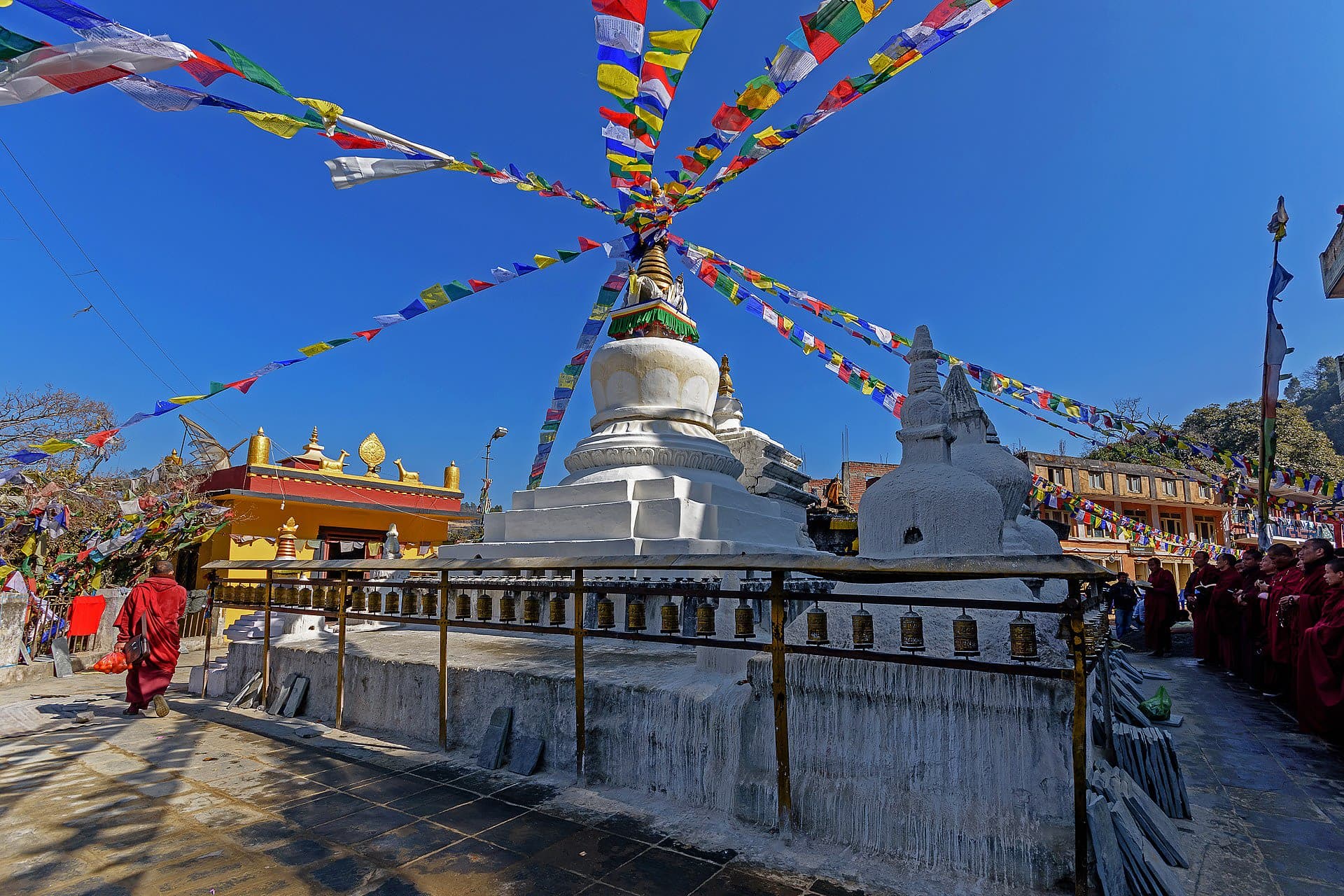
You notice the diversity first. Walking toward the Mahabodhi Temple, you pass monasteries representing traditions from across the Buddhist world: the Tibetan monastery with its prayer wheels and butter lamps, the Thai temple with its gilded spires, the Japanese pagoda, the Chinese temple, the Bhutanese complex. Each architectural style announces a different Buddhist culture, yet all oriented toward the same center.
The temple itself rises 50 meters, a pyramidal tower of the shikhara type, surrounded by smaller votive stupas accumulated over centuries. The main structure dates from the Gupta period, though it has been restored and modified many times. The architecture is not purely aesthetic but cosmological: the temple is a three-dimensional mandala, a representation of the Buddhist universe with enlightenment at its center.
You remove your shoes at the entrance and join the flow of pilgrims circumambulating the temple clockwise. The pavement is smooth from centuries of barefoot walking. Some pilgrims move slowly in meditation; others prostrate every few steps, full-body prostrations in the Tibetan style, marking their progress with prayer beads. The sound of chanting in Pali, Sanskrit, Tibetan, Japanese, and Korean creates a continuous polyglot devotion.
The Bodhi Tree spreads its branches behind the temple. This is a descendant of the original tree, possibly through several generations—the lineage has been maintained through destruction and renewal over millennia. The tree is a Ficus religiosa, the sacred fig, and pilgrims sit beneath its branches in the same posture the Buddha took: legs crossed, hands in meditation mudra, eyes closed or half-closed. Some sit for minutes, some for hours. The atmosphere beneath the tree is quieter than elsewhere in the complex, though never silent—the chanting and the shuffling of circumambulating feet continue as background.
The Vajrasana is beside the tree, a stone slab marking the exact spot where tradition says the Buddha sat. It dates from Ashoka's time, 3rd century BCE, making it one of the oldest Buddhist monuments in existence. Pilgrims touch it with reverence, leave flower offerings, or simply stand gazing at the spot where enlightenment occurred.
Inside the main temple, a gilded Buddha image sits in the earth-touching mudra (bhumisparsha), the gesture representing the moment of enlightenment when the Buddha called the earth to witness his achievement. Pilgrims offer flowers, incense, and butter lamps. The interior is dim and fragrant with incense.
The seven sacred spots mark locations where the Buddha spent the seven weeks after his enlightenment, meditating on his experience before setting out to teach. The Animeschalochana Chaitya marks where he gazed at the Bodhi Tree for a week without blinking. The Chankramanar is the walking meditation path he paced. Muchalinda Lake recalls the week when a serpent king sheltered him from storms. Visiting these sites extends the pilgrimage beyond the central temple to the surrounding sacred geography.
The atmosphere shifts throughout the day. Dawn brings the most serious practitioners, sitting in the cool darkness as light gradually illuminates the temple. Midday can be crowded and hot. Evening is when the temple is most atmospheric: butter lamps flicker in the gathering darkness, and the chanting intensifies. During Buddha Purnima (usually May), the grounds overflow with pilgrims, the temple lit by thousands of lamps through the night.
The temple complex is open approximately 5:00 AM to 9:00 PM daily. The Bodhi Tree area is the spiritual heart; plan to spend significant time there. Circumambulate the temple clockwise with the flow of pilgrims. The Vajrasana beside the tree marks the traditional spot of enlightenment. The seven sacred spots are spread around the complex. The Archaeological Museum near the entrance houses original sculptures and provides historical context. Bring modest clothing (shoulders and knees covered), and be prepared to remove shoes. Early morning offers the most peaceful atmosphere for meditation. Consider visiting multiple times if staying in Bodh Gaya, as the character of the site changes throughout the day and evening.
Bodh Gaya invites interpretation through multiple lenses: as the historical site where the Buddha achieved enlightenment, as a living pilgrimage destination where practice continues daily, as a convergence point for all Buddhist traditions, and as a place where the possibility of awakening is demonstrated and sought. These perspectives layer upon each other, each enriching the others.
Historians and archaeologists recognize Bodh Gaya as the actual site associated with the historical Buddha's enlightenment, with archaeological evidence of pilgrimage and veneration dating from the Mauryan period (3rd century BCE). The Mahabodhi Temple is one of the earliest surviving brick structures in India, with the current structure dating to the Gupta period (5th-6th century CE). The accounts of Chinese pilgrims Faxian (5th century) and Xuanzang (7th century) provide crucial historical documentation. UNESCO's 2002 inscription recognized both the site's historical significance and its continuing religious importance—it is the only living Buddhist site on India's World Heritage list.
For Buddhists, Bodh Gaya is not merely historically significant but supremely sacred—the place where enlightenment happened, where a human being achieved complete liberation from suffering, where the possibility of awakening was demonstrated. The Bodhi Tree is a living descendant of the tree under which the Buddha sat. The Vajrasana is the exact spot, the navel of the earth, the only place capable of supporting a Buddha's enlightenment. To sit where the Buddha sat, to meditate under the same species of tree, is to connect directly with the founding moment of the tradition. The convergence of all Buddhist traditions at this site reflects its universal importance: whatever differences developed later, this is where it began for all schools.
Some visitors experience Bodh Gaya as a place of accumulated spiritual power, the devotion of millions of pilgrims over millennia creating a palpable atmosphere conducive to practice. The concept of the Vajrasana as the 'navel of the earth'—the axis mundi connecting all realms—resonates with those interested in sacred geography across traditions. Contemporary seekers are often drawn to Buddhism's emphasis on direct experience over belief; Bodh Gaya offers not a doctrine to accept but an invitation to practice. The site attracts practitioners from contemplative traditions beyond Buddhism, recognizing the universal human interest in awakening.
Questions remain about the site's early history: the exact date of Buddha's enlightenment (traditional dates range from 589 BCE to the 5th century BCE); what the original site looked like before Ashoka's constructions; how the Bodhi Tree lineage was maintained through centuries of destruction and renewal; how Buddhist practice at the site evolved before the Chinese pilgrims' documentation. The relationship between the site's Buddhist and Hindu sacred geography—near Gaya, an important Hindu pilgrimage center—continues to be negotiated in temple management under the 1949 Bodh Gaya Temple Act.
Visit Planning
Bodh Gaya is accessible via Gaya Airport or Gaya Junction railway station, 16 km away. The temple complex is open approximately 5:00 AM to 9:00 PM. Entry is free or minimal. November-February offers the best weather. Allow at least 2-3 hours for the temple complex; many pilgrims stay multiple days.
Gaya Airport (GAY) has connections to major Indian cities including Delhi, Kolkata, and Mumbai. Gaya Junction railway station connects to Kolkata, Delhi, Varanasi, and other major destinations. Bodh Gaya is 16 km from Gaya city, accessible by auto-rickshaw (₹200-300) or taxi. The IRCTC Buddhist Circuit train connects major Buddhist pilgrimage sites. Many pilgrims combine Bodh Gaya with Sarnath (first sermon), Rajgir (Vulture's Peak), and Nalanda (ancient university).
Bodh Gaya offers accommodation ranging from simple guesthouses to international hotels. Many monasteries offer accommodation to pilgrims, typically simple but peaceful. The Root Institute offers residential retreat facilities. Budget options cluster near the temple; mid-range and luxury options are further from the center. Book well in advance during Buddha Purnima and major events.
Dress modestly (shoulders and knees covered). Remove shoes in temple areas. Circumambulate clockwise. Do not point feet toward Buddha images or the Bodhi Tree. Do not sit higher than monks. Maintain silence or quiet conversation in meditation areas. Photography is generally permitted but should not disrupt practice.
The Mahabodhi Temple is an active place of worship, and etiquette reflects both general religious courtesy and specific Buddhist cultural norms. The baseline is respect: for the site, for the practitioners, for the tradition.
Dress should be modest: shoulders and knees covered for both men and women. This is not merely a rule but a sign of respect for the sacred character of the space. Shoes are removed before entering temple areas; storage is available near entrances.
Circumambulation follows a clockwise direction—this is not arbitrary but reflects Buddhist cosmology, where the sacred is always kept to one's right. Do not walk against the flow of pilgrims. Move at whatever pace feels appropriate, whether slow walking meditation or simply attentive strolling.
In Buddhist cultures, feet are considered the lowest part of the body and should not be pointed at sacred objects or persons. When sitting in meditation or rest, tuck feet beneath you or to the side rather than extending them toward the Buddha image, the Bodhi Tree, or monks and nuns. Similarly, the head is the highest part of the body; do not sit in a position higher than monks or Buddha images.
Silence or quiet conversation is appropriate in meditation areas. The continuous chanting and practice create an atmosphere of devotion; loud conversation or behavior disrupts it. Cell phones should be silenced.
Photography is generally permitted but should be approached with discretion. Do not photograph monks or practitioners without permission. Do not use flash in interior spaces. Do not obstruct others' practice to get a shot. The goal is to photograph the site, not to treat practitioners as subjects.
Modest dress with shoulders and knees covered. Light, breathable fabrics are practical given the heat. Layers may be useful for early morning or evening visits when temperatures drop. Shoes will be removed frequently; sandals or slip-on shoes are practical.
Photography is generally permitted throughout the complex but may be restricted in specific areas. Do not photograph monks, nuns, or other practitioners without explicit permission. No flash photography in interior temple spaces. Be mindful not to obstruct others' practice or movement to compose a photograph.
Offerings of flowers, incense, butter lamps, and candles are traditional and encouraged. These can be purchased from vendors near the temple entrance. Offerings should be placed in designated areas, not directly on the Bodhi Tree or ancient structures. Offerings reflect participation in the devotional practice of the site.
Do not point feet toward Buddha images, the Bodhi Tree, or monks and nuns. Do not sit in positions higher than Buddha images or monks. Circumambulate in a clockwise direction. Do not touch the Vajrasana or climb on temple structures. Maintain silence in meditation areas. Do not remove anything from the site.
Sacred Cluster
Nearby sacred places create the location cluster described in the growth plan. This block is intentionally crawlable and links into the wider regional graph.