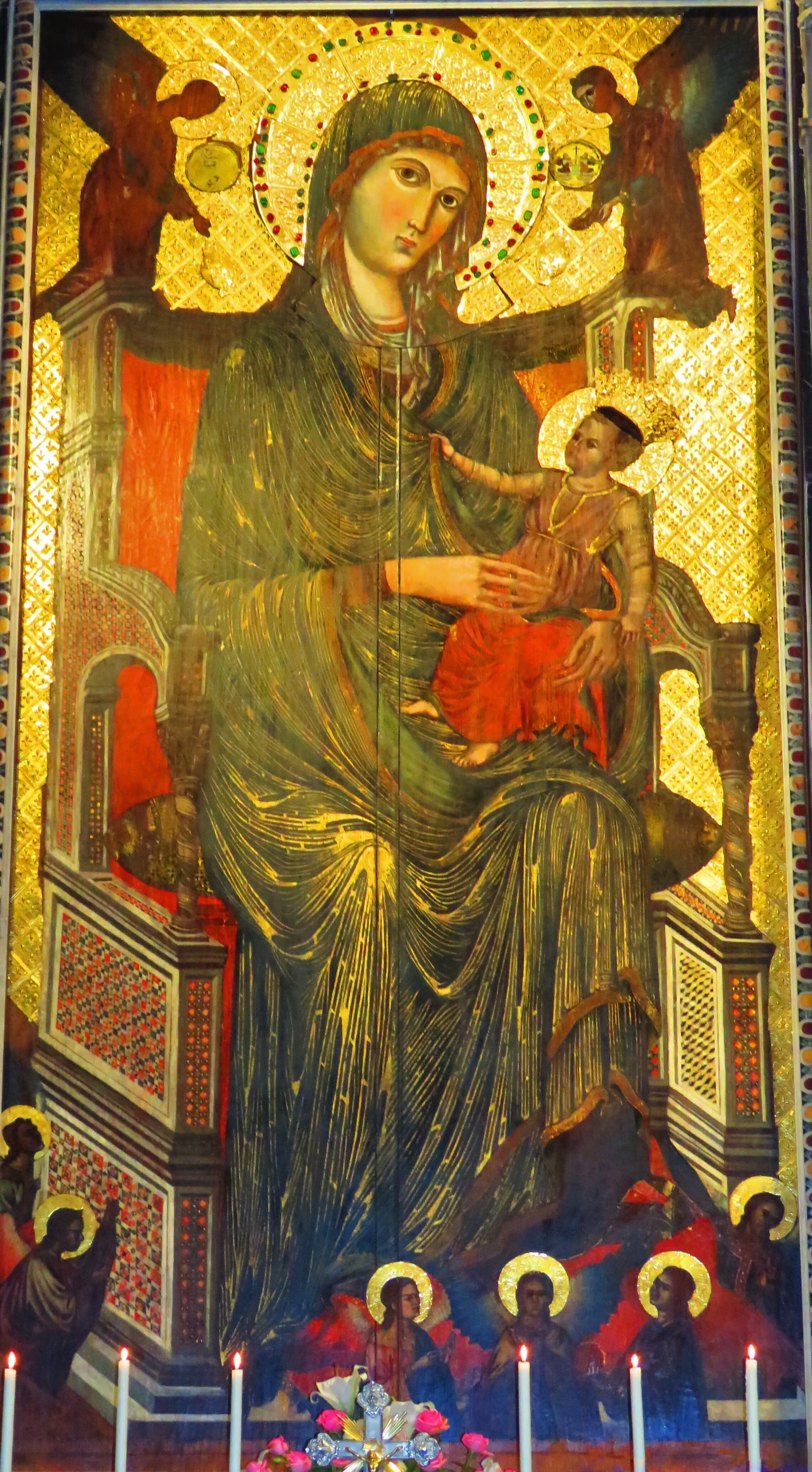
Madonna di Montevergine (Mamma Schiavona)
Where the Black Madonna welcomes all who have been turned away elsewhere
Mercogliano, Campania, Italy
At A Glance
- Coordinates
- 40.9353, 14.7289
- Suggested Duration
- A focused visit to the basilica and museum takes two to three hours. During festival periods, plan for a full day to experience the processions, Mass, and tammurriata dancing. Traditional pilgrims walking up from distant parts of Campania may take multiple days for their journey.
Pilgrim Tips
- Modest attire is required for entry to the basilica. Shoulders and knees should be covered. Paper cover-ups are provided for visitors who arrive without appropriate clothing. Due to the mountain's elevation, even summer days can be cool; warm layers are recommended regardless of the season in the lowlands.
- Personal photography is generally permitted in public areas of the sanctuary. Be conscious of worshippers: do not photograph people in prayer without permission, and refrain from using flash during services. Check for signage restricting photography near the sacred icon or in specific areas. If you wish to photograph the femminielli during their pilgrimage, ask permission first. Their devotion is not your subject without consent.
- While Montevergine is exceptionally welcoming, it remains an active Catholic sanctuary. Behavior during Mass should reflect this context. The dancing and celebration happen in the piazza outside, not within the basilica itself. During festival periods, crowds can be substantial. If solitude is part of what you seek, consider visiting on a quiet day outside the major feasts, or arriving very early before the crowds build. The mountain's elevation means temperatures are significantly cooler than in Naples or the lowlands. Dress in layers and prepare for weather that can change quickly, particularly if you plan to explore the grounds beyond the basilica itself.
Overview
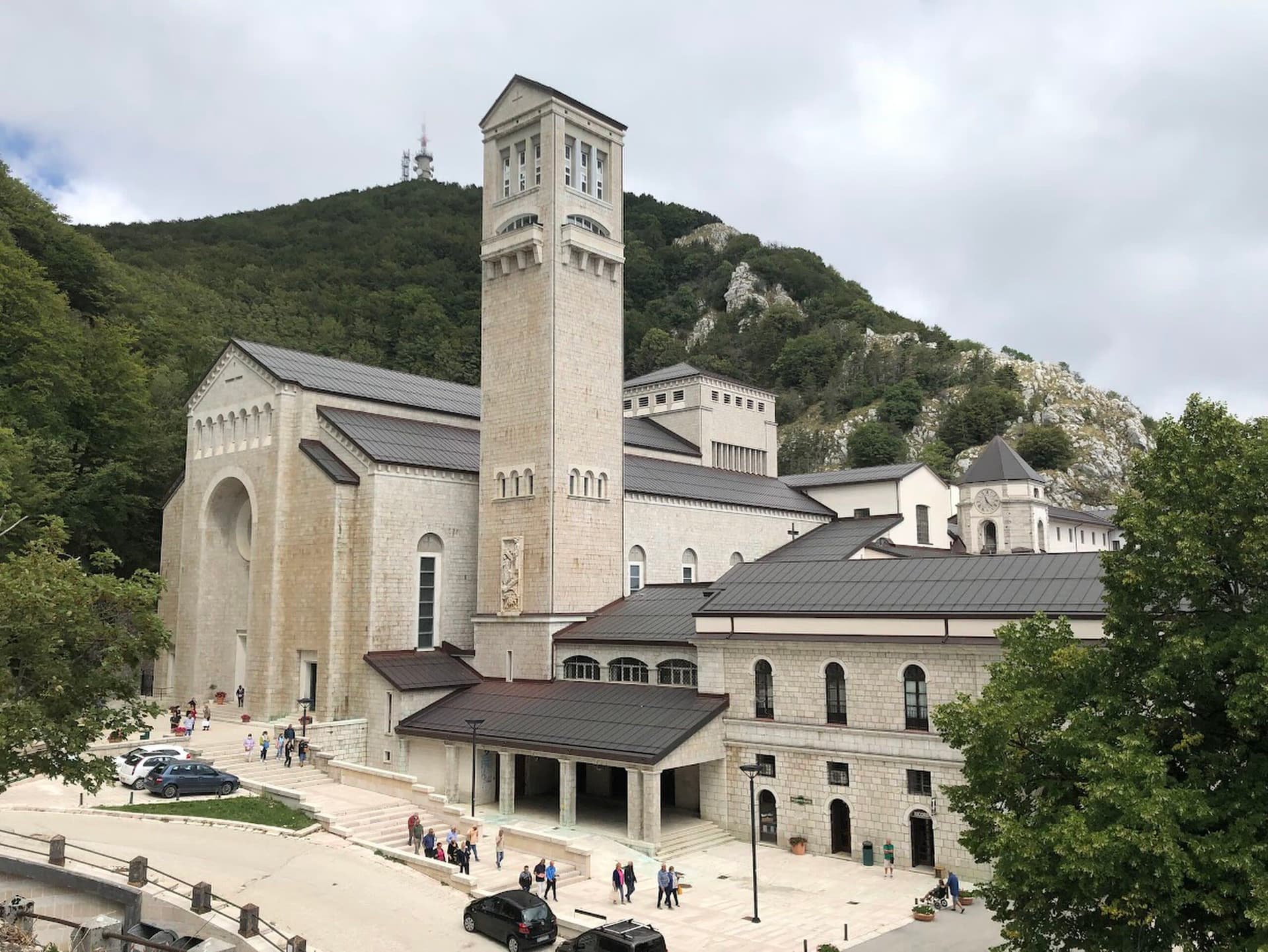
Rising 1,270 meters above the Campanian plains, the Sanctuary of Montevergine has drawn pilgrims for nine centuries to venerate Mamma Schiavona, the Black Madonna. This is a place where ancient goddess worship, Catholic devotion, and Neapolitan folk tradition merge into something singular: a sanctuary that explicitly welcomes those marginalized by mainstream religion, particularly the femminielli and LGBTQ communities who have claimed this mountain as sacred ground since at least the 13th century.
Some sanctuaries reveal their power gradually. Montevergine announces it on the ascent, as the funicular lifts you from the valley floor into clouds that wrap the mountain like a blessing withheld until you are ready.
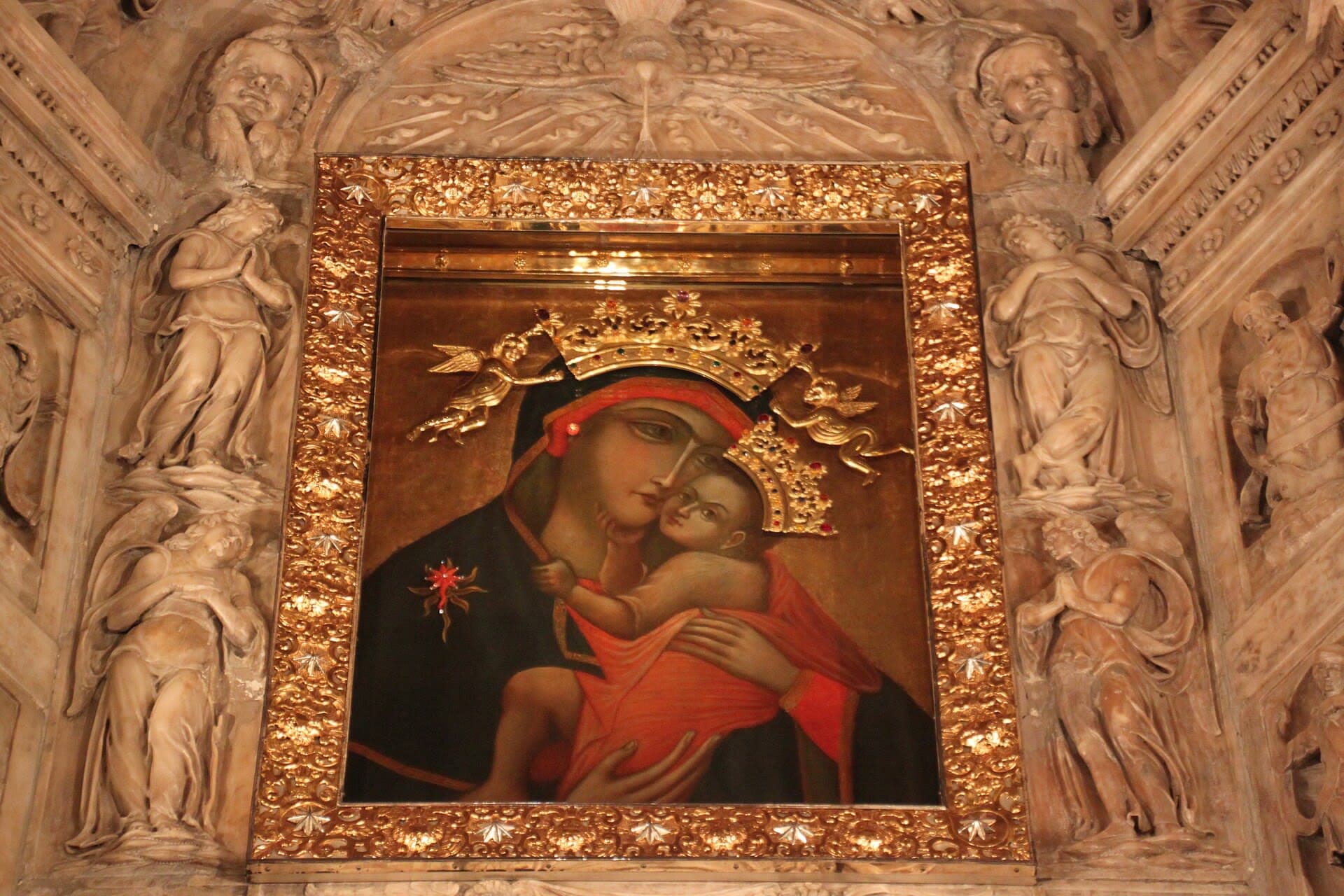
The Black Madonna who presides here is called Mamma Schiavona. Dark-faced and compassionate, her gaze has met pilgrims for seven centuries. According to tradition, she interceded when two male lovers were left bound to a tree on this mountain to freeze as punishment for their love. A miraculous ray of sunlight melted the ice and saved their lives. The community understood this as her judgment: those the world condemns, she protects.
That legend established something rare in Catholic tradition: a sanctuary where LGBTQ pilgrims, particularly the femminielli of Naples, have been welcomed for centuries. Their pilgrimage, the juta dei femminielli, traces back to at least 1611, when a church fire revealed the bodies of cross-dressed worshippers. What the flames exposed, the tradition absorbed.
But Montevergine's welcome extends beyond any single community. The tammurriata drums that have echoed on this mountain since before Christianity arrived still sound during festivals. The old goddess Cybele, whose temple once stood here, has not entirely departed: her priestesses' bleached blonde hair appears in the Madonna's icon, and the ecstatic dancing that marked her worship continues in the piazza after Mass. This is a mountain where boundaries blur: between Christian and pre-Christian, between genders, between the respectable and the outcast. Mamma Schiavona watches over them all.
Context And Lineage
Montevergine was founded in 1119 when Saint William of Vercelli established a hermitage on a mountain already sacred to the goddess Cybele. The sanctuary grew into a major Marian pilgrimage center, receiving its famous Byzantine-style icon in the late 13th century. The site's association with LGBTQ welcome derives from a legendary 13th-century miracle and from the unbroken presence of the femminielli in pilgrimage traditions documented since 1611.
In the late 11th century, a young man named William left his native Vercelli in northern Italy, renouncing the world for a life of pilgrimage and penance. He walked to Santiago de Compostela, then attempted the journey to Jerusalem. Robbers attacked him on the way, leaving him beaten and stripped of his possessions. William interpreted his misfortune as divine guidance: he was meant to remain in southern Italy rather than travel to the Holy Land.
He settled on Monte Partenio, where a chapel to the Virgin already stood among the ruins of an older temple. His holiness attracted followers. In 1119, he formally established a religious community that would become the Congregation of Monte Vergine, also called the Williamites. But William was austere beyond what most monks could bear. By 1128, tensions with his community led him to depart for Goleto, where he founded another monastery. He died in 1142, leaving behind two religious houses and a reputation for sanctity that would eventually lead to canonization.
The sanctuary he established continued to grow. In 1126, the first church dedicated to the Madonna was consecrated. Sometime around 1290, the Byzantine-style icon that would become the focus of pilgrimage arrived at Montevergine. According to tradition, the empress Catherine II of Valois donated the image in 1310, though art historians debate both the dating and the attribution. Some sources credit the painter Montano d'Arezzo; others point to the school of Pietro Cavallini. An older layer of paint, dated to the 5th century, has been detected beneath the 13th-century surface, giving credence to the tradition that the face itself was painted by Saint Luke the Evangelist.
The legend that established Montevergine as a sanctuary for LGBTQ pilgrims dates to the mid-13th century. According to the account, two young men discovered to be lovers were bound to a tree on the mountain and left to freeze as punishment. Through the Virgin's intercession, a miraculous ray of sunlight struck the ice and saved their lives. The community accepted this as a sign: those the world condemns, the Madonna protects.
From hermitage to territorial abbey, from medieval pilgrimage center to contemporary sanctuary, Montevergine has maintained its essential character while adapting to changing times. The Benedictines who now steward the site represent a different order from William's original Williamites, who eventually merged with the Benedictine confederation. But the mountain's role as a place of refuge has remained constant.
The femminielli who climb to Montevergine today are the inheritors of a tradition documented since at least 1611, when the fire that consumed part of the church revealed the remains of cross-dressed worshippers. Rather than condemning this discovery, the tradition absorbed it. The juta dei femminielli became part of what Montevergine means: a pilgrimage of those who transgress conventional boundaries, under the protection of a Madonna who transgressed the boundary between human rejection and divine mercy.
Saint William of Vercelli
founder
The hermit who founded the monastery in 1119 after interpreting his failed pilgrimage to Jerusalem as divine guidance to remain in southern Italy. His austere spirituality attracted followers but also led to conflict; he departed for Goleto in 1128, leaving behind the community that would grow into the great sanctuary.
Madonna di Montevergine / Mamma Schiavona
sacred figure
The Black Madonna whose Byzantine-style icon is the focus of veneration. Her dark face and compassionate gaze have drawn pilgrims for seven centuries. The name Schiavona is variously interpreted as relating to her dark complexion or to a Slavic/Dalmatian origin. She is understood as protector of the marginalized and outcast.
Cybele / Magna Mater
deity
The Great Mother goddess whose temple preceded the Christian sanctuary. Her worship involved ecstatic drumming, dancing, and transfeminine priestesses (the gallae). Some scholars and tradition holders see continuity between the ancient cult and contemporary devotion to the Black Madonna.
Vladimir Luxuria
contemporary figure
Italian television personality who would become Italy's first transgender parliamentarian. In 2002, after LGBTQ pilgrims were initially turned away by a priest, Luxuria led hundreds back to the sanctuary. The abbey responded with official welcome, cementing the modern tradition of blessing LGBTQ pilgrims at Candelora.
Why This Place Is Sacred
Montevergine's sacredness spans millennia, from pre-Christian temple to contemporary pilgrimage. The mountain itself was recognized as sacred ground before Christianity arrived. The site's position at 1,270 meters, its role as a place of refuge for the marginalized, the legendary miracle of the saved lovers, and the unbroken tradition of ecstatic worship create a location where the boundary between the ordinary and the sacred feels permeable to many who climb here.
Monte Partenio has been recognized as sacred ground for over two thousand years. The name itself derives from the same root as Parthenon: the mountain of the Virgin, though which virgin came first remains a question the mountain does not answer. A temple to Cybele, the Anatolian Great Mother, once stood where the sanctuary now rises. Her worship involved ecstatic drumming, dancing, and transfeminine priestesses called the gallae. When Christianity arrived, it built upon what was already here rather than erasing it entirely.
The mountain's elevation creates a natural threshold. Rising from the Campanian plains to 1,270 meters, it exists in a liminal zone where weather shifts unpredictably and the views stretch to both coasts on clear days. Pilgrims ascending on foot, as many still do, experience the journey as a gradual shedding of the lowland world. Those who take the funicular undergo a compressed version of the same transition: the modern world falling away as the cable car climbs into the clouds.
The legendary miracle of the two lovers establishes Montevergine as a place of divine intervention against human cruelty. According to the account, dating to 1252 or 1256, the Madonna sent a ray of sunlight to save the condemned men when the community had left them to freeze. The miracle rebuked the judges and vindicated the judged. For those who have experienced rejection from religious institutions, encountering a sanctuary rooted in such a legend can feel like arriving at a place that was always waiting for them.
The site also served as guardian of sacred objects during the 20th century's greatest darkness. From 1939 to 1946, the Holy Shroud of Turin was hidden here from the Nazis. When German soldiers searched the abbey in 1943, they failed to find it concealed beneath the altar. Something in this mountain seems to protect what the world would destroy.
Archaeological evidence indicates a Roman temple to Cybele occupied this mountain before the Christian sanctuary. The goddess known as Magna Mater was served by ecstatic rites: drumming, dancing, and the self-castration of the galla priestesses who devoted themselves to her. When Saint William of Vercelli arrived in 1119 and founded his hermitage, he was claiming ground already recognized as sacred. The chapel he established eventually absorbed elements of what preceded it. The drumming persists in the tammurriata. The welcome for gender-diverse worshippers continues in the juta dei femminielli. The dark-faced mother goddess simply changed her name.
For nine centuries, Montevergine has evolved while maintaining its essential character as a mountain of refuge. The austere hermitage Saint William founded became a Benedictine abbey, then a major pilgrimage center drawing over a million visitors annually. The funicular, inaugurated in 1956, made the mountain accessible to those who could not walk the old paths. A new basilica was completed in 1961 to accommodate growing crowds.
The relationship with LGBTQ pilgrims has evolved too. The tradition of the juta dei femminielli continued through centuries of varying tolerance. In 2002, when a priest initially turned away LGBTQ pilgrims at Candelora, hundreds returned with Vladimir Luxuria, who would later become Italy's first transgender parliamentarian. The abbey responded not with exclusion but with official welcome. Since then, the abbot has blessed LGBTQ pilgrims at the Candlemas festival. In 2017, Ospedaletto d'Alpinolo, the town at the mountain's base, opened Italy's first gender-neutral public bathroom for the festival crowds. The tradition of welcome has deepened rather than diminished.
Traditions And Practice
Montevergine hosts daily Mass services and two major annual festivals: Candelora (February 2) and the September feast (September 8-12). The tammurriata dancing that occurs during festivals represents a living folk tradition with pre-Christian roots. LGBTQ pilgrims receive the abbot's blessing during Candelora. Visitors can participate in veneration of the Madonna icon, attend services, and join the tammurriata dancing during festival periods.
The traditional pilgrimage to Montevergine involves walking up the mountain on ancient shepherd paths, a journey that can take days for those coming from distant parts of Campania. Along the way, pilgrims sang devotional songs and stopped at wayside shrines. Unmarried women intertwined broom branches during the climb, promising to return with a husband. On the descent, men performed the recanata, a chariot race through the streets.
The night before major feasts, pilgrims gathered in Ospedaletto d'Alpinolo at the mountain's base, holding vigils that blended prayer with celebration. The tammurriata dancing began in the streets and continued through the night, the frame drums and castanets keeping rhythms transmitted across generations. This tradition predates Christianity: the same ecstatic dance that honored Cybele now honors the Madonna who took her place.
The juta dei femminielli, the pilgrimage of the femminielli, can be documented to at least 1611 but is almost certainly older. The gender-diverse pilgrims who climb to Montevergine each Candelora enact a tradition that connects them to centuries of predecessors. Their pilgrimage is understood as devotion to a Madonna who explicitly welcomes those rejected by conventional society.
Daily Mass services are held at the basilica, open to all visitors. The museum (Museo Abbaziale di Montevergine, MAM) displays centuries of devotional offerings and religious art, providing context for understanding the pilgrimage tradition.
The major festival periods transform the mountain. Candelora, February 2, marks the feast of the Presentation of Jesus and the Purification of Mary. At Montevergine, it has become the primary occasion for the juta dei femminielli. LGBTQ pilgrims gather from across Italy and beyond. The abbot blesses all pilgrims, explicitly including the LGBTQ community. Tammurriata dancing fills the piazza after Mass.
The September feast, celebrating the Holy Name of Mary from September 8-12, closes the traditional pilgrimage season that runs from February through September. These days also see large crowds, processions, and tammurriata dancing. Both festivals offer opportunities to participate in living tradition rather than merely observing it.
If you come seeking more than tourism, consider these invitations.
For contemplative engagement, arrive during a quiet weekday. Attend morning Mass if your tradition permits, or simply sit in the basilica as services conclude. Approach the Madonna icon slowly. Allow her gaze to meet yours. Notice what arises in her presence. The tradition holds that she sees and accepts what others reject; if you carry experiences of religious exclusion, you may find this encounter unexpectedly moving.
For participatory engagement, attend during Candelora or the September feast. Learn the basic steps of the tammurriata by watching, then joining. The dance is traditionally performed between any gender configuration: two women, two men, a man and a woman, or mixed groups. No expertise is expected of visitors. The tradition transmits itself through participation.
For deeper connection, stay overnight in the area and return to the sanctuary multiple times. Walk the grounds as the light changes. Let the mountain reveal itself gradually rather than consuming it in a single visit.
Roman Catholicism - Marian Devotion
ActiveMontevergine is one of Italy's most important Marian shrines, founded in 1119 by Saint William of Vercelli. The sanctuary houses a venerated 13th-century Byzantine-style icon of the Madonna, known as Mamma Schiavona. The site is part of the Territorial Abbey of Montevergine, one of only six territorial abbeys in Italy. Approximately 1.5 million pilgrims visit annually, making it one of the major Catholic pilgrimage destinations in southern Italy.
Pilgrims attend Mass at the basilica, venerate the Madonna icon, light votive candles, and participate in the major feast celebrations. Traditional practices include walking pilgrimages up the mountain on the old paths and making promises to the Madonna for intercession in health, family, or other concerns.
Neapolitan Folk Religion - Tammurriata
ActiveMontevergine is one of the Seven Sisters: seven Black Madonna sanctuaries in Campania that form a sacred pilgrimage circuit. The tammurriata, an ancient folk dance performed to frame drum rhythms, is integral to celebrations at all these sites. The dance has pre-Christian roots linked to Cybele worship and represents a living continuation of ecstatic religious expression that Christianity absorbed rather than suppressed.
During festival periods, particularly Candelora and the September feast, the tammurriata is danced in the piazza outside the sanctuary. The tammorra frame drum and castanets provide rhythm. The dancing continues through the night during vigils. All-night celebrations in Ospedaletto d'Alpinolo precede the major feasts.
LGBTQ Spiritual Pilgrimage - Juta dei Femminielli
ActiveThe sanctuary has been a spiritual home for LGBTQ Catholics, particularly the femminielli (a traditional Neapolitan transfeminine identity), for centuries. The juta dei femminielli can be documented to at least 1611. The legendary miracle of the saved lovers establishes Montevergine as a place where divine protection extends to those condemned by society. Since 2002, the abbey has officially welcomed and blessed LGBTQ pilgrims at Candelora.
LGBTQ pilgrims gather at Montevergine on February 2 (Candelora) and September 12. They receive the abbot's blessing, dance tammurriata in the piazza, and honor Mamma Schiavona as protector of gender-diverse people. Celebrations extend into Ospedaletto d'Alpinolo. In 2017, Italy's first gender-neutral public bathroom opened there during Candlemas.
Pre-Christian - Cult of Cybele
HistoricalBefore the Christian sanctuary, a Roman temple to Cybele (Magna Mater) stood on Monte Partenio. The goddess was an Anatolian mother deity whose worship involved ecstatic rituals, drumming, and dancing. Her priestesses, the gallae, were transfeminine individuals who castrated themselves as an offering. Some scholars and local tradition holders see continuity between the ancient gallae and the modern femminielli, between the ecstatic rites of Cybele and the tammurriata that still echoes on the mountain.
Historical practices included temple worship, ecstatic drumming and dancing, and spring fertility festivals. The gallae priestesses served the goddess through permanent transformation of their bodies and identities.
Experience And Perspectives
Visitors to Montevergine consistently describe a profound sense of welcome and acceptance, particularly those who have experienced rejection from other religious spaces. The combination of solemn Marian devotion and ecstatic tammurriata dancing during festivals allows for both contemplative and embodied spiritual expression. Many report emotional encounters with the Black Madonna's compassionate gaze.
The experience of Montevergine begins before arrival, in the ascent itself. Whether climbing on foot through mountain paths or rising by funicular through the clouds, pilgrims undergo a transition from the ordinary world into something set apart. The funicular journey takes only minutes, but the shift in atmosphere is immediate: cooler air, thinner crowds, a quality of attention that changes as the valley falls away.
Inside the basilica, the Black Madonna presides from her position above the altar. Her dark face, framed by bleached blonde hair, gazes outward with an expression visitors consistently describe as compassionate rather than stern. For many, particularly those who have felt unwelcome in religious spaces, this first meeting with Mamma Schiavona becomes the moment the pilgrimage truly begins. Tears are common. The sense of being seen and accepted by something beyond human judgment produces effects that visitors struggle to articulate.
The experience transforms dramatically during the two great festival periods: Candelora in February and the September feast. The mountain fills with pilgrims. The piazza outside the sanctuary becomes a stage for tammurriata dancing, where the ancient frame drums called tammorre keep rhythms that predate the abbey by centuries. The dancing is ecstatic, joyful, and open to all: men and women, young and old, locals and visitors, LGBTQ pilgrims and traditional Catholics all moving together in patterns that honor the Madonna while invoking something older.
Those who attend the juta dei femminielli describe participating in a tradition that connects them to generations of gender-diverse worshippers who climbed this mountain before them. The fire of 1611 revealed bodies of cross-dressed pilgrims who died in worship: to dance in the same piazza is to honor their devotion. For many LGBTQ visitors, this is the first time they have experienced welcome rather than tolerance, celebration rather than permission, within a Catholic context.
Even on quiet days, when the mountain belongs to small groups and solitary pilgrims, something of this atmosphere persists. The museum displays centuries of devotional offerings. The air is cool and clear. The Madonna waits.
Montevergine rewards those who approach it as pilgrimage rather than tourism. The site can be visited in a few hours, but those who report the deepest experiences often describe staying overnight in Mercogliano or nearby, returning to the sanctuary multiple times, and allowing the mountain to work at its own pace.
Consider what you carry to this mountain. The Madonna who presides here has a history of welcoming those who have been turned away elsewhere. If you bring wounds from religious rejection, you may find this a place of unexpected healing. If you bring questions about belonging, identity, or the possibility of sacred space that includes rather than excludes, Mamma Schiavona has been holding such questions for centuries.
The tammurriata dancing during festivals invites participation from anyone willing to learn its rhythms. You need not be an expert; the tradition is transmitted through joining in. If you arrive during Candelora or the September feast, do not merely watch. Let your body become part of what has been happening on this mountain for two thousand years.
Montevergine invites multiple interpretations that need not be resolved into a single truth. Scholars, traditional practitioners, and seekers each offer genuine insight into this mountain's significance. The site is large enough, and old enough, to hold contradiction.
Art historians date the Madonna icon to approximately 1290, with attributions debated between Montano d'Arezzo and the school of Pietro Cavallini. The Hodegetria-style composition, with Mary pointing to Jesus as the Way, follows Byzantine iconographic tradition. A 5th-century paint layer detected beneath the visible surface supports the tradition that the icon's face may have older origins, though the claim of Saint Luke as original painter remains in the realm of pious legend rather than verifiable history.
Religious historians note Montevergine as a clear example of Christian appropriation of pre-existing sacred geography. The temple of Cybele was deliberately replaced with a Christian sanctuary, while elements of the goddess's cult, particularly the ecstatic drumming and the presence of gender-diverse worshippers, were gradually absorbed into festival traditions rather than entirely suppressed. The date of the two lovers legend is uncertain, with sources citing 1252 or 1256. The 1611 fire that revealed cross-dressed bodies is documented, though its interpretation varies.
Scholars of gender and sexuality in Mediterranean cultures see the femminielli of Naples as a distinct identity category with roots predating modern concepts of transgender identity. The continuity claimed between the ancient gallae of Cybele and contemporary femminielli is a matter of ongoing academic discussion, with some scholars finding the connection compelling and others urging caution about projecting modern identities onto ancient practices.
For Neapolitans and Campanians, Mamma Schiavona is a living protector who has watched over her people for centuries. The dark face of the Madonna connects her to the earth, to the ancient mother goddesses of the Mediterranean, and to all who labor under the sun. She is approached not as an abstract theological concept but as a mother who knows her children's struggles and intercedes on their behalf.
The femminielli who climb to Montevergine understand their pilgrimage as participation in an unbroken tradition stretching back through the 1611 fire martyrs, through the saved lovers of the 13th century, all the way to the gallae priestesses of Cybele. This is not academic reconstruction but lived inheritance. The blessing they receive from the abbot at Candelora is the Church catching up with what the Madonna has always offered: recognition and welcome.
The tammurriata is understood by its practitioners as more than entertainment or cultural preservation. It is a form of prayer expressed through the body, a way of honoring the Madonna that connects to something older than the sanctuary walls. The rhythms carry memory that words cannot hold.
Some contemporary practitioners see Montevergine as a site where the divine feminine was never fully suppressed. In this reading, the goddess Cybele simply changed her name to Maria. The Madonna's bleached blonde hair, matching the style of the galla priestesses, is interpreted as an encoded message that the Great Mother's welcome extends to all gender expressions. The tammurriata is understood as a form of sacred ecstasy continuous with the wild rites of Cybele.
New Age and esoteric visitors sometimes frame Montevergine as a site of goddess energy or feminine power, drawing connections to other Black Madonna sites across Europe. From this perspective, the dark face of the Madonna represents earth-based spirituality that Christianity absorbed but could not entirely transform.
Genuine mysteries persist. The exact date and circumstances of the two lovers legend remain uncertain, with sources varying by several years. The meaning of the name Schiavona is contested: some interpret it as relating to the Madonna's dark complexion, others to a possible Slavic or Dalmatian origin of the icon. The 5th-century paint layer detected beneath the 13th-century image raises questions about the icon's true history that scientific analysis cannot fully answer.
The precise nature of the relationship between the femminielli tradition and ancient Cybele worship is a matter of ongoing scholarly debate. The continuity claimed by practitioners is meaningful to them, but whether it represents unbroken cultural transmission or later reconstruction remains unclear. Perhaps it matters less whether the line can be traced historically than that it is traced devotionally.
Visit Planning
Montevergine is located on Monte Partenio above Mercogliano, approximately one hour from Naples by car. The funicular connects Mercogliano to the sanctuary. The two major festival periods are Candelora (February 2) and the September feast (September 8-12). The pilgrimage season runs February through September. Allow two to three hours for a visit; a full day during festivals; multiple days for traditional walking pilgrimage.
Mercogliano offers modest lodging options near the funicular base. Avellino, the provincial capital, provides a wider range of hotels. For those seeking to combine the pilgrimage with exploration of Campania, Naples is approximately one hour away and offers accommodation at all price levels. During festival periods, booking well in advance is essential.
Montevergine is an active Catholic sanctuary that welcomes visitors of all backgrounds. Modest dress is required inside the basilica. Photography is generally permitted with respect for worshippers. During festivals, visitors are welcome to join the tammurriata dancing in the piazza. The Madonna icon should not be touched.
This is an active site of worship. The sanctuary's remarkable inclusivity exists within a Catholic framework that asks for corresponding respect. The pilgrims you encounter, whether traditional Catholics or members of the LGBTQ community, have come for prayer and devotion, not performance.
The welcome you receive here has been hard-won. The tradition of LGBTQ inclusion at Montevergine rests on centuries of presence and, in living memory, on the willingness of the abbey to stand against exclusion. Visitors who treat the femminielli pilgrimage as spectacle rather than sacred tradition undermine what makes this place significant. You are welcome to witness, to participate, to be moved. You are asked not to reduce others' devotion to content.
During Mass and other services, maintain the same respectful quiet you would in any Catholic church. The celebration happens in the piazza afterward, not within the sanctuary walls.
Modest attire is required for entry to the basilica. Shoulders and knees should be covered. Paper cover-ups are provided for visitors who arrive without appropriate clothing. Due to the mountain's elevation, even summer days can be cool; warm layers are recommended regardless of the season in the lowlands.
Personal photography is generally permitted in public areas of the sanctuary. Be conscious of worshippers: do not photograph people in prayer without permission, and refrain from using flash during services. Check for signage restricting photography near the sacred icon or in specific areas. If you wish to photograph the femminielli during their pilgrimage, ask permission first. Their devotion is not your subject without consent.
Votive candles are available for lighting. Donations to the sanctuary are welcome. If you wish to leave a written prayer or intention, follow the protocols indicated within the basilica.
{"Respectful silence is expected during Mass and within the sanctuary proper","The Madonna icon should not be touched","Celebration and dancing occur in the piazza outside, not within the basilica","During tammurriata dancing, joining is welcomed, but observe the traditional patterns before entering; the dance has structure even in its ecstasy"}
Sacred Cluster
Nearby sacred places create the location cluster described in the growth plan. This block is intentionally crawlable and links into the wider regional graph.