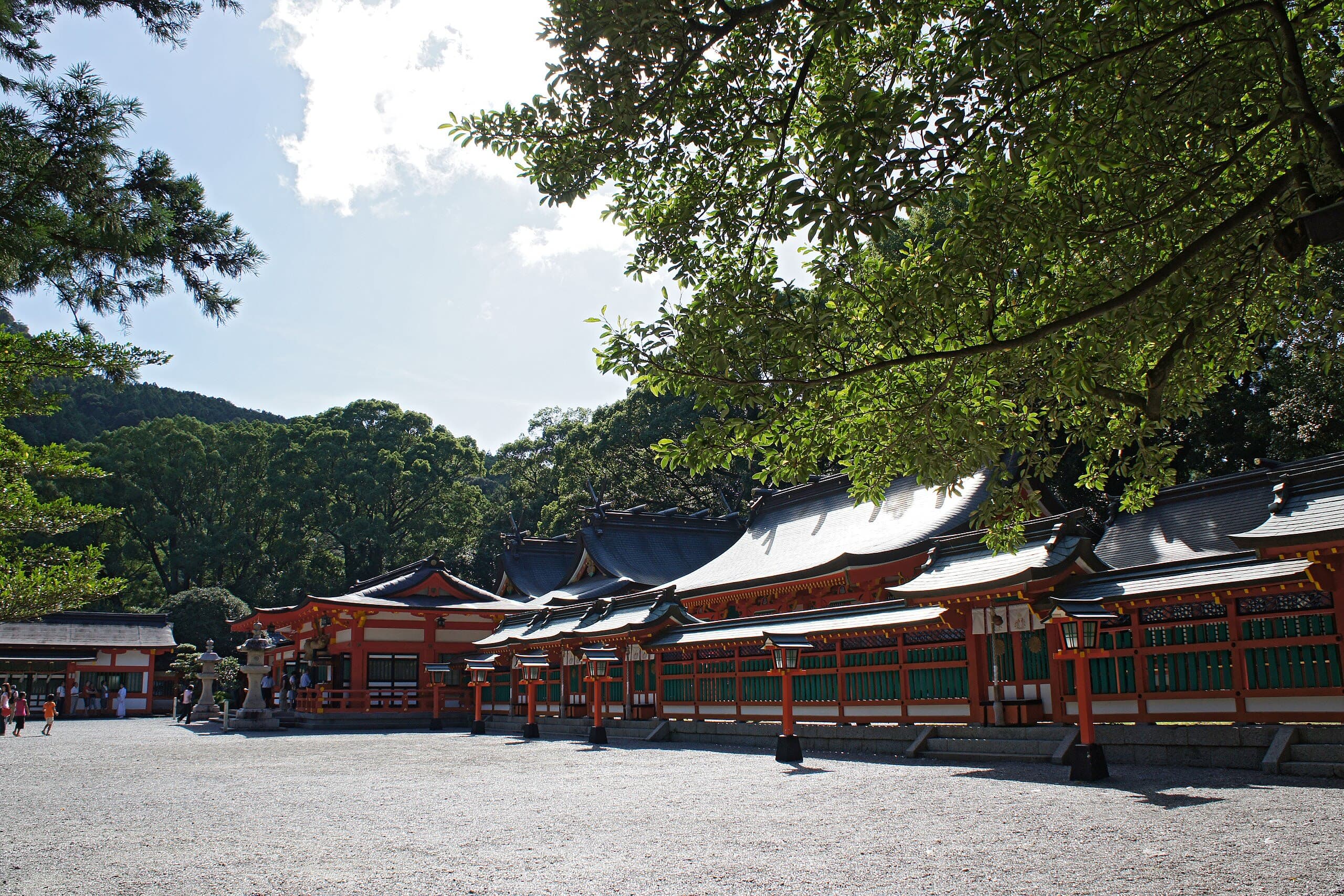
Kumano Hayatama Taisha
Where Japan's creators descended, and pilgrims still shed the weight of past lives
Shingū, Wakayama Prefecture, Japan
At A Glance
- Coordinates
- 33.7318, 135.9836
- Suggested Duration
- The main shrine can be visited in one to two hours, including time with the sacred Nagi tree and treasure hall. Adding the climb to Kamikura Shrine requires an additional two to three hours. A full day allows for unhurried exploration of both sites and the surrounding area. Those walking Kumano Kodo routes should plan according to their chosen itinerary.
- Access
- Shingu Station is served by JR Kisei Main Line. From Osaka, limited express trains take approximately three hours. From Nagoya, approximately three and a half hours. The shrine is a 15-minute walk from Shingu Station, or accessible by local bus. Limited parking (approximately 20 spaces) is available for those arriving by car. Kamikura Shrine is within walking distance of the main shrine complex.
Pilgrim Tips
- Shingu Station is served by JR Kisei Main Line. From Osaka, limited express trains take approximately three hours. From Nagoya, approximately three and a half hours. The shrine is a 15-minute walk from Shingu Station, or accessible by local bus. Limited parking (approximately 20 spaces) is available for those arriving by car. Kamikura Shrine is within walking distance of the main shrine complex.
- No formal dress code is enforced, but modest and respectful attire is appropriate. Comfortable walking shoes are essential, particularly if climbing to Kamikura Shrine. The steps are steep and uneven. Rain gear may be wise. The Kii Peninsula receives significant precipitation throughout the year.
- Photography is generally permitted in shrine grounds. Be conscious of worshippers, particularly at the main hall. Some areas of the treasure hall may have restrictions. Photographing festival participants without permission is discouraged.
- The Oto Matsuri fire festival, held February 6, is restricted to male participants. Women may watch from designated viewing areas. This restriction reflects traditional practice and is enforced at the event. The steps to Kamikura Shrine are genuinely steep and can be slippery when wet. Proper footwear is essential. Those with mobility limitations should assess carefully. There is no shame in choosing not to climb, the main shrine offers complete encounter.
Overview
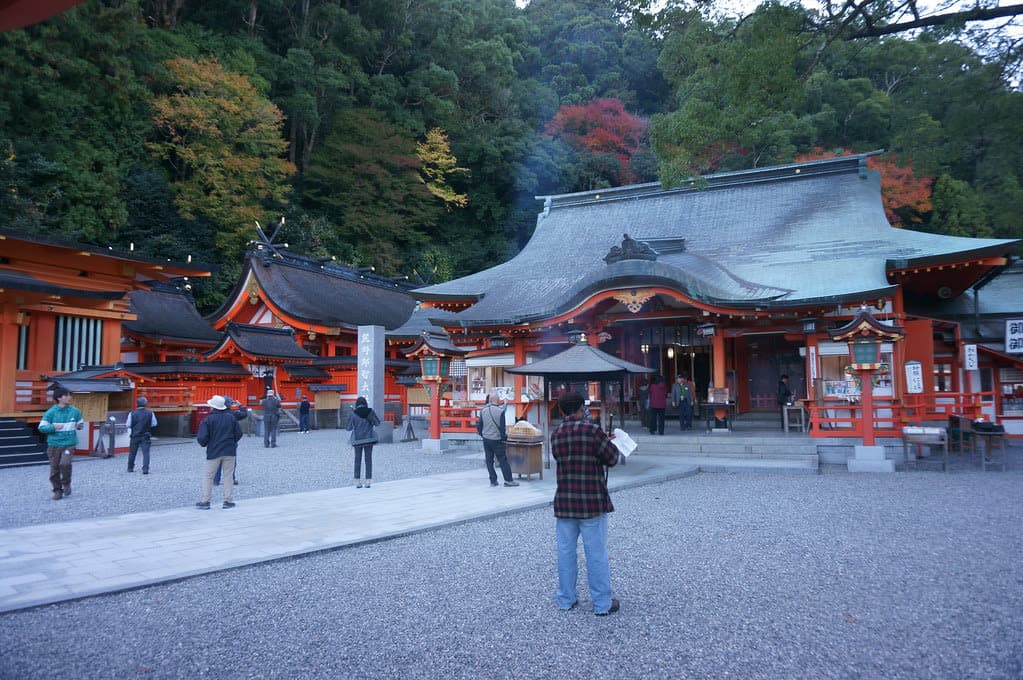
Kumano Hayatama Taisha stands at the mouth of the Kumano River where it meets the sea, one of three grand shrines that have drawn pilgrims for over a millennium. Shinto tradition holds that the divine creators of Japan first descended to earth here. Those who come seeking purification from the past find vermillion gates, an ancient tree, and waters that seem to carry something away.
The Kumano region has been called the Land of Rebirth for more than a thousand years. At its eastern edge, where the Kumano River empties into the Pacific, stands Kumano Hayatama Taisha. The shrine's vermillion buildings, striking against the forested mountains, mark a place where generation upon generation has come to be cleansed.
Shinto teaching holds that this is where Izanagi and Izanami, the divine couple who created the Japanese islands, first descended to earth. They arrived not at the shrine but above it, on a massive boulder called Gotobiki Rock, where an older subsidiary shrine still perches after a climb of 538 stone steps. The descent from heaven, the movement from rock to river to sea, the passage of water from mountain to ocean: these thresholds give the site its power.
Kumano Hayatama is specifically associated with purifying sins of past lives. The other two shrines of the Kumano Sanzan address the present and future. Here, what came before is released. Pilgrims who have walked for days through mountain forests arrive at this final threshold, where moving water meets the stillness of ocean, and something lifts.
The shrine remains vigorously active. Priests perform daily rituals. Festivals bring fire down mountain steps and boats across the river. A thousand-year-old Nagi tree stands in the courtyard, its leaves once carried as amulets by pilgrims returning home. This is not a site to be observed but entered. The shrine welcomes seekers with wet sandals, as a saying goes, attending to pilgrims above all else.
Context And Lineage
Kumano Hayatama Taisha stands within a pilgrimage tradition stretching back over a millennium. Imperial pilgrimages began in 908, and the route eventually opened to all classes. The shrine enshrines Izanagi and Izanami, the divine creators of Japan according to Shinto mythology. As head shrine of over 4,000 Kumano shrines nationwide, it remains central to Japanese religious geography.
According to the foundational texts of Shinto, the divine couple Izanagi and Izanami gave birth to the Japanese islands and to countless kami. When they first descended from the heavenly realm to earth, tradition holds they alighted on Gotobiki Rock, the massive boulder that still commands veneration above the current shrine.
This rock predates any human construction. Its shape, resembling a toad, earned its name in the local dialect. Before there were buildings, there was worship here, drawn by the rock's unusual presence and position overlooking the sea.
When the shrine was built at its current location by the river's mouth, the older site became Kamikura Shrine, a subsidiary maintaining the original connection. The new location, hence the city's name Shingu (New Shrine), brought the worship to the threshold of river and ocean. The two sites together hold the full story: the descent from heaven at the mountain's height, the passage of sacred waters to the sea.
The shrine serves as honsha, head shrine, of more than 4,000 Kumano shrines scattered throughout Japan. This network testifies to the Kumano faith's spread far beyond its mountain origins. Wherever people could not make the long journey, branch shrines carried something of the original power.
The treasure hall preserves this lineage in physical form. Over 1,200 sacred artifacts, many designated national treasures, document centuries of devotion: gold lacquer boxes, painted fans, objects of extraordinary craftsmanship offered by emperors and aristocrats seeking blessings. These are not merely historical artifacts but evidence of relationship, gifts given to the kami in reciprocity for what was sought and received.
Kumano Hayatama no Okami (Izanagi no Mikoto)
deity
The principal deity of the shrine, identified with Izanagi, the male half of the divine couple who created Japan. His name incorporates hayatama, relating to swift spirit or flowing water. He descended to Gotobiki Rock with his consort Izanami.
Kumano Fusumi no Okami (Izanami no Mikoto)
deity
The female creator deity, consort of Izanagi. Together they gave birth to the Japanese islands and the kami who populate the Shinto cosmos. She is enshrined alongside her partner at Hayatama Taisha.
Emperor Uda
historical
The first emperor to make pilgrimage to Kumano, in 908 CE. His journey established a pattern that imperial and retired emperors would follow for centuries, walking the mountain routes to the three grand shrines.
Taira no Shigemori
historical
The nobleman who, according to tradition, planted the sacred Nagi tree in 1159. His act of devotion created one of the shrine's most revered features, now over a thousand years old and designated a national natural monument.
The Twelve Kumano Gongen
deity
The ensemble of twelve deities venerated across the Kumano Sanzan, understood during the syncretic period as simultaneous Shinto kami and Buddhist manifestations. Hayatama's principal deity was identified with Yakushi Nyorai, the Healing Buddha.
Why This Place Is Sacred
Kumano Hayatama Taisha's sacredness emerges from convergent thresholds: the meeting of river and sea, the descent point of the kami on Gotobiki Rock, a millennium of continuous pilgrimage, and the Shinto understanding of flowing water as purifying. The site sits at a place of passage, and something of that liminal quality persists.
Long before the first shrine buildings rose here, the boulder called Gotobiki Rock commanded veneration. It sits on a mountainside above the current shrine, accessible only by climbing 538 steep and ancient stone steps. According to tradition, the creator kami descended to earth on this rock. It marks the point where heaven touched ground, the threshold between worlds.
The shrine itself sits at another threshold: the mouth of the Kumano River where its waters meet the Pacific. In Shinto understanding, flowing water carries impurity away. The position at the river's end, where mountain waters disperse into the vastness of ocean, intensifies this purifying quality. The shrine's name includes hayatama, which some interpret as relating to the swiftness or spirit of moving water.
A third threshold defines the site's meaning within pilgrimage. Kumano Hayatama Taisha is specifically associated with the past. Pilgrims who complete the circuit of all three Kumano shrines receive blessings across time: Kumano Hongu Taisha addresses the present life, Kumano Nachi Taisha the future, and Hayatama the past. Here, what weighs from previous lives can be released.
The accumulation of intention matters as well. Emperors and peasants have walked these paths for over a millennium. Emperor Uda made the first recorded imperial pilgrimage in 908. Retired emperors of the Heian period made the journey dozens of times, spending weeks on the road in each direction. When pilgrimage opened to common people, the phenomenon was described as the march of the ants to Kumano, a living stream of seekers moving through mountain forests toward these shrines. Their intentions persist. Whatever quality the landscape held before human arrival has been deepened by centuries of focused approach.
The earliest worship here predates documented history. Gotobiki Rock was venerated as a site where divine beings descended, a place of connection between realms. When the current shrine was established at the river's mouth, perhaps around the 12th century, it formalized what the landscape had long evoked. The name Shingu, meaning New Shrine, given to the city that grew around it, reflects this relocation from the original mountain site.
Within the Kumano pilgrimage system, Hayatama Taisha served as the place of purification from past karma. Pilgrims often arrived here last, having visited Hongu and Nachi, completing their circuit at the edge of the sea. The shrine's treasure hall suggests offerings of extraordinary quality, indicating patronage at the highest levels of society: lacquer boxes of gold, painted fans, objects worthy of emperors seeking absolution.
From the 10th century, the Kumano shrines developed within a syncretic system that merged Shinto kami with Buddhist deities. The three shrines together enshrined the Twelve Kumano Gongen, understood as avatars manifesting both Shinto and Buddhist powers. Hayatama's principal kami, identified with Izanagi, was simultaneously understood as a manifestation of Yakushi Nyorai, the Healing Buddha. This synthesis made Kumano pilgrimage accessible across religious lines.
The Meiji restoration of 1868 forcibly separated Shinto and Buddhism. The shrine's Buddhist elements were removed, and it returned to explicitly Shinto practice. Yet the pilgrimage culture has proven resilient. UNESCO inscription in 2004, as part of the Sacred Sites and Pilgrimage Routes in the Kii Mountain Range, brought international recognition. The Kumano Kodo walking routes, twinned with the Camino de Santiago in 2014, now draw pilgrims from around the world, continuing a thousand-year pattern in new forms.
Traditions And Practice
Daily Shinto rituals continue at Kumano Hayatama Taisha, conducted by shrine priests. Major festivals punctuate the year, including the ancient Oto Matsuri fire festival in February and the Mifune Matsuri boat procession in October. Visitors participate through standard Shinto worship, receiving goshuin stamps and protective amulets, and may complete the Kumano Sanzan pilgrimage.
The pilgrimage to Kumano was once a month-long undertaking. From Kyoto, the journey covered 600 kilometers round trip, through mountain forests on narrow paths. Pilgrims visited all three grand shrines to receive blessings across past, present, and future. The approach itself was practice, each step an accumulation of intention.
Purification rituals marked the journey. Before major festivals, participants still observe shojin kessai, a week of abstaining from certain foods and behaviors, eating only white foods like rice and tofu. On the morning of the Oto Matsuri, participants purify themselves in the ocean before climbing to Kamikura Shrine.
The annual festivals enact the mythology in movement. Oto Matsuri, Japan's oldest fire festival, sees two thousand men in white descend the 538 stone steps carrying torches, creating the appearance of a fire waterfall descending the mountain. The Mifune Matsuri involves boat races on the Kumano River, the deity carried on the vermillion Gokosen ship circling Mifune-jima Island three times.
Visitors engage through the standard forms of Shinto worship. At the water basin near the entrance, ritual purification begins: rinse left hand, right hand, pour water into left palm to rinse mouth, then rinse the ladle handle. At the main hall, offer coins, bow twice, clap twice, bow once. The form is simple. The intention varies with the seeker.
The shrine offers goshuin, the calligraphed stamps collected by pilgrims at each sacred site visited. These are not souvenirs but records of encounter, each one unique to its shrine and brushed by hand. Protective amulets featuring Nagi leaves are particularly prized here, continuing the ancient practice of carrying something of the shrine's power home.
The climb to Kamikura Shrine has become a practice in itself. The 538 steps demand attention and effort. Many visitors approach it as a form of moving meditation, the difficulty of the ascent mirroring the work of inner transformation. At the top, Gotobiki Rock awaits. There is no prescribed ritual here, only presence and whatever arises in its company.
If arriving as part of a Kumano pilgrimage, consider the sequence. Hayatama is traditionally associated with the past, Hongu with the present, Nachi with the future. Visiting in this order, or saving Hayatama for last, allows the specific quality of each shrine to emerge.
Climb to Kamikura Shrine early in the day, before heat and crowds. The steps require your full attention. Let the effort be the practice, not something to get through. At Gotobiki Rock, sit if conditions allow. The rock witnessed what tradition calls the beginning. What wants to end in you?
At the main shrine, after the standard worship, spend time with the Nagi tree. A thousand years of visitors have stood beneath these branches. The tree holds continuity, endurance through storms and centuries. What continues in you, regardless of what passes?
Shinto
ActiveKumano Hayatama Taisha stands as one of the Kumano Sanzan, among the most sacred Shinto pilgrimage destinations in Japan. It enshrines Izanagi and Izanami, the divine creators of the Japanese islands and countless kami. The shrine serves as head shrine of over 4,000 Kumano shrines throughout Japan, a network testifying to the Kumano faith's spread far beyond its mountain origins. It represents core Shinto principles: the veneration of natural features, the sacredness of water, the importance of purification, and the maintenance of relationship with kami through ritual practice.
Daily rituals are performed by shrine priests. Visitors engage through standard Shinto worship: temizu purification at the water basin, prayer and offering at the main hall, and the bow-clap-bow form of reverence. Pilgrimage to complete the Kumano Sanzan circuit remains central, as does the climb to Kamikura Shrine and Gotobiki Rock. Annual festivals, including the Oto Matsuri, Mifune Matsuri, and Ogitate Fan Festival, enact the tradition in communal form. Protective amulets featuring Nagi leaves continue a practice stretching back centuries.
Shinto-Buddhist Syncretism (Shinbutsu-shugo)
HistoricalFrom the 10th century until the Meiji-era separation of 1868, Kumano Hayatama Taisha operated within a syncretic system merging Shinto and Buddhist understanding. Under the honji suijaku doctrine, Shinto kami were understood as local manifestations of universal Buddhist deities. Hayatama's principal kami was identified with Yakushi Nyorai, the Healing Buddha. The Twelve Kumano Gongen, worshipped across the three grand shrines, represented this fusion. Pilgrimage to Kumano could fulfill Buddhist aspirations through Shinto forms, making the practice accessible across religious lines.
Syncretic practice included worship of the Twelve Kumano Gongen as simultaneous Shinto and Buddhist entities, pilgrimage undertaken for Buddhist merit through Shinto sites, and the integration of mountain asceticism (Shugendo) with shrine worship. Buddhist priests and Shinto clergy operated together within the shrine complex. Offerings and rituals drew from both traditions.
Ancient Nature Worship
HistoricalBefore formalized Shinto, before the first shrine buildings, the Kumano region drew veneration through its natural features. Gotobiki Rock was sacred before anyone named it. The mountains, the river, the meeting of water and sea, commanded attention independent of theology. This prehistoric layer remains the foundation of all that followed.
Early practices centered on the veneration of natural features as divine in themselves: rocks (iwakura) as dwelling places or manifestation points of spiritual power, mountains as realms of the sacred, flowing water as purifying agent. These practices were absorbed into later Shinto but preceded its systematization.
Experience And Perspectives
Visitors to Kumano Hayatama Taisha frequently describe a sense of completion and release, particularly those arriving after walking the pilgrimage routes. The climb to Kamikura Shrine and Gotobiki Rock offers physical challenge that mirrors inner purification. The shrine's riverside setting and ancient Nagi tree contribute to an atmosphere of stillness within movement.
Those who arrive at Kumano Hayatama Taisha by foot, having walked days through the mountain forests of the Kumano Kodo, often describe the experience differently than those who arrive by train or car. The walking creates conditions: accumulated fatigue opens something, and the approach matters as much as arrival. When the vermillion shrine buildings finally appear, there is a sense of threshold crossed.
The shrine grounds themselves hold a quality of settled peace. The Kumano River flows nearby, its presence felt even when not seen. The sacred Nagi tree, over a thousand years old and designated a national natural monument, anchors the courtyard. Its leaves, symmetrically veined, were once prized as amulets. Pilgrims would carry them home, believing the leaves protected bonds, ensured safe travel, calmed rough waters. To sit beneath its branches is to sit in the presence of something that has witnessed every kind of supplicant.
The climb to Kamikura Shrine intensifies everything. The 538 stone steps are steep, uneven, and require full attention. There is no way to hurry. At the summit, Gotobiki Rock appears, a massive boulder shaped like a crouching toad. This is where the kami descended. The view opens to forest and distant sea. Those who make this climb often report that something shifted in the effort, as though physical exertion created space for inner change.
The shrine is known for purifying sins of past lives. Whether visitors hold this belief literally or understand it metaphorically, something of the function persists. People leave feeling lighter. Whatever burden they carried seems less absolute. The waters flowing past, the vastness of ocean ahead, the centuries of pilgrims who brought their burdens here: the accumulation supports release.
Arrive, if possible, by walking at least part of the Kumano Kodo. Even a single day of approach changes the quality of encounter. If that is not possible, consider walking the final kilometers from Shingu Station rather than taking a bus, letting the threshold develop gradually.
Allow time for both the main shrine and the climb to Kamikura. They are different experiences. The main shrine offers refinement, beauty, the presence of ongoing ritual. Kamikura offers exertion, wildness, the power of the original site. Together they hold a more complete picture of what Kumano means.
Consider what you wish to release. The shrine's specific association with past lives is an invitation. You need not frame this in terms of karma or rebirth. The past you wish to set down may be last year's, last month's, last week's. The water flows regardless. The threshold stands ready.
Kumano Hayatama Taisha invites interpretation from multiple viewpoints: scholarly historical analysis, living Shinto tradition, and comparative religious study. These perspectives illuminate different aspects of the site without requiring resolution into a single account. The shrine is large enough to hold them all.
Historical and religious scholars recognize the Kumano region as one of Japan's most significant pilgrimage destinations with documented religious activity spanning over a millennium. Archaeological evidence at Gotobiki Rock suggests sacred activity predating historical records. The site exemplifies Japanese religious evolution from prehistoric nature worship through Shinto-Buddhist syncretism to modern Shinto practice.
The imperial pilgrimage phenomenon of the Heian and Kamakura periods is well documented. Records attest to 94 imperial or retired-imperial pilgrimages over 374 years. Retired Emperor Go-Shirakawa made 34 pilgrimages, Retired Emperor Go-Toba 28. This intensity of elite patronage supported the development of pilgrimage infrastructure, the Kumano Kodo routes, and the shrine's accumulated treasures.
The opening of pilgrimage to common people by the late 15th century created what contemporaries called the ant march to Kumano, continuous streams of pilgrims moving through the mountain forests. This democratization of sacred travel prefigured similar developments in European pilgrimage traditions.
Shinto understanding holds Kumano Hayatama Taisha as one of the holiest sites in Japan. The kami enshrined here, Izanagi and Izanami, gave birth to the Japanese islands and their countless kami. Their descent to Gotobiki Rock marks the connection point between heaven and earth.
The shrine's specific function within the Kumano Sanzan is purification of past-life karma. Visiting the three shrines grants blessings across temporal dimensions, with Hayatama addressing what lies behind. The flowing waters of the Kumano River, emptying into the sea, embody this carrying-away of what weighs.
The Nagi tree holds particular significance. Its name means calm, and its leaves, symmetrically veined and unusually strong, became symbols of enduring bonds and safe passage. Taira no Shigemori's planting of this tree in 1159 continued a tradition of devotional offering that the shrine's treasure hall documents in gold and lacquer and painted cypress.
Some contemporary spiritual seekers understand the Kumano region as a zone of heightened spiritual energy, a power spot comparable to sites identified in other traditions. The concept of yomigaeri no chi, Land of Rebirth, resonates with ideas of death and renewal found in initiation traditions worldwide.
The pilgrimage journey through dense mountain forests, ending at the liminal threshold of river meeting sea, follows a structure scholars of religion recognize across cultures: separation from ordinary life, passage through challenging terrain, arrival at sacred center, and return transformed. Whether this pattern reflects universal psychological processes, genuine spiritual geography, or both, the Kumano pilgrimage enacts it with unusual clarity.
Genuine mysteries remain regarding Kumano Hayatama Taisha. The exact origin and age of worship at Gotobiki Rock predates any documentation. The mechanisms by which prehistoric peoples discovered and began venerating this specific location remain unknown.
The full symbolic meaning of the Twelve Kumano Gongen and their relationships was partly lost with the Meiji-era separation of Shinto and Buddhism. The original forms of worship before Buddhist influence integrated with Shinto practice can only be inferred.
The age of the sacred Nagi tree presents conflicting accounts, with sources ranging from 800 to over 1,000 years. The exact date of the shrine's establishment at its current location similarly varies across sources, from the 12th century to legendary accounts placing it much earlier.
Visit Planning
The shrine is located in Shingu City, Wakayama Prefecture, a 15-minute walk from JR Shingu Station. Grounds are open from sunrise to sunset. The treasure hall operates from 9:00 AM to 4:00 PM with a 500 yen admission. Spring and autumn offer the mildest weather, though the shrine is accessible year-round. Allow half a day to include Kamikura Shrine.
Shingu Station is served by JR Kisei Main Line. From Osaka, limited express trains take approximately three hours. From Nagoya, approximately three and a half hours. The shrine is a 15-minute walk from Shingu Station, or accessible by local bus. Limited parking (approximately 20 spaces) is available for those arriving by car. Kamikura Shrine is within walking distance of the main shrine complex.
Shingu offers hotels and ryokan at various price points. Staying overnight allows for early morning visits before crowds arrive. For those walking Kumano Kodo routes, designated pilgrimage lodgings and guesthouses are available along the paths. Katsuura, a short train ride away, offers hot spring resorts that complement the pilgrimage experience.
Kumano Hayatama Taisha is an active place of Shinto worship. Standard shrine etiquette applies: perform ritual purification at the water basin, walk at the sides of pathways rather than the center (reserved for kami), and maintain appropriate quiet near worship areas. The shrine welcomes visitors of all backgrounds.
The shrine remains a living site of worship. Priests perform daily rituals. Local parishioners come for prayer and blessing. Visitors are welcomed, but as guests entering someone else's sacred space.
Begin at the water basin just inside the shrine gate. Take the wooden ladle, fill it with water, pour over your left hand, then right hand. Pour water into your cupped left palm and use it to rinse your mouth, discreetly spitting aside. Finally, rinse the ladle handle before replacing it. This temizu purification is not symbolic but preparatory, removing the pollution of the outside world before approaching the kami.
Walk at the sides of shrine pathways, not the center. The central path is understood as reserved for the kami. This applies particularly to the main approach but also to paths within the grounds.
At the main hall, stand before the offering box. If you wish, toss a coin as offering. Bow twice, clap twice (to announce your presence and focus your intention), then bow once more deeply, holding your prayer or intention. The form is standardized, the content is yours.
Maintain quiet near worship areas. Photography is generally permitted but should be practiced mindfully, without disturbing those at prayer. Flash may be restricted in certain areas.
No formal dress code is enforced, but modest and respectful attire is appropriate. Comfortable walking shoes are essential, particularly if climbing to Kamikura Shrine. The steps are steep and uneven. Rain gear may be wise. The Kii Peninsula receives significant precipitation throughout the year.
Photography is generally permitted in shrine grounds. Be conscious of worshippers, particularly at the main hall. Some areas of the treasure hall may have restrictions. Photographing festival participants without permission is discouraged.
Monetary offerings are placed in the offering box before the main hall. Standard practice is to toss coins, with five-yen coins (go-en) considered auspicious as their pronunciation echoes the word for good fortune or connection. Prayer plaques (ema) can be purchased and inscribed with wishes or prayers. Physical offerings beyond coins are not appropriate for visitors.
Participation in the Oto Matsuri fire festival is restricted to men. The Treasure Hall (Shinpokan) charges a separate admission fee of 500 yen. Dogs and other pets may not be permitted in certain areas. Follow posted signs and staff guidance.
Sacred Cluster
Nearby sacred places create the location cluster described in the growth plan. This block is intentionally crawlable and links into the wider regional graph.