Kom Ombu
Where crocodile and falcon, chaos and order, shared one temple—Egypt's only shrine built for duality itself
Koum Ombo City, Aswan, Egypt
At A Glance
- Coordinates
- 24.4521, 32.9284
- Suggested Duration
- 1-2 hours for temple and Crocodile Museum combined. The temple's size is manageable for thorough exploration. Those with particular interest in the surgical instruments relief or crocodile mummies may want additional time.
- Access
- Located on the east bank of the Nile approximately 45 km north of Aswan and 168 km south of Luxor. Most visitors arrive on Nile cruise ships—Kom Ombo is a standard stop on Luxor-Aswan itineraries. Boats dock directly adjacent to the temple. Train service connects Kom Ombo to Luxor and Aswan; the station is a short taxi ride from the temple. Opening hours vary by source (7AM-9PM or 8AM-5PM reported)—verify current schedule. Entry fees difficult to confirm—verify current prices on arrival. The Crocodile Museum may require separate admission.
Pilgrim Tips
- Located on the east bank of the Nile approximately 45 km north of Aswan and 168 km south of Luxor. Most visitors arrive on Nile cruise ships—Kom Ombo is a standard stop on Luxor-Aswan itineraries. Boats dock directly adjacent to the temple. Train service connects Kom Ombo to Luxor and Aswan; the station is a short taxi ride from the temple. Opening hours vary by source (7AM-9PM or 8AM-5PM reported)—verify current schedule. Entry fees difficult to confirm—verify current prices on arrival. The Crocodile Museum may require separate admission.
- No strict dress code, though modest clothing is recommended for cultural respect. Limited shade makes sun protection essential: hats, light long sleeves, comfortable walking shoes.
- Photography is generally permitted throughout the temple and museum. Tripods and professional equipment may require special permits. Flash photography may be restricted in certain areas.
- Limited shade makes sun protection essential during daytime visits. The temple can be crowded when multiple cruise ships dock simultaneously—late afternoon sees peak traffic. Some areas may be restricted for conservation. The Crocodile Museum may require separate admission and have different hours than the temple proper. Evening hours vary seasonally—confirm current schedule.
Overview
The Temple of Kom Ombo stands alone in Egypt as a double temple, its perfect bilateral symmetry honoring two gods who embody opposing forces: Sobek the crocodile, associated with the Nile's dangerous power, and Haroeris the falcon, representing cosmic order and healing. Two entrances, two sanctuaries, two priesthoods served side by side. Where other religions resolve contradictions, Kom Ombo enshrined them.
Most temples choose. They dedicate their stones to one god, one principle, one aspect of the divine. Kom Ombo refused to choose. On a promontory above a Nile bend where crocodiles once basked in the sun, the Ptolemaic builders constructed something unprecedented: a temple of perfect bilateral symmetry, its southern half dedicated to Sobek the crocodile god, its northern half to Haroeris the elder falcon god.
Two entrances pierce the façade. Two processional paths lead through twin courts and hypostyle halls. Two sanctuaries house two divine presences. The architecture itself argues that opposing forces need not cancel each other but can exist in productive tension. Sobek embodies the Nile's dangerous, untamed power—the floods that could destroy as easily as nourish. Haroeris represents order, kingship, the protective sky. The crocodile and the falcon faced each other across the temple's central axis for centuries.
Between the two sanctuaries, a secret chamber allowed priests to speak as oracle—perhaps for both gods, perhaps delivering divine messages that transcended the temple's duality. On the temple's outer walls, a relief depicts surgical instruments so precise that scholars recognized scalpels, forceps, and birthing chairs. Kom Ombo healed bodies as well as souls. The crocodiles that once lived within these precincts, fed by priests and observed for omens, now lie mummified in the adjacent museum—over 300 sacred animals who embodied the god they served.
Context And Lineage
Built by Ptolemaic rulers seeking legitimacy through Egyptian religion, Kom Ombo's unique double design honored two established local cults simultaneously. The temple served strategic as well as spiritual functions—Kom Ombo was a training ground for war elephants.
Sobek emerged from the primeval waters at the world's beginning. His sweat became the Nile. The crocodile god thus embodied both the river's creative power and its destructive potential—the same waters that fertilized the fields could drown the careless. Haroeris was older still, a primordial falcon associated with the sky before the familiar Osiris mythology developed. These two ancient powers found joint worship at the Nile bend where crocodiles naturally gathered.
The Ptolemaic builders faced a theological puzzle: how to honor both cults without privileging either? Their solution was architectural. Perfect bilateral symmetry allowed Sobek and Haroeris equal space, equal grandeur, equal ritual attention. The temple became a theological statement: opposing forces need not resolve into unity but can coexist productively. This may reflect the Ptolemies' own situation as Greek rulers of an Egyptian population—masters of integration who built Egyptian temples while maintaining Hellenistic culture.
The Kom Ombo basin holds archaeological significance reaching back to the Late Paleolithic (c. 15,000-12,000 BCE), when the Sebilian stone-working industry developed here. Whether this prehistoric presence influenced later sacred associations remains uncertain. The Ptolemaic temple built on earlier New Kingdom foundations represents the culmination of crocodile veneration in Upper Egypt. The cult of Sobek had centers throughout Egypt, but nowhere else was he paired so completely with another deity. The temple's healing function connected it to the broader tradition of Egyptian temple medicine that influenced Greek and later Arab medical practice.
Sobek
Deity
Haroeris
Deity
Ptolemy VI Philometor
Builder
Ptolemy XII Neos Dionysos
Builder
Why This Place Is Sacred
Kom Ombo sanctified duality itself. The pairing of Sobek (chaos, danger, fertility) with Haroeris (order, kingship, healing) created a theological statement: opposing forces maintain the world when held in balance. The crocodile and falcon were not enemies but complements.
The temple's theology resists simplification. Sobek was dangerous—the Nile crocodile killed animals and humans with equal efficiency. Yet the Egyptians did not build this temple to appease a monster. They recognized in the crocodile something essential: the Nile's raw power, the fertility that came with floods, the protective force that could guard as fiercely as it could destroy. Sobek rose from the primeval waters, the texts said, and created the Nile from his sweat. He was chaos in service of creation.
Haroeris—'Horus the Elder'—represented different divine qualities. Older than the Horus who avenged Osiris, this primordial falcon god embodied the sky itself, the eternal cycle of day and night, the principle of legitimate authority. At Kom Ombo, Haroeris was also the 'head of physicians,' a divine healer whose presence drew pilgrims seeking cure. The surgical instruments relief on the temple's walls, dated to the 2nd or 3rd century CE, suggests healing practices continued here into the Roman period.
The temple's bilateral symmetry made a theological argument through architecture. Two gods, two priesthoods, two sets of rituals operated simultaneously without conflict. Where monotheistic traditions resolve opposing forces by subordinating one to the other, Kom Ombo held both in suspension. The crocodile did not defeat the falcon; the falcon did not triumph over the crocodile. Ma'at—cosmic order—required both.
The nilometer near the entrance added another dimension. The circular well with its steps measured the Nile's annual flood, that event on which all Egyptian civilization depended. Sobek controlled these waters. The measurement was therefore not merely practical but theological: reading the flood level was reading the god's disposition. High water meant divine favor; low water, divine displeasure. The temple participated in this drama of fertility and survival.
The temple served simultaneously as cult center for Sobek (with Hathor and Khonsu forming his triad) and for Haroeris (with Tasenetnofret and Panebtawy). It functioned as a healing sanctuary, drawing pilgrims seeking Haroeris's curative power. Sacred crocodiles lived within the temple precincts as incarnations of Sobek, fed by priests and consulted as oracles. The nilometer connected the temple to the Nile's flood cycle. A strategic location—Kom Ombo served as a Ptolemaic elephant training ground—added military significance.
Earlier structures may have existed at Kom Ombo during the New Kingdom (c. 1550-1069 BCE), but the present temple was built under Ptolemaic rulers beginning with Ptolemy VI Philometor (180-145 BCE). Ptolemy XII Neos Dionysos (80-51 BCE) completed the hypostyle halls. Roman additions included the surgical instruments relief (2nd-3rd century CE). Active worship continued until Emperor Theodosius banned pagan practice in the late 4th century CE. Nile flooding, earthquakes, and stone quarrying damaged the structure over subsequent centuries. Jacques de Morgan restored the southern portion in 1893. The Crocodile Museum opened in 2012 to house mummified sacred animals discovered at the site. Archaeological excavations in 2018 revealed a Ptolemaic sphinx and a bust of Marcus Aurelius.
Traditions And Practice
Two priesthoods performed parallel rituals for Sobek and Haroeris. Sacred crocodiles lived within the temple, fed and observed for omens. Pilgrims sought healing from Haroeris. The nilometer measured divine favor through flood levels.
The temple's dual priesthoods maintained separate but simultaneous rituals. Daily offerings—food, drink, clothing, fragrant oils—were presented to divine statues in both sanctuaries. The 'Feeding of the Crocodiles' was a documented ritual: temple reliefs show priests offering sustenance to Sobek's sacred animals. These crocodiles were not pets but incarnations. Their behavior was read for divine messages; their deaths occasioned elaborate mummification and burial with honors similar to royalty.
Festivals coincided with the Nile's annual flood, typically beginning in late summer. Sobek's control over these life-giving waters made the inundation season a time of special devotion. Grand processions carried divine statues outside the temple, allowing the broader population to witness what normally occurred behind closed sanctuary doors.
The oracle chamber between the sanctuaries allowed priests to deliver divine pronouncements. A secret passage permitted unseen entry; a speaking tube may have amplified the priestly voice. Whether oracles came from Sobek, Haroeris, or some merged divine presence remains unclear.
Healing rituals centered on Haroeris. The surgical instruments relief, presented to the deified Imhotep, suggests sophisticated medical practice. Pilgrims seeking cure came to designated healing chambers where therapeutic rituals unfolded under divine guidance. The temple thus served bodies as well as souls.
No religious practices occur at Kom Ombo today. The temple and Crocodile Museum function as archaeological monuments, visited primarily by Nile cruise passengers who typically arrive in late afternoon. Evening illumination transforms the ruins into dramatic spectacle. The mummified crocodiles in the museum receive respectful treatment as archaeological artifacts rather than sacred objects.
Walk both processional paths to appreciate the temple's complete symmetry. Stand at the central axis where Sobek's domain meets Haroeris's—the architectural argument for balance becomes physical here. Examine the surgical instruments relief on the outer wall; consider what it means that a temple housed medical practice. In the Crocodile Museum, spend time with the mummified animals. These were not decoration but incarnation. The largest stretches over four meters; the smallest are hatchlings. If timing permits, experience the temple at sunset when the sandstone catches golden light, and again after dark when illumination creates different shadows and emphasizes different features.
Cult of Sobek
HistoricalSobek the crocodile god received worship in the temple's southern half. He embodied the Nile's dangerous power and its fertile, life-giving force—a deity of duality in himself. Sacred crocodiles lived within the temple precincts as incarnations of the god, fed by priests, observed for omens, and mummified with elaborate honors after death. Over 300 such mummies were discovered at Kom Ombo.
The 'Feeding of the Crocodiles' ritual is depicted in temple reliefs. Priests presented offerings to the living sacred animals, reading their behavior for divine messages. Festivals coincided with the Nile's annual flood in late summer, celebrating Sobek's control over the life-giving waters. After death, sacred crocodiles received mummification ceremonies comparable to those accorded royalty. A crocodile well near the nilometer may have housed young crocodiles destined for eventual mummification.
Cult of Haroeris
HistoricalHaroeris ('Horus the Elder') received worship in the temple's northern half along with Tasenetnofret and Panebtawy. This primordial falcon god, older than the Horus who avenged Osiris, represented the sky, kingship, and divine healing. Worshippers called him 'head of physicians,' and the temple functioned partly as a healing sanctuary.
Daily rituals presented offerings to Haroeris in the northern sanctuary. Pilgrims seeking cure came to designated healing chambers. The surgical instruments relief, dated to the 2nd-3rd century CE and presented to the deified Imhotep, documents medical practices associated with the cult. The oracle chamber between the sanctuaries may have served both Haroeris and Sobek, delivering divine guidance to seekers.
Ptolemaic Egyptian Religion
HistoricalGreek-speaking Ptolemaic rulers built Kom Ombo to honor Egyptian religion while serving their political interests. The unique double design solved a practical problem—how to support two established local cults without privileging either—while making a theological statement about balance. The temple's location at an elephant training ground reflected military as well as spiritual concerns.
The temple's bilateral symmetry allowed two priesthoods to perform parallel rituals without conflict. Twin entrances, twin courts, twin sanctuaries maintained the duality throughout. The architecture itself was theological argument: opposing forces could coexist productively. Grand festivals featured processions carrying divine images outside the temple for public celebration.
Experience And Perspectives
Approaching Kom Ombo by river at sunset—the common cruise ship experience—offers the temple at its most dramatic: sandstone walls catching golden light above the Nile where crocodiles once basked. The symmetrical design becomes apparent immediately: two entrances, two paths, one temple.
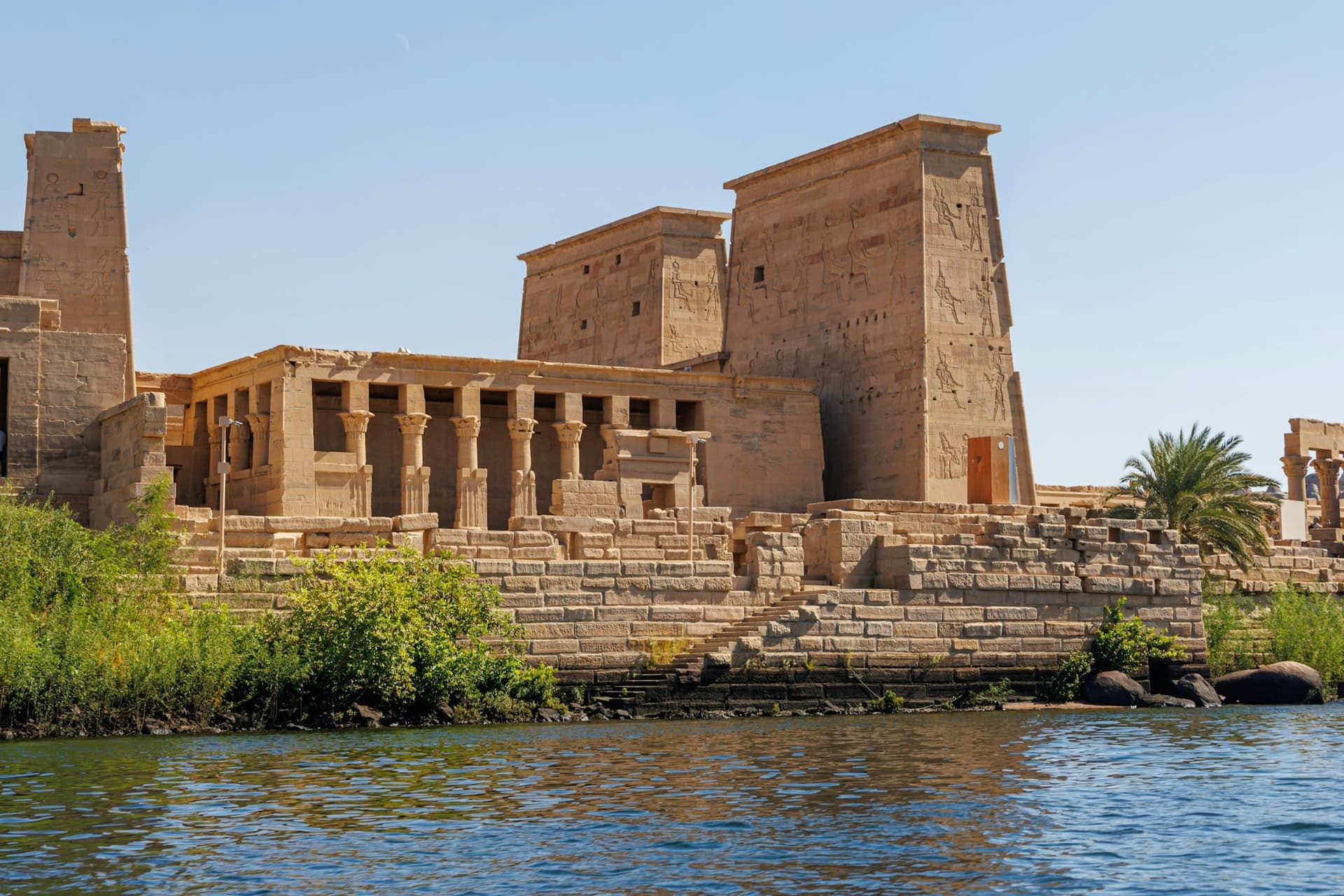
The temple rises on a promontory above a bend in the Nile. For visitors arriving by cruise ship—and most do—the approach reveals the structure against the western sky, its remaining columns and walls glowing in late afternoon light. This was crocodile country. The animals that embodied Sobek basked on these banks, and the temple's location acknowledged their presence.
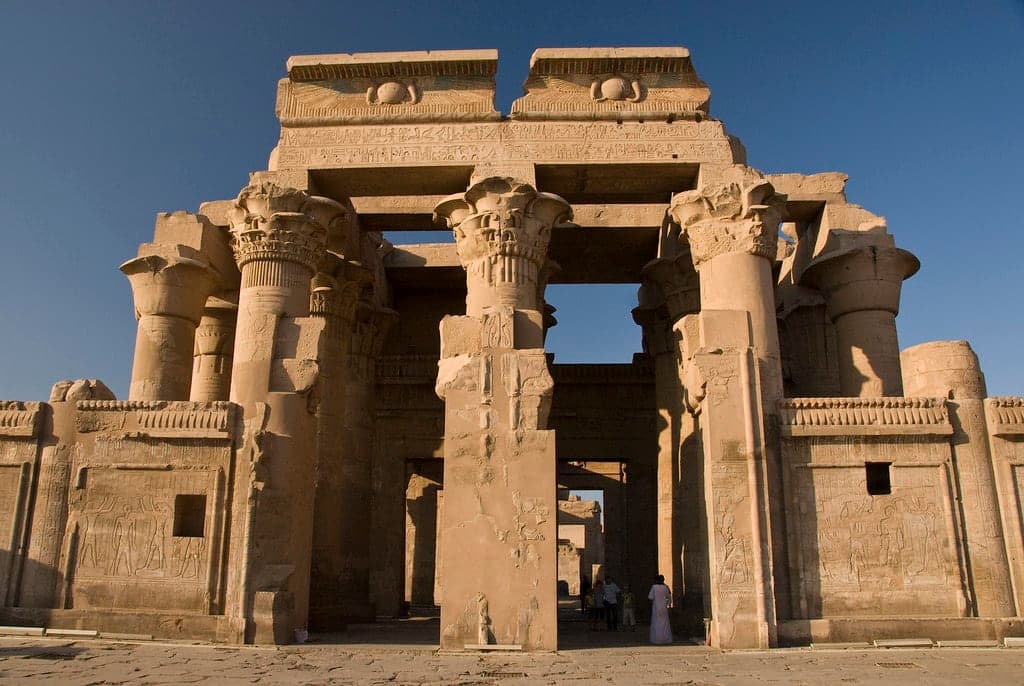
The first striking feature is the double entrance. Two doorways, side by side, pierce what remains of the outer walls. The symmetry is not approximate but exact: every element on the southern (Sobek) side has its counterpart on the northern (Haroeris) side. Walking through either entrance, visitors begin a processional path that mirrors its twin. The hypostyle hall's twelve columns rise overhead, their capitals carved with floral designs, their surfaces covered in reliefs.
Between the two sanctuaries lies the hidden chamber. A narrow passage allowed priests to enter unseen and deliver oracular messages—perhaps for both gods, perhaps speaking with the voice of divine duality itself. The sanctuaries themselves are smaller than the great processional spaces that precede them. Here the cult statues stood, receiving daily offerings from their respective priesthoods.
On the outer enclosure wall, the surgical instruments relief draws particular attention. Scalpels, forceps, probes, what appear to be birthing chairs—nearly forty implements depicted with precision. This was not decoration but documentation. The temple healed, and these were the tools.
The adjacent Crocodile Museum completes the experience. Mummified crocodiles, over 300 discovered at the site, lie in cases like the sacred animals they were. Some stretch over four meters; others are hatchlings. Crocodile coffins, crocodile teeth, crocodile fetuses—the museum makes tangible what was meant by honoring the dangerous as divine.
Enter through either of the double doorways to experience the temple's symmetry from the start. The southern path leads to Sobek's domain, the northern to Haroeris's—but the two interweave throughout. Note the nilometer near the entrance, the circular well that measured the flood. In the hypostyle hall, examine the column reliefs showing offerings to both deities. The secret passage between sanctuaries is visible but not always accessible. The surgical instruments relief is on the outer enclosure wall—ask a guide for precise location. Leave time for the Crocodile Museum, which may require separate admission. Evening visits offer the temple illuminated—a different experience than the golden afternoon light most cruise passengers see.
Kom Ombo invites interpretation through multiple lenses: architectural analysis of its unique dual design, theological inquiry into Egyptian attitudes toward opposing forces, medical history through the surgical instruments relief, and broader questions about how cultures honor the dangerous.
Egyptologists recognize Kom Ombo as the only known Egyptian temple with perfect bilateral symmetry honoring two distinct deities simultaneously. The pairing of Sobek (chaos, danger, fertility) and Haroeris (order, kingship, healing) is understood as theological statement about the complementarity of opposing forces necessary for Ma'at. The surgical instruments relief, dated to the 2nd-3rd century CE, provides valuable evidence of ancient medical practices, though some scholars debate the precise identification of all depicted tools. The temple's strategic location at a Ptolemaic elephant training ground reflects military as well as religious interests. The approximately 300 crocodile mummies discovered at the site document the extensive cult of Sobek that flourished here into the Roman period.
Ancient Egyptian understanding held that the crocodile was both feared and sacred. Sobek's dual nature reflected the Nile itself, which brought life through floods but could also destroy. Sacred crocodiles were not merely symbols but actual incarnations of divine presence—their behavior revealed divine will, their deaths required royal-level honors. Haroeris as 'head of physicians' positioned healing as divine intervention: illness came from disruption of Ma'at, and restoration required the god's attention. The nilometer measured not merely water levels but divine favor. A high flood meant the gods approved; a low flood suggested displeasure. The temple thus functioned as interface between human need and divine response.
Some researchers view the surgical instruments relief as evidence of more sophisticated ancient medical knowledge than mainstream scholarship typically acknowledges. The dual temple design attracts interest from those who see in it teachings about reconciling opposites—a theme that appears in later Hermetic and alchemical traditions that drew on Egyptian sources. The oracle chamber interests those exploring ancient divination practices. Contemporary seekers drawn to animal spirituality sometimes connect with the crocodile cult as an example of honoring dangerous forces rather than seeking to eliminate them—a practice relevant to psychological and ecological thinking.
Genuine mysteries persist at Kom Ombo. The complete theological meaning of pairing Sobek and Haroeris specifically at this location—rather than elsewhere—remains unclear. Some scholars question whether all depicted items in the surgical instruments relief were actually medical tools or whether some served ritual purposes. How the oracle chamber functioned in practice, and what questions seekers brought to its priests, is not fully documented. The full extent of the temple's healing practices and their effectiveness cannot be reconstructed from surviving evidence. The relationship between the site's prehistoric significance (the Sebilian industry) and later sacred associations invites speculation but resists confirmation.
Visit Planning
Kom Ombo lies between Luxor and Aswan, making it a standard Nile cruise stop. Most visitors arrive by boat in late afternoon. The dramatic riverside setting makes sunset and evening visits particularly rewarding.
Located on the east bank of the Nile approximately 45 km north of Aswan and 168 km south of Luxor. Most visitors arrive on Nile cruise ships—Kom Ombo is a standard stop on Luxor-Aswan itineraries. Boats dock directly adjacent to the temple. Train service connects Kom Ombo to Luxor and Aswan; the station is a short taxi ride from the temple. Opening hours vary by source (7AM-9PM or 8AM-5PM reported)—verify current schedule. Entry fees difficult to confirm—verify current prices on arrival. The Crocodile Museum may require separate admission.
Most visitors arrive on Nile cruises that provide accommodation. Kom Ombo town has limited tourist facilities. Day trips from Aswan (45 km south) are common for independent travelers.
Standard archaeological site protocols apply. Modest dress is recommended. Photography is generally permitted. The Crocodile Museum may have separate admission.
Kom Ombo functions as an archaeological monument rather than an active religious site. No particular ritual etiquette applies beyond basic respect for the ancient structure and fellow visitors. The mummified crocodiles in the museum deserve respectful viewing—these were sacred animals, not curios.
No strict dress code, though modest clothing is recommended for cultural respect. Limited shade makes sun protection essential: hats, light long sleeves, comfortable walking shoes.
Photography is generally permitted throughout the temple and museum. Tripods and professional equipment may require special permits. Flash photography may be restricted in certain areas.
Not expected or traditional at this archaeological site.
Do not touch reliefs or carvings. Stay on marked pathways. Some areas may be restricted for conservation. The inner sanctuary areas may have limited access. The Crocodile Museum has separate entry procedures.
Sacred Cluster
Nearby sacred places create the location cluster described in the growth plan. This block is intentionally crawlable and links into the wider regional graph.