Kathmandu Valley
Where Hindu and Buddhist traditions have woven together for two millennia beneath the gaze of the Himalayas
Kathmandu, Bagmati Province, Nepal
At A Glance
- Coordinates
- 27.7172, 85.3240
- Suggested Duration
- 3-4 days minimum to visit the major UNESCO sites. 5-7 days allows meaningful engagement with multiple sites and participation in daily rhythms. 2+ weeks permits deeper exploration including meditation retreats, festival participation, and visits to lesser-known sites. Extended stays for serious practitioners may involve enrolling in teachings at Tibetan Buddhist monasteries around Boudhanath.
Pilgrim Tips
- Shoulders and knees must be covered for both men and women at all sacred sites. Loose, comfortable clothing in neutral or muted colors is appropriate. Bring a scarf or shawl for covering when entering temples. Comfortable walking shoes are essential, but choose those easily removed since shoes must be taken off frequently. Limit leather goods.
- Photography rules vary by site and should always be checked. Photography of the Kumari is strictly prohibited. At cremation ghats, photograph only from a respectful distance and never photograph mourning families without permission. Many temple sanctums prohibit photography. Turn off camera sounds. Professional or commercial photography typically requires permits.
- The main Pashupatinath Temple is closed to non-Hindus; respect this restriction. Do not photograph mourning families at cremation ghats without permission. Do not touch sadhus or their possessions without invitation. Some sadhus pose for photos for money; be aware this is a transaction, not a blessing. At Boudhanath and Swayambhunath, walk clockwise only. Female visitors must not touch monks. Be aware of monkeys at Swayambhunath—they will grab food, glasses, and other items.
Overview
The Kathmandu Valley is a sacred landscape unlike any other on Earth. Seven UNESCO World Heritage monument zones hold temples, stupas, and shrines where Hindu and Buddhist traditions have coexisted for over two thousand years. At Pashupatinath, cremation fires release souls to moksha while sadhus contemplate Shiva. At Boudhanath, Tibetan pilgrims circumambulate one of the world's great stupas. At Swayambhunath, the primordial flame that legend says emerged when Manjushri drained the cosmic lake still draws devotees at dawn. And in Kathmandu's Durbar Square, a young girl embodies the Living Goddess Kumari, her gaze believed to bestow blessings.
According to legend, the Kathmandu Valley was once a vast lake inhabited by serpent beings. The bodhisattva Manjushri saw a sacred lotus flame rising from the waters and resolved to make this holy place accessible to pilgrims. With his flaming sword, he cut through the mountains, draining the lake and revealing the valley that would become one of humanity's most concentrated sacred landscapes. Whether myth or geological memory—the valley was indeed once a lake—this origin story captures something essential: the Kathmandu Valley is a place of divine revelation made accessible to seekers.
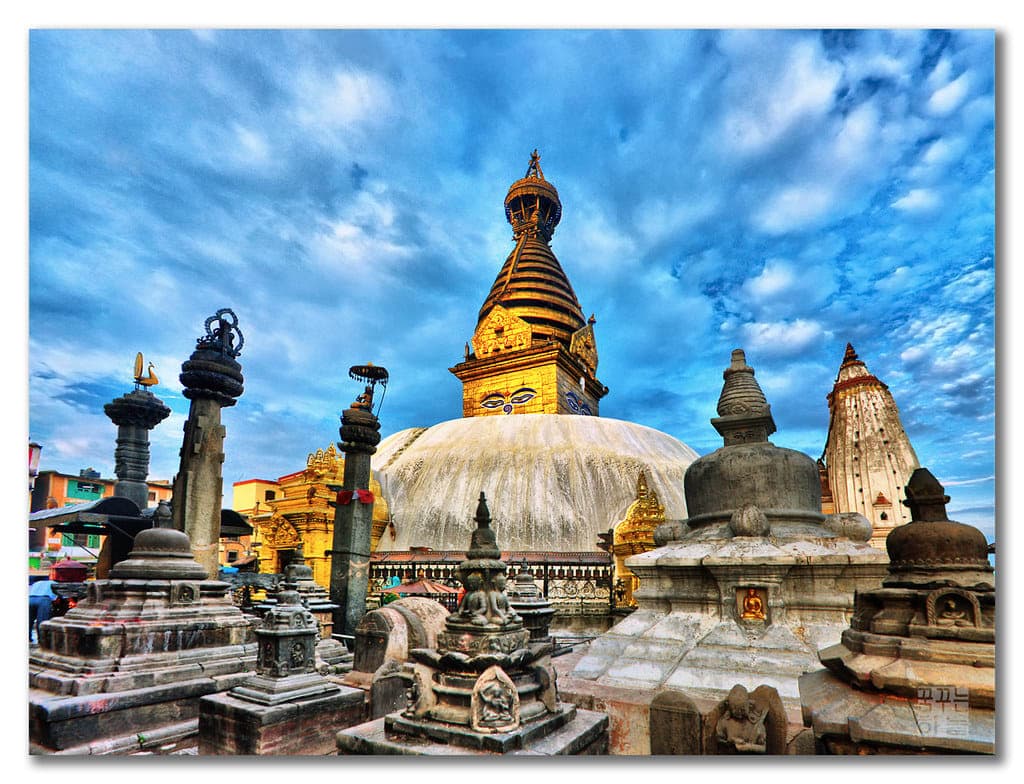
Today, seven UNESCO monument zones preserve a spiritual heritage that exists nowhere else in such density or diversity. Pashupatinath Temple is among the holiest sites in all of Hinduism—believed to be the head of Lord Shiva's cosmic body, the place where cremation ensures liberation from the cycle of rebirth. Boudhanath Stupa rises above a community of Tibetan Buddhist monasteries, its all-seeing eyes gazing in all directions, prayer wheels spinning beneath the feet of pilgrims performing kora. Swayambhunath—the 'Self-Arisen One'—crowns a hilltop where Buddhist and Hindu shrines cluster together, monkeys leap through ancient trees, and the valley spreads below like a mandala.
The three Durbar Squares of Kathmandu, Patan, and Bhaktapur preserve the royal palaces and temple complexes of the medieval Malla kingdoms, where kings competed in architectural devotion. Changu Narayan holds Nepal's oldest inscription and finest Vishnu worship. And threading through all of these is something found perhaps nowhere else in the world: a profound syncretism where Hindu and Buddhist practices blend, where the same deities appear in different forms, where a Buddhist girl from the Shakya clan is worshipped as the incarnation of the Hindu goddess Taleju. The Living Goddess Kumari sits in her palace window, and her glance is believed to bring good fortune to all who receive it.
The valley remains a landscape of living religion, not a museum of ancient belief. Every temple is alive with worship. Cremation fires burn daily at Pashupatinath. Pilgrims spin prayer wheels around Boudhanath at dawn. Festivals transform the streets into rivers of devotion. The Kathmandu Valley offers what seekers have sought here for millennia: immersion in living spirituality at the crossroads of two of humanity's great wisdom traditions.
Context And Lineage
The Kathmandu Valley has been sacred for over two millennia, with Hindu and Buddhist traditions developing together in a unique syncretism. Legends tell of Manjushri draining a primordial lake to reveal the valley; Shiva's head is believed to reside at Pashupatinath.
The valley's creation mythology speaks of waters and revelation. In the Buddhist telling, recorded in the Swayambhu Purana, the Kathmandu Valley was originally a vast lake called Naga Hrad, inhabited by serpent beings. A sacred lotus bloomed at the center, radiating light that attracted the Seven Past Buddhas. The bodhisattva Manjushri, traveling from China's Mount Wutai, saw this light from afar. He resolved to drain the lake so pilgrims could venerate the lotus. With his flaming sword Chandrahasa, he cut through the surrounding mountains at Chobar, and the waters rushed out. The lotus transformed into the hill where Swayambhunath now stands; the sacred flame became the stupa. Manjushri named the new city Manjupattana and taught the people civilization. He instructed the Naga king Karkotak to protect the valley and told the displaced serpent beings to dwell in Taudaha, the 'Snake Lake' that remains.
Geological evidence confirms the valley was indeed a lake in prehistoric times, drained when the Bagmati River cut through the surrounding mountains—the story preserves memory in mythological form, and consecrates the landscape as a place of divine revelation.
The Hindu tradition adds another layer: Pashupatinath is the head of Lord Shiva, whose body extends to Kashi Vishwanath in India. One legend tells that Shiva and Parvati took the form of antelopes in the forest by the Bagmati River. When gods found them, Shiva's antler broke. The broken horn was worshipped as a linga but eventually lost. Centuries later, a herdsman discovered his cow showering one spot with milk. When he dug there, he found the divine Shivalinga of Pashupatinath.
Another tradition connects Pashupatinath to the Mahabharata. After the Kurukshetra war, the Pandavas sought Shiva to absolve their sins of killing their own relatives. Shiva, avoiding them, took the form of a bull and disappeared into the earth. His back emerged at Kedarnath in the Himalayas; his head appeared at Pashupatinath—connecting these two great pilgrimage sites.
Pre-Buddhist Naga worship and animist traditions. Hindu development from Licchavi period (5th century CE onward). Buddhist establishment possibly as early as 3rd century BCE (Ashokan era). Newar Buddhist tradition developing unique Vajrayana practices. Malla period (12th-18th century) temple construction and Kumari tradition establishment. Tibetan Buddhist community growth after 1959. UNESCO inscription 1979. Continuous living traditions to present day.
Manjushri
Valley creator (Buddhist tradition)
King Manadeva
Licchavi builder
The Malla Kings
Medieval patrons
The Royal Kumari
Living Goddess
Why This Place Is Sacred
The Kathmandu Valley is thin because it is a place where the divine has been continuously present for over two millennia—in stone temples and living goddesses, in cremation fires and turning prayer wheels, in the coexistence of traditions that elsewhere stand apart.
What makes the Kathmandu Valley thin is the accumulation of continuous devotion across millennia in a place where the boundaries between traditions, between the living and the dead, between the human and the divine, are remarkably permeable.
Begin with origins. The valley's creation story is itself a thinning: the bodhisattva Manjushri cutting through mountains to drain a primordial lake and reveal the sacred lotus flame beneath. Geological evidence confirms the valley was once underwater—the story preserves memory in mythological form. Swayambhunath, the 'Self-Arisen One,' marks where the lotus flame emerged. The hill existed before humans; the sacred presence predates all temples.
Add the concentration of sacred sites. Seven UNESCO monument zones. Pashupatinath with its cremation ghats, where the smoke of bodies carries souls to moksha while sadhus who have renounced the world live in the presence of Shiva. Boudhanath, where Tibetan refugees rebuilt their spiritual world in exile, where over fifty monasteries surround a stupa holding relics of the Buddha Kassapa. Swayambhunath, where monkeys leap through prayer flags and the all-seeing eyes of the Buddha gaze over the valley. The Durbar Squares with their pagoda temples and stone guardians. Changu Narayan with Nepal's oldest inscription. Each is thin in itself; together they create something greater.
Then there is the syncretism—the blending of Hindu and Buddhist traditions that creates its own kind of thinness. In Newar Buddhism, Shiva and Buddha are worshipped together. The Kumari is selected from a Buddhist caste but venerated as a Hindu goddess. The boundaries Western categories impose dissolve here. This fluidity between traditions is itself a thinning, a demonstration that the sacred is larger than any single framework.
And most dramatically, there is the presence of the divine in living form. The Kumari tradition places the goddess in the body of a young girl. This is not symbolic representation; it is actual embodiment. The divine dwells in human form, walks on human feet, looks through human eyes. When the Kumari appears at her window, devotees believe they receive the goddess's blessing directly. The boundary between human and divine thins to transparency.
Finally, there are the cremation grounds. At Pashupatinath, the boundary between life and death is crossed daily in plain sight. Families bring their dead to the ghats. The flames consume the body. The ashes enter the Bagmati River. The soul, tradition holds, achieves liberation. To witness this is to witness the thin place between worlds where souls pass through.
The valley's sacred sites developed across millennia for varied purposes: Pashupatinath as a center of Shiva worship and cremation ensuring moksha; Boudhanath as a pilgrimage stupa holding Buddhist relics; Swayambhunath marking the place where the primordial lotus flame emerged; the Durbar Squares as royal religious and political centers; Changu Narayan as a temple to Vishnu. Together they created a sacred landscape serving both Hindu and Buddhist traditions.
Earliest religious activity dates to the 3rd century BCE (possible Ashokan-era temple at Swayambhunath). Licchavi period (400-750 CE) brought major temple construction including Changu Narayan and early Pashupatinath. Malla dynasty (12th-18th century) built the Durbar Squares and established the Kumari tradition. Tibetan refugee influx after 1959 transformed Boudhanath into a center of Tibetan Buddhism. 1979 UNESCO inscription. 2015 earthquake damage with ongoing restoration. Living traditions continue unbroken.
Traditions And Practice
The Kathmandu Valley supports an extraordinary range of active spiritual practices: Hindu cremation rituals and temple worship, Buddhist kora circumambulation and meditation, the Kumari living goddess tradition, and countless festivals including Maha Shivaratri, Dashain, and Indra Jatra.
The cremation rituals at Pashupatinath are among the most sacred in Hinduism. The deceased is bathed, dressed in ceremonial clothes, and carried on a bamboo stretcher to the ghat. The eldest son or closest male relative circumambulates the body before lighting the funeral pyre. Cremation occurs within 24 hours of death. Ashes are collected and immersed in the Bagmati River. Tradition holds that cremation at Pashupatinath ensures moksha—liberation from the cycle of rebirth.
The Kumari selection process involves choosing a girl aged 2-4 from the Buddhist Shakya caste who meets 32 requirements of physical perfection. Candidates undergo a test in a darkened room with severed buffalo heads and masked dancers; only she who shows no fear is chosen. The selected Kumari lives in the Kumari Ghar, rarely touching the ground, receiving daily worship until she menstruates or suffers injury, at which point she returns to ordinary life.
Kora at Boudhanath follows Buddhist practice: walking clockwise around the stupa, keeping it to the right, spinning prayer wheels, reciting mantras (especially Om Mani Padme Hum), lighting butter lamps. This circumambulation is performed especially at dawn and dusk; devout pilgrims may complete multiple circuits or perform prostrations.
Maha Shivaratri, the 'Great Night of Shiva,' occurs in February or March and draws over a million pilgrims to Pashupatinath. Devotees fast and keep all-night vigil. Thousands of sadhus from across India and Nepal gather. The temple complex transforms into a sea of humanity united in devotion to Shiva.
Dashain, Nepal's most important festival, lasts 15 days in September or October, celebrating Durga's victory over evil. The first nine days involve tantric rituals worshipping nine aspects of Durga. On Dashami (Tika), families reunite and elders place vermilion tikas on foreheads while giving blessings.
Indra Jatra, an eight-day festival in September, features the Living Goddess Kumari paraded through Kathmandu in a golden palanquin. Traditional masked dances and the unveiling of the massive Aakash Bhairav idol create a spectacular atmosphere.
Evening aarti ceremonies at Pashupatinath draw crowds nightly. Priests perform fire offerings to Lord Shiva accompanied by bells, drums, and chanting. The ceremony can be viewed from the eastern bank of the Bagmati River.
For cremation witnessing at Pashupatinath, arrive in early morning. Find a respectful position on the eastern bank. Observe in silence. The experience of impermanence made visible can be profound; allow time for contemplation afterward.
For kora at Boudhanath, arrive in late afternoon. Walk clockwise, keeping the stupa on your right. Spin the prayer wheels. Make multiple circuits—the repetition creates rhythm and opens contemplative space. Stay for sunset when the light turns golden and the community of practitioners grows.
At Swayambhunath, climb the 365 steps at sunrise or sunset. Pause at the top to take in the view and the mixing of Hindu and Buddhist iconography. Walk clockwise around the central stupa.
If seeking the Kumari, wait patiently in the courtyard of the Kumari Ghar in Kathmandu Durbar Square. She may appear at her window; there is no schedule. Photography is prohibited. Receive her gaze as blessing.
Visit Changu Narayan for quieter contemplation away from crowds. The hilltop setting and ancient carvings offer a different quality of sacred space.
Hinduism (Shaivism)
ActiveThe Kathmandu Valley is one of the holiest regions for Shiva worship in the world. Pashupatinath Temple is believed to be the head of Lord Shiva's cosmic body, with its existence recorded as early as 400 CE and tradition claiming much older origins. The temple contains a sacred Shivalinga with five faces representing Shiva's aspects: Sadyojata, Vamadeva, Tatpurusha, Aghora, and Ishana. According to Hindu belief, being cremated at Pashupatinath ensures moksha, liberation from the cycle of reincarnation.
Daily puja and worship at Pashupatinath. Cremation rituals on the Bagmati River ghats. Maha Shivaratri festival with all-night vigils drawing over a million devotees. Pilgrimage circumambulation of the temple complex. Offerings of flowers, rice, and milk to Shivalingas. Sadhu darshan—receiving blessings from holy men who have renounced the world to dwell with Shiva. Evening aarti ceremonies with fire offerings, bells, and chanting.
Tibetan Buddhism
ActiveBoudhanath Stupa is one of the most sacred sites for Tibetan Buddhism outside of Tibet. Built around the 5th century CE and believed to contain relics of the Buddha Kassapa, it became the spiritual center for Tibetan refugees after 1959. Over 50 gompas and monasteries now surround the stupa, making Boudhanath a living center of Tibetan Buddhist learning and practice.
Kora (circumambulation) around Boudhanath, walking clockwise with the stupa to the right. Spinning prayer wheels while walking. Reciting mantras, especially Om Mani Padme Hum. Lighting butter lamps at shrines around the stupa's base. Prostrations before the stupa. Receiving teachings at surrounding monasteries. Thangka painting and ritual arts. Prayer flag offerings.
Newar Buddhism (Vajrayana)
ActiveNewar Buddhism is a unique form of Vajrayana Buddhism that developed in the Kathmandu Valley, distinct from Tibetan or East Asian traditions. It has developed within a Hindu-dominant society, resulting in remarkable syncretism where gods like Shiva and Buddha are worshipped together. The clergy consists of the Vajracharya (Buddhist priests) and Shakya castes who maintain ancient shrines called bahas. This tradition preserves Sanskrit Buddhist texts, many of which survive only in Nepal.
Worship at baha (vihara) monastery courtyards. Creation of paubha scroll paintings and mandala sand paintings. Tantric rituals performed by Vajracharya priests. Worship of both Buddhist and Hindu deities. Circumambulation of stupas. Celebration of Buddhist festivals within Newari cultural context. Preservation and study of ancient Sanskrit Buddhist manuscripts.
Hindu-Buddhist Syncretism (Kumari Tradition)
ActiveThe Kumari tradition is a unique syncretic practice where a prepubescent girl from the Buddhist Shakya caste is venerated as the living incarnation of the Hindu goddess Taleju (a form of Durga) and the Buddhist tantric goddess Vajradevi. The tradition dates to the Malla dynasty (17th century in its current form, though virgin worship in Nepal may date back 2,300 years). The Royal Kumari of Kathmandu lives in the Kumari Ghar at Durbar Square and is believed to have such powerful presence that even a glimpse brings good fortune.
Selection of new Kumari from Shakya clan girls meeting 32 requirements of perfection. Daily worship and offerings to the living goddess. Public appearances during Indra Jatra and Dashain. Chariot procession through Kathmandu during festivals. Receiving tika (blessing) from the Kumari. The Kumari rarely walks on the ground and receives constant veneration until she reaches puberty or suffers injury.
Hinduism (Vaishnavism)
ActiveChangu Narayan Temple, built in the 4th century CE, is the oldest Hindu temple in Nepal and the finest example of Vishnu worship in the valley. It houses ancient sculptures including a famous 7th-century Garuda Narayan (Vishnu riding Garuda) depicted on Nepal's 10 rupee banknote. The temple contains Nepal's oldest inscription from 464 CE by Licchavi King Manadeva.
Worship at Changu Narayan Temple. Darshan of Vishnu images. Festivals for Vishnu avatars. Reading and recitation of Vishnu Sahasranama. Pilgrimage to the hilltop temple.
Experience And Perspectives
Visitors encounter living spirituality at every turn—watching cremation fires at dawn, performing kora around Boudhanath at sunset, climbing 365 steps to Swayambhunath, glimpsing the Living Goddess, exploring the medieval Durbar Squares, and receiving blessings from sadhus who have renounced the world.
The experience of the Kathmandu Valley is one of immersion in living spirituality at an intensity found in few other places on Earth. This is not a landscape of ruins; it is a landscape of active devotion where the boundaries between tourist and pilgrim, between observation and participation, blur and dissolve.
Begin at Pashupatinath, preferably in the early morning when the light is soft and the cremation ghats are already active. Cross the Bagmati River to the eastern bank where non-Hindus can observe. The main temple with its golden pagoda roof is visible but inaccessible to non-Hindus. What is accessible is something perhaps more profound: the open cremation grounds where Hindu families bring their dead. Bodies wrapped in orange and white are carried to the ghats on bamboo stretchers. The eldest son lights the pyre. The flames consume what was. The ashes will enter the sacred river. This is death made visible, the transition between worlds performed in the open air. There is no barrier between the living and the dying. Sadhus—ash-smeared holy men who have renounced worldly life—sit in small shelters around the complex, meditating, receiving offerings, embodying the presence of Shiva. The encounter with impermanence and renunciation here is visceral and unavoidable.
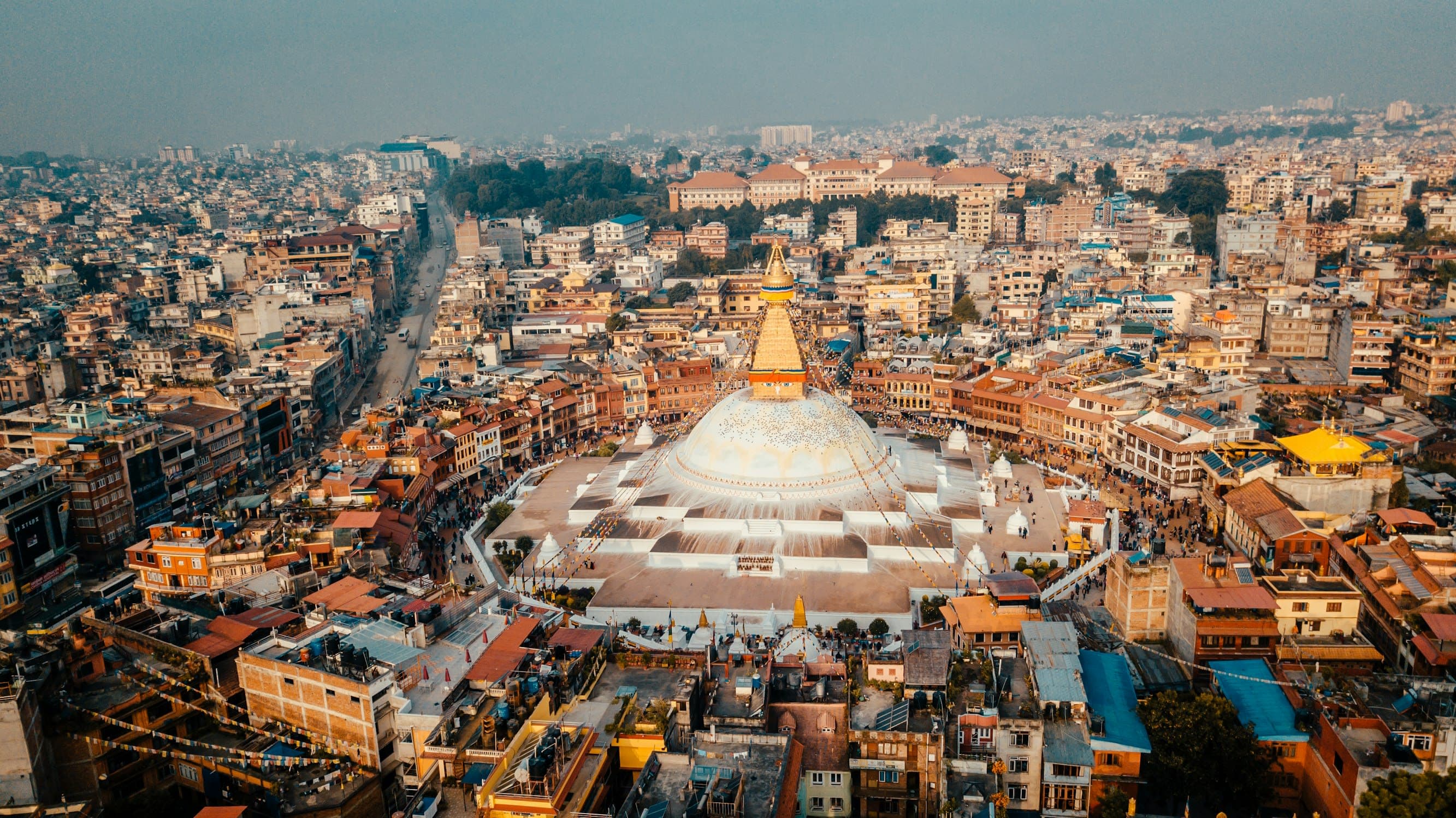
Boudhanath offers a different experience. The great white dome of the stupa rises above a surrounding plaza of shops, restaurants, and Tibetan monasteries. The stupa is one of the largest in the world, and it draws Tibetan Buddhists the way Mecca draws Muslims. The practice here is kora—circumambulation. Walk clockwise around the stupa, keeping it to your right. Spin the prayer wheels set into the base. Listen to the mantras being chanted, the prayers being murmured, the butter lamps being lit at small shrines. The best time is late afternoon into evening, when the light turns golden, the pigeons wheel overhead, and the kora path fills with monks in maroon robes, Tibetan elders with prayer beads, pilgrims performing prostrations. Multiple circumambulations create a meditative rhythm. The stupa's all-seeing eyes gaze in all directions; the prayer flags flutter their mantras into the wind.
Swayambhunath requires the climb of 365 steps through forests inhabited by monkeys—the source of its nickname, the 'Monkey Temple.' But the ascent is a pilgrimage in miniature: the effort of elevation, the gradual revealing of the valley below, the arrival at the hilltop complex where Hindu and Buddhist shrines cluster together. The central stupa is ancient, possibly dating to the time of Emperor Ashoka. The eyes of the Buddha are painted on all four sides of the spire. Hindu deities share space with Buddhist iconography. The syncretism is visible and tangible. Sunrise and sunset here offer views of the entire valley—the Himalayas visible on clear days, the landscape that legend says emerged when Manjushri drained the primordial lake.
The Durbar Squares of Kathmandu, Patan, and Bhaktapur transport visitors to the medieval world of the Malla kings. Pagoda temples rise in layers of carved wood and gilded metal. Stone guardians flank staircases. The Kumari Ghar in Kathmandu's Durbar Square houses the Living Goddess, and patient visitors may glimpse her at her window—a young girl in whom the goddess Taleju is believed to dwell. Photography of the Kumari is prohibited; her appearance is blessing enough. Patan's square is considered the most architecturally refined. Bhaktapur's feels like stepping centuries back, its streets still made of brick, its medieval atmosphere largely preserved.
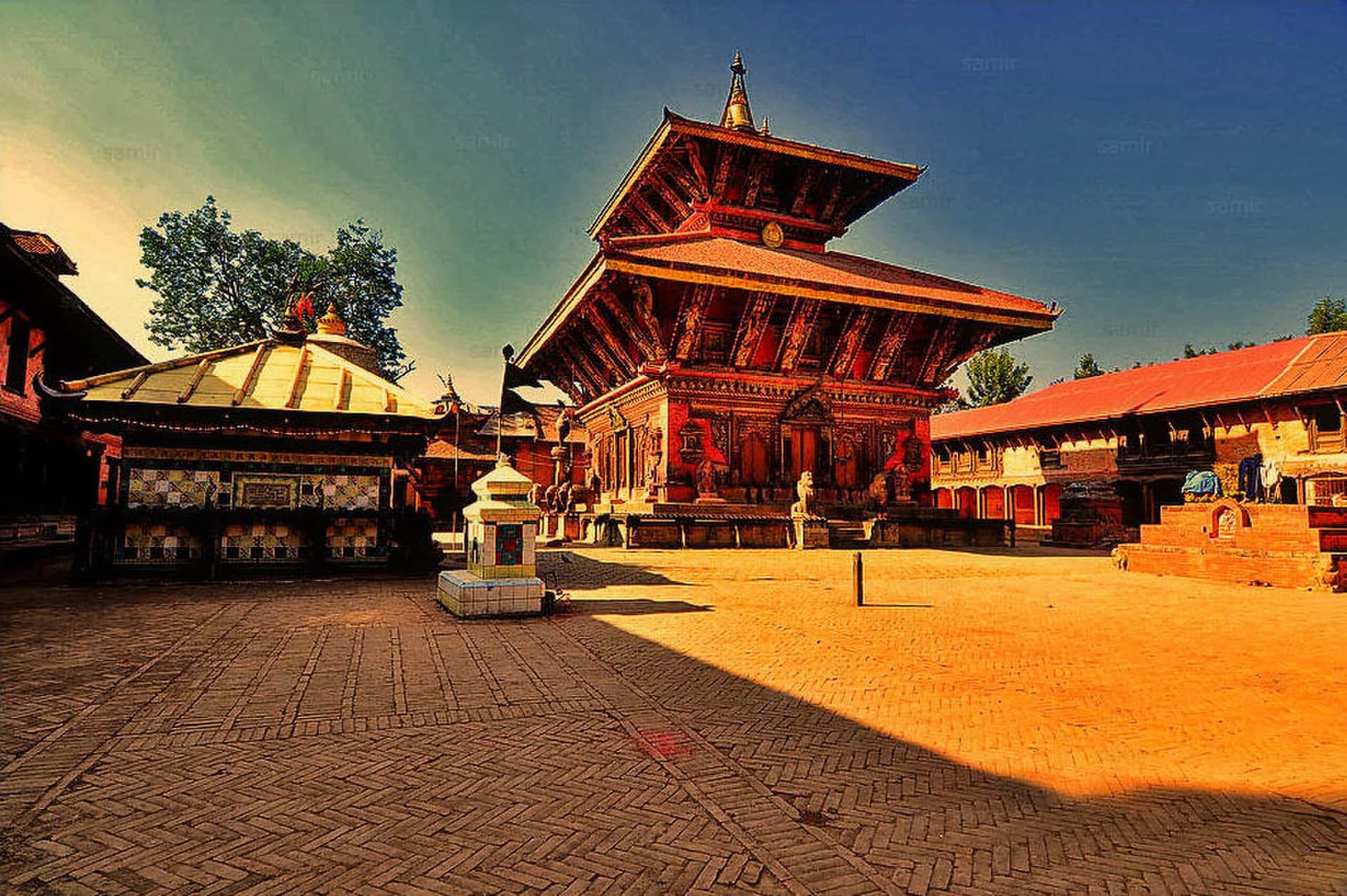
Changu Narayan, the oldest Hindu temple in Nepal, sits on a hilltop east of Kathmandu. The 4th-century temple contains Nepal's oldest inscription and some of its finest stone carvings. The image of Vishnu riding Garuda depicted here appears on the ten-rupee note. The approach through terraced fields and small villages offers a quieter, more contemplative experience than the urban sites.
The cumulative effect is overwhelming—temples beyond counting, rituals beyond comprehension, sensory immersion in incense and bells and chanting and color. The Kathmandu Valley does not offer the silence of natural thin places. It offers the thickness of accumulated devotion, the presence of traditions old beyond memory and alive in this moment.
The Kathmandu Valley contains seven UNESCO monument zones spread across three cities: Kathmandu, Patan (Lalitpur), and Bhaktapur. Pashupatinath and Boudhanath are in Kathmandu's eastern outskirts. Swayambhunath is west of central Kathmandu. The three Durbar Squares are in the respective city centers. Changu Narayan is about 20 km east. Plan at minimum 3-4 days to visit the major sites; a week or more allows deeper engagement. Taxis, ride-sharing apps, and local buses connect all sites.
The Kathmandu Valley invites engagement with one of humanity's most remarkable experiments in religious coexistence—two millennia of Hindu and Buddhist traditions developing together, borrowing from each other, creating something found nowhere else on Earth.
The Kathmandu Valley is recognized by UNESCO for its 'unique intermingling of Hinduism and Buddhism' and as 'exceptional testimony to the cultural traditions of the multi-ethnic people.' Scholars note that the valley's religious architecture and practices preserve traditions that have largely disappeared in India, making it invaluable for understanding South Asian religious history. Newar Buddhism in particular has preserved Sanskrit Buddhist texts, artistic traditions, and ritual practices found nowhere else—manuscripts that survived only because they crossed the Himalayas. The coexistence of Hindu and Buddhist communities sharing sacred sites and sometimes worshipping the same deities challenges Western categories of distinct religions. The Kumari tradition, the cremation rituals of Pashupatinath, and the unique architecture of Newar pagoda temples all represent living heritage of global significance.
For the Newar people, the indigenous inhabitants of the valley, the landscape is alive with divinity. Every locality has its protective deities; every family its household shrine combining Hindu and Buddhist figures. The origin story of Manjushri draining the primordial lake is not merely legend but the sacred charter for the valley's existence. The Living Goddess Kumari represents the most dramatic expression of divine presence—a young girl literally embodying the goddess. The cremation ghats at Pashupatinath are not places of death but of liberation, where souls achieve moksha. For traditional communities, the valley remains a mandala—a sacred cosmic diagram made manifest in geography. The sites are not museums but functioning nodes in a spiritual ecosystem that has operated for millennia.
The Kathmandu Valley attracts spiritual seekers drawn to the concept of 'thin places' where boundaries between physical and spiritual worlds are permeable. The continuous worship across millennia is understood to create accumulated spiritual energy perceptible to sensitive visitors. The geological fact that the valley was indeed once a lake, drained by the Bagmati River cutting through surrounding mountains, lends credence to the Manjushri legend in a way that interests those seeking connections between myth and science. The syncretic blending of Hindu and Buddhist practices suggests to some a primordial unity beneath surface differences.
Significant mysteries remain. The exact nature and beliefs of pre-Buddhist Naga worship in the valley are largely lost. The precise founding dates of many temples are legendary rather than documented—Pashupatinath is traditionally claimed to date to the 5th century BCE, but the earliest confirmed evidence is from the 5th century CE. The full extent of tantric practices that continue among traditional practitioners is not publicly discussed. How the remarkable Hindu-Buddhist syncretism developed and maintained itself over centuries, resisting the pull toward religious exclusivism, remains a question for historians. The spiritual experiences of the Kumari themselves are never publicly discussed—what does a young girl experience when worshipped as a goddess?
Visit Planning
Located in central Nepal at 1,400 meters elevation. International flights to Kathmandu. Entry fees vary by site (USD 7-15 for major sites). Best weather September to November or March to May. Allow 3-7 days minimum for meaningful engagement.
Kathmandu offers accommodations from budget guesthouses to luxury hotels. Thamel district has the highest concentration of tourist accommodations. The Boudhanath area offers immersion in Tibetan Buddhist culture with monastery guesthouses available. Bhaktapur offers medieval atmosphere with fewer tourists at night. Some monasteries accept guests for meditation retreats.
Dress modestly with shoulders and knees covered. Remove shoes in temple sanctums. Walk clockwise around stupas. Do not photograph the Kumari. Maintain respectful distance at cremation grounds. Female visitors must not touch monks.
The Kathmandu Valley is a landscape of living religion, and appropriate behavior acknowledges that visitors are guests in active sacred spaces.
Dress conservatively everywhere. Both men and women should cover shoulders and knees. This is strictly enforced at most sites. A scarf or shawl is useful for covering when needed. Limit leather goods, which some temples consider disrespectful. Remove shoes before entering temple sanctums and many courtyards; look for piles of shoes as indicators.
Move with respect. Walk clockwise around stupas, chaityas, and Buddhist shrines, keeping them to your right. Never point feet toward sacred images, people, or religious texts. Use your right hand or both hands when giving or receiving anything. Do not touch statues, sculptures, or religious objects without permission. Keep voices low in sacred spaces.
At cremation grounds, maintain respectful distance from funeral proceedings. Do not photograph mourning families without explicit permission. Observe in silence. This is not spectacle; it is the sacred transition between worlds.
Regarding the Kumari: do not photograph her. She may appear at her window; receive her gaze as blessing. Enter the Kumari Ghar courtyard quietly and wait patiently. If she does not appear, do not demand or complain.
With monks and sadhus: female visitors must not touch monks; if you wish to hand something to a monk, place it on the ground for him to pick up. Some sadhus will pose for photographs in exchange for money—be aware this is a transaction. Others are in deep meditation and should not be disturbed.
Do not interrupt prayers or rituals. Avoid public displays of affection near temples. Turn off camera sounds in sacred spaces. Drones require special permission and are typically prohibited.
Shoulders and knees must be covered for both men and women at all sacred sites. Loose, comfortable clothing in neutral or muted colors is appropriate. Bring a scarf or shawl for covering when entering temples. Comfortable walking shoes are essential, but choose those easily removed since shoes must be taken off frequently. Limit leather goods.
Photography rules vary by site and should always be checked. Photography of the Kumari is strictly prohibited. At cremation ghats, photograph only from a respectful distance and never photograph mourning families without permission. Many temple sanctums prohibit photography. Turn off camera sounds. Professional or commercial photography typically requires permits.
Visitors can make offerings at most temples. Common offerings include flowers (especially marigolds), rice, fruit, incense, and coins. Butter lamps can be purchased and lit at Buddhist sites. Offerings to sadhus (usually small cash donations) are appropriate but not required. Never touch offerings meant for deities.
Non-Hindus cannot enter the main Pashupatinath Temple complex (surrounding areas are accessible). Walk clockwise around stupas and chaityas. Never point feet toward sacred images or people. Female visitors must not touch monks. Do not photograph the Kumari. Respect closures on Buddhist holy days at Boudhanath monasteries. Secure belongings from monkeys at Swayambhunath.
Sacred Cluster
Nearby sacred places create the location cluster described in the growth plan. This block is intentionally crawlable and links into the wider regional graph.