Budhanilkantha Temple
Nepal's sleeping god lies in timeless rest, awaiting the universe's renewal
Kathmandu, Bagmati Province, Nepal
At A Glance
- Coordinates
- 27.7800, 85.3642
- Suggested Duration
- One to two hours allows for observation and contemplation. Combine with a visit to nearby Shivapuri National Park for a fuller day.
- Access
- Located in Budhanilkantha municipality, 9 km north of central Kathmandu. Taxi is the most convenient transport. The site is about 10 km from Tribhuvan International Airport.
Pilgrim Tips
- Located in Budhanilkantha municipality, 9 km north of central Kathmandu. Taxi is the most convenient transport. The site is about 10 km from Tribhuvan International Airport.
- Modest dress covering shoulders and legs. Remove shoes in temple area.
- Permitted from viewing areas; be discreet.
- Non-Hindus cannot touch the statue. Respect this boundary without resentment; it maintains the sacred character of the space.
Overview
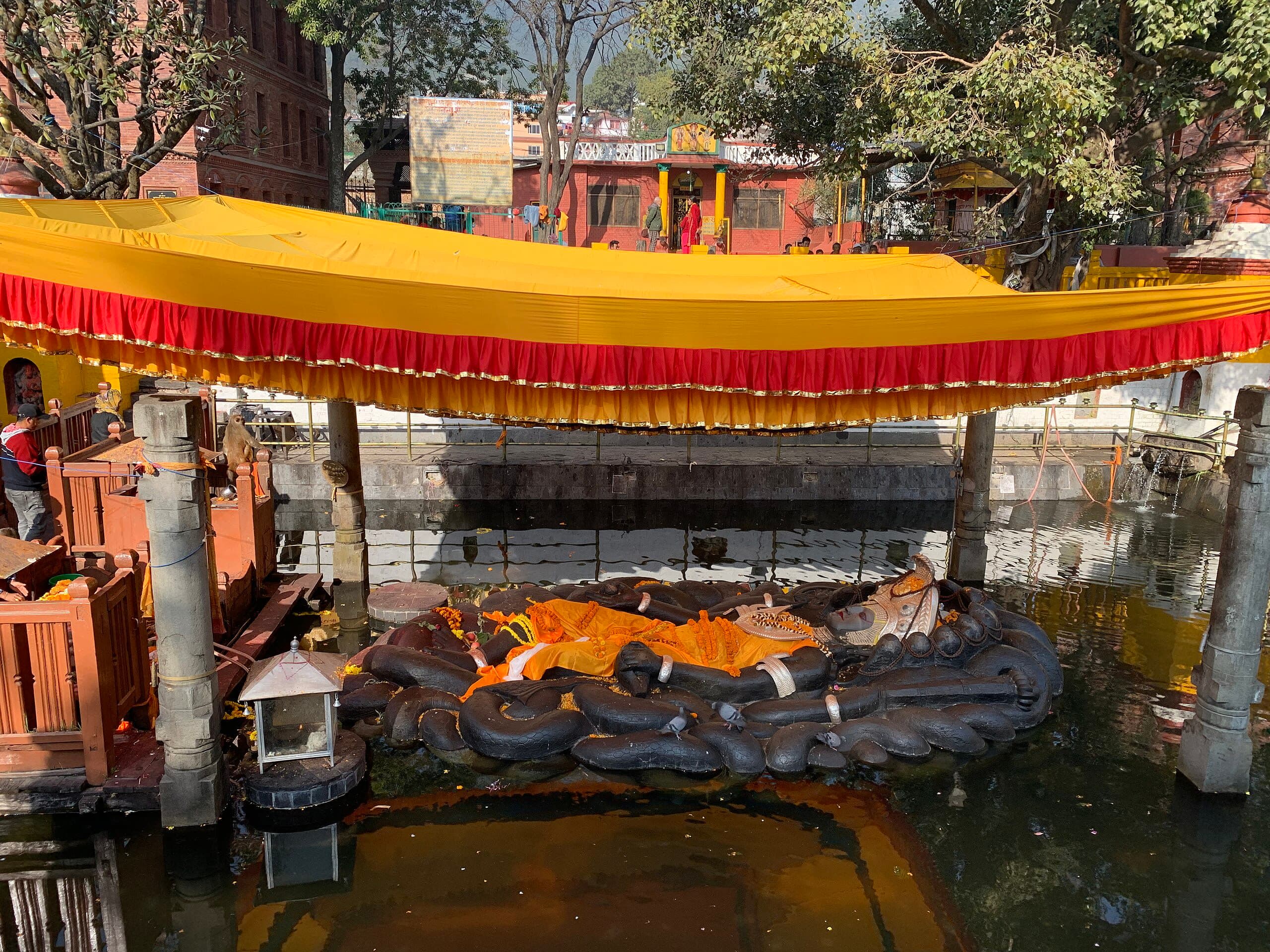
In a water-filled tank at the foot of Shivapuri Hill, Nepal's largest stone carving depicts Vishnu asleep on the cosmic serpent Shesha. The five-meter black basalt statue, believed to be over 1,400 years old, shows the deity in yogic rest between cosmic cycles—when one universe has dissolved and another has not yet begun. Kings of Nepal were forbidden to visit, lest they disturb the god's sleep. Devotees still approach with reverence, making offerings to the one who dreams worlds into being.
The encounter with Budhanilkantha is an encounter with stillness. Vishnu lies on his back in a recessed pool of water, eyes closed, expression of perfect peace, the coils of the serpent Shesha forming both bed and canopy. The statue is not merely large—at five meters, it is Nepal's most monumental stone carving—but carries a presence that exceeds dimensions.
The deity is depicted in the moment between times, the cosmic interval when one universe has ended and another has not yet begun. In Hindu cosmology, Vishnu dreams creation into being; the worlds arise from his consciousness as he rests upon the infinite serpent who floats upon the primordial waters. The recessed pool surrounding the statue echoes these waters.
A curse is said to prevent Nepal's kings from visiting this site. If a king were to come, tradition holds, he would die. The Shah dynasty reportedly honored this prohibition throughout their reign. Whatever the curse's origin, it reinforces the sense that this is a place where ordinary rules are suspended, where something powerful enough to touch the fate of kings lies in sculptured rest.
Context And Lineage
The statue dates to the Licchavi period (5th-7th century CE) and is believed to be Nepal's oldest major stone carving. Legend holds that a farmer discovered it while plowing his field.
The origin story centers on revelation rather than construction. A farmer working his field struck something with his plow. Investigating, he found a massive stone carving of Vishnu buried in the earth. In some versions, the plow drew blood from the buried god before the farmer realized what he had discovered.
This narrative follows a pattern common in South Asian sacred geography: the deity is not made but revealed, choosing to make itself known at the moment and in the manner it desires. The farmer is instrument rather than agent; the true protagonist is the god who emerges from concealment.
Historical analysis places the carving in the Licchavi period, likely the 7th century. The sophistication of the sculpture—a single block of black basalt carved with extraordinary skill—suggests a major royal commission, though specific attribution remains uncertain.
The temple belongs to the Vaishnava tradition—worship of Vishnu as the supreme deity. Within this tradition, the image of Vishnu sleeping on Shesha holds particular theological importance, representing the divine presence that underlies and creates all manifest existence.
Why This Place Is Sacred
The statue's antiquity, its depiction of the cosmic pause between worlds, and its location at the foot of sacred Shivapuri Hill create conditions where the boundary between ordinary time and eternal time feels permeable.
Budhanilkantha derives its thin-place quality from multiple sources. The statue's age—likely carved during the Licchavi period, over 1,400 years ago—saturates it with accumulated veneration. Each century of worship adds to the site's charge.
The iconography itself speaks to thinness. Vishnu sleeps in the interval between universes, the pause when temporal existence has collapsed into potential. The pool's water connects this specific location to the cosmic waters on which Shesha floats. Visitors approaching the deity are, symbolically, approaching the threshold of manifestation itself.
The statue's discovery reinforces the sense of revelation. Tradition holds that a farmer's plow struck the buried image while working the field. The earth concealed something powerful; the ordinary act of cultivation uncovered it. Some say the plow drew blood.
The setting adds a final dimension. Shivapuri Hill rises directly behind the temple, a forested peak considered sacred in its own right. The juxtaposition places the sleeping god at the foot of the mountain, as if resting at the base of a natural temple.
The statue was likely commissioned by a Licchavi king as a major devotional image of Vishnu, establishing this as a pilgrimage site for Vaishnava worship.
The temple has operated continuously since the Licchavi era, maintaining traditional practices across political changes and maintaining the prohibition against royal visits. The site remains among the most important Vishnu temples in Nepal.
Traditions And Practice
Daily puja maintains the worship relationship. Haribondhini Ekadashi marks Vishnu's annual awakening from cosmic sleep, drawing large crowds. Non-Hindus may observe but not touch the deity.
Daily worship follows a rhythm that has continued for over a millennium. Priests perform abhisheka (ritual bathing) and puja, maintaining the deity's ongoing presence. Devotees make offerings of flowers, vermillion, and food, seeking blessings for their concerns.
The most significant annual celebration is Haribondhini Ekadashi, usually in October or November. This festival marks the moment when Vishnu awakens from his four-month cosmic sleep. The parallel with the statue's eternal repose creates particular resonance: worshippers celebrate the god's awakening while the stone image continues its timeless rest.
The temple continues to function primarily as a Hindu pilgrimage site rather than a tourist attraction. Daily worship proceeds regardless of visitor presence. The restriction preventing non-Hindus from touching the statue maintains ritual boundaries.
Visit in the morning when worship activity is most visible. Observe from the designated areas with attention to what the devotees are doing—the offerings, the prayers, the gestures of reverence. Allow enough time for the site's stillness to work on your own attention. Even if the approach is purely secular, sitting in the presence of something so ancient and so continuously venerated can shift perspective.
Hinduism (Vaishnavism)
ActiveNepal's largest stone carving depicts Vishnu in cosmic sleep on the serpent Shesha. The 1,400+ year old statue represents the deity who dreams all existence into being.
Daily puja and abhisheka, offerings, Haribondhini Ekadashi celebration of Vishnu's awakening.
Experience And Perspectives
Approaching Budhanilkantha requires descending to the level of the recessed pool where Vishnu rests. Devotees can touch the deity; non-Hindus observe from the viewing area. The stillness of the scene often evokes similar stillness in the viewer.
The approach to the Sleeping Vishnu draws you downward. The statue lies in a recessed tank below ground level, requiring visitors to descend steps to reach the pool's edge. This spatial descent mirrors a psychological one—leaving ordinary busy-ness for something quieter.
The statue comes into full view as you approach the poolside. The black basalt contrasts sharply with the water and surrounding stone. Vishnu's four hands hold his attributes: the chakra (discus), gada (mace), shankha (conch), and a lotus bud. His expression conveys peace so complete it might be infectious.
Hindu devotees approach the pool's edge to make offerings and, if permitted, to touch the deity. The physical contact with a carving over 1,400 years old, still receiving daily worship, connects present to deep past. Non-Hindus observe from designated viewing areas, close enough for clear sight but separated from the ritual space.
What visitors consistently report is stillness. The sleeping god seems to radiate repose. The pool's water reflects and amplifies the quiet. Even with morning crowds making offerings, the site maintains a contemplative atmosphere that invites matching inward attention.
The temple is located at the northern end of Kathmandu Valley, in the municipality of Budhanilkantha. The main statue lies in a recessed water tank. Viewing areas and pathways allow access. The site is best approached by taxi or private vehicle from central Kathmandu.
Budhanilkantha lies at the intersection of ancient artistic achievement, Hindu theological depth, and continuing devotional practice. Each lens reveals different aspects of the site's significance.
Art historians recognize the statue as a masterwork of Licchavi-period sculpture, demonstrating exceptional technical skill in carving the five-meter image from a single block of black basalt. The iconography follows classical conventions while displaying distinctive local style. The statue's continuous veneration provides a case study in how religious sites maintain continuity across centuries.
Within Vaishnava theology, the Sleeping Vishnu represents the deepest truth about reality: all that exists arises from and returns to divine consciousness. The image captures Vishnu in the cosmic sleep from which creation dreams into being. To approach such an image is to approach the source.
The royal curse preventing kings from visiting remains unexplained. Some scholars suggest it originated as a power arrangement between religious and political authorities; others see it as a genuine taboo rooted in cosmic danger. The prohibition was honored by the Shah kings, but its origin lies beyond historical record.
Visit Planning
Located 9 km north of central Kathmandu at the foot of Shivapuri Hill. Morning visits allow observation of active worship. Haribondhini Ekadashi brings the largest crowds.
Located in Budhanilkantha municipality, 9 km north of central Kathmandu. Taxi is the most convenient transport. The site is about 10 km from Tribhuvan International Airport.
Day trip from Kathmandu accommodations. Some travelers combine with visits to Shivapuri for hiking.
Remove shoes in the temple area. Dress modestly. Non-Hindus should observe from designated areas and refrain from attempting to touch the statue.
Budhanilkantha maintains traditional distinctions between devotees and visitors. Non-Hindus are welcome to observe but may not touch the deity or participate directly in worship. This is not hostility but preservation of the ritual space's integrity.
Remove shoes before entering the temple area. Dress modestly, covering shoulders and legs. The site is a living temple, not a museum, and appropriate behavior supports this character.
Photography is permitted from the viewing areas but should be done discreetly. Pointing cameras at worshippers during prayer is inconsiderate.
Modest dress covering shoulders and legs. Remove shoes in temple area.
Permitted from viewing areas; be discreet.
Flowers, vermillion, and sweets are traditional. These can be purchased near the entrance.
{"Non-Hindus may not touch the statue","Remove shoes","Respect ongoing worship"}
Sacred Cluster
Nearby sacred places create the location cluster described in the growth plan. This block is intentionally crawlable and links into the wider regional graph.