Garni Temple
The sole pagan temple to survive Armenia's conversion, standing where fire worship once met the highland sky
Garni, Kotayk Province, Armenia
At a glance
- Coordinates
- 40.1123, 44.7303
- Type
- Temple
- Suggested duration
- 1-2 hours for the temple, gorge overlook, and surrounding area
- Access
- Located in Garni village, Kotayk Province, approximately 30 km east of Yerevan (40 minutes by car). Marshrutkas run from Yerevan. Standard entrance fee applies. The site is at 1,400 m elevation.
Pilgrim tips
- Located in Garni village, Kotayk Province, approximately 30 km east of Yerevan (40 minutes by car). Marshrutkas run from Yerevan. Standard entrance fee applies. The site is at 1,400 m elevation.
- No specific dress code. Comfortable footwear for walking on stone and uneven ground near the cliff edge.
- Photography is permitted throughout the site. During neopagan ceremonies, ask before photographing practitioners.
- Neopagan ceremonies are observable but not open to casual participation. The practitioners are a small community and their rituals deserve the same respect accorded to any living tradition.
Overview
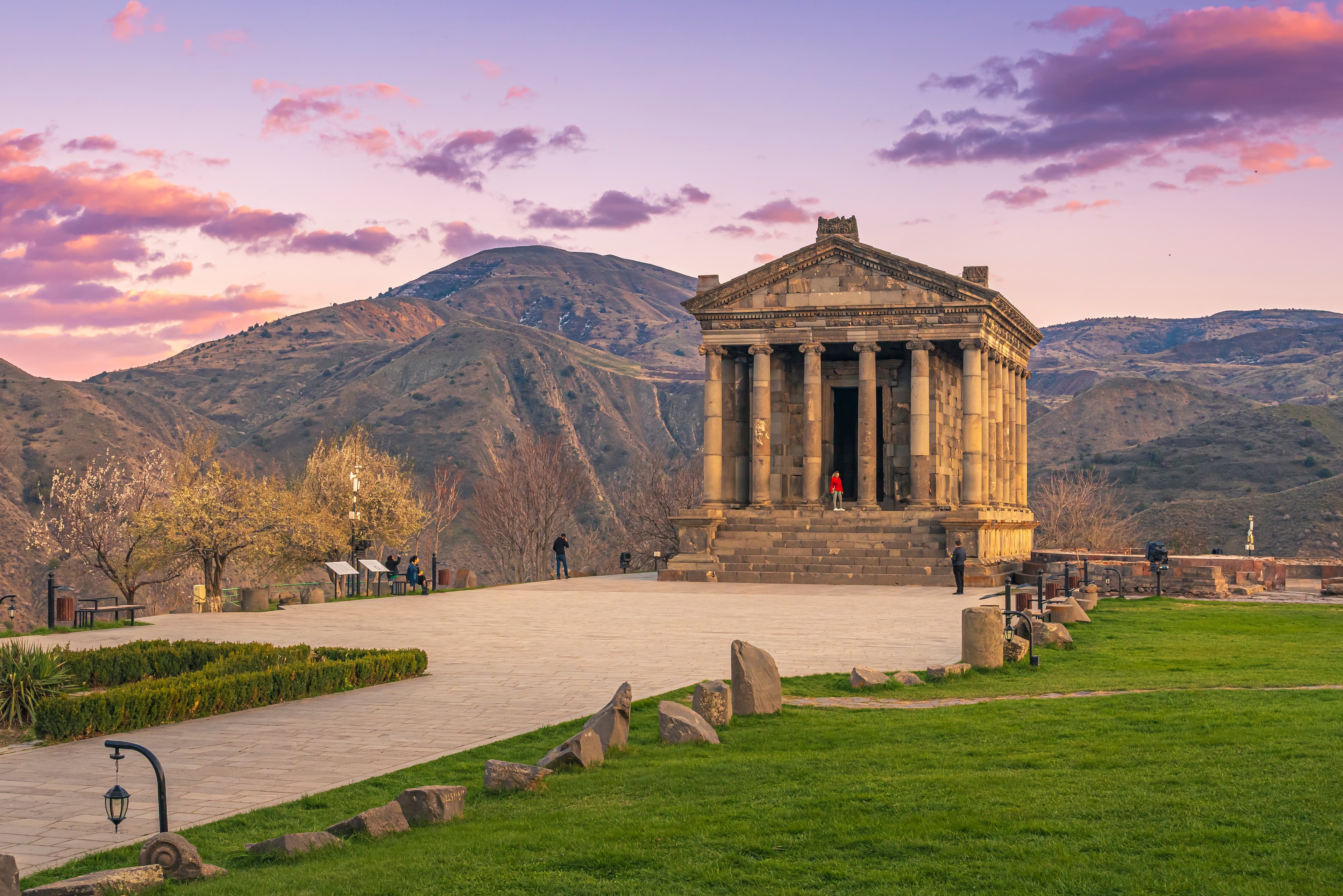
On a cliff above the Azat River gorge, twenty-four Ionic columns hold the only Greco-Roman pagan temple left standing in the Caucasus. Built for the sun god Mihr in the first century, spared from Christian destruction by a princess's plea, collapsed by earthquake, and reassembled from its own ruins, Garni embodies a survival that borders on the improbable. Armenian neopagans now gather here to tend a lineage that was nearly extinguished.
Garni Temple stands at the edge of a basalt cliff in Armenia's Kotayk Province, looking out over a gorge whose hexagonal stone columns echo the geometry of the temple's own construction. King Tiridates I built it around 70 CE, likely after his visit to Emperor Nero's Rome, and dedicated it to Mihr — the Armenian form of Mithra, god of light and the sun. For two centuries it served as a centre of worship within a broader pagan tradition that included fire rituals, astronomical symbolism, and a pantheon shaped by Zoroastrian influence.
When Armenia became the first Christian nation in 301 CE, King Tiridates III ordered the systematic destruction of every pagan shrine in the country. Gregory the Illuminator carried out the work. Garni alone survived, saved by the intervention of Princess Khosrovdoukht, the king's sister. The reasons for her intervention are not recorded. The temple stood for another thirteen centuries before a 1679 earthquake brought it down. Its fragments remained on the clifftop until Soviet-era archaeologists, led by Alexander Sarhinyan, reassembled the structure between 1969 and 1975 using the original stones — a process called anastylosis that gives the temple its particular quality of being simultaneously ancient and reconstructed.
Since the 1990s, a small community of Armenian neopagans has claimed Garni as their spiritual capital. On March 21 each year — the pagan New Year, coinciding with Nowruz — they gather to honour Vahagn, the god of fire, with ritual dances, apricot wood flames, and prayers in a language of devotion that was silenced for seventeen centuries.
Context and lineage
Built by King Tiridates I around 70 CE as a temple to the sun god Mihr, spared from destruction during Armenia's Christianization, collapsed in a 1679 earthquake, and reconstructed in 1969-1975 using original stones.
King Tiridates I of Armenia visited Rome around 66 CE, where Emperor Nero crowned him. The architectural influence of that encounter is visible in the temple's Greco-Roman design — unusual in the Armenian highlands. According to Roman historian Dio Cassius, Nero gave Tiridates artisans to help rebuild Artaxata, and the temple may reflect this Roman-Armenian cultural exchange. The dedication to Mihr places the temple within a Zoroastrian-influenced Armenian religion that preceded Christianity by centuries.
The site traces a discontinuous lineage from first-century Mihr worship through seventeen centuries of silence (as a ruin and then a reconstruction) to the Armenian neopagan revival of the 1990s. The gap is not concealed; it is the defining feature of the tradition's relationship to this place.
King Tiridates I
Builder of the temple, c. 70 CE, following his diplomatic visit to Rome
Princess Khosrovdoukht
Sister of King Tiridates III; her intercession saved the temple from Christian destruction in the early 4th century
Alexander Sarhinyan
Archaeologist who oversaw the temple's reconstruction (anastylosis) from 1969 to 1975
Why this place is sacred
Garni's thinness derives from survival against overwhelming odds. A pagan temple in the world's first Christian nation, destroyed by earthquake and rebuilt from its own rubble, it occupies a singular position between erasure and persistence.
The temple's power is not architectural grandeur — it is modest by Roman standards, a small peripteros with twenty-four columns on a basalt platform. What makes the space thin is the accumulated weight of what it has endured. Every other pagan temple in Armenia was demolished in the fourth century. This one was not, and nobody recorded why Khosrovdoukht's plea succeeded. That unexplained survival is the first layer of thinness — a gap in the historical record that feels less like an omission than a mystery.
The second layer is physical. When the 1679 earthquake brought the temple down, the stones did not scatter. They remained on the clifftop for nearly three centuries, waiting. The reconstruction was not a replica; it was a reassembly of original material, each column drum and carved frieze returned to its position. The temple today is both the original and not the original — a paradox that mirrors the relationship between the ancient religion and the neopagan practice that now inhabits the space.
The gorge below adds a geological dimension. The basalt columns lining the Azat River walls — known as the Symphony of Stones — are themselves columnar, as though the earth had been practising the temple's geometry for millions of years before human hands arrived.
The temple was built as a shrine to Mihr (Mithra), the sun god in Zoroastrian-influenced Armenian mythology. The 24 columns are traditionally said to represent the 24 hours of the day, encoding a cosmological meaning into the structure itself. The nine steps leading to the entrance are said to represent the nine social classes of ancient Armenia.
From active pagan temple to spared anomaly in a Christian landscape, to ruin after the 1679 earthquake, to reconstructed monument under Soviet archaeology, to the spiritual capital of Armenian neopaganism. Each phase has added meaning without erasing what came before.
Traditions and practice
Armenian neopagans hold annual ceremonies at the temple, particularly on March 21 (pagan New Year) and during the summer festival of Vardavar. The temple is otherwise a heritage site open for exploration.
The original rituals of Mihr worship are largely lost to history, erased along with the temples that housed them. What is known comes through fragments: fire played a central role, as did solar symbolism. The 24 columns encoding the hours of the day suggest a liturgical relationship with the passage of light.
Armenian neopagans celebrate March 21 — the birthday of Vahagn, the fire god, coinciding with Nowruz — with ceremonial dancing, ritual prayer, and the lighting of apricot wood fires. Vardavar, a summer festival with pre-Christian origins, also brings practitioners to the temple. Wish-ribbons are tied to nearby trees. Animal sacrifice, once part of the tradition, is now prohibited on site by law.
Visit on or near March 21 to witness the neopagan ceremonies. On ordinary days, walking through the temple and standing in the cella offers a quiet encounter with the space. The gorge overlook rewards extended contemplation.
Armenian neopaganism
ActiveGarni is the central shrine of the Armenian neopagan movement, which seeks to revive the pre-Christian religious traditions of Armenia. The temple's survival makes it the sole physical link to a worship tradition that was otherwise systematically dismantled in the fourth century.
Annual ceremonies on March 21 (pagan New Year/Vahagn's birthday) and during Vardavar. Ceremonial dancing, fire rituals with apricot wood, ritual prayer, and wish-ribbon offerings.
Ancient Armenian paganism (Mihr/Mithra worship)
HistoricalThe temple was dedicated to Mihr, the sun god in Zoroastrian-influenced Armenian mythology. The original worship tradition was part of a broader polytheistic system that included fire rituals, astronomical symbolism, and a divine pantheon with Indo-Iranian roots.
Specific ritual details are largely lost. Fire worship, solar observance, and offerings to Mihr are inferred from broader knowledge of the tradition.
Experience and perspectives
The approach from the village of Garni leads to a clifftop where a small Greco-Roman temple stands against a vast highland sky. The interior is accessible. The gorge below reveals basalt formations that mirror the temple's own columnar architecture.
The temple appears as you approach through the village — modest in scale, emphatic in presence. Twenty-four Ionic columns of grey basalt rise from a stepped platform at the cliff's edge. The proportions are harmonious without being imposing; this is a temple built for a hilltop, not a city forum. Walk up the nine steps and enter the cella. The space is small, enclosed, and quiet. Light enters through the doorway and reflects off stone walls that have absorbed and released seventeen centuries of weather, worship, earthquake, and reconstruction.
Outside, move to the cliff edge. The Azat River gorge opens below, its walls lined with hexagonal basalt columns — the Symphony of Stones — that stand like organ pipes in a cathedral whose ceiling is the sky. The correspondence between the temple's columns and the gorge's columns is not designed but is impossible to ignore. It suggests a conversation between human architecture and geological process that neither party initiated.
On March 21, the atmosphere changes. Armenian neopagans arrive in ceremonial dress. Fires are lit with apricot wood. Dances circle the temple. Prayers addressed to Vahagn, the fire god, fill a space that has not heard them continuously for seventeen hundred years. The ceremonies are not theatrical; they are earnest, and the practitioners are few. The smallness of the community gives the rituals an intimacy that larger gatherings would not possess.
Begin with the temple itself — enter the cella and stand where worshippers of Mihr once stood. Then walk to the gorge overlook to see the Symphony of Stones below. If visiting near March 21, allow time to observe the neopagan ceremonies from a respectful distance. The combination of temple, gorge, and living ritual creates a sequence that moves from stone to landscape to human devotion.
Garni Temple invites reading as an architectural anomaly, a survivor of religious revolution, a Soviet-era reconstruction, and a living shrine for a revived tradition.
Architectural historians classify Garni as a Greco-Roman peripteros temple, the only such structure surviving in the former Soviet Union. Its Ionic order and decorative programme show Roman influence consistent with Tiridates I's contact with Nero's court. A minority scholarly position argues the structure was a royal tomb rather than a temple, citing parallels with Roman funerary architecture. The 1969-1975 anastylosis reconstruction is studied as an example of Soviet archaeological restoration methodology.
For Armenian neopagans, Garni is not a monument but a living temple — the physical anchor of a spiritual tradition that was suppressed but not extinguished. The ceremonies held here are understood as a restoration of ancestral practice, albeit with acknowledged gaps in the chain of transmission. The fire rituals, dances, and invocations to Vahagn are sincere acts of worship, not re-enactment.
The temple's survival — unique among hundreds of destroyed pagan sites — has generated speculation about an inherent sacredness or power that transcended the Christian destruction campaign. The numerical symbolism of 24 columns (hours) and 9 steps (social classes) has attracted numerological interest. The geological correspondence between the temple's columns and the gorge's basalt formations has been read as evidence of deliberate site selection based on landscape resonance.
Why did Khosrovdoukht's plea succeed when every other temple was destroyed? Was the structure truly a temple, or might it have served another function that justified its preservation? The answers are not recorded, and the silence around them is part of what gives the site its particular gravity.
Visit planning
Garni is located 30 km east of Yerevan in Kotayk Province, easily combined with a visit to Geghard Monastery. The temple sits at 1,400 m elevation above the Azat River gorge.
Located in Garni village, Kotayk Province, approximately 30 km east of Yerevan (40 minutes by car). Marshrutkas run from Yerevan. Standard entrance fee applies. The site is at 1,400 m elevation.
Limited in Garni village. Most visitors base in Yerevan and combine the temple with Geghard Monastery as a half-day trip.
The temple is an open heritage site with few formal restrictions. During neopagan ceremonies, observers should maintain respectful distance.
Garni is primarily experienced as a historical monument, and most visitors engage with it as such. The site charges a standard entrance fee and is well-maintained. During neopagan ceremonies, the dynamic shifts. The practitioners are few in number and their tradition was interrupted for seventeen centuries; approaching their rituals with curiosity and respect, rather than as spectacle, matters.
No specific dress code. Comfortable footwear for walking on stone and uneven ground near the cliff edge.
Photography is permitted throughout the site. During neopagan ceremonies, ask before photographing practitioners.
Visitors sometimes tie wish-ribbons to trees near the temple, following neopagan custom.
Do not climb on the temple structure | Stay behind barriers at the cliff edge | Observe neopagan ceremonies from a respectful distance unless invited closer | Animal sacrifice is prohibited on site by law
Nearby sacred places
Sacred places within a half-day’s reach. Pilgrims often visit them together: walk one, stay for the other.