Fugoppe Cave
One of Japan's only petroglyph caves, 2,000-year-old winged figures whose makers vanished
Yoichi, Hokkaidō, Japan
At A Glance
- Coordinates
- 43.1945, 140.8383
- Suggested Duration
- 30 minutes to 1 hour for the cave viewing and small museum. The site can be combined with a visit to Yoichi's other attractions, including the Nikka Whisky distillery.
- Access
- Located in Yoichi Town, Hokkaido. Train to Yoichi Station on the JR Hakodate Line from Otaru. From Yoichi Station, the cave is accessible by taxi (short ride) or on foot. The cave is on the slope of Maruyama hill in the Sakae-cho neighborhood, facing the Sea of Japan coast.
Pilgrim Tips
- Located in Yoichi Town, Hokkaido. Train to Yoichi Station on the JR Hakodate Line from Otaru. From Yoichi Station, the cave is accessible by taxi (short ride) or on foot. The cave is on the slope of Maruyama hill in the Sakae-cho neighborhood, facing the Sea of Japan coast.
- No specific dress code. Dress appropriately for the weather and for visiting a museum facility.
- Strictly forbidden inside the cave viewing facility. This rule is non-negotiable. Photography may be permitted in the museum area; check with staff.
- Photography is strictly forbidden inside the viewing facility. This rule is enforced for conservation purposes and must be respected. Violation can result in removal from the site.
Overview
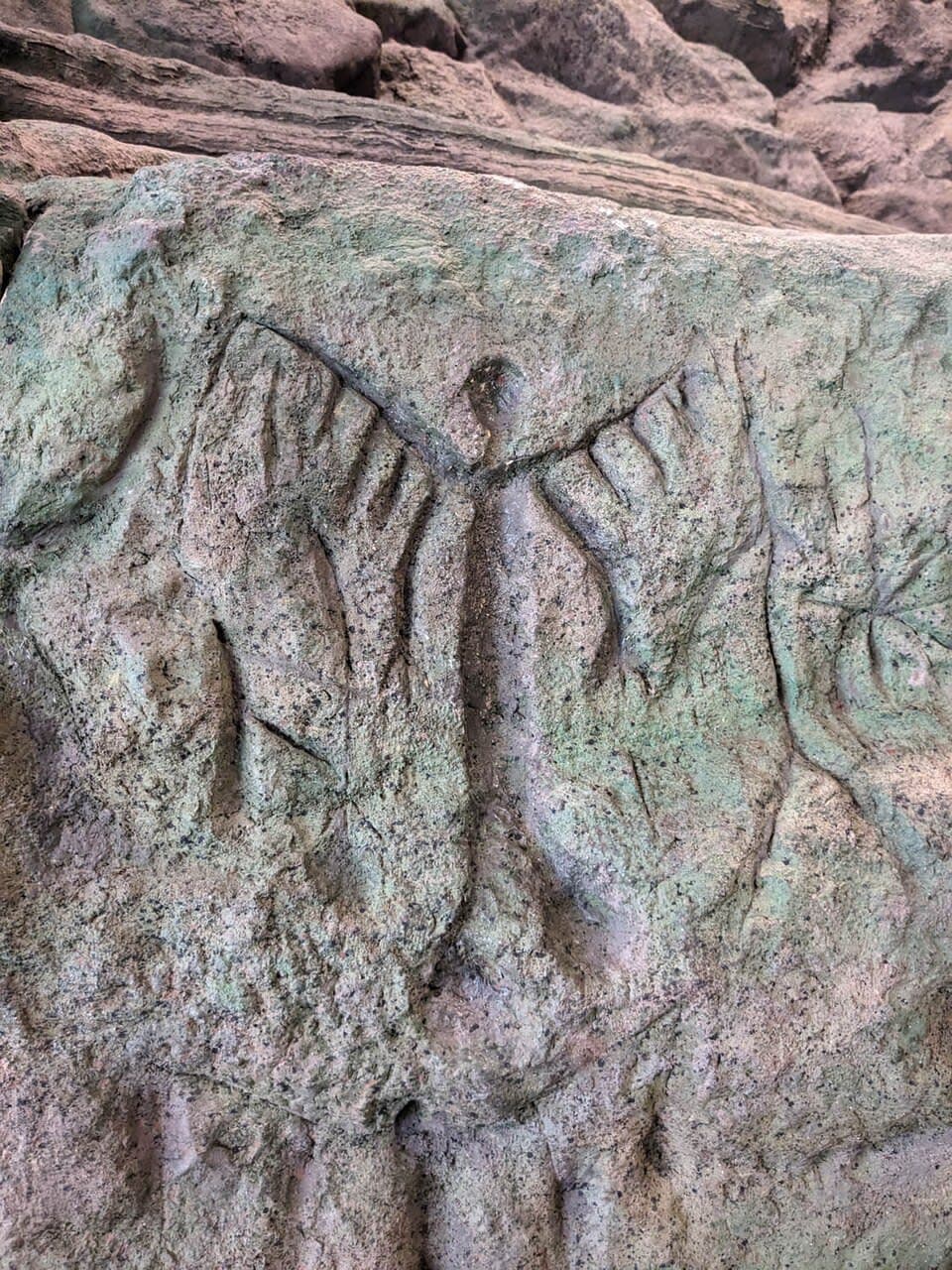
Carved into the walls of a small sea-facing cave near Yoichi, approximately 800 petroglyphs have puzzled scholars since their discovery in 1950. The images—human figures with wings or horns, boats, fish, marine creatures—date to roughly 2,000 years ago, created by a people whose identity remains unknown. The 'winged man' figures have become iconic in Hokkaido. This is one of only two petroglyph caves in all of Japan, preserving evidence of a spiritual tradition that appeared briefly and then vanished.
In 1950, two brothers went searching for engravings they had heard about in local stories—tales of ancient texts carved on cave walls. What they found in a small cave on the slope of Maruyama hill, facing the Sea of Japan, would become one of Japan's greatest archaeological mysteries. Approximately 800 petroglyphs cover the cave's interior, depicting figures that belong to no known tradition: humans with wings or horns, boats with passengers, fish and marine animals, geometric patterns whose meanings are lost.
The carvings date to the Zoku-Jomon (also called Epi-Jomon) period, roughly 2,000 years ago—around the 1st century CE. But who made them? The people responsible did not remain on Hokkaido long enough to leave other traces of their presence. Stylistic similarities to rock art in the Amur River region of mainland Asia suggest a seafaring culture that arrived on these shores, created these images for purposes we cannot reconstruct, and then departed or disappeared. The tradition that produced the Fugoppe petroglyphs did not continue.
The 'winged man' figures have become the site's iconic image, reproduced throughout Hokkaido popular culture. These strange beings—humans transformed by wings or horns into something more than human—suggest shamanic themes, journeys between worlds, transformations of identity. Divination bones found in the cave's archaeological layer confirm spiritual use. But the specific beliefs that animated these images are not recoverable.
Fugoppe is one of only two petroglyph caves in Japan, the other being nearby Temiya Cave in Otaru. This rarity makes it irreplaceable. The cave has been preserved since 1972 within a climate-controlled capsule facility that allows viewing while protecting the fragile stone from deterioration. Photography is forbidden inside—you must encounter these images with your own eyes, in the presence of mystery that no reproduction can capture.
The experience of Fugoppe is the experience of unknowing. We can observe what the cave's creators did; we cannot understand what they believed. This gap between evidence and interpretation is not a failure but an invitation—to stand before genuine mystery, to acknowledge the limits of human knowledge, to recognize that some sacred traditions have passed beyond recovery.
Context And Lineage
Fugoppe Cave's petroglyphs date to approximately the 1st century CE, during the Zoku-Jomon (Epi-Jomon) period. The creators' identity remains unknown, but stylistic similarities to Amur River rock art suggest a seafaring culture with connections to mainland Asia. The tradition that produced these images did not continue on Hokkaido.
The petroglyphs' creation is not recorded in any known tradition. No oral history, no written account, no continuous practice connects to the images on these cave walls. What we know comes from the archaeological evidence: the style of the carvings, the dating of associated deposits, the comparative analysis with rock art traditions elsewhere.
The discovery, by contrast, is documented. In 1950, two brothers went searching for legendary engravings described in local stories—tales of 'ancient texts' carved on cave walls. These stories suggest that some memory of the petroglyphs persisted in folk tradition, though without understanding of their origin or meaning. When the brothers found the cave, they found not ancient texts but images: winged figures, boats, marine creatures.
Some researchers connect the petroglyphs to the 'Hokkaido Characters' discovered in 1886—inscriptions that some interpreted as an ancient writing system. This interpretation is disputed. More likely, the local stories of 'ancient texts' represent misremembering of the pictorial images as writing.
Fugoppe Cave stands isolated in Japanese archaeological context—one of only two petroglyph caves in the entire country, the other being Temiya Cave in nearby Otaru. No local tradition connects to the cave's imagery. The Ainu people, indigenous to Hokkaido, do not maintain practices or beliefs that explain the petroglyphs, suggesting the images predate or are distinct from Ainu culture.
The strongest connection leads not to other Japanese sites but to the Asian mainland. Stylistic similarities to rock art in the Amur River region—the great river that forms part of the Russia-China border before emptying into the Sea of Okhotsk—suggest that the Fugoppe carvers came from or were connected to that cultural sphere. This connection implies a seafaring people who crossed to Hokkaido, bringing their spiritual traditions with them.
But this connection, however suggestive, does not fully explain the Fugoppe petroglyphs. The people who made them did not remain on Hokkaido in identifiable form. Their tradition appeared, flourished briefly in this cave and perhaps at Temiya, and then vanished. No descendants carry their beliefs forward.
Why This Place Is Sacred
The thinness of Fugoppe lies in encountering what cannot be understood. The petroglyphs are visible, tangible, undeniably present—yet the tradition that created them has vanished without trace. This is not the thinness of a continuing sacred tradition but of a mystery that refuses resolution.
Stand before the petroglyphs at Fugoppe and you face a particular kind of thinness—not the thinness between present and accessible past, but between present and irrecoverable past. The images are here: winged figures, boats, marine creatures, geometric forms. But the people who carved them, the beliefs that motivated them, the purposes they served—these have crossed a threshold from which there is no return.
The 'winged man' figures concentrate this mystery. These are not realistic depictions of humans but transformed beings: humans with wings, humans with horns, humans becoming something other. Such imagery, across many cultures, suggests shamanic practice—the spiritual specialist who travels between worlds, who takes on animal or supernatural attributes, who serves as intermediary between the human community and powers beyond it. But this suggestion is inference, not knowledge. We do not know what the Fugoppe figures meant to those who carved them.
The abrasion technique used to create the petroglyphs adds to the puzzle. This method—wearing away the rock surface rather than incising lines—is unusual for Northeast Asian rock art, making it difficult to connect Fugoppe to known traditions. The carvers used techniques that set them apart, suggesting cultural origins that the archaeological record has not preserved.
Similarities to Amur River rock art provide the strongest thread connecting Fugoppe to a broader context. The style, the subjects, the techniques find parallels in sites along that great river of the Asian mainland. This connection suggests a seafaring people who crossed to Hokkaido, bringing their spiritual traditions with them. But they did not stay. Whatever community carved these images did not establish permanent presence on Hokkaido. They came, they created, they departed or disappeared.
The cave itself is small—roughly 5 meters wide and 6 meters deep. The dense coverage of this limited space with sacred imagery creates an intense, enclosed atmosphere. Every surface spoke. The cave was not merely decorated but saturated with meaning, transformed from geological formation to sacred space.
Divination bones found in the archaeological layer beneath the petroglyphs confirm ritual use. The practice of reading the future in burned bone is attested across many cultures; its presence at Fugoppe indicates that the cave served purposes beyond image-making. This was a place of practice, of seeking knowledge beyond ordinary perception.
That photography is forbidden inside the viewing facility creates a particular quality of encounter. You cannot capture and carry away the images; you must be present with them. This restriction, imposed for conservation purposes, has the effect of returning the visitor to direct experience. The petroglyphs must be seen, not recorded.
Fugoppe Cave served as a sacred space for a people whose identity remains unknown, probably around the 1st century CE. The approximately 800 petroglyphs—human figures with wings or horns, boats, marine creatures—suggest shamanic or religious purposes related to transformation, seafaring, and the relationship between humans and the animal/supernatural world. Divination bones found in the cave confirm ritual practice. The dense coverage of the small cave with sacred imagery indicates intensive spiritual use. The specific beliefs and rituals are not recoverable.
The petroglyphs were created approximately 2,000 years ago, during what is called the Zoku-Jomon or Epi-Jomon period—a transitional era after the long Jomon period but before the later cultures that would dominate Hokkaido.
The tradition that created the petroglyphs did not persist. No later peoples on Hokkaido—including the Ainu—maintain traditions that explain or connect to the cave's imagery. Whatever community carved these figures departed, died out, or was absorbed into other populations without transmitting their beliefs.
The cave passed into local memory, with stories circulating about 'ancient texts' carved on its walls. These stories prompted the 1950 discovery by two brothers seeking the legendary engravings.
In 1953, Fugoppe Cave was designated a National Historic Site, recognizing its exceptional importance as one of only two petroglyph caves in Japan.
In 1972, a preservation facility was constructed to protect the petroglyphs. The cave is now enclosed in a climate-controlled capsule that allows viewing while preventing deterioration from exposure. This approach has preserved the carvings but altered the experience—visitors view the cave through glass rather than entering the space directly.
Traditions And Practice
No active religious practices occur at Fugoppe Cave. The site is managed for preservation and education. The tradition that created the petroglyphs did not continue; no modern practice connects to the images.
The petroglyphs themselves represent spiritual practice: the creation of sacred images in a consecrated space. The winged or horned human figures suggest shamanic themes—transformation, journeying between worlds, becoming something more than ordinary human. Such themes appear across many cultures but take specific forms in specific traditions; the Fugoppe forms are not recoverable.
Divination bones found in the cave indicate the practice of burning animal bones and reading the cracks that appeared—a method of seeking knowledge beyond ordinary perception attested in many cultures. This practice confirms the cave's use for ritual purposes.
The boats depicted in the petroglyphs may represent physical vessels used by a seafaring people, or they may carry symbolic meaning—journeys of the dead, voyages to other worlds. The dense population of the small cave with sacred imagery indicates intensive ritual use over some period of time.
No active religious practices occur at Fugoppe today. The cave is managed for preservation and education. The tradition that created the petroglyphs did not continue on Hokkaido; no modern community maintains connection to the images.
The small museum provides educational context, explaining what is known and acknowledging what is not known about the petroglyphs. Scholarly research continues, though the fundamental mystery—who made these images and why—remains unresolved.
Approach Fugoppe as encounter with genuine mystery. The petroglyphs are undeniably present, undeniably the product of human intention and sacred purpose. But the beliefs that animated them have passed beyond recovery. Let this unknowing inform your experience.
Take time before the preservation facility glass. The images are small and dense; details reveal themselves slowly. Look for the 'winged man' figures that have become iconic. Notice the boats, the marine creatures, the geometric forms. Let your eye move across the surfaces, observing what the cave's creators considered worth recording.
Reflect on the limits of knowledge. We can observe what these people did; we cannot know what they thought. This gap is not a failure of archaeology but a condition of facing the deep past. Some things are lost.
The prohibition on photography forces presence. You cannot defer this encounter; you must have it now, with your own eyes. Let this restriction become a gift.
Zoku-Jomon (Epi-Jomon) Spirituality
HistoricalFugoppe Cave contains approximately 800 petroglyphs dating to the Zoku-Jomon period, roughly 2,000 years ago. These carvings—depicting human figures with wings or horns, boats, fish, and marine animals—represent shamanic or religious imagery whose full meaning remains unknown. The 'winged man' figures have become iconic, appearing throughout Hokkaido popular culture. The petroglyphs were created using techniques unusual for Northeast Asian rock art, suggesting the carvers came from a distinct cultural tradition. Similarities to Amur River rock art imply connections to continental cultures, possibly indicating a seafaring society that arrived on Hokkaido but did not remain long. Divination bones and ritual objects in the cave's archaeological layer indicate sustained spiritual use. Fugoppe is one of only two petroglyph caves in Japan, making it irreplaceable for understanding this enigmatic tradition.
The creation of petroglyphs was itself a form of spiritual practice, transforming the cave from geological formation to sacred space. Divination using burned animal bones indicates the practice of seeking knowledge beyond ordinary perception. The winged or horned human figures suggest shamanic themes—transformation, journeying between worlds, becoming something more than ordinary human. Boats and marine animals indicate a seafaring culture whose spiritual life was tied to the sea.
Experience And Perspectives
Visitors view the petroglyphs through a climate-controlled preservation facility that protects the fragile carvings. Photography is prohibited inside, requiring direct encounter with the images. A small museum provides context, though the fundamental mystery of the carvings—who made them and why—remains unresolved.
The experience of Fugoppe begins with the approach: a small cave on the slope of Maruyama hill, in the town of Yoichi, facing toward the Sea of Japan. The location speaks to the seafaring culture that likely created the petroglyphs—people whose lives were oriented toward the water, whose sacred imagery included boats and marine creatures.
The preservation facility, built in 1972, encloses the cave in a climate-controlled capsule. This approach has preserved carvings that might otherwise have deteriorated but has also changed the nature of the encounter. You view the petroglyphs through glass, not by entering the cave directly. The intimacy of the original space—5 meters wide, 6 meters deep—is mediated by modern intervention.
Once inside the viewing area, the petroglyphs reveal themselves. Approximately 800 individual images cover the cave walls: human figures with wings or horns, boats carrying passengers, fish and marine animals, geometric forms whose meanings are lost. The 'winged man' figures are immediately striking—beings that are human but also more than human, transformed or transforming.
Photography is strictly forbidden. This prohibition, imposed for conservation, has an unexpected effect: it returns you to direct seeing. You cannot defer the encounter to a camera, cannot promise yourself you'll look at the images later. You must be present now, with your own eyes, in the mystery of what you're viewing.
The small museum provides context: the discovery story, the dating evidence, the scholarly theories about Amur River connections. But the museum cannot provide what does not exist—explanation of what the images meant to those who carved them. You leave knowing more about the mystery but not having solved it.
For visitors interested in rock art, shamanism, or the limits of archaeological interpretation, Fugoppe offers profound encounter with genuine unknowing. These are not images whose meaning has been recovered; they are images whose meaning has been irretrievably lost. Standing before them, you stand before the boundary of human knowledge.
Fugoppe Cave is located in Yoichi Town, Hokkaido. From Yoichi Station (JR Hakodate Line from Otaru), the cave is accessible by taxi or walk. The preservation facility is open 9:00-16:30, closed Mondays. Begin with the small museum to understand the site's context and discovery. Then proceed to the viewing area where the petroglyphs are visible through the preservation facility. Remember that photography is forbidden inside. Allow 30 minutes to 1 hour for the complete visit.
Fugoppe Cave presents interpreters with a fundamental challenge: the tradition that created the petroglyphs did not continue. No written records, no oral traditions, no continuous practices explain what the images meant to those who carved them. Scholarly interpretation can identify patterns and suggest comparisons, but the specific beliefs and rituals remain beyond recovery.
Archaeologists date the Fugoppe petroglyphs to the Zoku-Jomon (Epi-Jomon) period, approximately the 1st century CE. This transitional era saw changes in Hokkaido's population and culture, with new influences arriving from various directions.
The unusual abrasion technique used to create the carvings—wearing away the rock surface rather than incising lines—distinguishes Fugoppe from most Northeast Asian rock art and complicates dating and cultural attribution. Conventional methods of dating petroglyphs are difficult to apply.
Stylistic similarities to rock art in the Amur River region suggest connections to continental cultures. The Fugoppe carvers may have been a seafaring people with origins or connections in that distant river valley. This interpretation remains provisional; the evidence does not permit certainty.
The 'winged man' figures have attracted particular attention. Such imagery—humans with supernatural attributes—appears across many cultures in shamanic contexts. The Fugoppe figures likely represent spiritual beings or humans in transformed states, but the specific meanings are not recoverable.
Divination bones in the archaeological layer confirm ritual use of the cave. The practice of reading burned bones for omens is widely attested; its presence at Fugoppe indicates the cave served purposes beyond image-making.
No continuous tradition connects to the Fugoppe petroglyphs. The Ainu people, indigenous to Hokkaido, do not maintain beliefs or practices that explain the cave's imagery. This absence suggests the petroglyphs predate or are culturally distinct from Ainu tradition.
Local folk memory preserved stories of 'ancient texts engraved on cave walls,' which prompted the 1950 discovery. But these stories do not constitute explanation of the petroglyphs—rather, they represent the persistence of awareness that something significant lay in the cave, without understanding of what it was.
Some researchers interpret the Fugoppe carvings as an ancient writing system—the 'Hokkaido Characters' theory. This interpretation proposes that the images are not pictorial art but a form of proto-writing. Most scholars reject this view, seeing the carvings as clearly pictorial rather than script-like. However, the debate reflects uncertainty about how to categorize images that fit no established tradition.
The 'winged man' figures attract those interested in shamanism across cultures. Comparative study of transformation imagery—humans becoming birds, spirits, or supernatural beings—provides context for understanding what the Fugoppe figures might represent, even if their specific meaning remains unknown.
The identity of the people who created the Fugoppe petroglyphs remains unknown. They arrived on Hokkaido, created these images, and departed or disappeared without leaving other identifiable traces.
The specific meanings of the figures are debated. The 'winged man' images suggest transformation or supernatural beings, but this suggestion is inference from cross-cultural comparison, not recovery of the carvers' beliefs.
Why this tradition appeared briefly and then vanished is not understood. The seafaring culture that created the petroglyphs did not establish permanent presence on Hokkaido. Where they came from, where they went, what happened to them—these questions have no answers.
The relationship between Fugoppe and Temiya Cave—Japan's only two petroglyph caves—is not fully understood. Were they created by the same people? Were they contemporary or separated in time? Did they serve similar purposes? The evidence does not decide these questions.
Visit Planning
Fugoppe Cave is located in Yoichi Town, Hokkaido. Access by train to Yoichi Station (JR Hakodate Line from Otaru), then taxi or walk. Open 9:00-16:30, closed Mondays. Admission approximately 300 yen.
Located in Yoichi Town, Hokkaido. Train to Yoichi Station on the JR Hakodate Line from Otaru. From Yoichi Station, the cave is accessible by taxi (short ride) or on foot. The cave is on the slope of Maruyama hill in the Sakae-cho neighborhood, facing the Sea of Japan coast.
Accommodations available in Yoichi and in nearby Otaru. Otaru offers a wider range of options, from budget to upscale, and is a popular tourist destination in its own right with canal scenery and historic buildings.
Respect the site's archaeological significance and conservation requirements. Photography is forbidden inside the viewing facility. Follow all facility guidelines.
Fugoppe Cave contains irreplaceable petroglyphs that have survived approximately 2,000 years. The preservation facility exists to protect these fragile images for future generations. Respect this purpose.
Photography is strictly forbidden inside the viewing facility. This rule exists because flash and even ambient light from camera equipment can contribute to deterioration. The prohibition may feel restrictive, but it serves the images' survival. Encounter them directly, without the mediation of recording devices.
Follow all guidelines established by facility staff. Do not touch the glass. Do not attempt to access the cave itself. The climate-controlled environment requires careful management.
The small museum allows photography unless otherwise posted. Check with staff if uncertain.
No specific dress code. Dress appropriately for the weather and for visiting a museum facility.
Strictly forbidden inside the cave viewing facility. This rule is non-negotiable. Photography may be permitted in the museum area; check with staff.
Not applicable. This is an archaeological site, not an active place of worship.
Photography forbidden inside the viewing facility. Follow all posted guidelines. Do not attempt to access the cave directly.
Sacred Cluster
Nearby sacred places create the location cluster described in the growth plan. This block is intentionally crawlable and links into the wider regional graph.