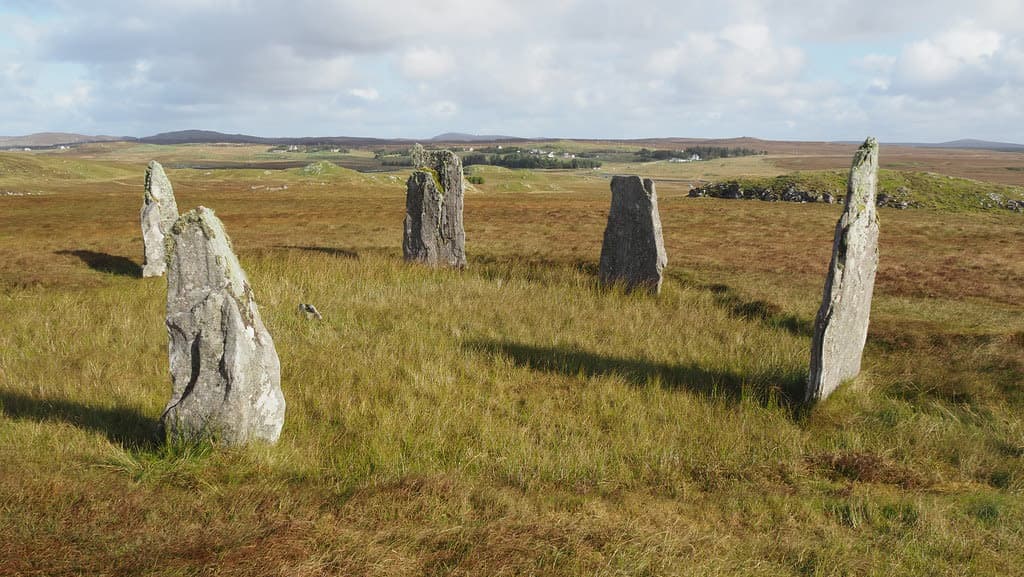
Callanish 4 Stone Circle
A small oval of ancient gneiss on a Lewis hilltop, holding silence where the Callanish landscape opens wide
Callanish, Alba / Scotland
At A Glance
- Coordinates
- 58.1753, -6.7134
- Suggested Duration
- 45 minutes
Pilgrim Tips
- No specific requirements beyond the practical. The Isle of Lewis has a maritime subarctic climate with frequent rain, wind, and rapidly changing conditions. Waterproof outer layers, warm clothing, and sturdy waterproof footwear are essential. The approach crosses marshy bogland where ankle-deep water is common. Walking boots or wellies are strongly recommended.
- Photography is freely permitted. The stones photograph well against the Lewis sky, particularly in morning and evening light when the banding patterns of the Lewisian gneiss become more visible. The low angle of winter sun on Lewis can be especially revealing of the stones' surface textures.
- The approach crosses marshy bogland that can be waterlogged and difficult to navigate. Waterproof boots are essential. The terrain is uneven and there is no shelter at the site. Weather on Lewis can change rapidly. There are no facilities, no interpretive signage, and no mobile phone signal in some conditions. Visit with awareness of the conditions and your own capabilities.
Overview
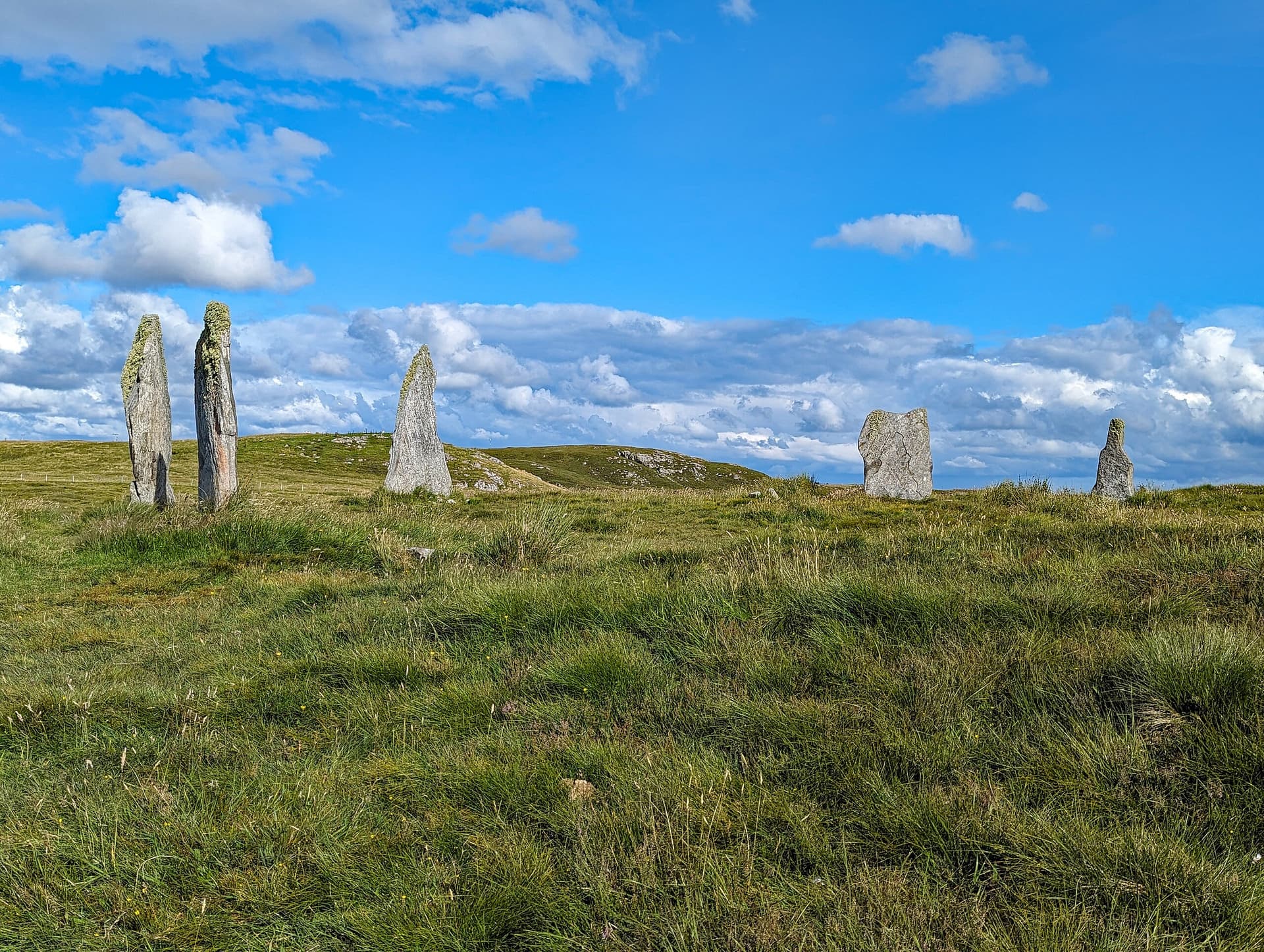
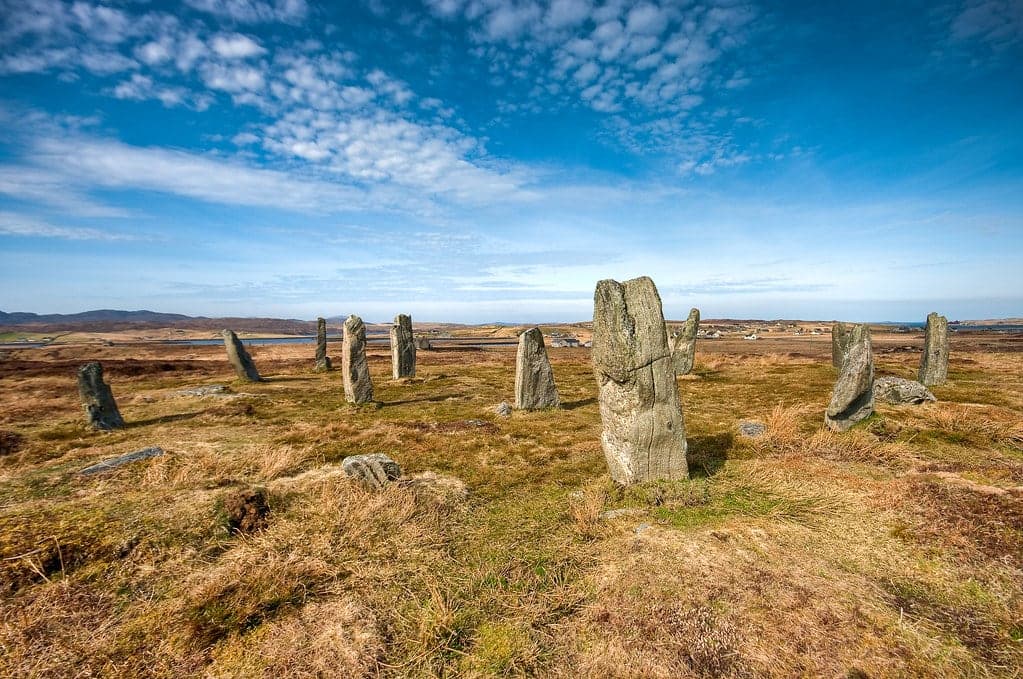
On rising ground above Loch Ceann Hulabhig, five standing stones of Lewisian gneiss form a quiet oval around a small burial cairn. This is Callanish 4, one of at least eleven stone circles in the Callanish ceremonial landscape of the Isle of Lewis. Smaller and far less visited than its famous neighbour, it offers something the main site cannot: solitude with stones that are three billion years old, on ground that has been sacred for five thousand.
The walk from the road takes only a few minutes, but the ground changes everything. You leave the tarmac of the B8011, pass through a swing gate, and cross a stretch of marshy bogland that resists easy passage. The boardwalk helps, but the land itself is telling you something: this place was not meant to be casually reached. When you arrive, five upright stones of Lewisian gneiss stand in an oval roughly thirteen metres long and nine metres wide, enclosing a small central cairn of loose stone perhaps two metres across.
This is Ceann Hulavig, known to archaeologists as Callanish IV. It belongs to a constellation of Neolithic and Bronze Age monuments scattered across the western Lewis landscape, anchored by the great cruciform circle of Callanish I some two miles to the northwest. Where that site draws tens of thousands of visitors each year, this satellite circle receives a handful. The stones here are modest in height, the setting intimate rather than grand. But the gneiss they are made from is among the oldest rock on Earth, formed roughly three billion years ago in conditions that preceded complex life by aeons.
The central cairn speaks of death and remembrance. Someone was interred here, within the embrace of the standing stones, during the Bronze Age. The cairn has never been excavated. What lies beneath remains unknown, held in trust by the peat and stone. The circle sits on a natural plateau that offers views across the loch toward the ridge where the main Callanish stones stand. This intervisibility was almost certainly deliberate. The builders placed their monuments where they could see one another, creating a web of sacred sightlines across the landscape.
Context And Lineage
One of at least eleven stone circles in the Callanish ceremonial landscape of the Isle of Lewis, constructed during the Late Neolithic and modified in the Bronze Age with the addition of a central burial cairn.
Sometime between 3000 and 2500 BC, a community on the western coast of Lewis selected this elevated plateau above Loch Ceann Hulabhig as the site for a stone circle. They sourced slabs of Lewisian gneiss, the ancient metamorphic rock that forms the bedrock of the island, and erected them in an oval arrangement. The effort was communal. Even modest standing stones require coordinated labour to quarry, transport, and raise, and the choice of this particular location, with its views toward other monuments in the Callanish landscape, suggests deliberate planning within a wider ceremonial programme.
The builders were part of a tradition of megalithic construction that spanned Atlantic Europe during the Neolithic period. From the passage tombs of Ireland to the stone rows of Brittany to the circles of Orkney and Lewis, communities across the western seaboard were raising stone monuments to mark sacred ground, track celestial movements, and honour the dead. The Callanish complex, with its concentration of at least eleven circles and nine standing stones within a few kilometres, represents one of the densest clusters of such monuments anywhere in Europe.
The central cairn came later, probably during the Early Bronze Age, between 2500 and 1500 BC. This pattern of inserting burial cairns within existing stone circles is found throughout the Callanish complex and across Scotland more broadly. It suggests a shift in the circle's function, or an expansion of it: what had been a place of communal gathering and ceremony now also became a place where the dead were laid among the stones. The cairn has never been excavated. Its contents, the identity and manner of burial of whoever lies within, remain unknown.
Callanish 4 belongs to the Atlantic European megalithic tradition, a widespread cultural phenomenon spanning the 4th and 3rd millennia BC. Its closest relatives are the other circles of the Callanish complex: the great cruciform circle and avenue of Callanish I, the smaller circles of Callanish II (Cnoc Ceann a'Gharaidh) and Callanish III (Cnoc Filibhir Bheag), and the numerous other settings and standing stones scattered across the western Lewis landscape. Beyond Lewis, the tradition connects to the stone circles and henges of Orkney, the recumbent stone circles of northeast Scotland, the stone rows and circles of Dartmoor and Cornwall, the megalithic alignments of Carnac in Brittany, and the passage tombs of the Boyne Valley in Ireland. What these diverse monuments share is a commitment to shaping the landscape with stone, to creating permanent markers of sacred intention in a world otherwise made of perishable materials.
Royal Commission on the Ancient and Historical Monuments of Scotland (RCAHMS)
Martin Martin
Why This Place Is Sacred
A small circle on boggy high ground, held between water and sky, where the intimacy of five ancient stones creates an enclosure that the great Callanish site cannot replicate.
The thinness of Callanish 4 arises from its scale and its solitude. The main Callanish circle overwhelms through its cruciform geometry, its avenue of tall stones, its sheer architectural ambition. Callanish 4 operates differently. Five stones standing in a rough oval, waist-high to shoulder-high, enclosing a space you could cross in a few strides. This is not a cathedral. It is a chapel. And in that intimacy lies its particular quality of encounter.
The setting amplifies this. The circle occupies an elevated plateau above Loch Ceann Hulabhig, a tidal inlet that separates this southern ground from the main Callanish ridge to the northwest. Water surrounds and defines the approach. The marshy terrain that makes the walk from the road effortful also creates a sense of threshold: the ordinary ground of the roadside gives way to uncertain, saturated peat, and then to the firmer ground where the stones stand. You arrive through a kind of passage, from the dry to the wet to the dry again, and this physical transition mirrors an older logic of sacred approach.
The Lewisian gneiss of the stones carries its own weight of time. Three billion years. The stone existed for most of the history of the planet before anyone shaped it into a monument. To touch it is to place your hand on material that predates the oxygenation of the atmosphere, the emergence of multicellular life, the formation of most of the continents. The Neolithic builders who erected these stones five thousand years ago were themselves latecomers to the rock's story.
Then there is the cairn at the centre. Unexcavated, undisturbed, it holds whatever was placed within it during the Bronze Age. This is a genuine unknown: the contents of the cairn, the identity of whoever was interred, the specific ceremonies that accompanied the burial. The not-knowing is itself a form of thinness. The site holds a secret it has kept for four thousand years.
The stone circle was constructed during the Late Neolithic period, likely between 3000 and 2500 BC, as part of the broader Callanish ceremonial landscape. Its precise function is unknown, but the oval arrangement of standing stones suggests communal ritual use, possibly including astronomical observation, seasonal gatherings, and ceremonies linking the community to the wider network of Callanish monuments. The central burial cairn was likely added during the Early Bronze Age, transforming the circle into a place of funerary commemoration and ancestor veneration.
The site was actively used from the Late Neolithic through the mid-Bronze Age, after which it fell out of ritual use. Over the following millennia, peat accumulated around and within the circle, partially burying the lower portions of the stones and obscuring the monument from casual view. At least one stone fell or was toppled at some point. The Royal Commission on the Ancient and Historical Monuments of Scotland first surveyed the site in 1914, with subsequent surveys in the 1970s and 2009. No archaeological excavation has ever been conducted. The site was designated a Scheduled Ancient Monument (SM5457) on 1 December 1992 and is now protected under Scottish law. A boardwalk and swing gate have been installed to provide visitor access from the B8011 road.
Traditions And Practice
Cross the bogland slowly. Enter the oval. Sit with the stones and the unexcavated cairn. Let the silence of this rarely visited circle do its work.
No specific rituals are documented for Callanish 4 itself. The presence of the central burial cairn indicates funerary ceremonies were conducted within the circle during the Bronze Age. By analogy with the broader Callanish complex and other British Neolithic stone circles, practices likely included communal gatherings for astronomical observation, ceremonial processions between the interconnected monuments of the Callanish landscape, funerary rites involving interment within the sacred circle, and seasonal observances marking solstices, equinoxes, or the 18.61-year lunar standstill cycle. The Gaelic tradition of 'Fir Bhreige' (false men or giants turned to stone) suggests that later communities understood the stones as transformed beings, which may have informed folk practices around the monuments.
No organised ceremonial practices take place at the site. Individual visitors and small groups occasionally visit for meditation, quiet reflection, and personal spiritual practice. The broader Callanish complex attracts neo-pagan, Druid, and other spiritual practitioners, particularly around solstices and equinoxes, though Callanish 4 itself sees far less of this activity than the main site.
Begin at the road. Before crossing the swing gate, pause and take in the landscape. The rising ground ahead of you, the loch beyond, the sky above. Notice what the wind is doing. Then walk.
The boardwalk and bogland crossing is itself a practice. The uneven ground asks you to pay attention to each step. Let this be intentional rather than merely inconvenient. Sacred sites across many traditions require an approach that is neither straight nor easy, and the marshy ground here serves that function whether or not it was designed to.
When you reach the circle, do not enter immediately. Walk around the outside first. Notice the shape of the oval, the spacing of the stones, the way the ground rises and falls. Observe which stones are taller, which lean, which carry the most lichen. Each one was selected and placed by human hands five thousand years ago.
Then enter. Stand near the cairn at the centre. This is the heart of the monument, the place where the dead were brought into the company of the stones. You do not need to know who lies here to honour the fact that someone does. Stillness is sufficient.
If conditions allow, sit on the ground within the circle. From this lower vantage, the stones rise around you and the sky opens above. The Lewisian gneiss is warm to the touch in afternoon sun, cold in cloud. Place your hand on the surface. The banding patterns in the rock were formed three billion years ago. Your presence here is brief. The stone does not mind.
Before leaving, look northwest toward Callanish I. If visibility is clear, the main stones will be visible on the ridge across the loch. Consider the network you are standing within: monument seeing monument, circle answering circle, across a landscape that was deliberately consecrated over centuries.
Neolithic Megalithic Ceremonial
HistoricalCallanish 4 belongs to the broader Callanish complex, one of the most remarkable assemblages of Neolithic and Bronze Age monuments in northwest Europe. The construction of stone circles in this landscape reflects a widespread tradition of megalithic monument-building that flourished across Atlantic Europe from approximately 3000 to 2000 BC. The concentration of at least eleven circles and nine standing stones within a few kilometres indicates the area was a major ceremonial centre, with communal labour driven by shared spiritual purpose.
Communal construction of stone monuments, ceremonial gatherings, possible astronomical observation, and the creation of intervisible networks of sacred sites across the landscape.
Bronze Age Funerary and Ritual
HistoricalThe central burial cairn within the circle indicates the site was used for funerary purposes during the Bronze Age. This mirrors the pattern at Callanish I and Callanish III, both of which contain burial cairns within their stone circles. The placement of the dead within these sacred circles suggests a tradition of ancestor veneration linking the living community to the cosmic cycles and sacred geometry embodied in the stone monuments.
Interment of the dead within the stone circle, funerary ceremonies, ancestor commemoration, and the ritual incorporation of burial into existing sacred architecture.
Gaelic Folk Tradition
HistoricalThe Callanish stones, including the satellite circles, are embedded in Gaelic oral tradition as Fir Bhreige (false men or petrified giants). This folk memory represents a continuity of awareness spanning millennia, from the stones' original sacred purpose through to the cultural framework of later Gaelic-speaking communities.
Storytelling, place-naming, and the transmission of oral tradition about the stones' origins and meaning.
Experience And Perspectives
Cross the bogland from the B8011, climb the gentle rise, and enter a small oval of ancient stones overlooking the loch. Stand among five uprights of three-billion-year-old gneiss and a central cairn that has never been opened.
You will find the site from the B8011 road between Garynahine and the Bhaltos peninsula. Driving west from Garynahine, watch for the stone tops appearing on the rising ground to your right after roughly a mile. There is space for one or two cars on the opposite side of the road. A swing gate opens onto a boardwalk that crosses the first stretch of bogland, and then you are on the open moor.
The ground is marshy. This is not a suggestion but a statement of fact that will make itself known through your footwear if you have chosen poorly. Waterproof boots are not optional. The walk is short, perhaps 180 metres, but the terrain demands attention. The peat is dark and saturated, tufted with heather and moss, and the path is not always clear beyond the boardwalk. You are walking through a landscape that has been accumulating since the Bronze Age, layer upon layer of compressed vegetation slowly swallowing the lower courses of the monument.
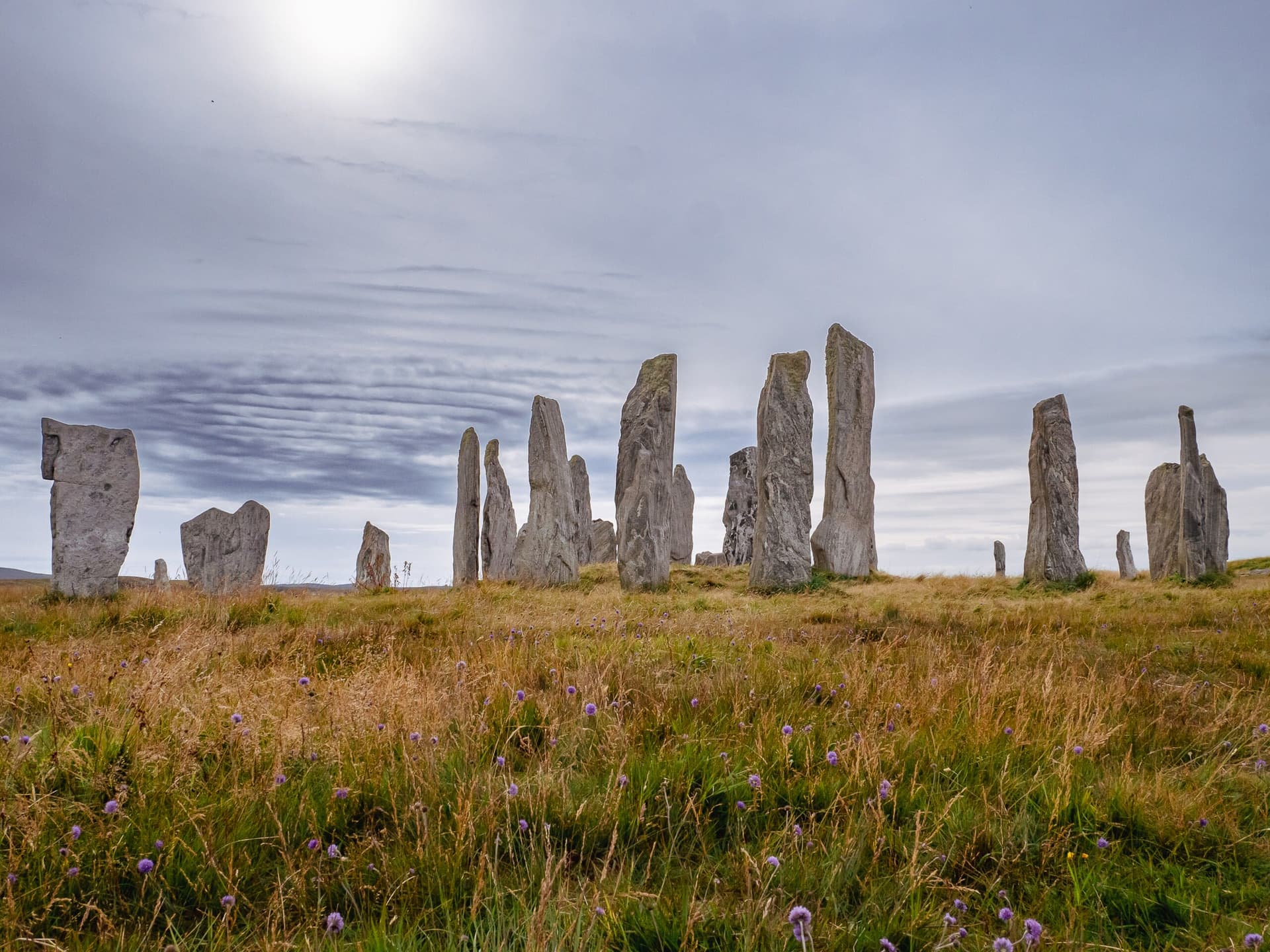
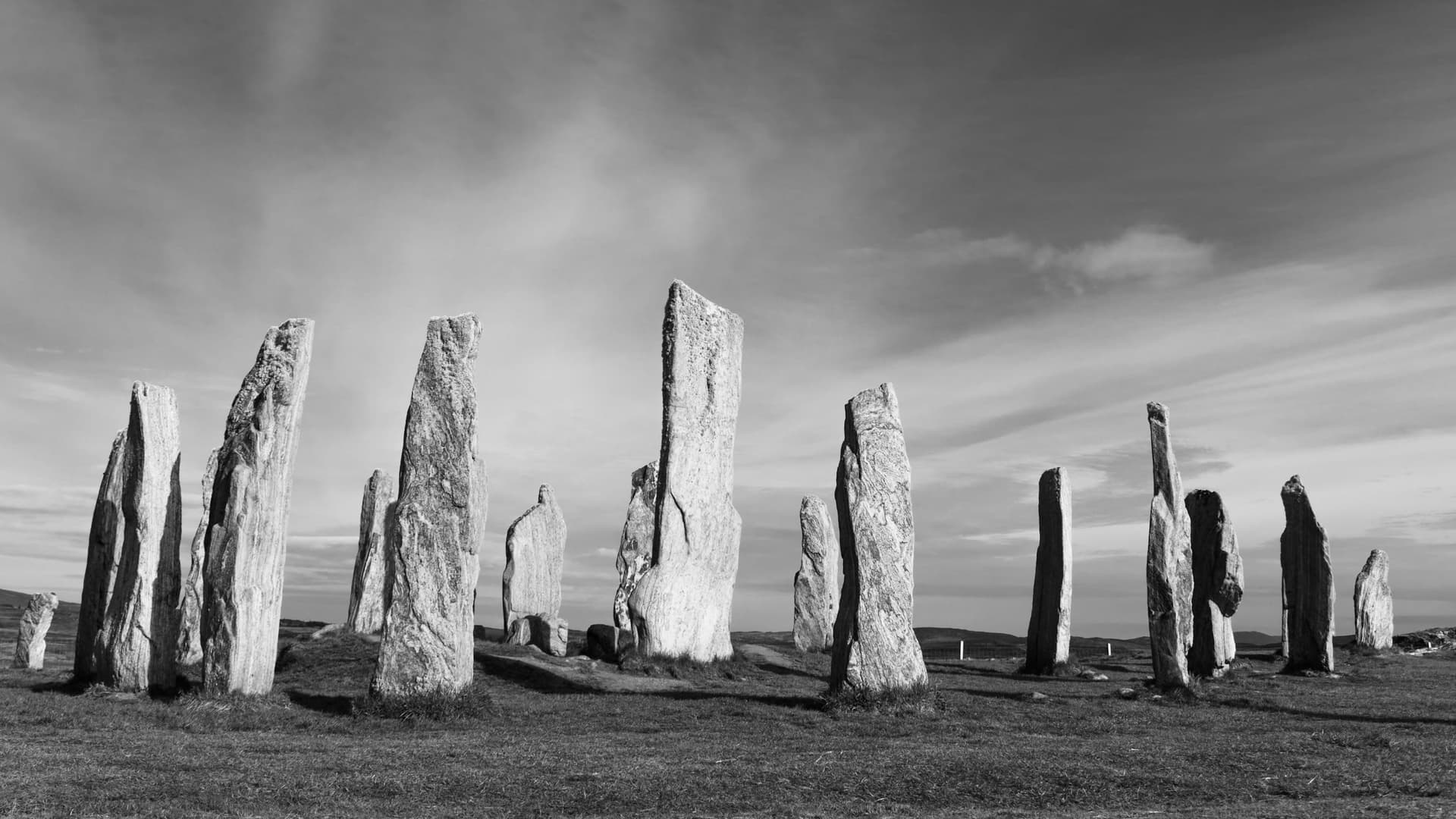
The circle reveals itself gradually. The stones are not tall enough to dominate the skyline from a distance. As you climb the gentle rise, they emerge from the moorland like figures standing in conversation. Five uprights of Lewisian gneiss, grey and striated, textured with lichen. Their surfaces carry the banding patterns of metamorphic rock formed under extreme pressure three billion years ago. Each stone has its own character, its own lean, its own relationship to the others.
The oval they form is elongated roughly north-northwest to south-southeast, approximately thirteen metres by nine metres. Step inside and the scale becomes personal. You are enclosed but not confined. The stones are close enough that you could reach out and touch any of them in a few steps. At the centre, the burial cairn rises low from the grass, a mound of loose stone perhaps two metres across. It is unassuming, easy to overlook. But it is the reason the living came here four thousand years ago: to place the dead within the circle, to hold them among the stones.
From the circle, the view opens in all directions. To the northwest, across Loch Ceann Hulabhig, the ridge where Callanish I stands is visible on clear days. The intervisibility was intentional. These monuments were meant to see one another, to exist in relationship across the landscape. To the south and east, the Lewis moorland stretches toward Garynahine and beyond. The sky is enormous here, as it is everywhere on Lewis, and the wind is a constant companion.
If you are fortunate enough to visit alone, the silence is remarkable. No interpretive panels, no visitor centre, no audio guide. Just the stones, the peat, the water, the wind. The site asks nothing of you except presence.
Callanish 4 Stone Circle sits on an elevated plateau approximately 180 metres north of the B8011 road, roughly one mile west of Garynahine on the Isle of Lewis. The oval is elongated NNW-SSE. The central burial cairn occupies the interior. Loch Ceann Hulabhig lies to the north and northwest. The main Callanish I complex is visible approximately two miles to the northwest across the loch.
Understanding of Callanish 4 is shaped primarily by its position within the broader Callanish complex and by comparison with better-studied monuments in that landscape. The site itself has never been excavated, so interpretation relies on survey work and analogy.
Callanish 4 is recognised as a nationally important scheduled monument and a key member of the Callanish group of circles, settings, and cairns. The complex as a whole is considered one of the most remarkable Neolithic and Bronze Age site assemblages in northwest Europe. The monument consists of an oval stone circle of Lewisian gneiss, with five upright and possibly one fallen stone, surrounding a small central burial cairn. Construction likely dates to the Late Neolithic, around 3000 to 2500 BC, with the cairn possibly added during the Early Bronze Age. The site was first surveyed by RCAHMS in 1914, with subsequent surveys in the 1970s and a comprehensive resurvey in 2009. No excavation has ever taken place. Scholars note that the site's intervisibility with other Callanish monuments suggests the satellite circles functioned as part of an integrated ceremonial landscape rather than as isolated monuments. The undisturbed deep peat surrounding the site is considered to hold significant potential for recovering information about contemporary land use, economy, and possibly additional buried structural evidence.
In Gaelic tradition, the standing stones of the Callanish landscape are known as Fir Bhreige, meaning false men, with legends telling of ancient giants turned to stone. One version holds that they were giants who refused to convert to Christianity and were petrified by Saint Kieran. Martin Martin, visiting Lewis in 1695, recorded that local people associated the Callanish stones with ancient Druidic worship, indicating that cultural memory of the stones' sacred function persisted across millennia. The name Ceann Hulavig itself reflects the layered cultural history of the Western Isles: Ceann is Gaelic for head or end, while Hulavig derives from Old Norse, likely meaning Head of Hula Bay. The name preserves the memory of Norse settlement on Lewis, itself a later chapter in the island's long story.
The Callanish complex, including its satellite circles, holds significance in esoteric traditions as a major centre of earth energy. The broader complex is sometimes called the Temple of the Moon due to its lunar alignments. Paul Devereux's Dragon Project reportedly detected doubled radiation intensity at the main Callanish site during the solstice period. The satellite circles are sometimes interpreted as amplifying nodes within a network of ley lines or earth energy pathways connecting the monuments. Some visitors report heightened sensitivity or energy sensations at the stones. The Callanish complex features in sacred site pilgrimage itineraries focused on divine feminine or lunar spirituality.
The precise relationship between Callanish 4 and the other monuments in the Callanish landscape remains unresolved. Whether the satellite circles were constructed simultaneously with the main site or over a period of centuries, and whether they served complementary or independent ceremonial functions, is not known. The original number of stones in this circle is uncertain: the current five uprights may represent a significant loss from an original complement of up to thirteen. The contents and purpose of the central cairn are entirely unknown, as it has never been excavated. Whether the specific orientation of the oval, elongated north-northwest to south-southeast, carries astronomical significance has not been studied. The site's relationship to the 18.61-year lunar standstill cycle, so central to interpretation of the main Callanish site, is unexplored.
Visit Planning
Free, open-access site off the B8011 road on the Isle of Lewis, approximately one mile west of Garynahine. Short but boggy walk from the road. No facilities on site.
The nearest accommodation is in Callanish village or along the A858 between Callanish and Stornoway. Options include B&Bs, self-catering cottages, and the Calanais Visitor Centre area. Stornoway, 15 miles east, offers a full range of hotels, hostels, and guesthouses. The Isle of Lewis is served by CalMac ferries from Ullapool to Stornoway and by flights to Stornoway Airport.
A scheduled ancient monument requiring care and respect. Leave nothing, take nothing, disturb nothing.
Callanish 4 Stone Circle is a scheduled ancient monument protected under the Ancient Monuments and Archaeological Areas Act 1979. This legal protection means that any disturbance to the stones, the cairn, the ground, or the surrounding peat is a criminal offence. The monument has survived for five thousand years in part because it has never been excavated, and the undisturbed peat surrounding the site holds significant potential for future archaeological research.
The site receives very few visitors compared to the main Callanish circle, and this solitude is one of its gifts. Treat the space as you would treat any place of burial and remembrance. The cairn at the centre holds human remains that have rested undisturbed for millennia. Move quietly. Take nothing. Leave nothing.
The stones themselves should not be climbed upon, leaned against heavily, or used as surfaces for placing objects. They have stood for five thousand years. They do not need to be tested.
No specific requirements beyond the practical. The Isle of Lewis has a maritime subarctic climate with frequent rain, wind, and rapidly changing conditions. Waterproof outer layers, warm clothing, and sturdy waterproof footwear are essential. The approach crosses marshy bogland where ankle-deep water is common. Walking boots or wellies are strongly recommended.
Photography is freely permitted. The stones photograph well against the Lewis sky, particularly in morning and evening light when the banding patterns of the Lewisian gneiss become more visible. The low angle of winter sun on Lewis can be especially revealing of the stones' surface textures.
No traditional offerings are associated with the site. Do not leave any items at the monument. Presence and attention are the appropriate offerings here.
As a scheduled ancient monument, it is illegal to dig, disturb, or remove anything from the site. Do not climb on the stones. Do not disturb the central cairn. Do not remove peat, stone, or any other material from the monument or its surroundings. Leave no trace of your visit.
Sacred Cluster
Nearby sacred places create the location cluster described in the growth plan. This block is intentionally crawlable and links into the wider regional graph.