Cairn de Gavrinis
The Sistine Chapel of prehistory, where spirals carved six thousand years ago still speak in a language we cannot translate
Kerners, Brittany, France
At A Glance
- Coordinates
- 47.5725, -2.8975
- Suggested Duration
- Two to three hours total, including boat crossing to and from the island, walking to the cairn, and guided tour of the interior. The interior tour itself is approximately forty-five minutes.
- Access
- Boats depart from Larmor-Baden, near Vannes. Gavrinis is an uninhabited island accessible only by this boat. Advance booking is strongly recommended during peak season. The crossing takes about ten minutes. The walk from landing to cairn is manageable but uneven terrain.
Pilgrim Tips
- Boats depart from Larmor-Baden, near Vannes. Gavrinis is an uninhabited island accessible only by this boat. Advance booking is strongly recommended during peak season. The crossing takes about ten minutes. The walk from landing to cairn is manageable but uneven terrain.
- Comfortable walking shoes suitable for the island terrain. Weather-appropriate clothing for the boat crossing, which can be cool and windy even in summer.
- Prohibited inside the cairn. Exterior photography of the island and cairn exterior is permitted.
- Do not touch the carved stones. The oils and pressure of hands damage surfaces that have survived six millennia. Do not attempt to leave offerings or objects of any kind. Follow guide instructions at all times. The site's preservation depends on visitor compliance.
Overview
On an island in the Gulf of Morbihan, Neolithic builders created something unprecedented: a passage tomb whose every stone is carved with spirals, concentric circles, and symbols that defy interpretation. Called 'the Sistine of the Neolithic,' Gavrinis represents the summit of Atlantic megalithic art. The meaning of its carvings remains unknown, inviting each visitor into direct encounter with ancient mystery.
To enter Gavrinis is to walk into a message you cannot read. Twenty-three of the twenty-nine stones lining the passage bear carvings so intricate, so deliberate, so clearly meaningful that their opacity feels almost personal. Spirals spin outward. Concentric circles ripple like water. Shapes that might be axes or bows or something else entirely repeat with variation. The Neolithic carvers had something to say. Six thousand years later, we still do not know what.
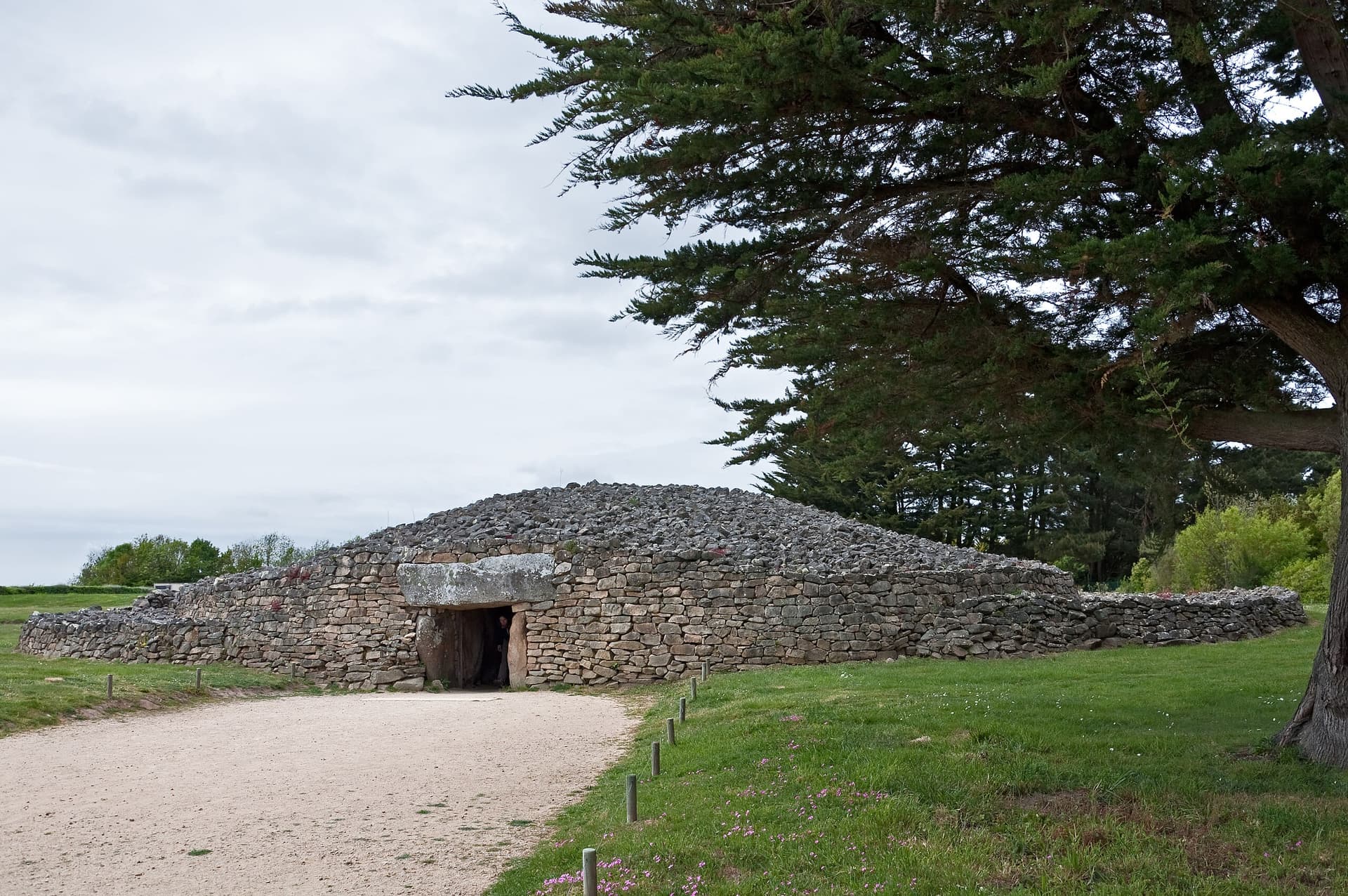
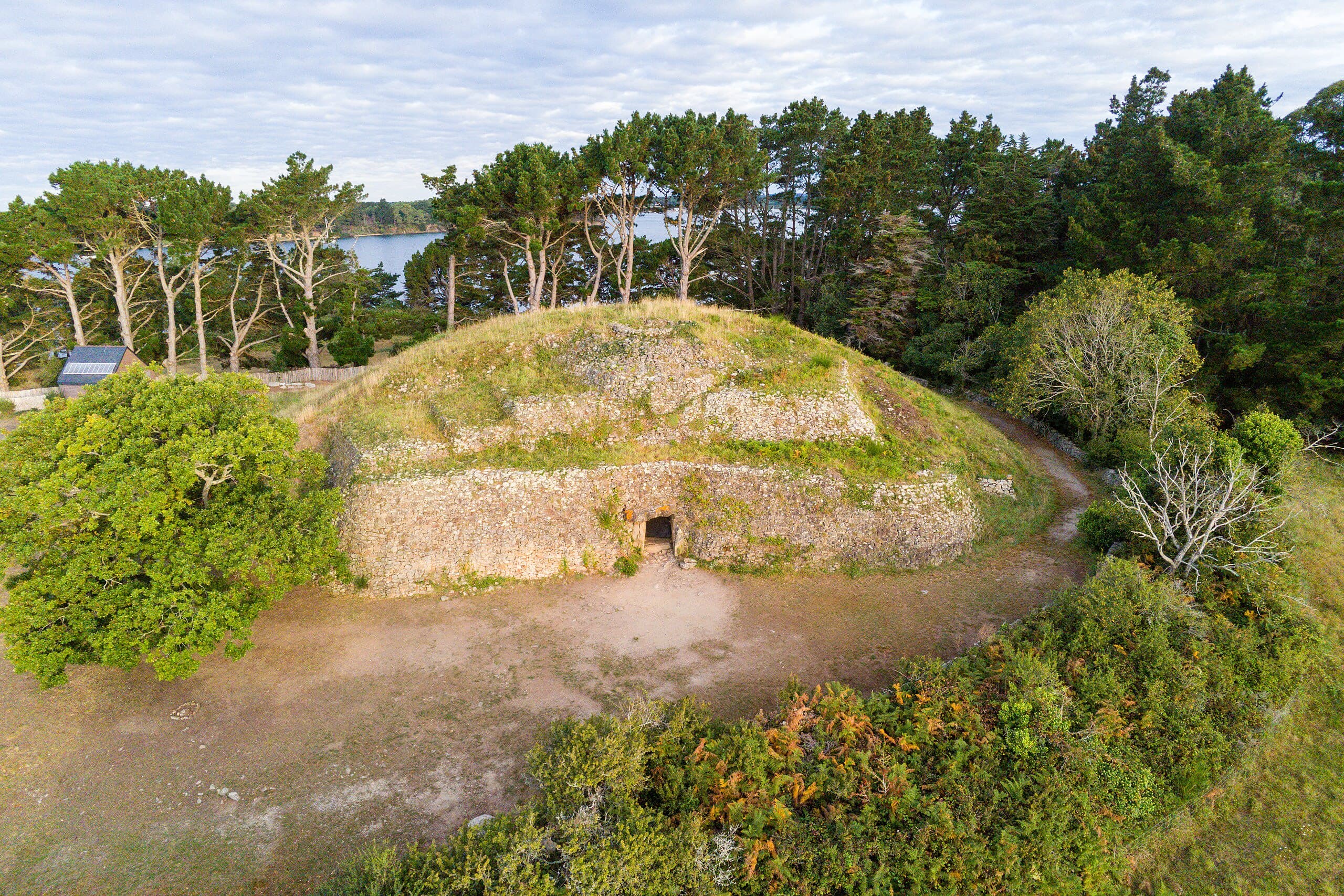
The boat crossing to the island begins the transition. This is not a monument you drive to and park beside. The water passage separates Gavrinis from ordinary geography. When you step onto the island and approach the cairn—eight meters high, fifty meters across—the scale announces importance. But it is inside the passage, confronting the carved stones at arm's length, that the encounter deepens.
The prohibition on photography forces presence. You cannot process these images through a screen, file them for later, substitute documentation for experience. You must look. You must let the spirals work on you without knowing what work they are doing.
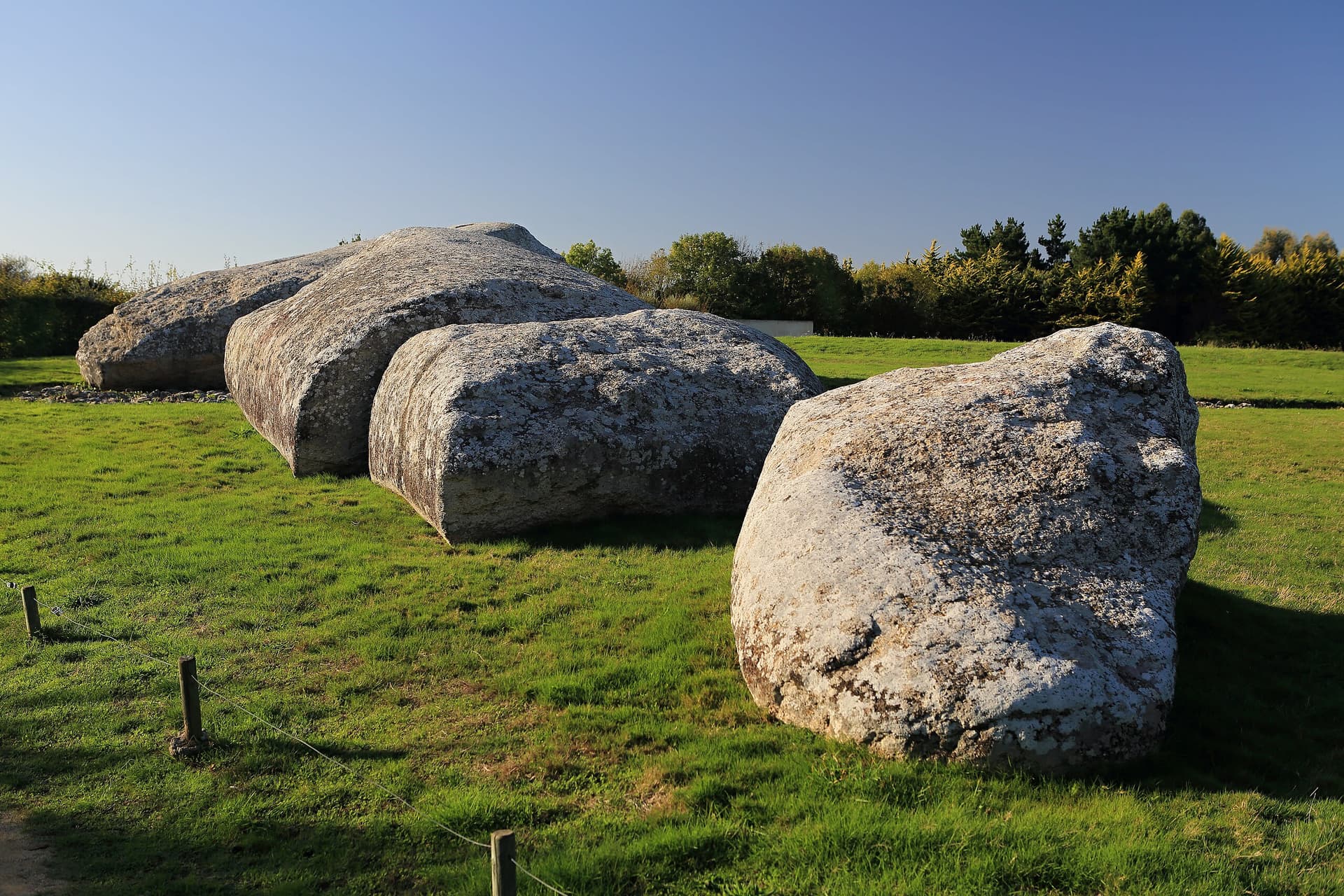
The ceiling slab adds another layer of mystery. It once formed part of a massive standing stone, perhaps fourteen meters tall, that was deliberately broken and distributed among three monuments: Gavrinis, Table des Marchands, and Er Vingie. Why break what you had labored to erect? Why share fragments across sites kilometers apart? The questions multiply. The answers do not arrive.
Context And Lineage
Gavrinis was constructed around 4200-4000 BCE by Neolithic communities in what is now Brittany. It represents the most elaborately decorated passage tomb in Europe, with twenty-three of twenty-nine stones bearing carvings. The ceiling slab connects to two other monuments through shared fragments of a once-great standing stone.
No origin narrative survives for Gavrinis. What can be reconstructed is archaeological: around six thousand years ago, communities on the Morbihan coast undertook the construction of a monumental passage tomb. They carved symbols onto stone slabs, some before installation, some after. They built a cairn fifty meters wide and eight meters high on an island in the gulf.
The ceiling slab tells part of the story. It was once a segment of a massive standing stone, perhaps fourteen meters tall. At some point, this great menhir was deliberately broken and its pieces distributed. One piece became the ceiling of Gavrinis. Another went to Table des Marchands, two kilometers away. A third to Er Vingie. Three tombs now share one stone.
What motivated this division remains unknown. But the intentionality is clear. Someone decided that these sites should be connected through shared material. The dead in each place would rest beneath fragments of a single sacred stone.
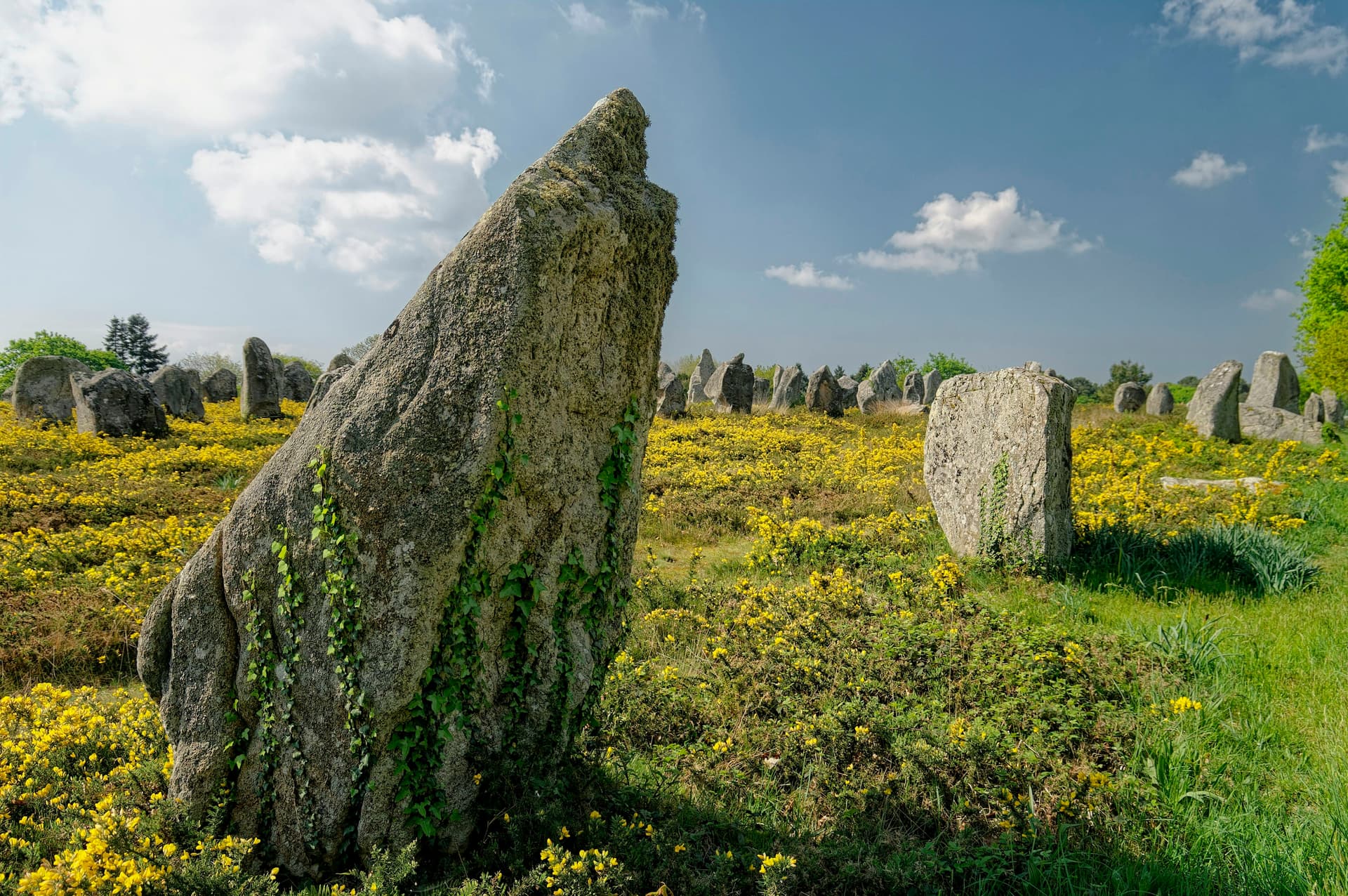
Gavrinis exists within a broader Atlantic megalithic tradition that includes Newgrange and Knowth in Ireland, Maes Howe in Orkney, and numerous Breton sites. Stylistic parallels in carved motifs suggest connection across remarkable distances. Whether this reflects trade, migration, shared cosmology, or something else cannot be determined, but the spirals and geometric patterns repeat across sites separated by hundreds of miles.
The Neolithic builders who carved Gavrinis are anonymous. We do not know their language, their gods, their social organization. What survives is their work: a corridor of carved stone that has spoken to visitors for centuries, even as the specific words remain untranslated.
Why This Place Is Sacred
Gavrinis derives its sacred power from the intersection of extreme artistry and impenetrable mystery. The most elaborately decorated passage tomb in Europe, it was designed to carry the dead from one world to another through a corridor saturated with meaning. The meaning has been lost, but the threshold remains.
A passage tomb is by definition a liminal space. The dead enter; they do not return. The passage itself is the threshold between worlds, the doorway the living cannot fully cross. The Neolithic builders of Gavrinis understood this and saturated their threshold with intention.
Every carved spiral, every concentric circle, every repeated pattern represents deliberate choice. Carving granite with stone tools requires sustained labor. The extensive decoration of Gavrinis—over twenty-three carved orthostats—represents enormous investment in making the passage meaningful. Whatever ceremony accompanied burial here would have moved through a corridor designed to transform.
The island location amplifies the liminal quality. Gavrinis sits in the Gulf of Morbihan, reachable only by boat. Water crossing has served as threshold metaphor across cultures: the River Styx, the Celtic voyages to the otherworld, the island of Avalon. Whether Neolithic Bretons shared this symbolism is unknown, but the effect persists. Arriving by boat, one has already crossed something.
The shared stone fragments add deeper connection. The ceiling slab of Gavrinis matches pieces at Table des Marchands and Er Vingie. Once, these were a single standing stone. Someone decided to break it and distribute the fragments. Three burial sites now share one stone. The dead in each location are connected through shared material. What this meant to those who made the choice cannot be recovered, but the fact of it speaks to intentional linking of sites across the landscape.
Archaeological evidence indicates Gavrinis was constructed around 4200-4000 BCE as a passage tomb. The single chamber at the end of the fourteen-meter passage would have received human remains, though what survives after millennia of disturbance is minimal. The elaborate carving suggests that the passage itself held ritual significance, not merely as access route but as transformative corridor.
For several thousand years, Gavrinis stood as a tomb and monument. At some point, likely in late prehistory or early history, its use changed. The chamber was sealed or forgotten. The cairn remained visible on the island, known but perhaps no longer understood.
First modern excavation occurred in 1835, revealing the carved interior. Subsequent work by archaeologists including Zacharie Le Rouzic in the 1930s and Charles-Tanguy Leroux in the 1980s has consolidated the structure and deepened understanding. The 1984 discovery that external surfaces of slabs were also decorated before being built into the cairn revealed another layer of intentionality.
Today, Gavrinis functions as both archaeological monument and, for many visitors, a place of encounter with ancient sacred practice. The guided tours structure the experience but cannot contain the effect of standing in a corridor six millennia old, surrounded by symbols no one can translate.
Traditions And Practice
No living religious tradition claims Gavrinis. Visits are structured as guided archaeological tours. However, many visitors approach the experience as pilgrimage, treating the boat crossing and entrance into the carved passage as meaningful ritual sequence.
The rituals once performed at Gavrinis are lost beyond recovery. Archaeological parallels and the structure itself suggest ceremonies of burial, perhaps involving procession through the carved passage. The astronomical orientation of some passage tombs suggests possible calendrical observance, though specific alignments at Gavrinis are uncertain.
The carving of the stones was itself likely ritualized. The labor involved, using stone tools on granite, suggests more than decoration. Each spiral, each circle, each repeated pattern represented someone's sustained intention.
Modern visitors experience Gavrinis through guided tours. The boat from Larmor-Baden, the walk across the island, the entry into the passage, and the return all follow a structured sequence that functions like liturgy even when no religious content is intended.
Some visitors approach the site with explicit spiritual intent. Neo-pagan practitioners, earth-energy enthusiasts, and seekers of various kinds have recognized Gavrinis as a place of power. While no formal ceremonies take place at the site, individual intention shapes experience.
The prohibition on photography creates accidental ritual. Without cameras, visitors must be present to what they see. The act of seeing becomes the practice.
If you come seeking more than archaeology, consider these approaches. On the boat crossing, let the water passage signify transition. You are traveling to another kind of place.
In the passage, let the guide's words be background. Listen, but give primary attention to the stones themselves. The spirals are not illustrations of a lecture. They are primary.
In the chamber, if the group pauses, breathe. You are standing where the dead were placed. The passage behind you is the corridor the living walked and the dead remained. Notice what arises.
Carry no expectation of transcendent experience. The stones are old and strange; they do not perform on cue. But openness creates space for something to happen.
Neolithic Megalithic Tradition
HistoricalGavrinis represents the summit of Atlantic megalithic art, the most elaborately decorated passage tomb in Europe. It belongs to a tradition spanning from Iberia to Orkney, with related sites at Newgrange, Knowth, and Maes Howe. The builders invested extraordinary labor in carving symbols that likely held cosmological significance. The sharing of stone fragments with other monuments indicates intentional network-building across the sacred landscape.
Historical practices at Gavrinis would have included burial ceremonies, possibly processed through the carved passage as a transformative corridor between worlds. The carving itself was likely ritualized. Potential astronomical observations and calendrical ceremonies cannot be verified but remain plausible.
Experience And Perspectives
Visitors to Gavrinis consistently describe awe at the elaborate carvings, wonder at standing within such ancient artistry, and a sense of privilege at proximity to these irreplaceable stones. The prohibition on photography intensifies direct encounter. The boat crossing creates pilgrimage consciousness before arrival.
The experience of Gavrinis unfolds in stages. The boat crossing from Larmor-Baden establishes separation from ordinary routine. The water of the Gulf of Morbihan, calm or choppy depending on weather, enforces transition. You cannot simply arrive; you must travel to this place.
Approaching the cairn on the island, scale becomes apparent. Eight meters high, over fifty meters in diameter, the mound dominates its setting. The grass-covered stone structure announces itself as something made, something intended, something worth the effort of construction six thousand years ago.
Entering the passage changes everything. The fourteen-meter corridor is lined with carved stones that press close. Light dims. The carvings emerge in relief, their spirals and patterns covering surfaces at eye level and below. A guide speaks, providing context, but the experience exceeds explanation. These symbols meant something. They still mean something, even if what cannot be specified.
Many visitors describe a quality of presence or intensity they struggle to name. Some speak of energy; others speak of solemnity; still others speak of beauty. The consistency of strong response, across cultures and belief systems, suggests something about the place that transcends individual projection.
The prohibition on photography inside the cairn proves a gift. Without the impulse to document, visitors simply look. The carvings cannot be captured and processed later; they must be encountered now. This forced presence deepens the experience in ways that unrestricted access might not.
Gavrinis rewards open attention more than specific practice. No religious tradition currently claims the site; no ritual is expected. What helps is willingness to let the unfamiliar symbols work without forcing interpretation.
The guide will provide archaeological context. Listen, but recognize that the factual frame is partial. What the carvings meant remains unknown. Your own response is data, too.
In the chamber at the passage's end, if the group pauses there, allow yourself to feel the weight of stone above and around you. Thousands of years ago, this is where the dead were placed. The passage you walked is the corridor between worlds. Stand in the threshold.
Gavrinis presents an interpretive challenge. The carvings are so elaborate, so deliberate, so clearly meaningful that their undeciphered status feels almost unbearable. Scholarly consensus can describe what is carved but not what it means. Alternative interpretations flourish in the vacuum. The honest position is one of informed uncertainty.
Archaeological consensus dates Gavrinis to approximately 4200-4000 BCE. It is classified as a passage tomb in the Atlantic tradition, related to sites in Ireland, Orkney, and along the Atlantic coast. The twenty-three carved orthostats represent the most extensive program of megalithic art in Europe.
The carved motifs include spirals, concentric circles, lozenges, zigzags, and shapes interpreted as axes, bows, or shields. Similar motifs appear at other Atlantic sites, suggesting cultural connection across distances. The 1984 discovery that slabs were carved on their exterior faces before installation in the cairn indicates that the carving preceded construction, not merely decorated it.
The ceiling slab's origin as part of a large standing stone, shared with Table des Marchands and Er Vingie, demonstrates intentional linking of monuments. Scholarly interpretation of why this was done remains speculative.
No indigenous tradition survives to explain Gavrinis. The builders left no texts, and their descendants absorbed into subsequent cultures without preserving explanatory narratives. The site belongs to no living religion.
Breton folklore about megaliths generally attributes them to giants, fairies, or supernatural construction, but specific narratives about Gavrinis are not prominent in the recorded tradition.
The mystery of Gavrinis invites alternative interpretation. Some see the spirals as shamanic imagery, representing altered states of consciousness. Others interpret the patterns as astronomical maps, calendrical calculations, or energy signatures. Earth-energy practitioners identify the site as a significant node on telluric networks.
These interpretations lack archaeological support but emerge from genuine encounter with the carvings. The experience of standing in the passage, surrounded by symbols that should mean something but whose meaning is lost, naturally generates speculation. The alternative perspectives may say more about the interpreters than about Neolithic intention, but they demonstrate the site's power to provoke meaning-making.
The central mystery of Gavrinis is the meaning of the carvings. Despite over a century of study, no consensus exists on what the spirals and symbols represent. They may be decorative. They may be narrative. They may record astronomical observations. They may represent spiritual cosmology. They may do all of these at once, or none.
Why the great menhir was broken and distributed among three sites remains unexplained. What rituals accompanied burial at Gavrinis cannot be reconstructed. Whether astronomical alignments exist within the passage is debated. The site generates more questions than answers, and that is part of its power.
Visit Planning
Gavrinis is an island in the Gulf of Morbihan, accessible only by boat from Larmor-Baden. Visits are by guided tour only and require advance booking during peak season. Allow two to three hours including the boat crossing. The site operates seasonally; check dates before planning.
Boats depart from Larmor-Baden, near Vannes. Gavrinis is an uninhabited island accessible only by this boat. Advance booking is strongly recommended during peak season. The crossing takes about ten minutes. The walk from landing to cairn is manageable but uneven terrain.
Hotels in Larmor-Baden, Vannes, or Auray. The island itself has no facilities.
Gavrinis is a protected archaeological monument accessed only through guided tours. Photography is prohibited inside the cairn to protect the carvings. Do not touch the stones. Respectful behavior preserves the site for future generations and maintains appropriate atmosphere.
The primary etiquette obligation at Gavrinis is preservation. Every stone is irreplaceable. The carvings have survived six thousand years; they should survive six thousand more. Do not touch the surfaces, lean against the walls, or make contact with the carved stones.
Follow guide instructions at all times. The guided tour structure exists to protect the monument while allowing meaningful access. Questions are welcome, but disruption is not.
The prohibition on photography inside the cairn exists to protect the carvings from flash damage and to prevent the congestion that photography creates in the confined passage. Respect this restriction. The experience you have in person cannot be adequately captured in images anyway.
Other visitors share the space. Move through at appropriate pace. Allow others to see what you have seen. Keep voices low, not from religious requirement but from recognition that some experiences are better held in quiet.
Comfortable walking shoes suitable for the island terrain. Weather-appropriate clothing for the boat crossing, which can be cool and windy even in summer.
Prohibited inside the cairn. Exterior photography of the island and cairn exterior is permitted.
Not appropriate at this site. Do not leave objects of any kind.
Access by guided tour only. Book in advance during peak season. No touching of carved stones. Photography prohibited inside.
Sacred Cluster
Nearby sacred places create the location cluster described in the growth plan. This block is intentionally crawlable and links into the wider regional graph.