Basilica of Our Lady of Marceille
A Black Madonna who returned three times to her chosen spot, her head stolen in 2007, her devotion continuing
Limoux, Occitanie, France
At A Glance
- Coordinates
- 43.0538, 2.2177
- Suggested Duration
- 45-90 minutes including fountain and views
- Access
- Hilltop outside Limoux, Aude department, Occitanie. Car required. Free admission.
Pilgrim Tips
- Hilltop outside Limoux, Aude department, Occitanie. Car required. Free admission.
- Modest attire
- Permitted with respect
- Remote location; car required.
Overview
On a hilltop outside Limoux, a Gothic basilica guards one of France's most poignant Black Madonnas. Legend says a plowman found her statue and took it home three times; three times she returned to this spot. A chapel rose, then a church, then basilica status in 1905. In 2007, vandals decapitated her and stole the head. She stands now with a reproduction—diminished in artifact, undimmed in devotion.
The statue insisted on this place. According to local tradition, a plowman discovered a Black Madonna while working the land. He brought her home. She returned. He brought her home again. She returned again. A third time he tried; a third time she was found at the original spot. The message was clear: here she would stay.
So they built her a chapel, then a church, then elevated the site to basilica when a pope visited in 1905. The Gothic structure dates to the 14th and 15th centuries, rising on its hilltop outside Limoux with views across the Aude valley. Pilgrims walked the 'sacred path' to reach her, seeking protection from plague and drought that she was credited with averting.
The Black Madonna—wooden, perhaps 11th or 12th century—held court here for centuries. Then in October 2007, vandals came. They decapitated the statue and stole the head, never recovered. What stands now is a reproduction, the original head lost to hatred or greed.
But the devotion continues. The miraculous fountain outside the basilica still flows. The pilgrims still come. A Black Madonna who three times returned to her chosen spot will not be dislodged by loss of her medieval head. The devotion is older than any single artifact.
Context And Lineage
Marceille expresses the Black Madonna tradition of southern France, enriched by connection to the region's layers of sacred geography.
A plowman found a Black Madonna statue and took it home. She returned to the original spot. Three times he tried; three times she returned. A chapel was built where she chose to stay.
One of France's 180+ Black Madonnas. Part of Occitanie's sacred geography including Rennes-le-Château and Cathar sites.
Why This Place Is Sacred
Marceille's thinness comes from the Madonna's insistence—three returns to this hilltop—and from the devotion that outlasts even her decapitation.
What makes a place thin is sometimes what refuses to leave it. The Black Madonna of Marceille demonstrated that refusal: taken away three times, she returned three times. This is not legend about distant events but the founding narrative of a living shrine—the reason there is a basilica here rather than somewhere else.
The 2007 decapitation adds painful dimension. The head that gazed at pilgrims for eight or nine centuries is gone—stolen, lost, perhaps destroyed. What remains is diminished. But the devotion is not the statue; the devotion is what the statue anchors. The pilgrims who climb to Marceille now come to someone wounded, mutilated, resilient—a Madonna who has lost her original face but not her place.
The miraculous fountain continues to flow. The dramatic hilltop setting continues to reward the climb. The connection to 'Grail country'—this region saturated with Cathar history and alternative sacred geography—adds layers that some find meaningful. What was thin before is thin still.
Chapel built because Black Madonna returned three times to this spot; elevated to pilgrimage church
First written reference 1137. Gothic church 14th-15th century. Lazarist Seminary 1659. Elevated to basilica 1905. Statue decapitated 2007.
Traditions And Practice
Practice at Marceille centers on Black Madonna veneration and use of the miraculous fountain.
Pilgrimage along sacred path, Black Madonna veneration, drinking from miraculous fountain
Mass, pilgrimage visits, fountain use
Approach as pilgrimage—walk if possible, climb to the hilltop, spend time before the Madonna. Drink from the fountain. Take in the views.
Black Madonna Veneration
ActiveBlack Madonna returned three times to this spot. Basilica since 1905. Statue decapitated 2007; head never recovered. Miraculous fountain. Part of Occitanie's sacred geography.
Pilgrimage, veneration, use of miraculous fountain
Experience And Perspectives
Visiting Marceille is climbing to a hilltop basilica to encounter a Black Madonna whose original head was stolen but whose devotion continues.
The basilica stands on its hill outside Limoux, the Aude valley spreading below. The approach is part of the experience—the modern road replacing the medieval 'sacred path' that pilgrims once walked. Arrive and find Gothic architecture that exceeds expectation: vaulted ceilings, stained glass, statuary accumulated across centuries.
At the center waits the Black Madonna. Her 11th or 12th century wooden body supports a head that is not original—the medieval head was stolen in 2007. This knowledge adds dimension to the encounter. She is wounded. She continues. The devotion that built this basilica is not diminished by what vandals did.
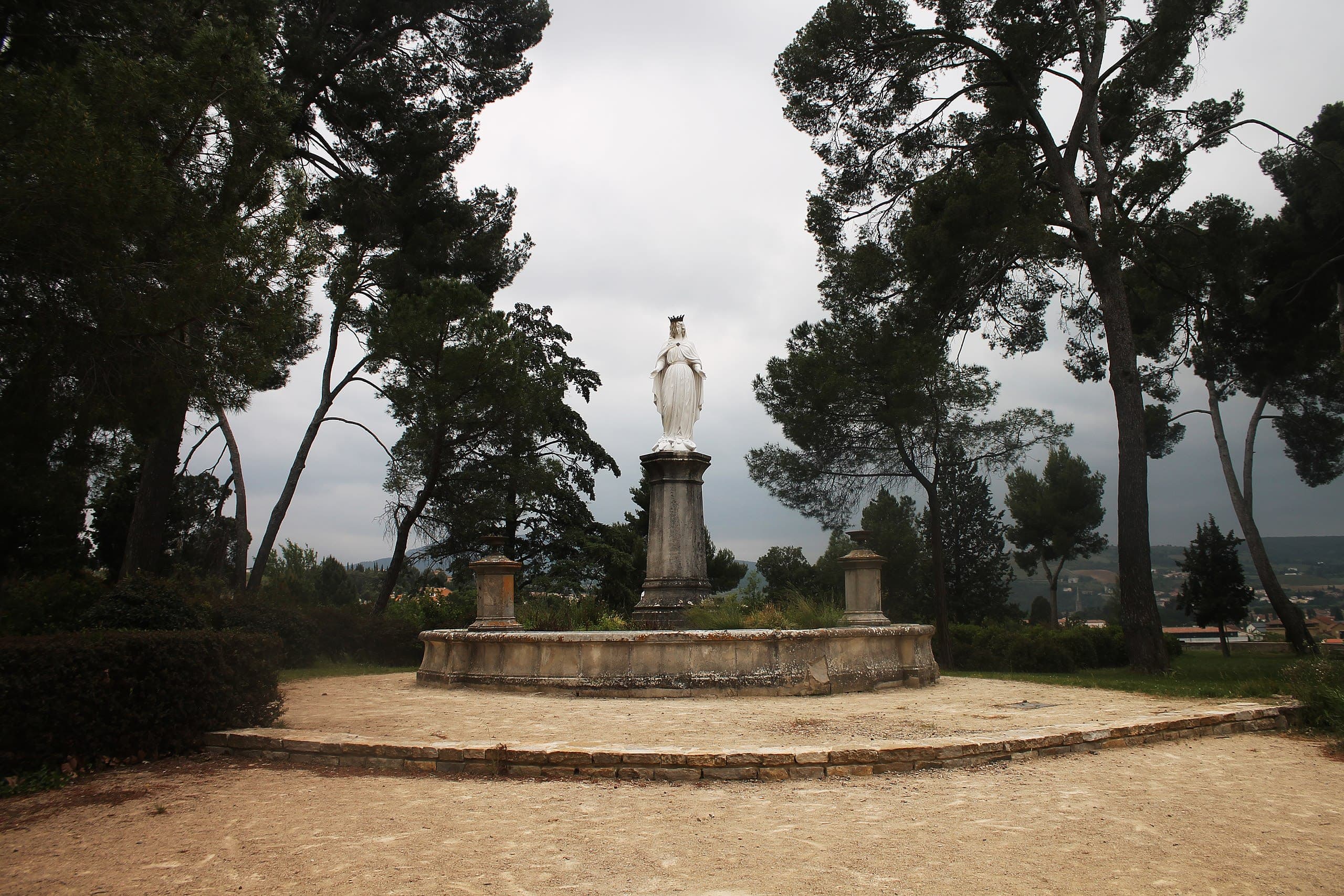
Step outside to the miraculous fountain. The water is said to have healing properties; pilgrims have drawn from it for centuries. The views from the hilltop place you in the landscape—Pyrenean foothills visible, the Aude river valley green below, the sense of being lifted above ordinary geography that characterizes pilgrimage sites on heights.
Come as pilgrims have come for centuries—climbing to reach a Madonna who chose this place and refuses to leave it.
Marceille can be approached as Black Madonna pilgrimage site, Gothic architectural treasure, or node in the region's alternative sacred geography.
Gothic basilica with documented Black Madonna tradition. 2007 decapitation well-documented loss.
Catholic tradition honors Madonna's threefold return as miracle. Fountain credited with healing properties.
Some connect Marceille to Rennes-le-Château mysteries and sacred geometry of 'Grail country.'
Original appearance of statue. Fate of stolen head. Full documentation of miracles.
Visit Planning
Hilltop basilica outside Limoux in Aude department. Car required. Open daily.
Hilltop outside Limoux, Aude department, Occitanie. Car required. Free admission.
Limoux and surrounding villages
Standard church etiquette in active basilica.
The basilica remains active place of worship. Respect those praying before the Black Madonna.
Modest attire
Permitted with respect
Candles
Quiet during services
Sacred Cluster
Nearby sacred places create the location cluster described in the growth plan. This block is intentionally crawlable and links into the wider regional graph.