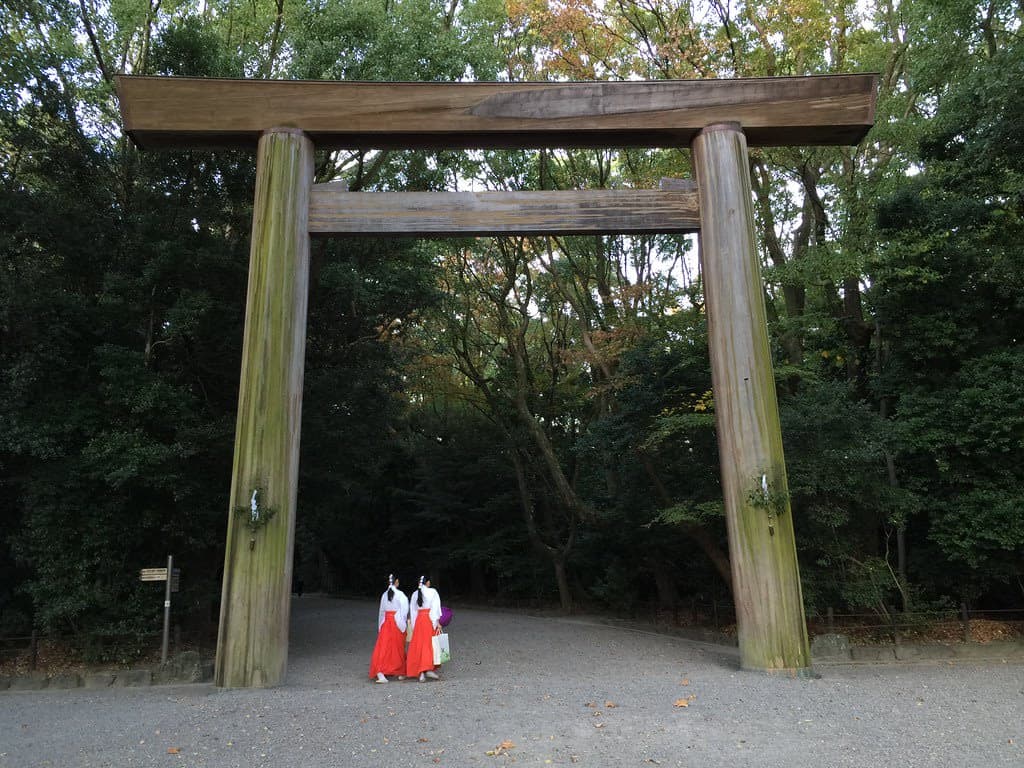
Atsuta Shrine
Guardian of the Grass-Cutting Sword and Japan's Imperial legitimacy
Nagoya, Aichi Prefecture, Japan
At A Glance
- Coordinates
- 35.1232, 136.9050
- Suggested Duration
- 1-2 hours to explore main grounds and pilgrimage path. Additional time for treasure hall.
- Access
- Located in Atsuta-ku, southern Nagoya. Meitetsu Jingu-Mae Station is adjacent. About 10 minutes from Nagoya Station.
Pilgrim Tips
- Located in Atsuta-ku, southern Nagoya. Meitetsu Jingu-Mae Station is adjacent. About 10 minutes from Nagoya Station.
- Modest dress appropriate for one of Japan's most sacred shrines.
- Generally permitted in grounds. Restrictions may apply in certain areas.
- The sacred sword is never displayed—do not expect to see it. The treasure hall shows other remarkable objects but not Kusanagi.
Overview
Atsuta Shrine houses Kusanagi-no-tsurugi, the Grass-Cutting Sword—one of three sacred objects that legitimize Japan's Imperial throne. The sword has not been seen publicly since the 7th century. Found by the god Susanoo in the tail of an eight-headed serpent, passed to Amaterasu, and inherited by the legendary warrior Yamato Takeru, it represents the martial virtue of Japan itself. Nine million pilgrims visit annually, making Atsuta second only to Ise Grand Shrine in Shinto sanctity. The treasure hall displays over 4,000 artifacts, including 174 Important Cultural Properties.
Of the three Imperial Regalia of Japan—the mirror, the jewel, and the sword—the sword rests here. Kusanagi-no-tsurugi, the Grass-Cutting Sword, has legitimized Imperial authority since mythological times and has not been displayed publicly since the 7th century. To stand in Atsuta's sacred forest is to stand in the presence of one of the most closely guarded objects in human history. The sword's mythology runs deep. The god Susanoo found it in the tail of Yamata no Orochi, the eight-headed serpent he had slain to save a princess. He presented it to his sister Amaterasu, the sun goddess. Generations later, the legendary warrior prince Yamato Takeru carried it against Japan's enemies. When rivals trapped him in a grass fire, the sword's power controlled the wind and cut an escape path—earning the name Kusanagi, Grass-Cutter. When Yamato Takeru died in 113 CE, his widow Miyasuhime enshrined his possessions at what became Atsuta Shrine. With over 1,900 years of history and approximately 9 million visitors annually, Atsuta ranks second only to Ise Grand Shrine in Shinto sanctity. The shrine's architecture deliberately echoes Ise's Shinmei-zukuri style, reinforcing the connection between these two supreme sacred sites. The forested grounds spread across 190,000 square meters, creating meditative pilgrimage paths through ancient trees. The Bunkaden treasure hall displays over 4,000 relics including 174 Important Cultural Properties and a National Treasure dagger—but never the sword itself. Over 70 ceremonies and festivals animate the ritual calendar, from the Hatsu-Ebisu business blessing in January to the spectacular Atsuta Festival with lanterns and fireworks in June.
Context And Lineage
Atsuta Shrine was founded in 113 CE to enshrine the sacred sword Kusanagi and the possessions of the legendary warrior Yamato Takeru. It houses one of the three Imperial Regalia of Japan.
According to the Kojiki, the god Susanoo slew the eight-headed serpent Yamata no Orochi to save a princess. In the serpent's tail, he found a magnificent sword, which he presented to his sister Amaterasu, the sun goddess. The sword passed through generations until it reached the legendary warrior prince Yamato Takeru, who carried it in his campaigns to pacify Japan. When enemies trapped him in a grass fire, the sword's power controlled the wind and cut an escape path—earning the name Kusanagi, Grass-Cutter. Yamato Takeru died in 113 CE. His widow Miyasuhime enshrined his possessions, including the sacred sword, at what became Atsuta Shrine. The sword has remained here for 1,900 years, though historical accounts suggest it may have been moved briefly during times of conflict. Some historians debate whether the original sword was lost at the Battle of Dan-no-ura in 1185 when Emperor Antoku drowned with the Heike—but the shrine maintains the sword's presence as a matter of faith.
Atsuta Shrine ranks second only to Ise Grand Shrine in Shinto sanctity. The enshrined deity Atsuta-no-Ōkami is understood as Amaterasu manifest in sword form.
Kusanagi-no-tsurugi
The sacred sword itself—one of three Imperial Regalia, never publicly displayed since the 7th century
Yamato Takeru
The legendary warrior prince who wielded the sword and whose death led to its enshrinement at Atsuta
Susanoo
The god who discovered the sword in the tail of the eight-headed serpent and presented it to Amaterasu
Why This Place Is Sacred
The presence of the sacred sword Kusanagi—one of Japan's three Imperial Regalia—creates extraordinary spiritual concentration. The sword has not been publicly seen since the 7th century, yet its presence defines the shrine's sanctity.
What makes Atsuta thin is the presence of the unseen. Kusanagi-no-tsurugi, the sacred sword, is never displayed. No photographs exist. The last reliable historical record of anyone seeing it dates to the 7th century. Yet the sword's presence—invisible but absolute—concentrates spiritual power that nine million annual pilgrims come to approach. This paradox defines Atsuta's particular sacredness: the most important object is the one you cannot see, yet its presence pervades everything. The sword is not merely symbolic but, in Shinto understanding, is Amaterasu herself—the sun goddess manifest in blade form. The enshrined deity Atsuta-no-Ōkami is thus Amaterasu in sword presence. To worship at Atsuta is to approach the supreme deity of Shinto in one of her most concentrated forms. The mythology deepens this. Kusanagi's power is not metaphorical: it controlled wind and cut through fire when Yamato Takeru needed escape. The martial virtue the sword embodies—the protective power of Japan itself—remains available to those who come seeking. The 190,000-square-meter forested complex creates space for this encounter. Pilgrimage paths wind through ancient trees, connecting sacred spots where prayer concentrates. The architectural choice of Shinmei-zukuri style (like Ise Grand Shrine) reinforces the shrine's supreme status. The treasure hall's 4,000 relics, including the National Treasure dagger and 174 Important Cultural Properties, suggest what the hidden sword must represent—sacred art accumulated around an invisible center.
The shrine was founded in 113 CE to enshrine the possessions of Yamato Takeru, including the sacred sword Kusanagi, when his widow Miyasuhime memorialized the legendary warrior.
The shrine has maintained its role as guardian of the sacred sword for 1,900 years. The architecture was remodeled to Shinmei-zukuri style in 1893, explicitly connecting Atsuta to Ise Grand Shrine. Damage in WWII was restored by 1955. Over 70 annual ceremonies maintain living ritual tradition.
Traditions And Practice
Over 70 annual ceremonies maintain living ritual tradition, from business blessings to the spectacular Atsuta Festival. Pilgrimage through the forested grounds offers meditative practice.
The shrine maintains over 70 annual ceremonies preserving Heian Period and ancient Shinto traditions. Touka Shinji (January 11) is a variation of Heian court ceremony praying for strong crops. Bugaku Shinji (May 1) performs ceremonial Heian dance outdoors. Hosha Shinji (January 15) involves ritual archery. These ceremonies have been maintained since the shrine's founding.
Daily worship continues. Hatsumode (New Year pilgrimage) draws millions. Hatsu-Ebisu (January 5) offers business fortune blessing. Shobu-sai Festival (early June) features Noh and Kyogen performances. The Atsuta Festival (June 5) fills the grounds with lanterns and fireworks. Pilgrimage path stopping at sacred spots continues year-round.
Walk the pilgrimage path slowly, stopping at each sacred spot for prayer. Standard Shinto worship form (coin offering, two bows, two claps, prayer, one bow) is appropriate at the main hall. Visit the treasure hall to encounter the martial spiritual tradition. If possible, attend one of the 70+ annual ceremonies.
Shinto
ActiveAtsuta Shrine is second only to Ise Grand Shrine in Shinto sanctity. It houses Kusanagi-no-tsurugi, one of the three Imperial Regalia that legitimize the Japanese throne. The enshrined deity Atsuta-no-Ōkami is understood as Amaterasu manifest in sword form.
Daily worship continues with over 70 annual ceremonies. The pilgrimage path connects sacred spots throughout the forested grounds. Hatsumode at New Year and the Atsuta Festival in June draw millions of visitors.
Experience And Perspectives
Visitors walk forested pilgrimage paths knowing they approach one of Japan's most sacred and closely guarded objects, experience over 70 annual ceremonies, and view the treasure hall's remarkable collection.
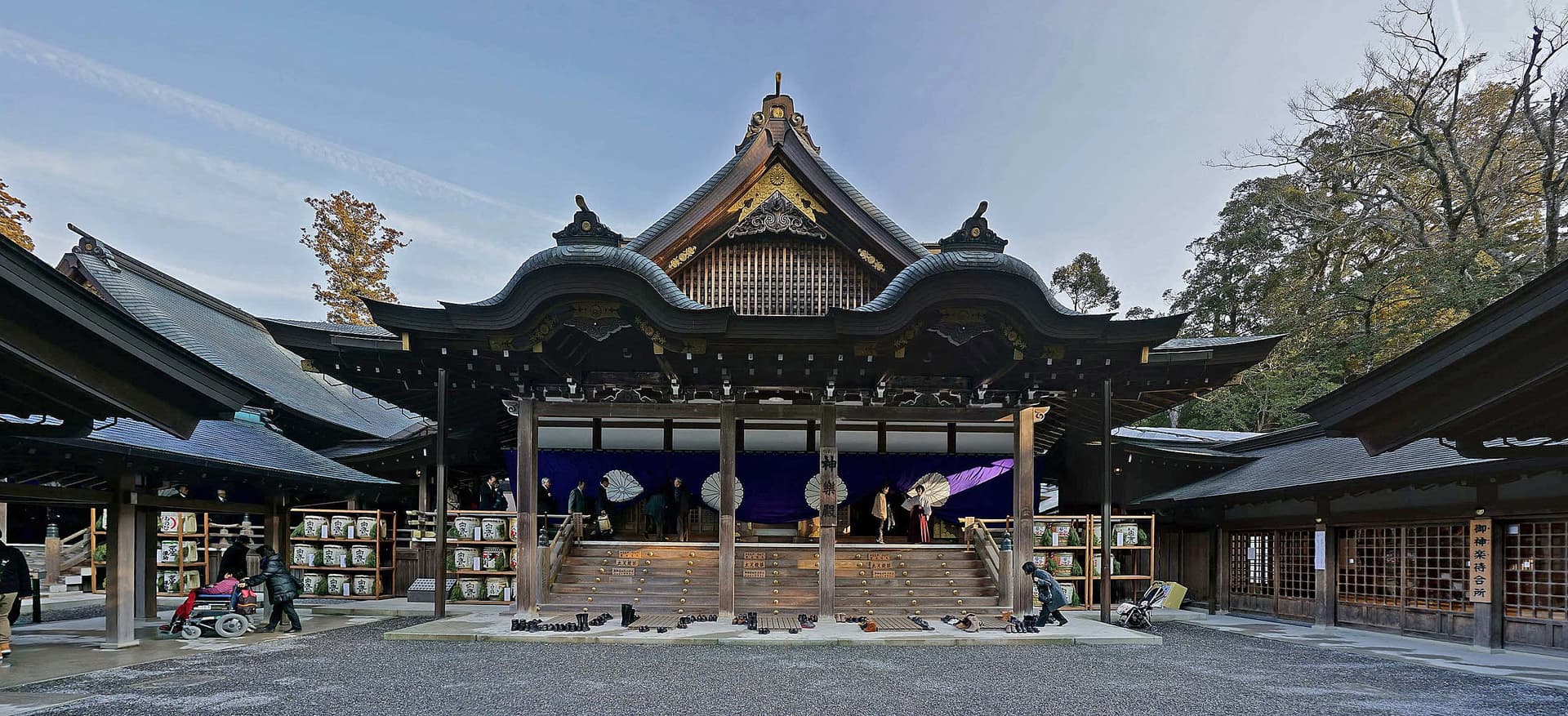
The experience of Atsuta Shrine operates on two levels: what you see and what you know is present but invisible. The 190,000-square-meter forested complex provides the visible experience—ancient trees, pilgrimage paths, the main hall in Shinmei-zukuri style echoing Ise Grand Shrine. The invisible presence is Kusanagi-no-tsurugi, the sacred sword that has not been publicly seen since the 7th century yet defines every aspect of the shrine's significance. Walking the pilgrimage path creates meditative transition. Various sacred spots invite prayer; the path itself becomes practice. The main hall, rebuilt after WWII damage, maintains the architectural tradition appropriate to one of Shinto's supreme sites. Standard worship—offering, bow, clap, bow—takes place here, in the presence of the hidden sword. The Bunkaden treasure hall provides encounter with what can be shown. Over 4,000 relics include 174 Important Cultural Properties and a National Treasure dagger. The sword collection, though not including Kusanagi itself, evokes the martial spiritual tradition the shrine embodies. For timing, the Atsuta Festival on June 5 fills the shrine with lanterns and fireworks—one of Nagoya's most spectacular celebrations. New Year hatsumode draws enormous crowds seeking the blessing of the new year near the sacred sword. Over 70 ceremonies throughout the year provide opportunities to witness Shinto ritual.
Walk the pilgrimage path through the forest before approaching the main hall. Allow the awareness of the hidden sword's presence to inform your experience. Visit the Bunkaden treasure hall to encounter what can be seen. If possible, time your visit to coincide with a festival or ceremony.
Atsuta Shrine can be experienced as guardian of one of Japan's most sacred objects, as supreme Shinto pilgrimage site, or as connection to the mythological foundations of Japanese civilization.
Historians acknowledge Atsuta Shrine's profound importance in Japanese religious and political history as repository of one of the three Imperial Regalia. The traditional 113 CE founding date is based on legendary accounts in the Kojiki and Nihon Shoki rather than archaeological evidence. Debate exists over whether the original Kusanagi was lost at the Battle of Dan-no-ura in 1185 when Emperor Antoku drowned. The current sword's provenance remains a matter of faith rather than historical verification.
Within Shinto tradition, the sacred sword Kusanagi is literally a manifestation of Amaterasu Ōmikami, the supreme deity. The sword possesses genuine supernatural power, as demonstrated when it saved Yamato Takeru from the grass fire. The sword's presence makes Atsuta one of the holiest sites in Japan, second only to Ise. The Five Great Gods of Atsuta continue to watch over the sword and bestow blessings on pilgrims.
Some visitors experience the shrine as a power spot connected to Japan's martial and sovereign energy. The hidden nature of the sword adds to perceptions of concealed power—what cannot be seen may be more powerful than what can.
The sacred sword Kusanagi has not been publicly displayed since the 7th century. Its current condition and whether it survived the 1185 Battle of Dan-no-ura are matters of faith rather than historical certainty.
Visit Planning
Located in Nagoya, about 10 minutes from Nagoya Station by Meitetsu line. Nine million annual visitors make it one of Japan's busiest shrines.
Located in Atsuta-ku, southern Nagoya. Meitetsu Jingu-Mae Station is adjacent. About 10 minutes from Nagoya Station.
Nagoya offers extensive hotel options. Day trip from Tokyo (Shinkansen 1.5-2 hours) or Osaka (Shinkansen 50 minutes) is feasible.
Standard Shinto etiquette applies with particular reverence appropriate to one of Japan's most sacred sites.
Atsuta Shrine welcomes visitors while maintaining the supreme reverence appropriate to a site housing one of the Imperial Regalia. Standard Shinto etiquette applies: bow at the torii, wash hands and mouth at the temizuya if you wish, approach the main hall with awareness that you approach the presence of the hidden sword. Modest dress is expected—this is one of Japan's most sacred sites, not merely a tourist attraction. Photography is generally permitted in the grounds but restrictions may apply in certain areas.
Modest dress appropriate for one of Japan's most sacred shrines.
Generally permitted in grounds. Restrictions may apply in certain areas.
Monetary offerings at prayer spots along pilgrimage path. Omamori available for various blessings.
Sacred sword Kusanagi is never displayed. Standard Shinto etiquette applies with particular reverence appropriate for the site's supreme status.
Sacred Cluster
Nearby sacred places create the location cluster described in the growth plan. This block is intentionally crawlable and links into the wider regional graph.