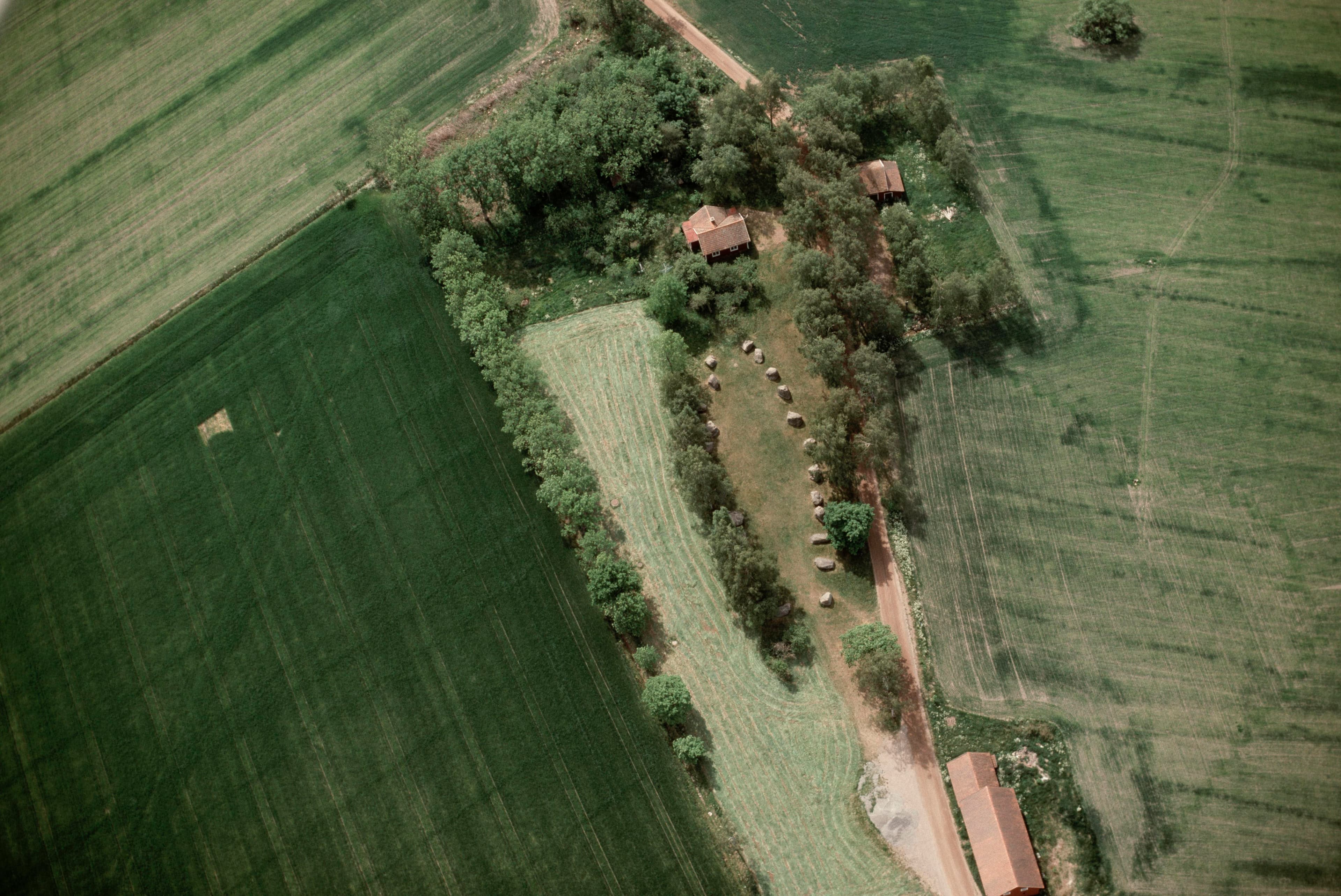
Askeberga Stone Ship
Twenty-four massive boulders whose purpose remains genuinely unknown after centuries of inquiry
Tidan, Västra Götalands län, Sweden
At A Glance
- Coordinates
- 58.5754, 13.9839
- Suggested Duration
- Thirty minutes to one hour to explore the stone ship and read information boards. Longer if combined with King Rane's Mound nearby.
- Access
- Located near the village of Tidan, approximately twenty-five kilometres north of Skovde in Vastergotland. Accessible by car with parking available at the site. Signposted from local roads. Freely accessible at all times. No admission charge.
Pilgrim Tips
- Located near the village of Tidan, approximately twenty-five kilometres north of Skovde in Vastergotland. Accessible by car with parking available at the site. Signposted from local roads. Freely accessible at all times. No admission charge.
- No specific dress requirements. Sturdy footwear recommended for the open farmland terrain.
- Photography is permitted throughout the site.
- The stones should not be climbed on. The terrain is open farmland and can be uneven. The site is rural and has no facilities.
Overview
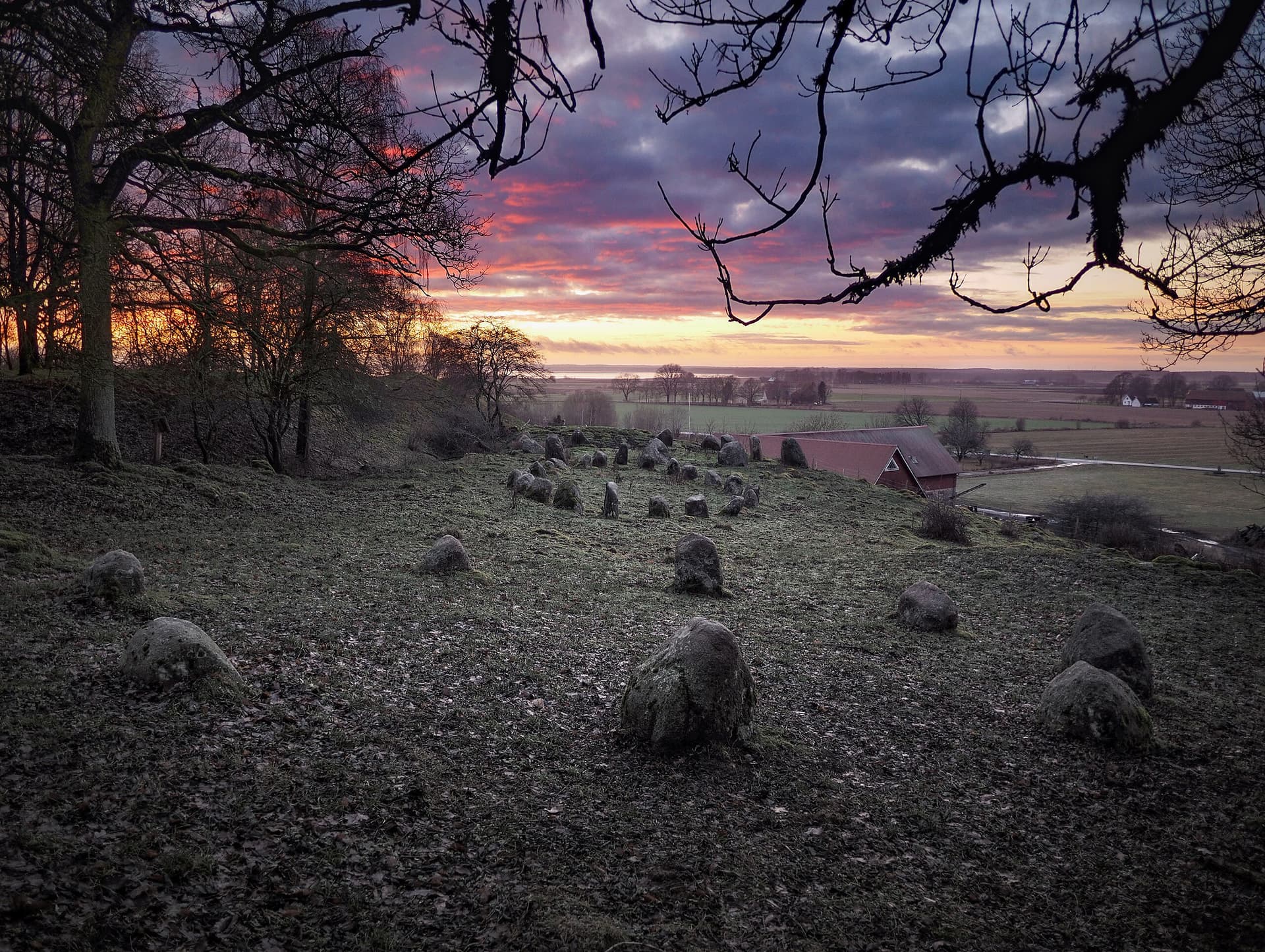
Near the village of Tidan in Vastergotland, twenty-four boulders weighing up to thirty tonnes each stand arranged in an oval formation fifty-five metres long. Sweden's second largest stone ship defies classification: no burial was found within it, it lacks the characteristic stem stones of a true ship setting, and scholars have proposed it as everything from a burial monument to an Odin worship hall. Its purpose remains one of Swedish archaeology's enduring mysteries.
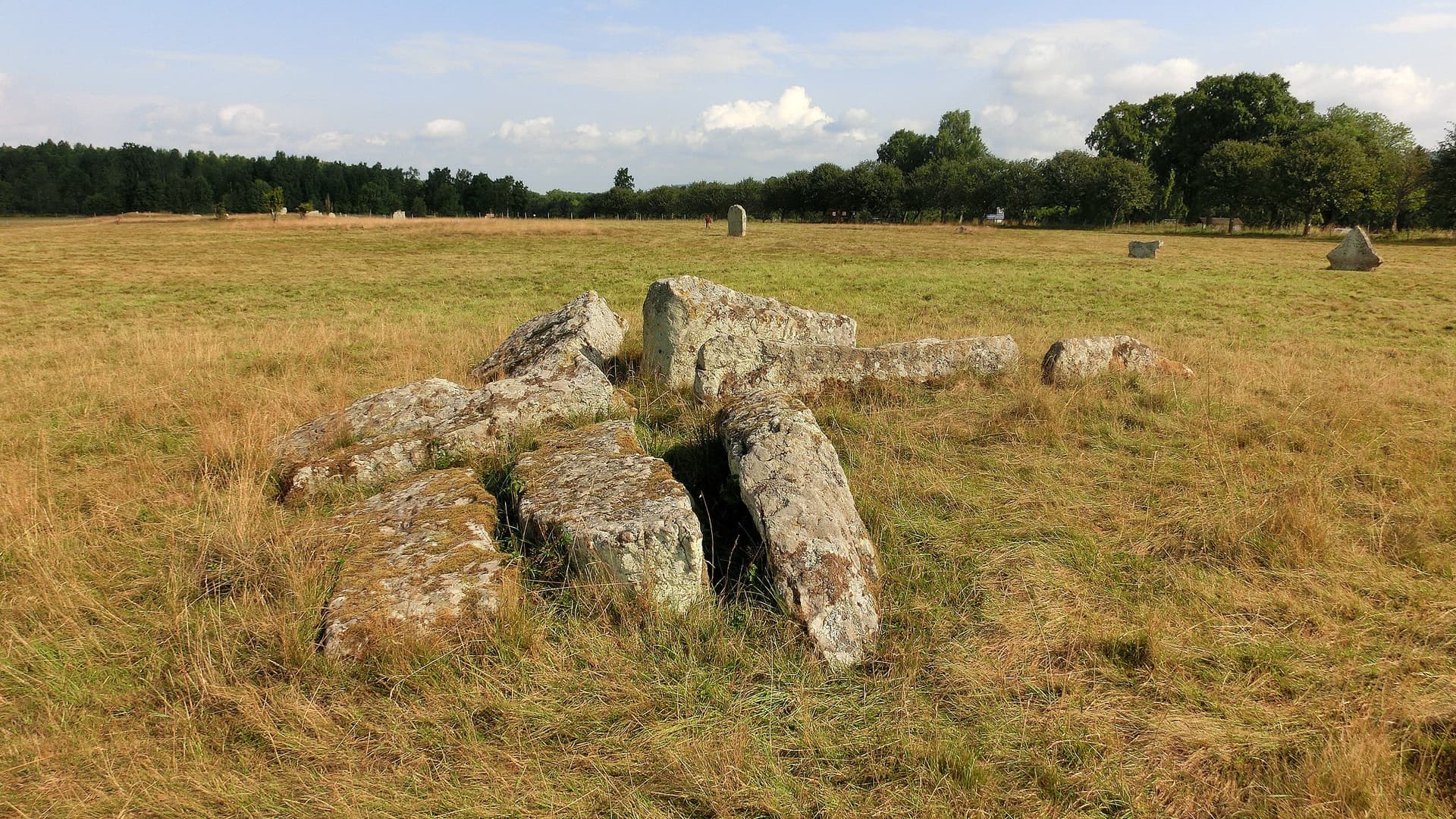
Askeberga Stone Ship is a monument that resists explanation. Twenty-four massive boulders, each weighing between fifteen and thirty tonnes, stand arranged in a broad oval fifty-five metres long and eighteen metres wide in open farmland near the village of Tidan. By conventional classification, the formation is Sweden's second largest stone ship. But it is not, strictly speaking, a ship. It lacks the characteristic stern and bow stones that define the stone ship tradition. No burial was found when the interior was examined in the 1920s. Its purpose remains genuinely unknown.
The National Property Board tentatively dates the formation to the Late Iron Age, around 500 AD, but even this is uncertain. The sheer weight of the individual stones, some approaching thirty tonnes, poses questions that no theory has fully answered. Transporting and positioning these boulders required communal effort on a scale that implies deep significance, whatever that significance may have been.
Local tradition offers one answer. The stones are also known as Ranes stenar, Rane's Stones, named after King Rane, a ruler of the Vadsbo district whose burial mound lies a few kilometres to the southwest in Flistad. According to Icelandic sagas, Rane was a name used by the god Odin when traveling the human world in disguise. This connection has generated the hypothesis that Askeberga may have been a hall or sacred gathering place for Odin worship, the missing stem stones functioning as entrances to what was once a roofed or enclosed ritual space.
Other interpretations place it as a thing site, a communal assembly place for legal proceedings and trade, consistent with the area's known importance as a trading center in the medieval period. The nearby Lake Osten area was a wealthy region with extensive trade connections, and several medieval churches and the estate of Vad confirm the area's historical significance.
None of these theories has been confirmed. Ground-penetrating radar investigations are ongoing at both the stone ship and King Rane's Mound, promising new data that may resolve questions that have persisted for centuries. Until then, Askeberga offers something increasingly rare: a genuinely unsolved mystery, a monument whose builders knew its purpose but chose not to record it in any form we can read.
Context And Lineage
Sweden's second largest stone ship formation, an anomalous monument of uncertain date and purpose connected by legend to King Rane and the god Odin.
The formation's origin remains genuinely unknown. Local tradition associates it with King Rane, a ruler of the Vadsbo district whose burial mound lies nearby. The stones are known as Ranes stenar, and according to Icelandic sagas, Rane was a name adopted by the god Odin when traveling the human world in disguise.
This connection has generated several origin theories. If the site was an Odin worship hall, the massive boulders may have supported a roofed structure used for ceremonial gatherings. If it was a thing site, the formation served as an assembly place where the people of the district gathered for legal proceedings, trade, and governance. If it was a burial monument, the 1920s examination may have missed evidence that lies deeper beneath the surface.
The area's medieval significance supports several of these interpretations. The nearby Lake Osten region was a prosperous trading area, and the medieval estate of Vad and several medieval churches confirm a long history of settlement and economic importance.
Askeberga sits within the broader Scandinavian stone ship tradition, where ship-shaped stone formations were erected as burial monuments or ceremonial markers. However, its anomalous features, including its immense scale, the absence of stem stones, and the lack of any discovered burial, set it apart from this tradition. The connection to King Rane and the god Odin places it within Norse mythological geography, while the area's medieval importance as a trading center suggests continuity of significance across the pre-Christian and Christian periods.
King Rane
Legendary ruler of the Vadsbo district, whose name attaches to the stones and whose burial mound lies nearby in Flistad
Why This Place Is Sacred
The unresolved mystery of twenty-four massive boulders whose purpose remains unknown creates a space where uncertainty itself becomes a form of reverence.
The thinness at Askeberga is the thinness of not knowing. Most sacred sites carry interpretive frameworks that help visitors organize their experience: this was a temple, this was a burial, this was a place of pilgrimage. Askeberga offers no such guidance. The stones stand in their formation, enormous and unexplained, and the visitor is left to reckon with the gap between the monument's undeniable importance and the complete absence of certainty about what it was for.
Approach the formation across the open farmland and the first impression is of scale. The boulders are not delicate standing stones but massive rounded forms, broader than they are tall, each one weighing as much as a loaded truck. They sit heavily in the ground, some partially sunken, their surfaces weathered by whatever span of time has passed since they were placed here. The oval they form is large enough to contain a substantial building, which is precisely what some theories propose.
Stand within the formation and look outward through the gaps between the stones. The landscape is open and agricultural, the kind of Swedish countryside that appears unremarkable until you realize that someone chose this specific place to position thirty-tonne boulders. The labor involved was extraordinary. These stones were not gathered from the immediate vicinity but transported from elsewhere, positioned with deliberation, and arranged in a formation that has no exact parallel in Scandinavian archaeology.
The Odin connection deepens the mystery rather than resolving it. If Rane was indeed a name used by the wandering god, then the stones may mark a place where the divine and human worlds were understood to intersect. Odin, in Norse mythology, is the god of wisdom, death, poetry, and the passage between states of being. A site associated with Odin is a site associated with transformation and the crossing of boundaries, including the boundary between knowledge and unknowing.
The ongoing ground-penetrating radar investigations hold the possibility of answers. Beneath the surface, evidence may exist that no previous investigation has found: burials missed by the 1920s examination, structural features of a building, or artifacts that would establish the site's function. Until such evidence emerges, Askeberga remains a place where the appropriate response is attentive uncertainty.
Unknown. Proposed functions include burial monument, ceremonial meeting place, legal assembly (thing site), trading center, and Odin worship hall. The absence of burials in the 1920s examination and the lack of characteristic ship stones make the monument anomalous within known Scandinavian traditions.
The formation has been a subject of local legend and scholarly speculation for centuries. The association with King Rane links it to both historical and mythological tradition. Modern archaeological investigation, including ongoing ground-penetrating radar studies, continues to seek answers. The site is now part of the Platabergens UNESCO Global Geopark, designated in 2022.
Traditions And Practice
No formal practices are conducted. The site invites contemplative engagement with archaeological mystery and the physical presence of unexplained monumental stones.
The original practices associated with Askeberga are unknown. If the formation was a stone ship, it would have been connected to Norse afterlife beliefs and the symbolic journey of the dead by ship to the next world. If it was a thing site, it would have hosted communal assemblies for legal proceedings, trade, and social gatherings. If it was an Odin worship hall, ceremonies connected to the Norse god of wisdom, death, and transformation may have been conducted within the stone enclosure.
No formal religious or ceremonial practices take place at the site. Askeberga is visited as an archaeological monument and a popular excursion destination within the Platabergens Geopark. Ongoing ground-penetrating radar investigations are seeking to establish the site's function.
Approach Askeberga with willingness to sit with uncertainty. This is a site whose purpose is genuinely unknown, and the most honest engagement with it begins by acknowledging that gap rather than filling it with assumptions.
Walk the perimeter first, registering the scale and weight of the individual boulders. Consider the effort required to transport and position stones weighing up to thirty tonnes each. Whatever this formation was for, it mattered enough to its builders to justify extraordinary labor.
Enter the formation and find a place to sit or stand within the oval. Spend time in the enclosed space. Notice how the stones alter the acoustic and spatial quality of the environment, creating a sense of interiority even without walls or a roof. If the Odin worship hall theory has merit, this spatial quality may have been central to the site's function.
If you visit King Rane's Mound afterward, consider the relationship between the two sites. If they are connected, they may represent different aspects of a single sacred landscape: the stone formation as a place of ceremony and the mound as a place of burial.
Norse Iron Age Stone Ship Tradition
HistoricalAskeberga is Sweden's second largest stone ship formation, consisting of twenty-four boulders weighing up to thirty tonnes each arranged in an oval fifty-five metres long. Stone ships in Norse tradition symbolized the journey to the afterlife. However, Askeberga is anomalous: it lacks characteristic stem stones, no burial was found in the 1920s, and its scale sets it apart from other stone ships. These differences have led to alternative theories about its function as a ceremonial meeting place, thing site, or Odin worship hall.
In the broader stone ship tradition, the deceased was cremated or inhumed within the ship outline with appropriate grave offerings. At Askeberga, the 1920s examination found no burial, suggesting the monument may have served a different purpose entirely, whether as a gathering space, assembly site, or ceremonial enclosure.
King Rane Legend and Odin Association
HistoricalLocal tradition associates the site with King Rane, a ruler of the Vadsbo district, and the stones are also known as Ranes stenar. According to Icelandic sagas, Rane was a name used by the god Odin when traveling in disguise. The association has generated the theory that Askeberga may have been a sacred site for Odin worship, with the formation serving as a ritual hall or gathering place.
If the Odin cult theory is correct, the site may have hosted ceremonies associated with Odin worship, including rituals connected to wisdom, death, transformation, and the passage between states of being. The adjacent King Rane's Mound may have been part of a larger sacred landscape connecting royal power with divine authority.
Experience And Perspectives
Walk among twenty-four massive boulders in an open Swedish landscape and sit with the genuine mystery of a monument whose purpose has eluded scholars for centuries.
Askeberga Stone Ship is reached by local roads from the Skovde area, signposted from the approach routes. A parking area provides access to the formation, which sits in open farmland near the village of Tidan. The transition from car to monument is immediate: there is no visitor center, no pathway, no graduated approach. You park and walk into the presence of twenty-four boulders of extraordinary size.
The scale registers first. These are not the slender standing stones found at many Scandinavian sites but broad, heavy boulders, some approaching two metres in height and weighing up to thirty tonnes. They sit in the ground with a stability that makes their placement seem almost geological, as if they grew from the earth rather than being transported and positioned by human effort.
Walk the perimeter of the formation first. The oval shape, fifty-five metres long and eighteen metres wide, becomes clearest from outside the stone ring. Note the absence of the characteristic stern and bow stones that would make this a true stone ship. The ends of the oval are open, which has fueled the theory that these openings served as entrances to an enclosed or roofed space.
Then enter the formation and stand within. The interior is large enough to feel enclosed by the surrounding stones even though there are gaps between them. The atmosphere within the oval is different from the open landscape outside, a subtle shift in acoustic quality and spatial feeling that may explain some of the site's persistent spiritual associations.
The information boards present the various theories about the site's purpose without favoring any single explanation. Read them, but give yourself time within the formation first. The experience of standing among genuinely unexplained stones, of confronting a mystery that centuries of scholarship have not resolved, is itself valuable. Not every ancient site needs to be understood to be meaningful.
King Rane's Mound, one of Skaraborg's largest burial mounds, lies a few kilometres to the southwest in Flistad and can be visited as a companion site, potentially forming part of the same sacred landscape.
Askeberga Stone Ship is located near the village of Tidan, approximately twenty-five kilometres north of Skovde in Vastergotland. The site is signposted from local roads. Parking is available adjacent to the formation.
Askeberga has attracted speculation for centuries precisely because it defies the categories available to explain it. Each interpretive framework illuminates aspects of the monument while leaving its central mystery intact.
Archaeologists classify Askeberga as Sweden's second largest stone ship, though its lack of characteristic stern stones and the absence of any burial found in the 1920s examination make it atypical. The National Property Board tentatively dates it to the Late Iron Age, around 500 AD. Ground-penetrating radar investigations are ongoing at both the stone ship and King Rane's Mound. The site remains one of Sweden's great archaeological mysteries, with no consensus on whether it served as a burial monument, meeting place, or ceremonial site.
Local legend connects the site to King Rane, a ruler of the Vadsbo district whose burial mound lies nearby. The association with Odin, who allegedly used the name Rane when visiting the human world, reflects how medieval Scandinavians interpreted prehistoric monuments through their own cultural and religious framework, linking the physical landscape to the world of gods and saga heroes.
The Odin cult theory proposes that Askeberga was a hall for Odin worship, with the missing stem stones serving as entrances to a roofed or enclosed sacred space. Some modern spiritual practitioners view the site as a power place connected to the Norse god of wisdom and the passage between worlds. The ship shape, if intentional, is read as a cosmic vessel linking earthly and spiritual realms.
The fundamental question at Askeberga is its purpose. Despite being one of Sweden's most prominent prehistoric monuments, no one has convincingly explained why twenty-four boulders weighing up to thirty tonnes each were transported and arranged in this formation. The absence of any burial, the lack of typical ship stones, and the enormous scale all set it apart from other stone ships in Scandinavia. How the builders transported and positioned stones of such immense weight remains unexplained. Whether the stone ship and King Rane's Mound form part of a larger sacred landscape has yet to be established.
Visit Planning
Near Tidan village, approximately twenty-five kilometres north of Skovde. Freely accessible year-round. Allow thirty minutes to one hour.
Located near the village of Tidan, approximately twenty-five kilometres north of Skovde in Vastergotland. Accessible by car with parking available at the site. Signposted from local roads. Freely accessible at all times. No admission charge.
Skovde offers a range of hotels and guesthouses. Tidan and the surrounding rural area have limited accommodation options.
Respect the formation as a protected archaeological monument. Do not climb on the stones.
Askeberga Stone Ship is a protected cultural heritage monument of national significance. The massive boulders, though they appear impervious to damage, should not be climbed on, leaned against, or used as seating. The ground within and around the formation should not be disturbed.
The site is unstaffed and unfenced, reflecting the Swedish tradition of open access to cultural heritage monuments. This openness depends on visitors treating the site with appropriate care.
No specific dress requirements. Sturdy footwear recommended for the open farmland terrain.
Photography is permitted throughout the site.
Do not leave objects at the site.
Do not climb on the stones. No digging or disturbing the site. Protected under Swedish cultural heritage law (Kulturmiljolagen). Part of the Platabergens UNESCO Global Geopark.
Sacred Cluster
Nearby sacred places create the location cluster described in the growth plan. This block is intentionally crawlable and links into the wider regional graph.