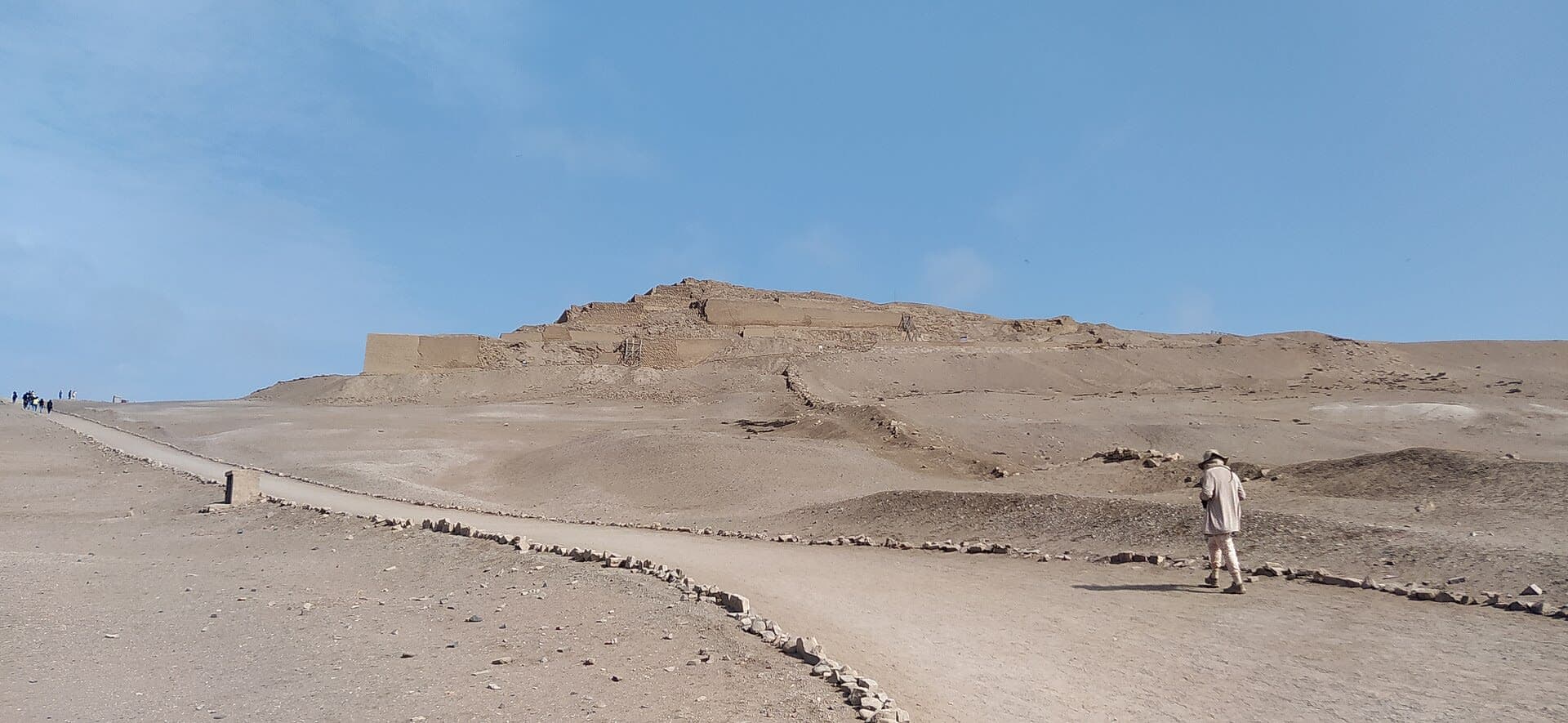
Archaeological Sanctuary of Pachacamac
For 1,300 years, pilgrims crossed Peru to consult the oracle of the Earth Maker—the god who could move the world with a single nod
Lurín, Lima, Peru
At A Glance
- Coordinates
- -12.2584, -76.9014
- Suggested Duration
- Half day minimum; full day recommended for thorough exploration.
Pilgrim Tips
- Sun protection essential—hat, sunscreen, appropriate clothing. Comfortable walking shoes for the extensive site.
- Photography permitted throughout the site. Flash may be restricted in the museum.
- The site is extensive; allow several hours. Sun protection essential—the coastal desert offers little shade. Some structures may be closed for conservation.
Overview
Pachacamac was Peru's most powerful oracle for over a millennium. Named for the creator god Pacha Kamaq—the 'Earth Maker' who could cause earthquakes with a single movement of his head—this sanctuary near Lima drew pilgrims from across the ancient Andes seeking answers to their most urgent questions: matters of war, harvest, and destiny. Four cultures built here over 1,300 years: Lima, Wari, Ychma, and finally Inca. Today, more than 50 temples spread across 450 hectares remain as testimony to the accumulated devotion of countless seekers.
Pachacamac sprawls across 450 hectares near the Pacific coast, just 36 kilometers from modern Lima, yet worlds away in time and purpose. This was the seat of the oracle of Pacha Kamaq—the Earth Maker—the most powerful divination center on the Pacific coast for over 1,300 years.
The name reveals the power. Pacha Kamaq means 'creator of the world' in Quechua. This god could reveal the future. He could grant divine favors. Most terrifyingly, with a single movement of his head, he could cause the earth to tremble. In earthquake-prone Peru, that power demanded respect.
Pilgrims came from across the Andes to consult the oracle. The priests who interpreted divine signs resolved crucial matters: wars were decided, harvests predicted, political destinies revealed through complex rituals, sacrifices, and offerings. The Plaza de los Peregrinos—Pilgrims' Square—provided space for the many seekers who gathered to wait their turn before the god.
Four cultures built at Pachacamac over 1,300 years. The earliest major construction dates to the Early Intermediate Period (c. 200 BC-AD 600), attributed to the Lima culture. The Wari expanded the site during their period of influence (600-1100 AD). The Ychma maintained it from 1100-1470 AD. Finally, the Inca incorporated Pachacamac into their empire, building the sun temple that now dominates the site—the highest structure, connecting Earth Maker worship with solar religion.
The Inca recognized Pachacamac's power rather than replacing it. They added their temple but preserved the oracle. When the Spanish arrived, they found a sanctuary that had accumulated sacred power for more than a millennium—a place so holy that multiple empires had chosen incorporation over destruction.
Today, the Pachacámac Museum displays the material culture of these successive occupations: ceramics, textiles, and tools that speak of four cultures united in their reverence for the god who made the earth and could unmake it at will.
Context And Lineage
Pachacamac served as Peru's most important oracle for over 1,300 years, with four cultures—Lima, Wari, Ychma, and Inca—building here to access the power of Pacha Kamaq, the Earth Maker who could cause earthquakes with a nod of his head.
The oracle at Pachacamac began in the Early Intermediate Period, around 200 BC. The Lima culture constructed the first major buildings, including the terraced adobe pyramid known as the Temple of Pachacamac. Even at this early date, the site drew pilgrims who believed the god could reveal the future.
Pacha Kamaq—the Earth Maker—was a creator god of terrifying power. He had made the world and could unmake it. In earthquake-prone Peru, his ability to shake the earth with a single movement of his head made him supremely powerful. The oracle at Pachacamac claimed to interpret his will.
The Wari culture expanded the site during their period of influence (600-1100 AD), adding structures that respected what came before while extending the ceremonial complex. The Ychma maintained and developed Pachacamac from 1100-1470 AD, preserving the oracle tradition through political changes.
When the Inca conquered this region around 1470, they made an unusual choice. Rather than destroying the existing shrine and imposing their solar religion, they built their sun temple alongside the oracle of the Earth Maker. The Inca recognized Pachacamac's power; they chose incorporation over replacement.
The Incan sun temple became the highest structure at the site, visually dominant but theologically complementary. The oracle continued to function; pilgrims continued to come. When the Spanish arrived, they found a sanctuary that had accumulated devotion for over 1,300 years—a place multiple empires had chosen to honor rather than destroy.
Lima culture origins (200 BC-AD 600), Wari expansion (600-1100 AD), Ychma maintenance (1100-1470 AD), Inca incorporation (1470-1533 AD). Multi-cultural pilgrimage tradition spanning over 1,300 years.
Pacha Kamaq (Earth Maker)
Deity
Arturo Jiménez Borja
Museum founder
Why This Place Is Sacred
Pachacamac's thin quality emerges from its function as ancient Peru's greatest oracle—where the veil between human knowledge and divine revelation grew thin for over a millennium—combined with the accumulated devotion of four successive cultures who built here to access the Earth Maker's power.
Oracle sites represent thin places of particular intensity, and Pachacamac was the greatest oracle on the Pacific coast. For 1,300 years, pilgrims crossed Peru to seek answers that ordinary knowledge could not provide. Each question asked, each offering deposited, each answer received added to the site's accumulated power. The thinness here was created by countless seekers whose need drew them to this place where the Earth Maker spoke.
The god himself was terrifying in his power. Pacha Kamaq made the world and could unmake it. In earthquake-prone Peru, where the earth regularly reminded humans of their fragility, the god who controlled seismic power commanded absolute respect. To approach his oracle was to approach the power that could destroy everything.
Four cultures built at Pachacamac—not replacing each other but adding to what came before. This unusual pattern of incorporation rather than destruction suggests that each successive power recognized something at this site that transcended political control. The Inca, who elsewhere destroyed what came before them, here built their sun temple alongside the existing shrines. The accumulated sacredness was too powerful to erase.
The Plaza de los Peregrinos creates a specific thin space—the antechamber where pilgrims waited before approaching the oracle. Imagine the anxiety of that waiting: questions prepared, offerings ready, the god's response unknown. The space absorbed that anxiety, that hope, that fear across more than a thousand years.
Pachacamac's location near the Pacific adds coastal power to earth-based worship. The sea's edge represents another boundary; the god who controlled earthquakes operated where land met water met sky. This convergence of boundaries multiplied the site's thin quality.
Oracle sanctuary dedicated to Pacha Kamaq, the Earth Maker god. Pilgrims from across the Andes came to seek divination on matters of war, harvest, and destiny.
Four cultures built here over 1,300 years: Lima (200 BC-AD 600), Wari (600-1100 AD), Ychma (1100-1470 AD), Inca (1470-1533 AD). Each added to rather than replaced what came before.
Traditions And Practice
Oracle consultations resolved matters of war, harvest, and destiny through rituals, sacrifices, and offerings interpreted by priests. Pilgrims gathered in the Plaza de los Peregrinos before approaching the god. Sun worship at the Inca temple complemented Earth Maker devotion.
Oracle consultations for matters of war, harvest, and politics. Complex rituals, sacrifices, and offerings. Divination through priestly interpretation of divine signs. Pilgrimage ceremonies in the Plaza de los Peregrinos. Sun worship at the Inca temple.
The site functions as Lima's largest and most significant archaeological destination. The Pachacámac Museum provides educational context. Academic research continues to reveal new aspects of the oracle tradition.
Visit the museum first to understand the cultural succession. Explore the temples from different periods, noting how each culture added to rather than replaced what came before. Spend time at the Plaza de los Peregrinos imagining the pilgrims who waited here. Climb to the Inca sun temple for views and reflection.
Multi-Cultural Oracle Tradition
HistoricalPachacamac served as Peru's greatest oracle for over 1,300 years, with four successive cultures—Lima, Wari, Ychma, and Inca—building at the site to access the power of the Earth Maker god.
Oracle consultations, pilgrimage ceremonies, sacrifices and offerings, priestly divination, sun worship (Inca period).
Experience And Perspectives
Explore over 50 temples across 450 hectares where four cultures built to access the Earth Maker's oracle. Climb to the Inca sun temple for Pacific views, walk the Plaza de los Peregrinos, and visit the museum to understand 1,300 years of accumulated devotion.
Pachacamac lies just 36 kilometers from Lima's center, in the Lurín district—close enough for a day trip, far enough to feel like genuine departure from the modern city. The 450-hectare site contains more than 50 temples and structures, testimony to 1,300 years of continuous sacred building.
Begin at the Pachacámac Museum, created in 1965 by Arturo Jiménez Borja. The collection displays ceramics, textiles, and tools from the Lima, Wari, Ychma, and Inca periods—material evidence of four cultures united in their reverence for the Earth Maker. Understanding this succession prepares you for what you'll encounter at the site itself.
Enter the archaeological zone and find the temples that represent each cultural period. The earliest structures from the Lima period show the oracle's origins. Wari and Ychma additions demonstrate how successive powers incorporated rather than replaced what they found. Notice how each culture added to the accumulated sacredness rather than starting fresh.
Seek out the Plaza de los Peregrinos—the Pilgrims' Square. This rectangular space next to the Temple of the Sun served as the antechamber for those who came to consult the oracle. Stand where pilgrims waited across more than a millennium, preparing their questions, readying their offerings, uncertain what answers the god would provide.
Climb to the Inca sun temple—the highest structure at the site. The Inca added this temple after their conquest, integrating their solar religion with the existing Earth Maker cult. From the summit, views extend to the Pacific Ocean and across the Lurín Valley—the landscape over which Pacha Kamaq held sway.
Consider what it meant to consult an oracle who could cause earthquakes. The priests who interpreted the god's signs held extraordinary power. Wars were decided, harvests predicted, political destinies sealed based on their interpretations. The responsibility—and the potential for abuse—was immense.
The site's proximity to Lima makes it uniquely accessible among major Peruvian archaeological sites. Yet its 1,300-year history of pilgrimage gives it significance comparable to any site in the Andes.
Located 36 km from Lima's center in the Lurín district. The site covers 450 hectares with more than 50 temples. The Pachacámac Museum is located at the site entrance.
Pachacamac can be understood as ancient Peru's most powerful oracle, as a site where four cultures built in succession, as a demonstration of how sacred places can transcend political conquest, or as Lima's most significant archaeological treasure.
Archaeological research has documented the site's multi-cultural construction history and its function as a major pilgrimage center. The decision of successive cultures to incorporate rather than destroy raises questions about how sacred power was understood in pre-Columbian Peru.
The oracle of Pacha Kamaq held the power to reveal divine will on the most crucial matters. The god's ability to cause earthquakes made him supremely important in seismically active Peru.
The site's incorporation by multiple cultures suggests that sacred power was understood as location-based rather than tradition-based—the place held power regardless of who controlled it politically.
The specific mechanics of oracle consultation. The training and selection of priests who interpreted divine signs. The extent to which the oracle was manipulated for political purposes.
Visit Planning
Located 36 km from Lima center, easily accessible for a day trip. Open Monday-Sunday 9:00 AM-5:00 PM. The Pachacámac Museum provides essential context. Allow half day minimum for site and museum.
Full range of accommodations in Lima. Day trip from the capital is standard.
Approach with reverence for a site where pilgrims sought divine guidance for over 1,300 years. Do not disturb archaeological features or climb on structures not designated for visitor access.
Pachacamac accumulated sacred power over 1,300 years of pilgrimage. Four cultures built here; countless seekers asked their questions of the Earth Maker. Treat the site with the reverence this history deserves.
Sun protection essential—hat, sunscreen, appropriate clothing. Comfortable walking shoes for the extensive site.
Photography permitted throughout the site. Flash may be restricted in the museum.
No offerings at archaeological structures. Support the site through entrance fees and museum purchases.
Stay on designated paths. Do not climb on structures unless specifically permitted. Do not remove any materials from the site.
Sacred Cluster
Nearby sacred places create the location cluster described in the growth plan. This block is intentionally crawlable and links into the wider regional graph.