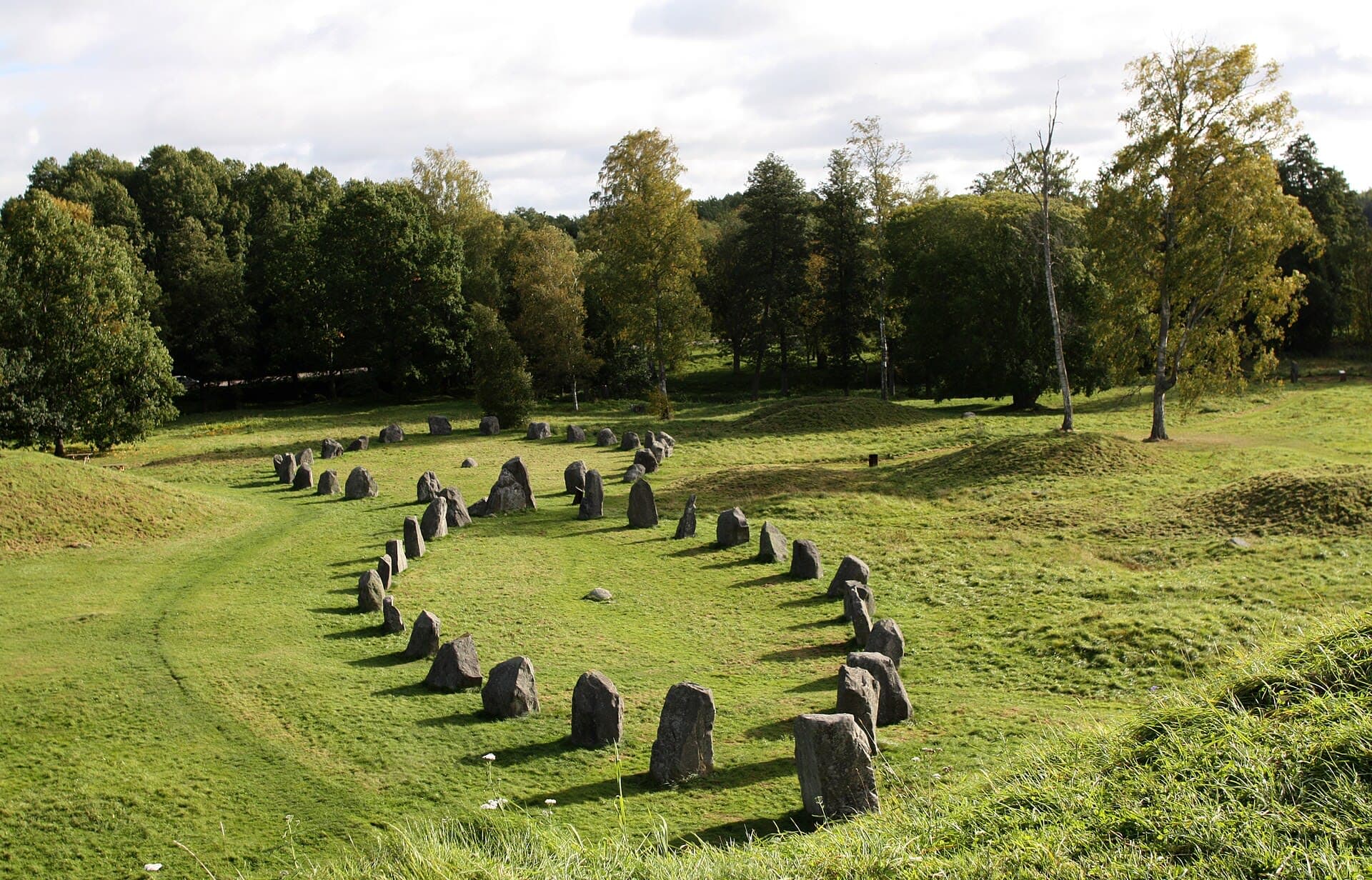
Anundshög Stone Ship
Sweden's largest burial mound, where stone ships converge at the threshold between death and governance
Västerås, Västmanlands län, Sweden
At A Glance
- Coordinates
- 59.6304, 16.6450
- Suggested Duration
- One to two hours to explore the full complex, including climbing the mound and visiting the stone ships, runestone, and other features. Longer if attending summer programs.
- Access
- Located at Badelundaasen, approximately five kilometres northeast of Vasteras city centre. Free admission. Parking available. Accessible by car or bus from Vasteras. Cafe Anund on site provides refreshments and audio guides.
Pilgrim Tips
- Located at Badelundaasen, approximately five kilometres northeast of Vasteras city centre. Free admission. Parking available. Accessible by car or bus from Vasteras. Cafe Anund on site provides refreshments and audio guides.
- No specific dress requirements. Sturdy footwear recommended for climbing the mound and walking the ridge.
- Photography is permitted throughout the site.
- The mound is permitted for climbing but the slope can be slippery when wet. The site has been targeted by illegal looters; any suspicious activity should be reported. Standard outdoor footwear recommended for the ridge terrain.
Overview
Five kilometres from Vasteras, Sweden's largest burial mound rises nine metres above a ridge lined with stone ships, runestones, and hundreds of Iron Age graves. This was both a necropolis and a place of living authority, where Viking Age assemblies met to settle law and where newly elected kings passed on the Eriksgata route to receive the people's confirmation. The mound has never been fully excavated. Its contents remain unknown.
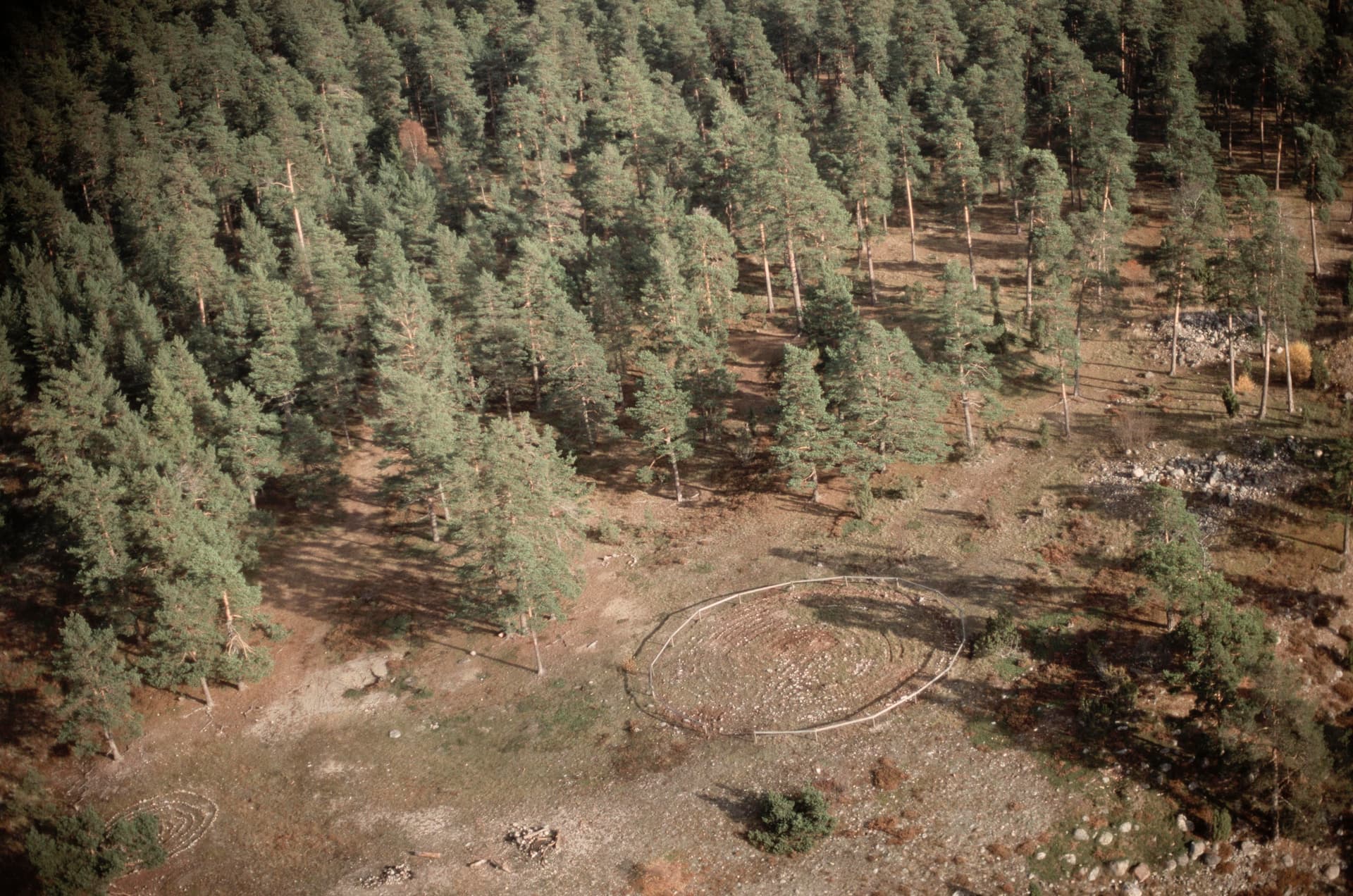
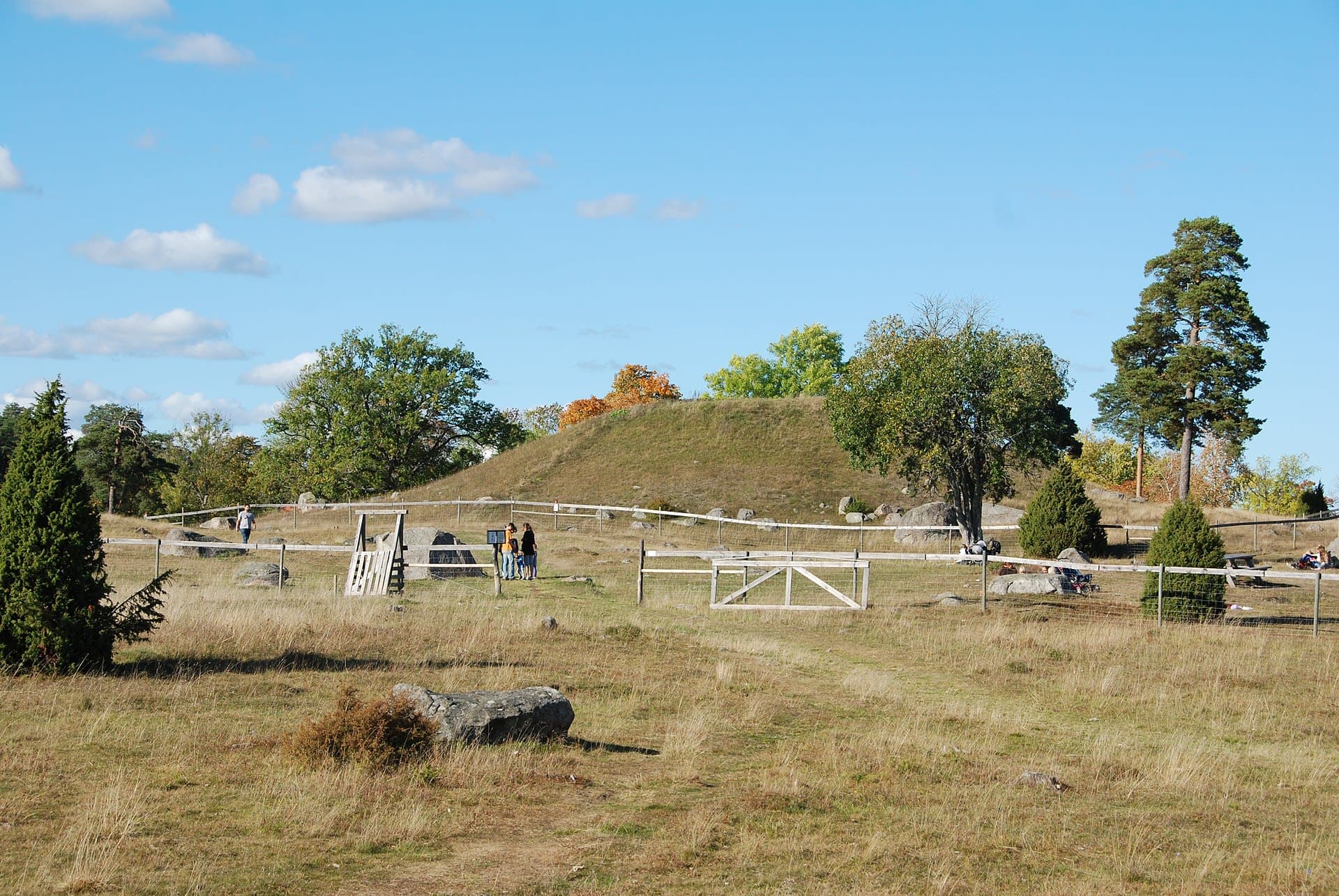
Anundshog is where death and governance converge. Sweden's largest burial mound, sixty to sixty-eight metres in diameter and nine metres high, rises from the Badelunda ridge northeast of Vasteras, surrounded by an archaeological landscape of extraordinary density: five stone ships, twelve smaller mounds, ten stone circles, fourteen standing stones, a runestone, and an estimated two thousand graves beneath the surface.
The mound is traditionally associated with King Anund, a semi-legendary seventh-century Swedish king of the House of Yngling, described in Snorri Sturluson's Ynglinga saga as a just ruler who brought peace after his father's wars. Whether Anund truly lies within the mound is unknown. The mound has never been fully excavated. A fireplace beneath it has been radiocarbon dated to AD 210-540, placing the site's origins in the Roman Iron Age, but the mound itself likely dates to the later period of 500-900 AD.
At the base of the mound, two stone ships face each other, their prows nearly touching. In Norse tradition, stone ships represented the vessel carrying the dead to the afterlife, and the paired formation at Anundshog creates a powerful image of convergence at the boundary between worlds. The runestone nearby, Vs 13, records that a man named Folkvid raised the standing stones and built the road past the mound in memory of his son Heden, described as Anund's brother. This eleventh-century inscription provides the name that was later applied to the mound itself.
But Anundshog was not only a place of the dead. It served as a thing site, a legal assembly where the people of Vastmanland gathered for governance and dispute resolution. It was also a waypoint on the Eriksgata, the traditional journey newly elected Swedish kings made through the kingdom's provinces to receive popular confirmation. A row of fifteen standing stones marks the Eriksgata route past the mound. At Anundshog, the authority of the living king was confirmed in the presence of the ancestral dead, a deliberate interweaving of political legitimacy with ancestral power.
Evidence of deliberate medieval destruction, including toppled stone ships, a thrown-down runestone, and missing grave goods, suggests the site was targeted during the Christianization of Sweden. What was so threatening about Anundshog that it needed to be physically dismantled? The answer likely lies in exactly the convergence the site embodies: a place where Norse pagan religion, ancestral veneration, and political authority were inseparable.
Context And Lineage
Sweden's largest burial mound, associated with a legendary Yngling king, surrounded by stone ships and hundreds of graves at a site that served as both necropolis and legal assembly.
The mound is named after the semi-legendary King Anund of the House of Yngling, described in Snorri Sturluson's Ynglinga saga as a seventh-century Swedish king who succeeded his father Yngvar and brought peace and good harvests to the realm. Whether Anund is truly buried within the mound remains unconfirmed, as the mound has never been fully excavated.
The story that can be confirmed through inscription belongs to Folkvid, who in the early eleventh century paid for the road past Anundshog, marked it with standing stones, and erected the runestone Vs 13 in memory of his son Heden. The inscription describes Heden as Anund's brother, providing the name that attached to the mound. Folkvid's act of memorialization, raising stones and building roads as acts of grief and commemoration, represents a tradition that connected personal loss to public landscape.
The deliberate medieval destruction of the site, with stone ships toppled, the runestone thrown down, and grave goods apparently removed, marks the violent transition from Norse paganism to Christianity. The site was too powerful in its pagan associations to be left intact.
Anundshog connects to the Yngling dynasty, one of the foundational royal lineages of Scandinavian history. The Eriksgata tradition, linking the site to the medieval Swedish monarchy's confirmation rituals, extends the lineage from legendary kings through the historical kingdom. The site's role as a thing assembly places it within the broader Scandinavian tradition of communal governance that produced the Icelandic Althing and similar institutions. The deliberate destruction during Christianization connects it to the continent-wide transition from Norse paganism to Christianity.
King Anund
Semi-legendary seventh-century Swedish king of the House of Yngling, traditionally associated with the burial mound
Folkvid
Powerful eleventh-century man who raised the standing stones, built the road, and erected the runestone in memory of his son Heden
Snorri Sturluson
Icelandic historian whose Ynglinga saga preserves the tradition of King Anund and the Yngling dynasty
Why This Place Is Sacred
At the intersection of the largest burial mound in Sweden and a living assembly place, the membrane between death and governance, between ancestral authority and present power, grows thin.
The thinness at Anundshog is layered and civic. This is not a site of solitary spiritual encounter but a place where the dead participated in the governance of the living, where the boundary between the ancestral realm and the political realm was deliberately maintained as thin as possible.
Climb the mound. You are permitted to do so, and the ascent is part of the experience. The slope is grass-covered and moderate, but the mound's height, nine metres above the surrounding ridge, provides enough elevation to transform your perspective. From the summit, the Badelunda landscape unfolds: the paired stone ships at the base, the smaller mounds and stone circles spreading along the ridge, and in the distance, the modern city of Vasteras. Stand here and you stand on the largest burial mound in Sweden, possibly atop the remains of a king whose identity has been debated for centuries.
The paired stone ships at the mound's base create the site's most evocative image. Two ship outlines face each other, their prows nearly meeting, as if two vessels have arrived simultaneously at the same shore. In Norse cosmology, the stone ship carried the dead on their journey to the afterlife. Two ships converging at the foot of the greatest mound suggest a threshold, a place where the voyage ends and the dead enter whatever lies beyond.
The thing site dimension adds a quality that is less mystical but equally profound. Here, the living gathered to make law, settle disputes, and confirm their kings, not in a purpose-built hall but in the presence of the ancestral dead. The fifteen standing stones marking the Eriksgata route would have been visible as the newly elected king approached, a procession through a landscape defined by death and memory on the way to receiving the people's assent. The authority conferred was not merely political but ancestral. The king was approved in the sight of the dead.
The evidence of medieval destruction adds a charged quality. The stone ships were deliberately toppled. The runestone was thrown down. Grave goods appear to have been removed. This was not neglect but targeted erasure, an attempt to break the connection between the living and the pagan dead. The fact that the site was considered threatening enough to warrant physical destruction speaks to the reality of its power.
A monumental burial site for a high-status individual, possibly the semi-legendary King Anund of the Yngling dynasty. The surrounding complex served as a necropolis for the Badelunda community, a legal assembly (thing site), and a waypoint on the Eriksgata royal confirmation route.
The Badelunda area has been in use since the Iron Age, approximately 500 BC. The main mound likely dates to 500-900 AD. The runestone (Vs 13) dates to the early eleventh century. The site served as a thing assembly through the medieval period. Deliberate destruction during Christianization toppled stone ships and removed grave goods. The stone ships were restored from 1932 onward, and the runestone was re-erected in the 1960s. Today the site functions as a cultural heritage destination with summer guided tours, Viking-era activities, and midsummer celebrations.
Traditions And Practice
Summer guided tours and Viking-era activities bring the site to life. Year-round, the mound, stone ships, and runestone invite contemplative engagement with death, power, and ancestral memory.
Iron Age and Viking Age mound burial for high-status individuals, with the construction of stone ships as afterlife journey symbols. Thing assemblies for legal and governmental proceedings. The Eriksgata royal confirmation route past the site, marked by standing stones. Erection of runestones as memorial and commemorative markers. Evidence suggests human and animal sacrifice may have accompanied major burials.
Summer guided tours led by archaeologists offer deep historical context. The free Iron Age Life experience provides hands-on activities including handicrafts, runic writing, and period games. Midsummer celebrations are held at the site. Year-round group tours and lectures are available on request. Cafe Anund serves visitors. Audio guides are available.
Begin by climbing the mound. The ascent is gentle and the summit provides the essential overview of the entire complex. Spend time at the top, orienting yourself to the stone ships, standing stones, and smaller mounds visible from this elevated position.
Descend to the paired stone ships and stand between them, facing the mound. In Norse cosmology, these ships carried the dead to the afterlife. Converging at the base of the largest mound in Sweden, they mark a threshold that was understood as the point of arrival in the realm of the dead.
Walk the line of standing stones that marks the Eriksgata route. Newly elected kings traveled this path past the mound to receive the people's confirmation. Walking it yourself, past the runestone and alongside the monuments of the dead, offers a physical experience of the intersection between political authority and ancestral power.
Read the runestone inscription: Folkvid raised these stones in memory of his son Heden. The personal grief encoded in the inscription grounds the monumental landscape in individual human loss.
If visiting in summer, the guided tours add substantial depth. The Iron Age Life activities are particularly valuable for families and for anyone wanting to understand the material culture that produced these monuments.
Iron Age and Viking Age Burial and Ancestor Cult
HistoricalAnundshog is the largest burial mound in Sweden, surrounded by five stone ships, twelve smaller mounds, ten stone circles, fourteen standing stones, and a runestone. The Badelunda area contains approximately five hundred visible graves on the ridge, with potentially two thousand more underground. The stone ships symbolized the journey to the afterlife, and the concentration of burial monuments reflects the area's importance as a center of power across centuries.
Cremation and mound burial for high-status individuals. Construction of stone ships as afterlife journey symbols. Erection of standing stones and runestones to commemorate the dead. Evidence of deliberate medieval destruction suggests the monuments were so strongly associated with pre-Christian religion that they were targeted during Christianization.
Thing Assembly and Eriksgata Royal Route
HistoricalAnundshog served as a thing site where the people of Vastmanland gathered for governance, dispute resolution, and the confirmation of royal authority. The site was part of the Eriksgata, the traditional journey newly elected Swedish kings made through the kingdom's provinces. The row of standing stones and the Vs 13 runestone marks the route past the mound.
Legal assemblies held at the site for regional governance. Newly elected kings traveled the Eriksgata past Anundshog to receive confirmation from the people of Vastmanland. The eleventh-century Folkvid paid for the road, raised standing stones, and erected the runestone as acts of commemoration and public infrastructure intertwined.
Experience And Perspectives
Climb Sweden's largest burial mound and survey a landscape of stone ships, runestones, and hundreds of graves, then explore the complex where death and governance converged.
Anundshog lies along the Badelunda ridge, five kilometres northeast of Vasteras city centre. The approach by car or bus brings you to a parking area with a small cafe (Cafe Anund) and the beginning of the archaeological complex. The first impression is of openness: the ridge is broad and grassy, dotted with mounds and stone formations that extend in both directions.
The main mound commands the landscape. Sixty to sixty-eight metres in diameter and nine metres high, it is visible from a considerable distance and grows more imposing as you approach. Unlike many archaeological sites, visitors are permitted to climb the mound. The ascent takes a few minutes on a worn path up the grass slope. From the summit, the full extent of the Badelunda complex becomes visible: the paired stone ships at the base, the smaller mounds scattered along the ridge, the stone circles and standing stones, and the Vs 13 runestone marking the Eriksgata route.
Descend and walk to the stone ships. The two largest face each other at the mound's base, their prows nearly meeting. These were restored from 1932 onward after medieval destruction, but their placement and orientation preserve the original design. Stand between the converging ships and face the mound: you occupy the exact point where, in Norse cosmology, the journey of the dead reaches its destination.
The runestone, Vs 13, stands along the row of standing stones that marks the Eriksgata route. The inscription records that Folkvid raised the stones in memory of his son Heden, described as Anund's brother. The runic text is visible on the stone's surface, connecting you to a specific individual, Folkvid, who stood in this landscape over a thousand years ago and chose to mark his grief in stone.
During summer, the site comes alive with programming. Archaeologist-led guided tours offer deeper context, and the free Iron Age Life experience provides hands-on activities including handicrafts, runic writing, and period games. Audio guides are available from the cafe. These additions make Anundshog accessible to families and visitors seeking active engagement alongside contemplative exploration.
The broader Badelunda ridge extends beyond the main complex, with additional burial mounds and archaeological features along the walking paths. An hour or two allows for the main complex; a half day permits exploration of the wider landscape.
Anundshog is located at Badelundaasen, approximately five kilometres northeast of Vasteras city centre. Free admission. Parking available. Cafe on site. Accessible by car or bus from Vasteras.
Anundshog has been interpreted through saga literature, archaeological excavation, political history, and spiritual engagement. The convergence of these perspectives at a single site mirrors the convergence of death and governance that defines the place itself.
Archaeologists recognize Anundshog as Sweden's largest burial mound and one of the most important Iron Age and Viking Age complexes in the country. The Badelunda area is understood as a major center of power in western Malardalen, with hundreds of graves and monuments reflecting centuries of elite burial and communal assembly. The runestone Vs 13 is securely dated to the early eleventh century. The main mound's dating remains approximate. The site's function as a thing site and Eriksgata waypoint is well-documented from medieval sources. The stone ships were deliberately destroyed in the medieval period, likely during Christianization, and were restored from the 1930s onward.
The site is named after the semi-legendary King Anund of the Yngling dynasty, as recorded in Snorri Sturluson's Ynglinga saga. The Icelandic sagas portray Anund as a just ruler who brought peace after his father's wars. The runestone inscription by Folkvid connects the stone ships to personal commemoration, but the naming of the mound after Anund reflects how communities anchored their identity in legendary royal ancestors and how the presence of the dead shaped the authority of the living.
Modern Viking heritage enthusiasts and some pagan practitioners view Anundshog as one of Sweden's most concentrated sites of ancestral energy. The paired stone ships are interpreted as cosmic vessels connecting earthly and spiritual realms. The evidence of deliberate medieval destruction is read as confirmation of the site's potent pagan spiritual significance, so threatening to the new Christian order that it required physical dismantling.
The main mound has never been fully excavated, so its contents remain unknown. The identity of the person or persons buried within is unconfirmed. The precise symbolic meaning of the paired stone ships at the mound's base, placed end to end, has not been conclusively explained. How many of the estimated two thousand underground graves in the Badelunda area exist, and what they contain, remains uninvestigated. The full extent of the medieval destruction, and what was removed from the site, is unknown.
Visit Planning
Five kilometres northeast of Vasteras. Free admission. Summer guided tours and activities. Cafe on site. Allow one to two hours.
Located at Badelundaasen, approximately five kilometres northeast of Vasteras city centre. Free admission. Parking available. Accessible by car or bus from Vasteras. Cafe Anund on site provides refreshments and audio guides.
Vasteras offers a full range of hotels, hostels, and guesthouses. The city centre is a short drive or bus ride from the site.
Respectful behavior at a nationally significant burial and heritage site. Climbing the mound is permitted. No disturbing archaeological features.
Anundshog is a nationally significant archaeological complex and a burial site. The main mound may be climbed, which is unusual for sites of this importance, but all other archaeological features should be treated with care. The stone ships, runestone, stone circles, and standing stones should not be climbed on, leaned against, or disturbed.
The site's history of illegal looting, most recently in 2022, makes visitor vigilance important. Any suspicious digging activity should be reported to the authorities.
During summer events and guided tours, follow the instructions of guides and staff. The site is free and open at all times, including outside of event programming.
No specific dress requirements. Sturdy footwear recommended for climbing the mound and walking the ridge.
Photography is permitted throughout the site.
Do not leave objects at the site.
No digging or disturbing archaeological features. Report any suspicious activity. The site is protected under Swedish cultural heritage law (Kulturmiljolagen).
Sacred Cluster
Nearby sacred places create the location cluster described in the growth plan. This block is intentionally crawlable and links into the wider regional graph.