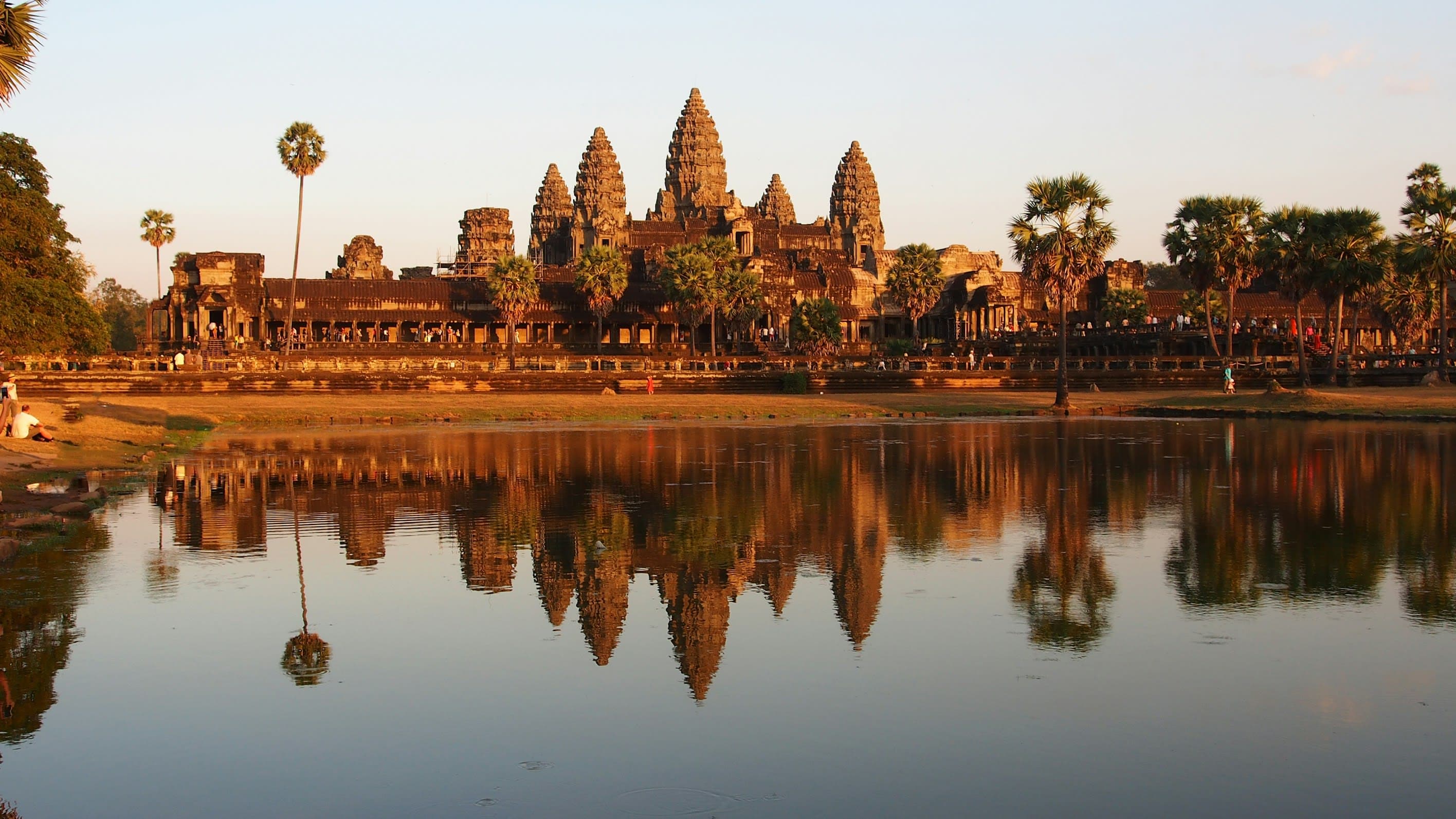
Angkor Wat
Where the Khmer built the cosmic mountain in stone and monks have kept watch for eight centuries
Siem Reap, Siem Reap, Cambodia
At A Glance
- Coordinates
- 13.4256, 103.8602
- Suggested Duration
- Half day minimum for Angkor Wat alone. Full day allows for both sunrise and exploration. 1-3 days recommended for Angkor Archaeological Park including Bayon, Ta Prohm, and other major temples. Consider a 3 or 7-day pass for thorough exploration.
Pilgrim Tips
- Shoulders and knees must be covered for both men and women. Strictly enforced since 2016. Bring lightweight layers or scarves. Comfortable walking shoes essential for the extensive grounds.
- Permitted in exterior areas and galleries. Ask permission before photographing monks. Tripods discouraged inside temples. Drones prohibited without permit. Professional/commercial photography requires APSARA Authority permit.
- The temple is an active place of worship, not merely a tourist site. Dress code is strictly enforced—shoulders and knees must be covered. The Bakan Sanctuary closes on Buddhist holy days; check the schedule before planning to ascend. Female visitors must not touch monks. The temple becomes extremely crowded at sunrise; consider alternative viewing locations. Midday heat is intense.
Overview
Angkor Wat is the largest religious structure on earth—a stone representation of Mount Meru, the cosmic mountain at the center of the universe. Built by King Suryavarman II in the 12th century as a Hindu temple to Vishnu, it transformed into a Buddhist shrine by the 14th century. Unlike every other temple at Angkor, it was never abandoned. Buddhist monks have maintained continuous worship here for over 800 years, creating an unbroken thread connecting today's pilgrims to the original builders.
The towers of Angkor Wat emerge above the jungle canopy like something from another world—which, in a sense, they are. The Khmer builders were not merely constructing a temple; they were building the center of the universe. The five towers represent the peaks of Mount Meru, the axis mundi where gods dwell. The 190-meter moat represents the cosmic ocean. The concentric galleries represent the mountain ranges that encircle the sacred mountain. To approach Angkor Wat is to approach the divine center. King Suryavarman II commissioned this representation of cosmic geography in the early 12th century, dedicating it to Vishnu and breaking from the Shaiva tradition of his predecessors. The scale was unprecedented: 400 acres, 5-10 million sandstone blocks fitted without mortar, 1,200 square meters of bas-relief sculptures depicting the churning of the cosmic ocean, the battles of gods and demons, the stories that structured Khmer understanding of reality. Then the Khmer world changed. Buddhism rose. The empire's capital moved. Other temples were swallowed by jungle. But Angkor Wat was different. By the late 13th century, Buddhist monks had transformed it into a shrine of the Dharma without destroying its Hindu architecture. They have kept watch ever since—eight centuries of unbroken devotion. Today, saffron robes move through galleries carved with Hindu gods. Incense rises before Buddhist stupas built within Hindu walls. The temple that represented the cosmic center has absorbed transformation without losing its function as a place where humans approach the divine.
Context And Lineage
King Suryavarman II built Angkor Wat as a temple to Vishnu and representation of Mount Meru. After the Khmer transformation to Buddhism, monks maintained the temple while other Angkor sites were abandoned.
The Khmer Empire at its height controlled most of mainland Southeast Asia—from Myanmar to Vietnam, from southern China to the Malay peninsula. Its kings were devarajas, god-kings who ruled as manifestations of Hindu deities. Suryavarman II, whose name means 'protector of the sun,' took the throne around 1113 CE and began the most ambitious building project in Khmer history. Rather than Shiva, whom previous kings had worshipped, Suryavarman chose Vishnu—the Protector, associated with the west and with the preservation of cosmic order. The temple he built was oriented to the west, unusual among Khmer temples, perhaps indicating its function as his eventual mausoleum or its dedication to Vishnu. The scale was unprecedented: the largest religious structure ever built, representing the cosmic mountain at the center of the universe, establishing the king's position at that center. Suryavarman died around 1150 CE. Within decades, the Cham forces sacked Angkor. When Jayavarman VII rebuilt the empire, he chose Buddhism. The great city of Angkor Thom, with its Buddhist Bayon temple, rose nearby. By the late 13th century, Theravada Buddhism had transformed Cambodian religion. Other temples were gradually abandoned. But at Angkor Wat, something different happened. Buddhist monks moved in, adding stupas and images without destroying the Hindu architecture. They have maintained the temple ever since—through the empire's fall, through centuries of obscurity, through French colonialism and Cambodian civil war and Khmer Rouge devastation. The temple that represented the Hindu cosmic center became a Buddhist sacred site, and the continuity of devotion created something perhaps even more remarkable than the original construction.
Hindu cosmology and Vaishnavism. Khmer imperial cult and devaraja tradition. Transformation to Theravada Buddhism (late 13th century). Eight centuries of continuous Buddhist maintenance. UNESCO World Heritage Site 1992.
Suryavarman II
Builder and patron
Jayavarman VII
Buddhist transformation
The Buddhist Monks
Continuous keepers
Why This Place Is Sacred
Angkor Wat is thin because it is the world's largest representation of the cosmic center—Mount Meru made in stone—with continuous worship for over 800 years bridging the transformation from Hindu to Buddhist.
What makes Angkor Wat thin is the convergence of cosmic geography and unbroken devotion. The Khmer builders constructed not merely a temple but a representation of the universe's structure. Mount Meru stands at the center of Hindu and Buddhist cosmology—the axis around which creation turns, the mountain that connects earth to heaven, the dwelling place of gods. The five towers represent Meru's peaks. The moat represents the cosmic ocean at the world's edge. The concentric galleries represent the mountain ranges surrounding the sacred center. To enter Angkor Wat is to enter a model of the cosmos, to walk inward toward the divine center. But cosmic geography alone does not make a place thin. What distinguishes Angkor Wat is continuity across transformation. The temple was built for Vishnu; it serves the Buddha. The civilization that built it fell; the monks remained. When other Angkor temples were abandoned to strangler figs and silk-cotton trees, Angkor Wat was maintained. Japanese Buddhist pilgrims came in the 17th century. French explorers came in the 19th. Through political upheaval and war, the monks kept watch. This continuity creates a compression of time. The paths worn by pilgrims today are the paths worn by pilgrims for eight centuries. The central shrine that served Suryavarman II now serves the Buddha—but it has served continuously. The thinness is in this persistence of the sacred across the transformation of everything else.
State temple and eventual mausoleum of King Suryavarman II, dedicated to Vishnu. Representation of Mount Meru, the cosmic center, establishing the king as devaraja (god-king) at the world's axis.
Hindu temple to Vishnu (1113-1150 CE). Gradual transformation to Buddhism (late 13th century onward). Buddhist stupas and images added without destroying Hindu architecture. Continuous maintenance by Buddhist monks. Never abandoned. Japanese pilgrims (17th century). French rediscovery (1860). UNESCO inscription (1992). Ongoing Buddhist worship.
Traditions And Practice
Buddhist monks maintain the temple and conduct daily ceremonies. Pilgrims make merit through offerings and prayers. The Bakan Sanctuary closes on Buddhist holy days for religious observances.
In the Hindu period, the temple served the cult of Vishnu and the devaraja tradition that identified the king with the divine. Rituals would have included worship at the central sanctuary, offerings, and royal ceremonies connecting political and cosmic order. After the transformation to Buddhism, merit-making became central: pilgrims earning spiritual credit through offerings, prayers, and support of the monks. Ancestor veneration ceremonies honor the dead at stupas within the temple grounds. Clockwise circumambulation follows Buddhist practice.
Buddhist monks reside at Angkor Wat and maintain the temple as a functioning sacred space. Daily worship continues at Buddhist shrines within the Hindu architecture. The Bakan Sanctuary (central tower) closes 8-10 days monthly on Buddhist holy days for religious observances. Monks offer blessings to visitors who approach with appropriate respect. Major festivals include Cambodian New Year (April), when the temple receives particular veneration. The temple appears on the Cambodian flag, representing national identity as well as spiritual heritage.
Arrive for sunrise to experience the temple emerging from darkness—a daily recreation of creation. Return later in the day to explore the bas-reliefs with attention: follow the Churning of the Ocean of Milk along the eastern portion of the southern gallery, where gods and demons pull a serpent to produce the elixir of immortality. Ascend to the Bakan Sanctuary (if open) and observe the Buddhist worship that continues in what was once the shrine of Vishnu. If you encounter monks, you may ask for a blessing by making an offering; approach with hands in prayer position and receive the blessing with gratitude. Walk the perimeter of the temple clockwise, as Buddhist tradition prescribes. Consider returning at different times of day to experience how light transforms the stone.
Theravada Buddhism
ActiveSince the late 13th century, Angkor Wat has functioned as a Theravada Buddhist temple. Buddhist monks transformed the Hindu shrine without destroying its architecture, adding stupas and images while preserving the bas-reliefs of Hindu gods. They have maintained continuous worship for over 800 years, through the fall of the Khmer Empire, centuries of obscurity, colonial rule, and civil war. This continuity is perhaps as remarkable as the original construction.
Daily worship at Buddhist shrines within the Hindu architecture. Merit-making through offerings and prayers. Ancestor veneration at stupas. Blessings offered to visitors. The Bakan Sanctuary closes on Buddhist holy days for religious observances. Clockwise circumambulation. Annual celebrations at Cambodian New Year and major Buddhist holidays.
Hinduism (Historical)
HistoricalAngkor Wat was built by King Suryavarman II as a temple to Vishnu, representing Mount Meru, the cosmic mountain at the universe's center. The five towers represent Meru's peaks; the moat represents the cosmic ocean; the galleries represent surrounding mountain ranges. The entire complex was a stone mandala, a representation of cosmic order that established the king as devaraja (god-king) at the world's axis. The bas-reliefs depict the great Hindu narratives: the Ramayana, the Mahabharata, and the Churning of the Ocean of Milk.
Historical practices included worship of Vishnu at the central sanctuary, royal rituals connecting the king to cosmic order, and possibly funerary rites if the temple served as Suryavarman II's mausoleum. The bas-reliefs may have been used for teaching the epic narratives that structured Khmer understanding of reality.
Experience And Perspectives
Visitors cross the moat at dawn, watch the towers emerge against the lightening sky, ascend through concentric galleries past 1,200 square meters of bas-reliefs, and reach the central sanctuary where Buddhist monks continue ancient worship.
The experience of Angkor Wat begins in darkness. Arrive before 5:00 AM, when the temple opens, and cross the causeway over the moat while the towers are still silhouettes against the eastern sky. Find a place by the reflecting pools on the northern or southern side. Wait. The sky lightens. The towers take shape—first as black masses, then as gray forms with distinguishable levels and detail, then as golden stone catching the first direct light. The scale becomes apparent only gradually. The central tower rises 65 meters; the entire complex covers 400 acres. Numbers do not convey it. What conveys it is the experience of walking toward the towers, crossing the moat that represents the cosmic ocean, passing through galleries that represent mountain ranges, ascending levels that approach the divine center. The bas-reliefs demand attention. Twelve hundred square meters of carved narrative wrap the outer gallery—the Churning of the Ocean of Milk, where gods and demons pull a serpent to create the elixir of immortality; scenes from the Ramayana and Mahabharata; historical processions of Suryavarman II's army. The carving is intricate: individual figures have individual faces; the serpent's scales are individually rendered; apsara dancers number in the thousands. Move inward through successively smaller, higher galleries. The transition is from public to sacred, from horizontal to vertical, from the world of humans to the abode of gods. The final ascent to the Bakan Sanctuary is steep—a physical reminder that approaching the divine requires effort. At the central shrine, Buddhist monks now tend what was once the image of Vishnu. Incense smoke rises. Prayers are chanted. The temple that was built as a representation of the cosmic center continues to function as a place where humans seek contact with something beyond themselves. The tourists come for the architecture; the pilgrims come for the presence that the architecture was built to house.
Angkor Wat is 6 km north of Siem Reap. Enter from the west across the causeway over the moat. The temple complex is enormous; allow half a day minimum. For sunrise, arrive before 5:00 AM. The Bakan Sanctuary (central tower) opens at 7:40 AM and closes on Buddhist holy days (8-10 days monthly). Dress code strictly enforced: shoulders and knees must be covered.
Angkor Wat invites engagement with human ambition at civilizational scale—the attempt to build the cosmic center in stone—and with the continuity of devotion that has maintained that center across eight centuries and the transformation from Hindu to Buddhist.
Art historians and archaeologists recognize Angkor Wat as the pinnacle of classical Khmer architecture and the largest religious structure in the world. The temple demonstrates sophisticated understanding of engineering (precision-fitted sandstone blocks without mortar), astronomy (equinox alignments), and symbolic representation (Mount Meru cosmology). The bas-reliefs are among the most significant works of narrative sculpture in Asian art. UNESCO inscription acknowledges the temple's outstanding universal value as testimony to Khmer civilization and its influence throughout Southeast Asia. The transition from Hindu to Buddhist use documents broader regional religious transformation.
For Cambodian Buddhists, Angkor Wat is both historical heritage and living sacred space. The temple appears on the national flag, representing Khmer identity and achievement. Buddhist monks have maintained the temple through centuries of political upheaval—through the empire's fall, French colonialism, civil war, and Khmer Rouge devastation. This continuity is itself a spiritual achievement. The temple is understood as a site of merit-making, a gateway between human and divine realms, a place where the cosmic center remains accessible despite the transformation of everything around it.
Some visitors are drawn by the temple's astronomical alignments, particularly the equinox sunrise directly over the central tower. Alternative theories propose connections to other ancient sites, advanced astronomical knowledge, or lost techniques of construction. The precision of the stonework and the cosmic symbolism invite speculation beyond scholarly consensus.
Significant mysteries remain. Why was Angkor Wat oriented to the west when most Khmer temples face east? Was it primarily intended as Suryavarman II's mausoleum, as some scholars suggest? How was the construction organized to achieve such precision without mortar across millions of sandstone blocks? What specific rituals were performed in the central sanctuary during the Hindu period? What astronomical calculations guided the temple's alignments?
Visit Planning
Located 6 km north of Siem Reap, Cambodia. Entry fees: 1-day $37, 3-day $62, 7-day $72 USD. Opens 5:00 AM for sunrise. Bakan Sanctuary opens 7:40 AM, closes on Buddhist holy days.
Siem Reap offers accommodations ranging from budget guesthouses to luxury resorts. Many hotels arrange temple visits and provide early transportation for sunrise viewing.
Dress modestly with shoulders and knees covered. Do not touch monks, carvings, or structures. Remove shoes in shrines. Walk clockwise. Respect the ongoing Buddhist worship.
Angkor Wat is a functioning Buddhist temple as well as a UNESCO World Heritage Site. The dress code has been strictly enforced since 2016: both men and women must cover shoulders and knees. Sleeveless tops, short shorts, and revealing clothing will result in denied entry. Bring a scarf or shawl if needed. Remove footwear before entering small shrines or wooden platforms. Walk clockwise around structures—this is traditional Buddhist practice. Do not touch the carvings, bas-reliefs, or stone surfaces; oils from hands damage the ancient stone. Do not climb on structures. Female visitors must not touch monks; if you wish to hand something to a monk, place it on the ground for him to pick up. Do not touch anyone's head, including children—this is considered sacred in Cambodian culture. Photography of monks requires permission. Keep voices low and behavior respectful; this is a place of worship. The Bakan Sanctuary closes on Buddhist holy days; respect these closures as religious observances rather than inconveniences.
Shoulders and knees must be covered for both men and women. Strictly enforced since 2016. Bring lightweight layers or scarves. Comfortable walking shoes essential for the extensive grounds.
Permitted in exterior areas and galleries. Ask permission before photographing monks. Tripods discouraged inside temples. Drones prohibited without permit. Professional/commercial photography requires APSARA Authority permit.
May be made at Buddhist shrines. Incense, flowers, and candles available. Offerings support the monks who maintain the temple.
Remove shoes in shrines. Do not touch carvings. Do not climb structures. No touching monks (especially by women). Walk clockwise. Bakan Sanctuary closes on Buddhist holy days.
Sacred Cluster
Nearby sacred places create the location cluster described in the growth plan. This block is intentionally crawlable and links into the wider regional graph.