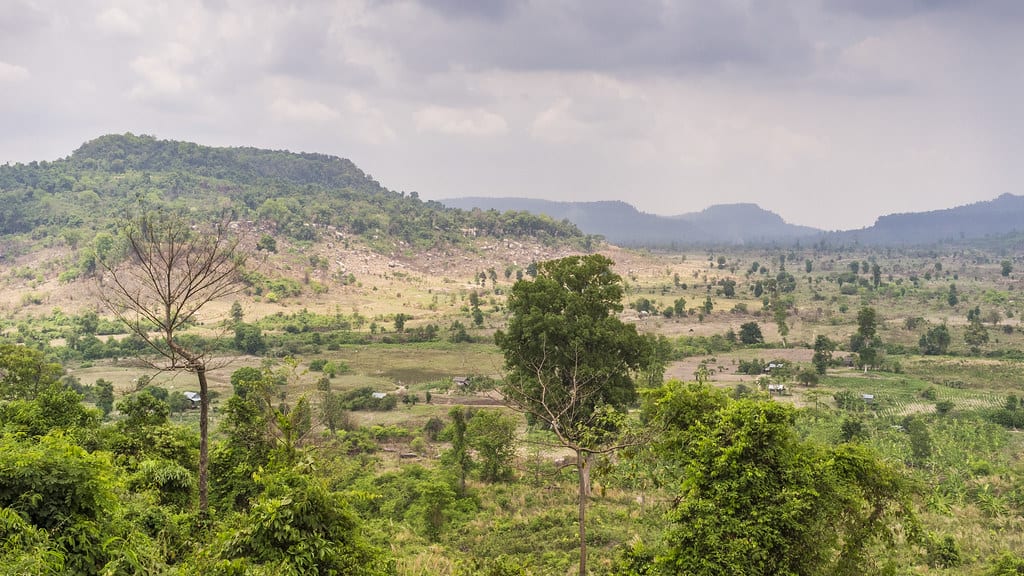
"The mountain where the Khmer Empire was born and every stone of Angkor was quarried"
Phnum Kulen
Svay Leu District, Siem Reap, Cambodia
Phnom Kulen is the most sacred mountain in Cambodia, the place where Jayavarman II declared the founding of the Khmer Empire in 802 CE. Every stone used to build Angkor Wat was quarried from its slopes. A river carved with over a thousand Shaivite lingas sanctifies the water flowing to the temples below. At the summit, a sixteenth-century reclining Buddha carved from living rock draws pilgrims who climb the mountain to touch the stone where their civilization began.
Weather & Best Time
Plan Your Visit
Save this site and start planning your journey.
Quick Facts
Location
Svay Leu District, Siem Reap, Cambodia
Coordinates
13.5758, 104.0750
Last Updated
Mar 29, 2026
Learn More
In 802 CE, Jayavarman II performed the ceremony on Phnom Kulen that established the Devaraja cult and founded the Angkor-era Khmer Empire, making this mountain the origin point of one of history's great civilizations.
Origin Story
Jayavarman II came to power in a period of Khmer political fragmentation, when the region was under the influence of the Javanese Sailendra dynasty. In 802 CE, he gathered his court on Phnom Kulen and, together with the Brahmin priest Hiranyadama, performed a ritual that established the Devaraja cult. This ceremony declared the Khmer king a chakravartin, a universal ruler, and a living manifestation of divine power. It simultaneously proclaimed independence from Javanese suzerainty and established the theological framework that would drive Khmer temple construction for the next six centuries.
The mountain was renamed Mahendraparvata, the Mountain of Great Indra, and served as the first capital of the unified empire. The choice of a mountain was not arbitrary. In Hindu cosmology, Mount Meru is the axis mundi, the center of the universe and the abode of the gods. Phnom Kulen, rising above the forested plain, became the Khmer Mount Meru, the sacred center from which political and spiritual authority radiated outward.
The quarrying of sandstone from the mountain for temple construction created a literal connection between the sacred source and its architectural expressions at Angkor. The carving of lingas into the Kbal Spean riverbed over subsequent centuries extended this connection through water: every drop that flowed to the Angkor reservoirs carried the mountain's blessing.
Key Figures
Jayavarman II
founder of the Angkor-era Khmer Empire
The king who in 802 CE performed the Devaraja ceremony on Phnom Kulen, establishing divine kingship and declaring Khmer independence from Javanese suzerainty. His choice of this mountain as the site for the founding ceremony and first capital made Phnom Kulen the origin point of the civilization that built Angkor.
Hiranyadama
Brahmin priest
The priest who performed the Devaraja consecration ritual alongside Jayavarman II, establishing the theological framework of divine kingship that would define Khmer civilization for six centuries.
Spiritual Lineage
Phnom Kulen connects to the broader Hindu-Buddhist tradition of sacred mountains in South and Southeast Asia, from Mount Meru in cosmology to Mount Kailash in practice. The Devaraja cult established here drew on Indian Shaivite theology while creating something distinctly Khmer: a system of divine kingship expressed through monumental architecture. The mountain's role as both quarry and sacred source created a material and spiritual chain connecting Phnom Kulen to every temple at Angkor.
Know a Sacred Site We Should Include?
Help us expand our collection of sacred sites. Share your knowledge and contribute to preserving the world's spiritual heritage.