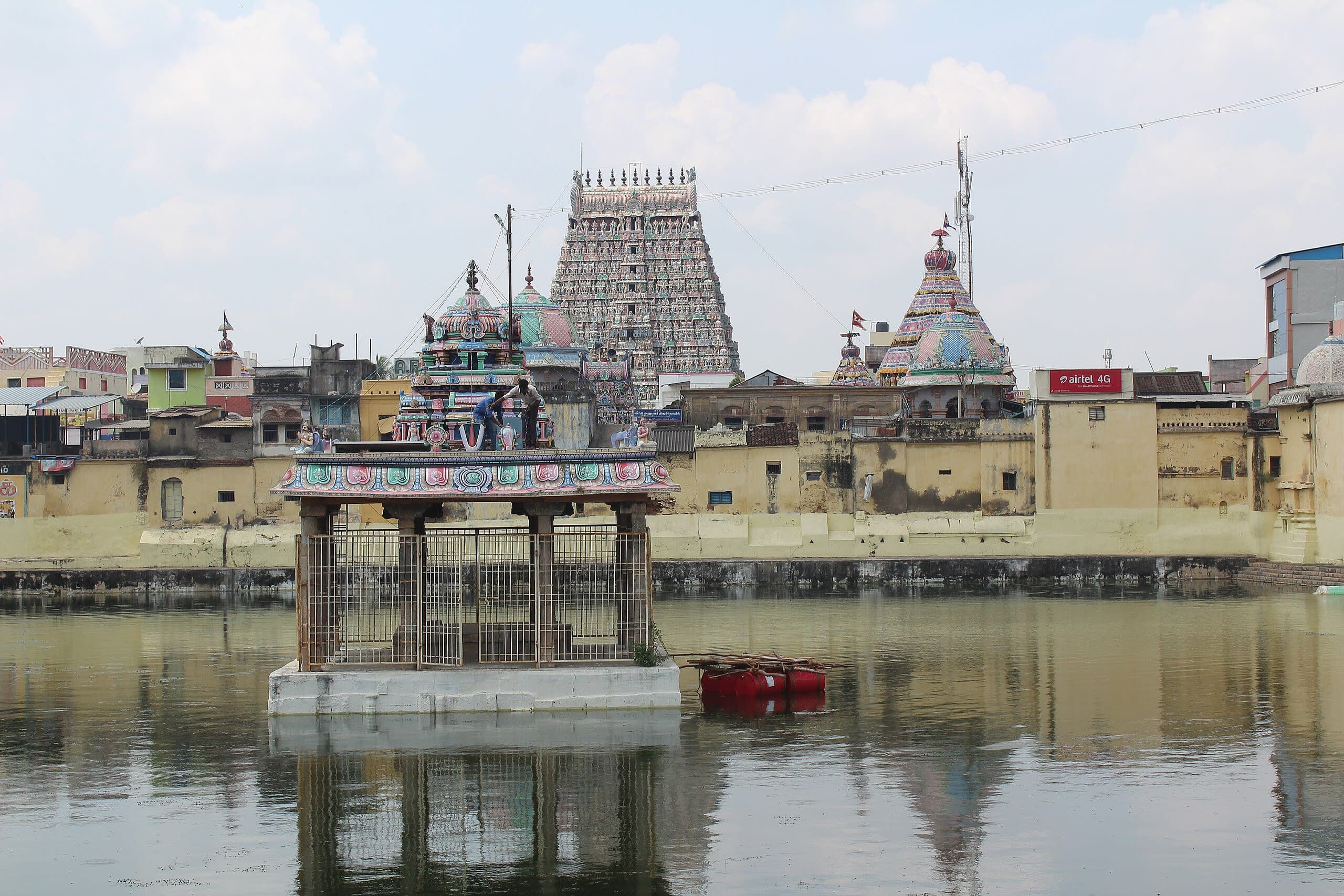
Adi Kumbeswarar Temple, Kumbakonam, Tamil Nadu
Where Shiva formed himself from the nectar of immortality at creation's dawn
Kumbakonam, Tamil Nadu, India
At A Glance
- Coordinates
- 10.9581, 79.3715
- Suggested Duration
- A comprehensive visit including all shrines, circumambulation, and unhurried darshan requires 1.5 to 2 hours. Festival periods require significantly more time due to crowds. Those seeking deeper engagement may wish to visit multiple times across several days, experiencing different ritual times.
Pilgrim Tips
- Traditional modest attire is expected. For men, dhoti is traditional though formal pants with appropriate shirts are acceptable. For women, sarees or salwar kameez are appropriate. Avoid revealing clothing—no shorts, sleeveless tops, or clothing that exposes legs above the knee. If uncertain, err toward more coverage. The temple's tone is formal worship, not casual visit.
- Photography is not permitted inside the temple complex. This includes mobile phone cameras. The restriction protects the sanctity of worship and the concentration of those engaged in prayer. Exterior photography of the gopurams is generally allowed from outside the temple compound. Do not attempt to take hidden photos inside—this violates the trust extended to visitors.
- Photography is not permitted inside the temple complex. This restriction exists to protect the sanctity of worship, not as arbitrary rule. Leave cameras and phones out of sight during darshan. The inner sanctum (garbhagriha) may have restricted access for non-Hindus. Do not attempt to enter areas where you are not welcome—this is not discrimination but respect for living practice. During festival periods, particularly Mahamaham, crowds can become intense. Those with medical conditions, mobility limitations, or anxiety about crowds should plan carefully. The spiritual potency of these moments does not eliminate physical risk. Be wary of unofficial guides or priests offering special services outside temple administration. Legitimate services are available through official channels.
Overview
Rising in the heart of Kumbakonam, Adi Kumbeswarar Temple holds what devotees understand as a swayambhu lingam—Shiva manifest in stone formed from amrita, the nectar of immortality. For over a millennium, this has been one of South India's most potent Shaiva pilgrimage sites, praised by the Nayanar saint-poets and drawing millions during the twelve-year Mahamaham festival.
Something happened here at the beginning. According to Shaiva teaching, when the cosmic dissolution ended and creation began again, Lord Brahma set adrift a pot containing the seeds of all life and the nectar of immortality. When it broke—struck by Shiva's arrow—the amrita mixed with sand and formed a unique conical lingam, broad at its base and tapering to a point. This is Adi Kumbeswarar, the primordial lord of the pot.
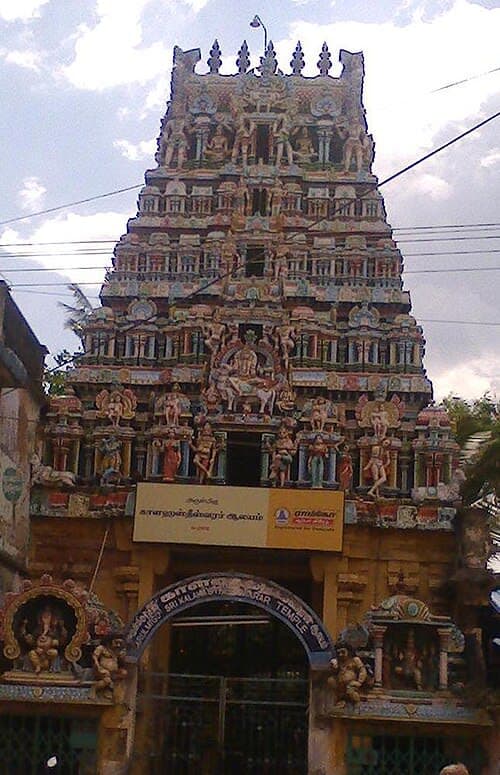
The temple that houses this lingam has stood for over a thousand years, though the stones themselves carry layers of construction from Chola, Vijayanagara, and Nayak periods. The eleven-story eastern gopuram rises 128 feet above the town, visible from across Kumbakonam, drawing pilgrims as it has since the seventh century when the Nayanar saint Appar sang nine verses here that would become part of the Tevaram—the foundational hymns of Tamil Shaivism.
This is not a monument. Six times daily, priests perform elaborate rituals that have continued without interruption for centuries. The lingam receives abhishekam—sacred bathing—while devotees press forward for darshan. In the adjacent shrine, Goddess Mangalambigai stands on a peetham said to be energized by 720 million mantras. Every twelve years, when Jupiter enters Leo, millions gather at the nearby Mahamaham tank for a sacred bath believed to cleanse all sins.
You enter here not as a tourist visiting ruins but as a guest in a living house of worship where something very old continues to happen.
Context And Lineage
Adi Kumbeswarar Temple was established during the Chola period (ninth century CE) at a site recognized as sacred since at least the seventh century. Royal patronage from Chola, Vijayanagara, and Nayak dynasties expanded the complex over centuries. The temple is the twenty-sixth Paadal Petra Sthalam, glorified in the foundational Tevaram hymns of Tamil Shaivism.
Shaiva tradition teaches that at the end of cosmic dissolution, when only primordial waters remained, Lord Brahma created a pot—a kumbha—containing the seeds of all life and amrita, the nectar of immortality. He set this pot adrift to preserve creation through the flood.
When the waters receded, Lord Shiva appeared as a hunter and shot an arrow at the pot. Where it broke, the amrita mixed with sand and spontaneously formed a lingam—not carved by human hands but self-manifested, swayambhu. This lingam, broad at its base and tapering to a point, became the Adi Kumbeswarar, the primordial lord of the pot. The nectar that spilled elsewhere created the Mahamaham tank and nearby sacred pools.
In the same teaching, India's holy rivers—Ganges, Yamuna, Saraswati, and others—accumulated the sins that devotees washed into them. They appealed to Brahma for purification. He instructed them to converge at this place once every twelve years, when celestial conditions aligned, and bathe together to regain purity. This is why the Mahamaham festival draws millions who understand themselves as bathing in all sacred rivers simultaneously.
The story is not presented as metaphor by those who hold it. It describes what happened. The temple exists because of this event.
The temple's earliest documented period begins with the Cholas in the ninth century, though Nayanar praise in the Tevaram points to seventh-century recognition. The Chola Dynasty, which made Shaivism the state religion, established the foundational structure and rituals that continue today.
The Vijayanagara Empire brought major expansion in the fifteenth and sixteenth centuries. Emperor Krishnadeva Raya witnessed the Mahamaham festival and made significant donations, recorded in inscriptions. Under the Thanjavur Nayaks, minister Govinda Dikshitar supervised further renovation during the reign of Achutha Nayakar.
With the end of royal patronage, the temple passed through colonial administration to its current status under the Hindu Religious and Charitable Endowments Department of Tamil Nadu. Priests maintain the unbroken tradition of six daily rituals. The Mahamaham festival continues its twelve-year cycle, most recently drawing millions in 2016. The lineage is not ended but ongoing.
Lord Shiva as Adi Kumbeswarar
deity
The presiding deity, understood as Shiva in swayambhu form—self-manifested from amrita at creation's beginning. The distinctive conical lingam is worshipped as the primordial lord of the cosmic pot.
Goddess Mangalambigai
deity
Shiva's consort, enshrined separately. Also known as Mandhira Peeteshwari, she stands on a gold peetham venerated as charged with 72 crore mantras. Her four-foot form is sheathed in gold.
Appar (Thirunavukkarasar)
saint
Seventh-century Nayanar saint-poet who composed nine verses here included in the Fifth Tirumurai. His praise established this as the twenty-sixth Paadal Petra Sthalam, elevating the temple's significance for all subsequent generations.
Murka Nayanar
saint
One of the sixty-three Nayanar saints, said to have attained liberation (mukti) at this temple—further confirming its spiritual potency in Shaiva tradition.
Why This Place Is Sacred
Adi Kumbeswarar Temple's sacredness emerges from its origin as the site where divine substance took physical form. The swayambhu lingam, the convergence of holy rivers at Mahamaham, praise from enlightened Nayanar saints, and over a millennium of unbroken worship create a place where devotees experience the boundary between human and divine as unusually permeable.
The temple's sanctity begins with its origin story. In Shaiva understanding, this is where the cosmic pot broke and divine nectar became stone. The lingam is not carved—it is swayambhu, self-manifested, Shiva himself choosing this form. Such sites are rare. They carry a different weight than temples built around installed deities.
The seventh-century Nayanar saints recognized this weight. Appar, also known as Thirunavukkarasar, composed nine verses here that entered the Fifth Tirumurai, making this the twenty-sixth of the 276 Paadal Petra Sthalams—temples glorified in the Tevaram, the foundational canon of Tamil Shaiva devotion. When enlightened practitioners across centuries identify the same location as exceptional, something is being registered.
The Mahamaham tank adds another dimension. According to traditional teaching, all of India's holy rivers—Ganges, Yamuna, Saraswati, Kaveri, and others—wished to cleanse themselves of the sins humans had washed into them. Brahma instructed them to converge here once every twelve years. During Mahamaham, when Jupiter enters Leo, pilgrims do not simply bathe in a tank—they bathe in the confluence of all sacred waters.
Within the temple, the Mangalambigai shrine is venerated as a Mantra Peetham. The four-foot goddess, sheathed in gold, stands on a platform traditionally understood as charged with 72 crore mantras—720 million sacred utterances accumulated over centuries. Whether this number is literal or devotional, it points to concentrated spiritual intention.
For practitioners, these factors compound. The amrita lingam, the Nayanar praise, the river confluence, the mantra-charged goddess—they create what in other traditions might be called a thin place, where the distance between worlds narrows. Visitors without this cosmology still often report a quality of presence they struggle to name.
According to Shaiva cosmology, this site marks where creation itself took root. When Brahma's pot of life-seeds and immortality nectar broke, the resulting lingam became the axis around which the current age would turn. The temple exists to honor this origin, to maintain the relationship between humanity and the divine force that manifested here, and to offer devotees access to the transformative power inherent in amrita—the substance that grants liberation from death.
The current temple reflects over a thousand years of continuous devotion and royal patronage. The Cholas established the core structure in the ninth century, but the site may have been sacred earlier—the Tevaram references suggest seventh-century recognition. The Vijayanagara emperors expanded the complex in the fifteenth and sixteenth centuries, with Krishnadeva Raya himself witnessing the Mahamaham festival. The Thanjavur Nayaks added further embellishments under minister Govinda Dikshitar.
Through political changes and the end of royal patronage, the temple continued. Today it operates under the Hindu Religious and Charitable Endowments Department of Tamil Nadu, maintaining the six daily rituals that have persisted for centuries. The Mahamaham festival draws millions, and the temple remains central to the Sapta Sthanam pilgrimage connecting seven sacred sites. What began as a cosmic event continues as living practice.
Traditions And Practice
Adi Kumbeswarar Temple maintains six daily rituals following ancient protocols. Visitors can participate in darshan, witness abhishekam, make traditional offerings, and join the twelve-year Mahamaham festival. The Sapta Sthanam pilgrimage connects this temple with six others for those seeking deeper engagement.
The temple's ritual life follows a six-pooja cycle from 5:30 AM to 9 PM, each involving abhishekam (sacred bathing of the lingam), alangaram (decoration), naivedyam (food offering), and deepa aradanai (lamp worship). These rituals have continued without interruption for centuries, maintained by hereditary priest families following Shaiva Agamic protocols.
The Mahamaham festival, occurring when Jupiter enters Leo (every twelve years), represents the tradition's most significant observance. Processional deities from all Kumbakonam temples converge at the twenty-one-acre Mahamaham tank. At noon, called Theerthavari, all deities bathe together with millions of pilgrims—a moment understood as bathing in the confluence of all India's sacred rivers.
The Sapta Sthanam pilgrimage connects Adi Kumbeswarar with six other Shiva temples through ritual procession, the palanquins of each temple joining together before returning. This practice acknowledges that sacred geography extends beyond single sites.
Daily worship continues according to traditional form. Devotees arrive for morning and evening darshan, joining lines that move through the sanctum past the swayambhu lingam. Special darshan tickets (Rs. 30) allow faster access for those with limited time. Many devotees commission abhishekam for personal intentions—health, protection, spiritual progress.
Weekly intensifications include Somavaram (Monday) and Sukravaram (Friday), auspicious days drawing larger crowds. Monthly observances—Pradosham, Amavasai, Pournami, Sathurthi—mark the lunar calendar. Annual festivals, particularly Brahmotsavam and Thirukalyanam, recreate celestial events through elaborate ritual and procession.
For non-Hindu visitors, the temple is accessible though certain areas may be restricted. Witnessing the rituals, making offerings through temple services, and circumambulating the complex are appropriate forms of engagement.
For a meaningful visit, consider these approaches:
Arrive before 8 AM when the temple is less crowded and morning light fills the courtyards. Allow the long entrance corridor to create transition—do not rush this threshold. At the main sanctum, wait for a quiet moment if possible. The lingam's distinctive form—conical, narrowing upward—is worth contemplating. This is not an installed deity but swayambhu, self-manifested.
Visit the Mangalambigai shrine with attention. Some find the goddess more approachable than the Shiva lingam. If offering is important to you, the temple provides services for flowers, fruits, and traditional items. Bilva leaves are particularly appropriate for Shiva.
Circumambulate the temple—pradakshina—moving clockwise, keeping the sanctum to your right. The practice is embodied, not merely symbolic. Complete at least one full circuit.
If your visit can align with Mahamaham, understand what you are entering. Millions attend. The experience is collective, not individual. Prepare for crowds, heat, waiting. What you receive will not be solitude but immersion in something larger than personal pilgrimage.
Shaivism
ActiveAdi Kumbeswarar Temple holds supreme importance within Tamil Shaivism as a Paadal Petra Sthalam—one of 276 temples glorified in the seventh-century Tevaram by the Nayanar saints. The presiding deity is understood as a swayambhu lingam, self-manifested from amrita at creation's beginning. The temple is central to the Mahamaham festival, which draws millions of Shaiva devotees every twelve years, and anchors the Sapta Sthanam pilgrimage connecting seven sacred sites.
Six daily poojas maintain continuous worship from 5:30 AM to 9 PM, following Shaiva Agamic protocols including abhishekam, alangaram, naivedyam, and deepa aradanai. Weekly intensification occurs on Mondays (Somavaram), sacred to Shiva. Monthly observances include Pradosham, Amavasai, Pournami, and Sathurthi. Annual festivals—Brahmotsavam, Thirukalyanam, Sabthasthanam—elaborate the ritual calendar. The twelve-year Mahamaham represents the tradition's most significant gathering.
Shaktism
ActiveThe Mangalambigai shrine within the temple complex is venerated as a Shakti Peetham or Mantra Peetham. The goddess, four feet tall and gold-sheathed, stands on a peetham traditionally understood as energized by 72 crore (720 million) mantras. She is also known as Mandhira Peeteshwari—the goddess of the mantra seat.
Worship of Goddess Mangalambigai follows alongside and integrated with Shiva worship in the main temple. Navaratri celebrations bring intensified goddess-focused practice. Devotees seeking the goddess's blessing visit her shrine separately, making offerings and receiving her darshan. The relationship between Shiva and Shakti—masculine and feminine divine principles—is honored through the temple's dual-shrine structure.
Experience And Perspectives
Visitors to Adi Kumbeswarar Temple consistently describe a sense of ancient sanctity, the weight of accumulated devotion, and particular power in the main sanctum and Mangalambigai shrine. During the twelve-year Mahamaham festival, the experience intensifies as millions gather in collective practice.
Entry through the towering eastern gopuram—eleven stories of carved mythology rising above the street—begins the transition. The corridor stretches 330 feet, a gradual passage from the noise of Kumbakonam into something older. The stone underfoot has been worn smooth by countless devotees making this same approach.
The main sanctum houses the lingam that tradition holds was formed at creation's dawn. It is distinctive—conical, broad at the base, narrowing to a point, different from the more common cylindrical forms. During abhishekam, when priests bathe the lingam in water, milk, honey, and other sacred substances, devotees press forward for darshan. The atmosphere is not quiet contemplation but active worship: bells, chanting, the movement of ritual.
Many report the Mangalambigai shrine as particularly powerful. The goddess stands four feet tall, gold-sheathed, on her mantra-charged peetham. Devotees speak of felt presence, of prayers that seem to land differently here. Whether this reflects the accumulated mantras, personal devotion, or something beyond explanation, the reports are consistent across backgrounds.
The most profound experiences often come during Mahamaham, every twelve years when Jupiter enters Leo. Millions gather at the adjacent tank. At noon, when processional deities from all Kumbakonam temples bathe together, something shifts. Devotees describe the boundary between individual and collective dissolving, the sense of participating in something that transcends personal journey. For those present at this convergence, the experience often marks a before and after.
Approach as a guest in an active house of worship, not as a tourist at a monument. The rituals happening around you are not performance—they are practice that has continued for over a thousand years. Your presence is welcomed but should not interrupt.
Arrive early morning, before crowds build and heat rises. Allow the gopuram approach to work—let the corridor length create the transition it was designed for. At the sanctum, receive darshan without rushing. The lingam will be there when the pressing crowd subsides.
If the Mangalambigai shrine calls you, spend time there. Some find the goddess more accessible than the Shiva lingam. Circumambulate the temple—pradakshina—if this resonates. The movement itself is practice.
If your visit can align with Mahamaham, the twelve-year festival, prepare for something extraordinary. But be honest with yourself about crowds—millions attend. If stillness matters more than intensity, ordinary days offer what festivals cannot.
Adi Kumbeswarar Temple invites understanding from multiple angles. Scholarly research documents its history and architecture; traditional Shaiva knowledge explains its spiritual significance; alternative interpretations suggest additional dimensions. Honest engagement holds these perspectives together without forcing resolution.
Historical and archaeological research confirms the temple's origins in the Chola period (ninth century CE) with subsequent expansions under Vijayanagara and Nayak rulers. Epigraphic evidence documents royal patronage, including donations by Vijayanagara emperor Krishnadeva Raya. The Tevaram references establish that the site was recognized as sacred by the seventh century when Appar composed his verses here.
The temple's classification as a Paadal Petra Sthalam places it within a documented network of 276 temples praised by the Nayanar saints—an early medieval religious geography that shaped Tamil Shaivism. Architectural analysis reveals layers of construction: Chola foundation, Vijayanagara expansion, Nayak embellishment. The eleven-story eastern gopuram represents mature Dravidian temple architecture.
Scholars note the Mahamaham festival's documentation in inscriptions and historical records, confirming its antiquity as a pilgrimage tradition. The precise origin of the twelve-year cycle—tied to Jupiter's transit—reflects the integration of astronomical observation with religious practice common in South Asian traditions.
Within Shaiva tradition, scholarly documentation captures only the outer form. The temple's significance lies in what it houses: a swayambhu lingam, self-manifested from amrita at the beginning of the current cosmic age. This is not metaphor but cosmology. The Adi Kumbeswarar is Shiva himself, present in stone formed from the nectar of immortality.
The Nayanar saints who praised this temple were not historians but realized practitioners. Their verses in the Tevaram emerge from direct experience of the divine presence here. When Appar sang of this place, he was not documenting culture but transmitting darshan. Subsequent generations of devotees access the same presence the saints encountered.
The Mangalambigai shrine's designation as a Mantra Peetham—charged with 72 crore mantras—points to accumulated spiritual power beyond ordinary measurement. The twelve-year Mahamaham represents not merely festival but cosmic event, when all sacred waters converge and the accumulated sins of pilgrims dissolve. These understandings are not beliefs but direct knowledge transmitted through unbroken lineage.
Some interpret the temple's significance through frameworks beyond both academic history and traditional Shaiva teaching. The twelve-year Mahamaham cycle's connection to Jupiter's transit through Leo suggests astronomical knowledge embedded in ritual timing. The convergence of ley lines or earth energies at this location has been proposed, though such interpretations lack documentation in traditional sources.
The concept of 72 crore mantras energizing the goddess peetham reflects tantric understanding of concentrated spiritual force. Some contemporary practitioners frame this in terms of accumulated vibration or frequency, translating traditional categories into modern vocabulary.
These interpretations neither replace scholarly historical analysis nor traditional Shaiva understanding but add additional layers of meaning for those who find them useful. They often emerge from genuine experience at the site, even when the explanatory framework differs from tradition.
Genuine mysteries remain at Adi Kumbeswarar Temple. The specific content and nature of the 72 crore mantras said to energize the Mangalambigai peetham are not documented in accessible sources. Precise astronomical calculations underlying the temple's original orientation remain a matter of interpretation. Complete translations and analysis of all Chola-era inscriptions would likely yield historical insights not yet widely known.
The exact relationship between the pot fragments mentioned in tradition and specific locations across Kumbakonam is transmitted orally rather than documented systematically. Whether the distinctive conical shape of the lingam reflects natural formation, ancient sculptural technique, or something else remains discussed.
These uncertainties preserve the site's capacity to exceed explanation—to remain alive to questioning rather than pinned down by premature certainty.
Visit Planning
Adi Kumbeswarar Temple is located in central Kumbakonam, Thanjavur District, Tamil Nadu. Open 6 AM to 12:30 PM and 4 PM to 9:30 PM with free entry. The dry season (October-March) offers the best visiting conditions. Allow 1.5-2 hours for a meaningful visit. The twelve-year Mahamaham festival offers the most spiritually significant experience, though with millions of attendees.
Kumbakonam offers lodging at various price points, from basic lodges to comfortable hotels. During Mahamaham festival, accommodation books months in advance and prices increase significantly. For those integrating this visit with broader pilgrimage, Thanjavur (38 km) offers additional options including heritage properties. No dedicated spiritual retreat centers operate in Kumbakonam, but the town's concentration of temples creates natural pilgrimage infrastructure.
Adi Kumbeswarar Temple requires modest traditional attire, removal of footwear, and behavior appropriate to active worship. Photography is prohibited inside. Maintain silence near the sanctum, do not touch deities or enter restricted areas, and approach with the understanding that your presence is a privilege extended by practitioners for whom this is a place of prayer.
This is one of Tamil Nadu's most sacred Shaiva temples. The rituals happening around you are not cultural performance for visitors—they are worship that has continued for over a millennium. Your presence is welcomed as a guest, not as a consumer of experience.
Remove footwear before entering the temple complex. Designated areas for leaving shoes are available near entrances. In South Indian temples, this is non-negotiable—feet that have walked the street do not enter sacred space.
Move clockwise when circumambulating the temple, keeping the sanctum to your right. This is not custom but practice—the direction matters. At the sanctum, receive darshan without pushing or lingering when others wait. The lingam will still be there; you need not capture every second.
Silence is expected near the main shrine and during rituals. If you need to speak, keep your voice low and move away from the sanctum. Mobile phones should be silenced—not just switched to vibrate, but silenced. The sounds of worship should not compete with notification tones.
Do not touch the deities, lingam, or sacred objects. The priests handle these according to ritual protocols. Touching by visitors, however devotional the intention, violates the purity maintained through these protocols.
Traditional modest attire is expected. For men, dhoti is traditional though formal pants with appropriate shirts are acceptable. For women, sarees or salwar kameez are appropriate. Avoid revealing clothing—no shorts, sleeveless tops, or clothing that exposes legs above the knee. If uncertain, err toward more coverage. The temple's tone is formal worship, not casual visit.
Photography is not permitted inside the temple complex. This includes mobile phone cameras. The restriction protects the sanctity of worship and the concentration of those engaged in prayer. Exterior photography of the gopurams is generally allowed from outside the temple compound. Do not attempt to take hidden photos inside—this violates the trust extended to visitors.
Traditional offerings include flowers (bilva leaves are particularly appropriate for Shiva), fruits, coconuts, camphor, incense, and oil for lamps. The temple provides official services for offerings—use these rather than attempting to offer directly. During festivals, the five silver-plated chariots carry the processional deities. Donations support temple maintenance and the continuation of ritual practice.
Maintain silence in the immediate vicinity of the sanctum. Do not touch the deities, lingam, or ritual objects. Non-Hindus may have restricted access to the garbhagriha (inner sanctum)—respect this boundary. Leather items, including bags and belts, should ideally be left outside with footwear. Mobile phones should be silenced completely. No food or drink inside the temple.
Sacred Cluster
Nearby sacred places create the location cluster described in the growth plan. This block is intentionally crawlable and links into the wider regional graph.