The Sanctuary of Saint Rosalia
A hermit's cave where plague was conquered and a city found its saint
Palermo, Sicily, Italy
At A Glance
- Coordinates
- 38.1682, 13.3514
- Suggested Duration
- 1-2 hours for the sanctuary. Add time for the bus journey and the seventy-step climb.
Pilgrim Tips
- Modest dress is expected. Shoulders and knees should be covered.
- Photography is generally permitted but may be restricted during services. Flash photography may not be appropriate in the intimate cave environment. Always defer to posted signs and staff guidance.
- The Acchianata and Festino draw enormous crowds; plan accordingly. The seventy steps to the entrance may challenge those with mobility limitations. The sanctuary is a place of active worship; maintain appropriate reverence.
Overview
High on Monte Pellegrino above Palermo, a sanctuary extends into the cave where a twelfth-century noblewoman spent her final years in solitary prayer. In 1624, when plague was killing thousands, her bones were discovered here and carried through the city. The dying stopped. Palermo had found its patron, and the mountain that had sheltered her became the spiritual center of Sicily's capital.
Monte Pellegrino rises 606 meters above Palermo, a limestone promontory that has drawn worshippers since before recorded history. The Carthaginians built a shrine here to the goddess Tanit. The Byzantines raised a small church to the Virgin Mary. But it is Santa Rosalia who made this mountain holy for the people of Palermo.
Rosalia Sinibaldi was born in 1130 to a noble Norman family. When she learned of her arranged marriage, she fled to the wilderness. Eventually she found a cave high on Monte Pellegrino, where she lived as a hermit until her death in 1170. The cave became her church, the mountain her cloister, solitude her companion in the search for God.
For over four centuries, her story was largely forgotten. Then came the plague of 1624. Palermo was dying. Thousands had perished. Medicine offered no remedy. On July 15, a soap maker named Vincenzo Bonelli climbed Monte Pellegrino and saw a vision: Rosalia herself, guiding him to a pile of bones in the cave. The relics were brought to Palermo and carried through the streets in procession on June 9, 1625.
The plague stopped.
Palermo embraced its new patron with fervor that has never diminished. The Santuario di Santa Rosalia was built in 1625, extending 25 meters into the sacred cave. Water dripping from the cave ceiling is collected in channels, believed by pilgrims to possess healing properties. Each September, thousands walk barefoot through the night from Palermo to the mountaintop in the Acchianata, the most intense expression of popular devotion in Sicily.
Context And Lineage
A mountain sacred since Punic times became the hermitage of a medieval noblewoman, then the site of a plague miracle, and finally the spiritual heart of Palermo. Each transformation preserved what came before.
Rosalia Sinibaldi was born in 1130 into one of Palermo's most prominent Norman families. Her father was Sinibald, Lord of Quisquina and Rosa; her mother was Maria, a niece of King Roger II. The young noblewoman was destined for an arranged marriage that would cement political alliances.
Rosalia refused. According to tradition, she first fled to a cave in Quisquina, then eventually made her way to Monte Pellegrino, where she found a cave that would become her home for the rest of her life. She lived as a hermit, in prayer and solitude, until her death in 1170. An inscription in the cave reads: 'I, Rosalia, daughter of Sinibald, Lord of Quisquina and Rosa, have taken the resolution to live in this cave for the love of my Lord, Jesus Christ.'
For over four centuries, her memory faded. Then came 1624. Plague swept through Palermo, killing thousands. The city's previous patron saints seemed powerless. On July 15, Vincenzo Bonelli, a soap maker, climbed Monte Pellegrino and received a vision: Rosalia appeared to him and guided him to the location of her bones within the cave.
The relics were authenticated, then carried through Palermo in solemn procession on June 9, 1625. The plague stopped spreading. The dying stopped dying. Palermo had found its true patron.
The sanctuary was built immediately, a church extending into the sacred cave. The annual Festino in June commemorates the 1625 miracle with one of Italy's most elaborate religious festivals. The Acchianata in September sends thousands of barefoot pilgrims up the mountain through the night.
From Punic goddess worship through Byzantine Christianity to the cult of Santa Rosalia, maintained since 1946 by the Orionine brothers (Sons of Divine Providence), a Catholic congregation founded in 1903.
Santa Rosalia
Patron saint
Vincenzo Bonelli
Visionary
Gregorio Tedeschi
Sculptor
Why This Place Is Sacred
A cave sanctuary where sacred water drips from stone, where a hermit's bones ended a plague, where ancient goddess worship transformed into Marian devotion and then into the cult of a medieval saint. The mountain remembers all its worshippers.
The thin quality at Monte Pellegrino emerges from accumulation. This mountain has called to worshippers for over two thousand years. Each tradition left traces; each transformation added depth rather than erasing what came before.
At the cave entrance, you can still see a small shrine from the original Punic sanctuary, a reminder that Tanit was worshipped here before anyone had heard of Christ. The spring that now feeds the sacred water channels predates Christianity. The impulse to climb this mountain seeking divine aid is older than any recorded history of Palermo.
What Santa Rosalia added was a story with the power to concentrate all this accumulated holiness into a single narrative. A noblewoman who refused wealth and marriage. A hermit who chose a cave over a palace. A saint whose bones, carried through pestilent streets, stopped a plague. The story is perfect: renunciation, hiddenness, miraculous intervention at the moment of greatest need.
The cave itself is the sanctuary. When you enter the church, you enter the cave where Rosalia prayed and died. The natural rock is the architecture. Water dripping from the ceiling is not a problem to be solved but a blessing to be collected. Pilgrims cup their hands beneath the channels, touch the water to their faces, believe in its healing power. This is Christianity in its most elemental form, where stone and water and bone mediate the sacred.
Goethe visited in 1787 and wrote that the cave was perfectly suited to the humility of the saint. He was right. The sanctuary does not impose grandeur on the mountain; it receives what the mountain offers. That receptivity is part of what makes the place thin. The sacred was here before the sanctuary; the sanctuary simply made it possible to enter.
The cave served the Carthaginian goddess Tanit and later a Byzantine chapel before becoming the hermitage of Santa Rosalia. The spring was considered miraculous in pre-Christian times.
After the miraculous end of the plague in 1625, the sanctuary became Palermo's most important pilgrimage site. The annual Acchianata and the June Festino have maintained continuous popular devotion for four centuries.
Traditions And Practice
Active Catholic worship continues daily. The Acchianata barefoot pilgrimage in September and the Festino in June draw enormous crowds. Pilgrims collect sacred water from the cave ceiling year-round.
The pre-Christian sacred spring was venerated for its healing properties. Rosalia's own practice consisted of solitary prayer and contemplation in the cave hermitage. After the miracle of 1625, procession with the saint's relics became central.
Daily Mass is celebrated in the sanctuary. Pilgrims collect water dripping from the cave ceiling, believing in its healing properties. Small stones from the mountain are taken as protection for homes. The Acchianata (September 3-4) involves thousands walking barefoot from Palermo to the summit through the night. The Festino (June 10-15) features elaborate processions, a towering ceremonial chariot, and fireworks.
Visit during a weekday for quiet contemplation, or during the Acchianata to witness popular devotion at its most intense. Touch the sacred water. Light a candle. Sit in the cave-church and consider what it would mean to choose this place as your home, as Rosalia did. Walk the seventy steps slowly, understanding them as preparation rather than obstacle.
Roman Catholicism / Popular Devotion
ActiveThe sanctuary is the center of Palermo's devotion to its patron saint, established following the miracle of 1625. The Acchianata and Festino represent some of Italy's most intense expressions of popular Catholicism.
Daily Mass, veneration of the saint's relics, collection of sacred water, barefoot pilgrimage during the Acchianata, processions during the Festino, lighting candles, naming children Rosalia.
Pre-Christian Sacred Site
HistoricalMonte Pellegrino was sacred to the Carthaginians, who built a shrine to the goddess Tanit at the cave. The sacred spring predates Christianity. This earlier sacredness was transformed rather than destroyed.
Worship of fertility goddesses, veneration of the sacred spring, pilgrimage to the mountaintop.
Experience And Perspectives
Climb seventy steps from the bus stop to enter a church built into a sacred cave. Water drips from the ceiling. Candles flicker before the golden statue of the recumbent saint. The views over Palermo are stunning; the atmosphere within is utterly intimate.
Take bus 810 from Piazza Politeama in Palermo. The ride takes approximately thirty minutes, climbing the hairpin curves of Monte Pellegrino as the city falls away below. At the sanctuary stop, you are 430 meters above sea level with Palermo spread beneath you like a map.
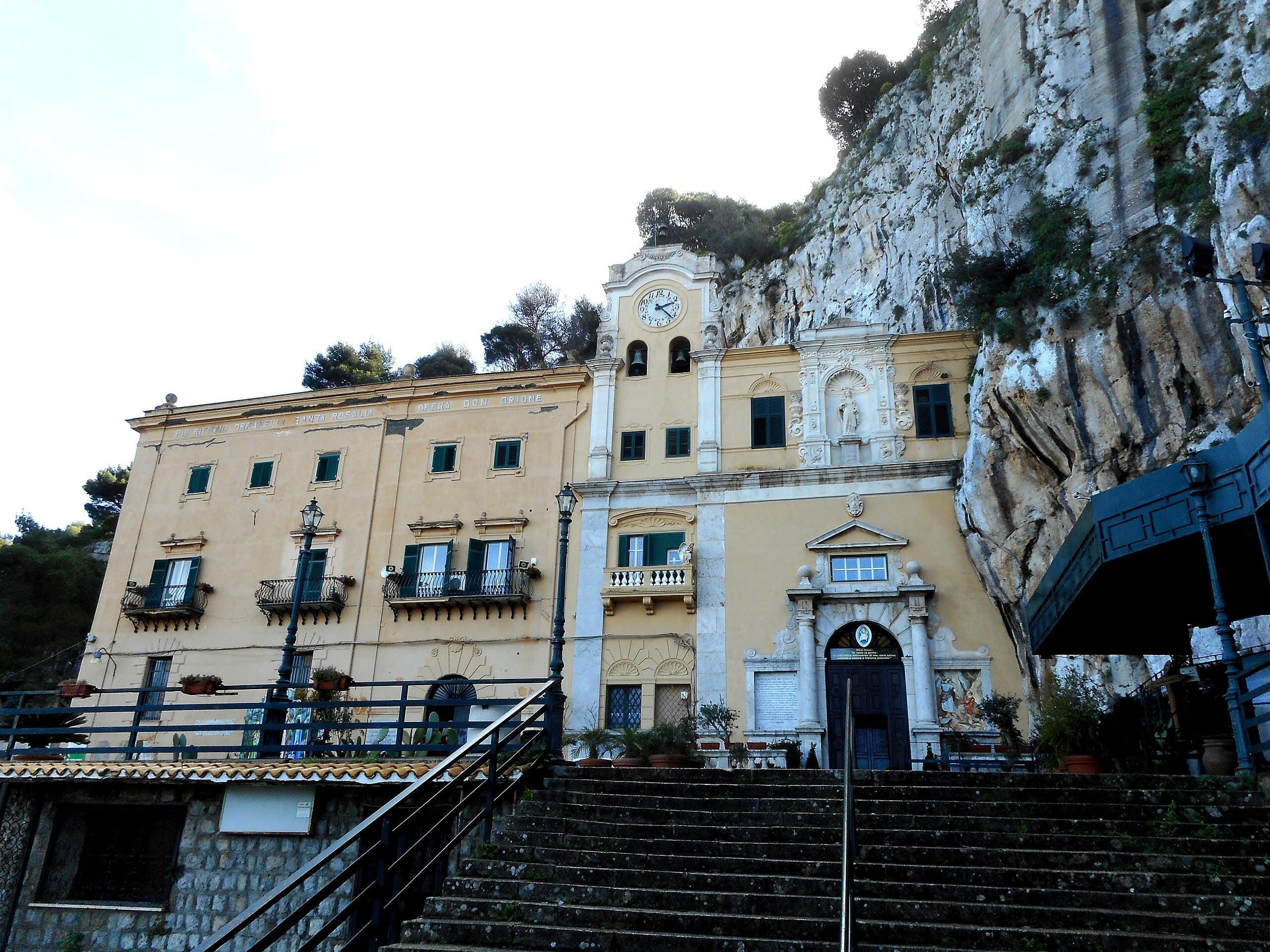
Seventy steps climb to the main entrance. Let them prepare you. This is pilgrimage in miniature, the physical effort that transforms arrival into achievement. At the top, pause before entering. Look at the cliff face into which the sanctuary is built. The church is the cave; the cave is the church.
Inside, the transformation is complete. Natural rock walls arch overhead. Water drips from the cave ceiling into metal channels that carry it to collection points. Pilgrims touch this water, cup it in their hands, believe in its blessing. Whether you share that belief or not, participate. Let the water touch your skin. Accept what is offered.
The centerpiece of the sanctuary is a glass case containing Gregorio Tedeschi's 1625 marble sculpture of the saint, depicted recumbent as if sleeping, attended by a cherub. Gold ornamentation was added in 1735 by King Charles III of Sicily. The figure is serene, beautiful, a noblewoman at rest after a life of renunciation.
To the right of the entrance, notice the small Punic shrine visible from outside, testimony that this cave was sacred before Rosalia was born. The layers of devotion accumulate: Tanit, Mary, Rosalia. The mountain remembers them all.
If you visit on September 3-4, you will encounter the Acchianata, when thousands walk barefoot from Palermo through the night. This is popular Catholicism at its most intense, a pilgrimage that demands everything the body can give. If you cannot participate, witness. Stand at the summit as the pilgrims arrive with the dawn.
Bus 810 from Piazza Politeama/Piazza Sturzo reaches the sanctuary in approximately 30 minutes. From the bus stop, climb 70 steps to the main entrance. The sanctuary is built into a natural cave extending approximately 25 meters into the mountain.
The Sanctuary of Saint Rosalia can be understood as a site of medieval hermit spirituality, as evidence of the transformation of pagan sacred space, as a center of popular Catholic devotion, or as a demonstration of the power of saints' relics in early modern Catholicism.
Historians study the sanctuary as an example of Christianization of pre-Christian sacred sites and the development of civic patron saint cults. The plague miracle of 1625 demonstrates patterns of religious response to epidemic disease that recurred throughout European history.
For Catholics, Santa Rosalia embodies the ideal of renunciation: a noblewoman who abandoned wealth and marriage to seek God in solitude. Her miraculous intervention to end the plague demonstrates the ongoing intercessory power of the saints and validates the veneration of relics.
The site's layered history, from Punic goddess worship through the sacred spring to Christian hermitage, suggests the continuity of sacred geography across religious traditions. The mountain called to worshippers before Rosalia; her story channeled that calling into a form that Palermo could embrace.
The precise circumstances of Rosalia's life in the cave are largely unknown. The mechanisms by which the plague actually ended cannot be scientifically established. The original Punic practices at the site are poorly documented.
Visit Planning
Located on Monte Pellegrino above Palermo, accessible by bus (line 810) in approximately 30 minutes from city center. Open daily with extended hours on Sundays and holidays. The Acchianata in September and Festino in June are peak pilgrimage times.
Full range of accommodations in Palermo. No lodging at the sanctuary itself, though the Festino and Acchianata see pilgrims camping on the mountain.
Respect the active Catholic worship that continues daily. Dress modestly, maintain appropriate silence, follow instructions from the Orionine brothers who maintain the sanctuary.
The Santuario di Santa Rosalia is a living place of worship maintained by a religious community. Visitors are welcomed as pilgrims rather than tourists.
Modest dress is expected. Shoulders and knees should be covered.
Photography is generally permitted but may be restricted during services. Flash photography may not be appropriate in the intimate cave environment. Always defer to posted signs and staff guidance.
Candles may be lit for offerings. Donations support the sanctuary's maintenance and the Orionine brothers' work. Small stones from the mountain may be taken as traditional protection for homes.
Certain areas may be reserved for worship. During the Acchianata and Festino, access may be affected by crowd management. The sacred water channels should be treated with respect.
Sacred Cluster
Nearby sacred places create the location cluster described in the growth plan. This block is intentionally crawlable and links into the wider regional graph.