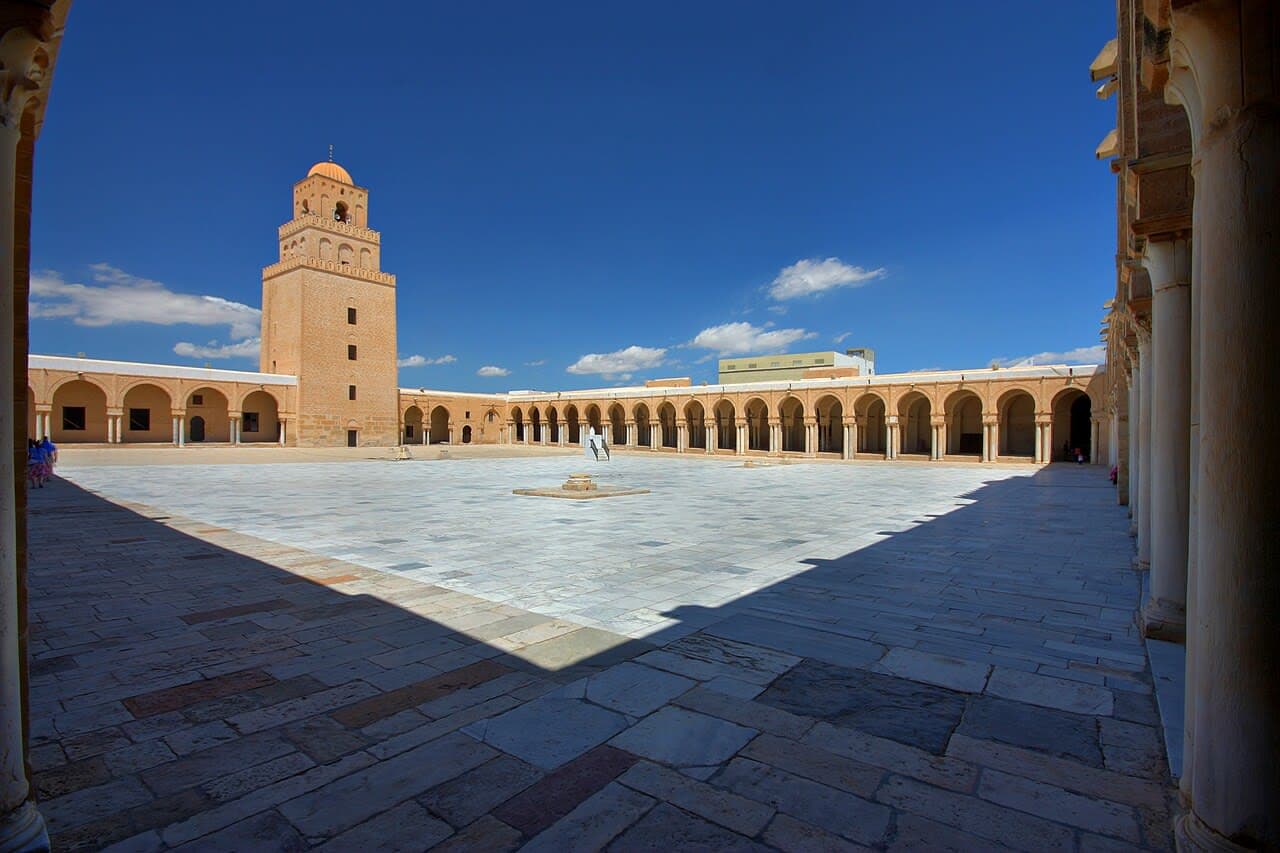
The Great Mosque of Kairouan
Where Islam first took root in Africa, and pilgrims still find the sacred waters of Mecca rising in the desert
Kairouan, Kairouan, Tunisia
At A Glance
- Coordinates
- 35.6814, 10.1041
- Suggested Duration
- A focused visit to the mosque itself takes one to two hours, allowing time to absorb the courtyard, view the prayer hall from the entrance, and appreciate the minaret and architectural details. A half-day allows for combined exploration of the medina, including nearby sites like the Zaouia of Sidi Sahab and Bir Barrouta. A full day permits a more contemplative pace plus the Aghlabid Basins and a proper immersion in the city's sacred atmosphere.
Pilgrim Tips
- Women must cover their hair completely with a headscarf. This is not optional. Shoulders, chest, arms to the elbow, and legs to the ankle must be covered. Loose, flowing garments are preferable to tight clothing. Men must wear long pants and shirts that cover the shoulders. Both sexes should avoid bright, attention-drawing colors that mark them as tourists rather than respectful visitors. Robes are available at the entrance if needed.
- Photography is permitted in the courtyard and exterior areas during visiting hours. Permission may be required for some specific areas; when in doubt, ask. Do not photograph worshippers during prayer; this is intrusive and disrespectful. Do not use flash. Do not attempt to photograph inside the prayer hall. Be mindful of the tendency to reduce sacred space to content; photograph less than you might elsewhere, and be present more.
- Do not attempt to enter the prayer hall if you are not Muslim. This is a firm boundary, and pressing against it disrespects both the tradition and those who worship here. The courtyard offers genuine access; be content with what is offered. Do not visit during prayer times with the intention of photographing worshippers. Prayer is intimate; treating it as spectacle violates its nature. If you happen to be present during prayer, watch respectfully or withdraw. Be aware that some guides may offer to arrange entry to spaces that are formally off-limits. Decline. The boundaries exist for reasons; circumventing them through informal arrangements does not make the access legitimate. What you can see legitimately is substantial; honor the limits.
Overview
Founded in 670 CE, only thirty-eight years after the Prophet Muhammad's death, the Great Mosque of Kairouan stands as the oldest mosque in Africa and the template for all Maghrebi sacred architecture. For North African Muslims, seven pilgrimages here equal one hajj to Mecca. The mosque remains an active place of worship, its prayers unbroken for over thirteen centuries.
The minaret rises from the North African plain like a watchtower between worlds. It has stood for nearly thirteen hundred years, the oldest still standing anywhere in the Islamic world, calling the faithful to prayer across a landscape where Islam first planted deep roots in African soil.
The Arab general Uqba ibn Nafi founded this mosque in 670 CE, when the companions of the Prophet Muhammad were still alive, when the memory of revelation was still within living reach. According to tradition, at the site where he chose to build, Uqba discovered a golden cup he had lost years earlier in the sacred Zamzam well at Mecca. The waters here, the legend holds, flow from the same source. Whether history or holy tale, the story speaks to what Kairouan has meant for generations of North African Muslims: a piece of Mecca transplanted to their own land.
The prayer hall holds over four hundred ancient columns, gathered from Roman and Byzantine ruins across Tunisia. Their varied capitals tell of Christianity and empire before Islam arrived. Now they carry the weight of a different prayer, their marble smoothed by centuries of worshippers who have passed between them. The mihrab, installed in 863 CE, remains among the finest examples of early Islamic decoration anywhere in the world.
This is not a museum. Five times daily, the call to prayer sounds as it has since the seventh century. Worshippers still descend these steps, still turn toward Mecca, still add their voices to a conversation with the divine that has never ceased. For seekers, the invitation is to witness continuity made tangible, to stand where thirteen centuries of prayer have worn grooves in stone.
Context And Lineage
The Great Mosque of Kairouan was founded in 670 CE by the Arab general Uqba ibn Nafi during the Muslim conquest of North Africa. The current structure dates primarily from the Aghlabid reconstruction of the ninth century. For centuries, Kairouan served as the spiritual and intellectual capital of Islam in Africa, its mosque the mother of all North African religious architecture. The site was inscribed as a UNESCO World Heritage Site in 1988.
The founding of Kairouan belongs to the great expansion of Islam following the Prophet's death in 632 CE. Within decades, Arab armies had swept across the Middle East, North Africa, and into Spain. Uqba ibn Nafi was the general charged with securing the Maghreb.
In 670 CE, Uqba needed a permanent base. He chose a site inland from the Byzantine coastal settlements, where his forces would be protected from naval attack and where they could control the trade routes. But the choice was also sacred. According to the founding legend, Uqba was searching for a location when he discovered at this site a golden cup he had lost years earlier in the Zamzam well at Mecca. This miracle revealed the ground's hidden connection to Islam's holiest site. Where the cup had traveled underground, the blessing of Mecca had followed.
Uqba laid out a simple mosque, orienting it toward Mecca as the Prophet had taught. Within the qibla wall, he set a mihrab to mark the direction of prayer. The first call to prayer sounded across North Africa. Islam had taken root in African soil.
The original mosque was modest, but its significance was immense. It marked the permanent presence of Islam in Africa, the foundation of a city that would become the spiritual capital of the Maghreb. Uqba himself would die fighting Berber resistance in 683 CE, but the mosque he founded would outlive him by over thirteen centuries.
The mosque founded by Uqba served for over a century before the Aghlabid dynasty undertook its transformation. Between 817 and 863 CE, successive Aghlabid rulers rebuilt and expanded the structure, creating the monument that stands today. They gathered hundreds of Roman and Byzantine columns from across Tunisia, incorporating the architectural heritage of previous civilizations into their Islamic vision.
Under the Aghlabids, Kairouan became a center of Islamic learning to rival any in the world. The mosque hosted scholars of Quranic sciences, Maliki jurisprudence, medicine, astronomy, and mathematics. Students came from across North Africa and beyond. The tradition of learning established here shaped Islamic thought throughout the western Muslim world.
Later dynasties, the Fatimids, Zirids, Hafsids, and Ottomans, maintained the mosque and added refinements, but the Aghlabid structure persisted. French colonial rule (1881-1956) treated Kairouan as a heritage site; Tunisian independence returned it to full religious function. Today, the mosque operates as it has since 670 CE: a place of prayer, pilgrimage, and continuity with the earliest days of Islam in Africa.
Uqba ibn Nafi
founder
The Arab general who founded both Kairouan and its Great Mosque in 670 CE. A companion of the companions, meaning he knew those who had known the Prophet Muhammad personally. His founding of the mosque planted Islam permanently in North African soil.
Ziyadat Allah I
historical
The Aghlabid ruler who began the major reconstruction of the mosque in 817 CE. His rebuilding project created the structure that still stands today, establishing the architectural template for all subsequent Maghrebi mosques.
Abu Ibrahim Ahmad
historical
The Aghlabid emir who commissioned the magnificent mihrab in 862-863 CE. The mihrab remains one of the finest examples of early Islamic decorative art, its lustrous tiles imported from Baghdad.
Abu Zama al-Balawi
saint
A companion of the Prophet Muhammad who traveled to Kairouan and is buried in the nearby Zaouia of Sidi Sahab, the Barber's Mosque. He reportedly carried three of the Prophet's beard hairs with him. His tomb adds to Kairouan's claim as a city blessed by proximity to the Prophet.
Why This Place Is Sacred
The Great Mosque of Kairouan derives its sacred power from multiple convergent factors: its founding during the lifetime of the Prophet's companions, its legendary connection to the Zamzam well in Mecca, thirteen centuries of unbroken worship, and its role as the spiritual heart of Islam in North Africa. The accumulation of prayer in this space is not metaphor but observable reality, worn into the stones themselves.
The thinness of Kairouan begins with proximity to the source. When Uqba ibn Nafi laid the first stones, men and women who had personally known the Prophet Muhammad were still alive. The chain of transmission was short; the heat of revelation had not yet cooled. To found a mosque in those decades was to participate in something still unfolding, to plant a seed while the gardener's hands were still warm.
Then there is the founding legend. In Islamic understanding, the Zamzam well in Mecca is the spring that God caused to flow for Hagar and Ishmael in the desert, the water that sustained the Prophet's ancestors and still sustains pilgrims today. The story of Uqba's golden cup, lost in Zamzam and found at Kairouan, establishes a subterranean connection between the holiest site in Islam and this outpost on a new continent. The sacred well of Bir Barrouta, still operating within the medina, is said to draw from this same underground river. Geography bends to accommodate the sacred.
For over thirteen hundred years, Muslims have prayed in this mosque without interruption. Consider what this means: every dawn, every noon, every afternoon, evening, and night, voices have risen here in praise and supplication. The weight of accumulated intention is not merely symbolic. Visitors describe a quality of stillness in the courtyard, a density to the silence between prayers. The marble pavement has been walked smooth by centuries of feet approaching the divine.
The mosque also served for centuries as a center of learning. Scholars taught Quranic sciences, jurisprudence, medicine, astronomy, and mathematics within these walls, creating a tradition of sacred scholarship that rivals medieval European universities. Knowledge and worship intertwined here, each supporting the other. The thinness of Kairouan is intellectual as well as devotional.
Finally, there is the tradition that seven pilgrimages to Kairouan equal one hajj to Mecca. For North African Muslims unable to make the long journey to Arabia, Kairouan offered a substitute that was not second-best but genuinely efficacious. The accumulated faith of generations who came here seeking what they could not find in Mecca has added its own weight to the site's sacred density.
The original mosque of 670 CE served both practical and sacred functions. Uqba ibn Nafi needed a place for his troops to pray as they consolidated Arab control over North Africa. But the site was chosen with care, the founding legend establishing spiritual credentials that transcended military necessity. The mosque marked the implantation of Islam in African soil, a statement that the faith had come to stay.
The current structure, rebuilt by the Aghlabid rulers in the ninth century, expanded this original purpose. The massive courtyard accommodated growing numbers of worshippers. The prayer hall's hundreds of columns created a forest of sacred space. The minaret served as both call to prayer and visible landmark, orienting the entire city toward the mosque. The mihrab, pointing toward Mecca, became a focal point of artistic devotion, its lustrous tiles and intricate carving declaring that God deserves beauty.
The mosque that stands today is primarily the work of the Aghlabid dynasty, who ruled from 800 to 909 CE. They rebuilt, expanded, and decorated, creating a monument that would serve as the prototype for all subsequent Maghrebi mosque architecture. The horseshoe arches, the T-shaped prayer hall, the massive courtyard, the three-tiered minaret, all originated here and spread across North Africa and into Spain.
Later dynasties added refinements but preserved the essential form. The Hafsids, the Ottomans, and the French colonial period all left marks, but the Aghlabid bones remain. Modern conservation has focused on preservation rather than transformation, recognizing that the mosque's power lies in its continuity.
What has changed is the composition of those who come. Once primarily local worshippers and regional pilgrims, Kairouan now draws visitors from across the Muslim world and beyond. The annual Mawlid celebration attracts hundreds of thousands. Yet the daily rhythm remains what it has always been: the call to prayer, the gathering of the faithful, the turning toward Mecca. Thirteen centuries have not altered the essential gesture.
Traditions And Practice
The Great Mosque of Kairouan maintains unbroken daily worship, with five prayers performed each day as they have been since 670 CE. Non-Muslims cannot enter the prayer hall but can witness worship from the courtyard. The annual Mawlid celebration draws hundreds of thousands for ten days of religious festivity.
The practices of the Great Mosque center on salat, the five daily prayers that form one of Islam's five pillars. Since the mosque's founding, this rhythm has continued without interruption: fajr before dawn, dhuhr at midday, asr in the afternoon, maghrib at sunset, isha at night. Each prayer time sees worshippers gathering in the prayer hall, arranging themselves in rows facing the mihrab, following the imam through the sequence of standing, bowing, and prostration.
Friday brings the jumu'ah, the congregational prayer that is obligatory for adult Muslim men. The prayer hall fills; the imam delivers a khutbah, a sermon addressing the community. This weekly gathering has continued for over thirteen centuries, making the Great Mosque one of the world's longest-running religious assemblies.
The tradition of learning also constitutes practice. For centuries, scholars taught within the mosque's walls, students gathered around columns to learn Quranic recitation and Islamic jurisprudence. Though the formal madrasa system has been displaced by modern universities, the mosque's identity as a place of sacred knowledge persists.
Pilgrimage to Kairouan, particularly the tradition that seven visits equal one hajj, constitutes another layer of practice. North African Muslims who could not reach Mecca came here instead, making tawaf-like circuits, seeking the blessing that legend says flows from the same source as Zamzam.
The Mawlid celebration of the Prophet's birthday has become Kairouan's defining contemporary practice. Each year on the 12th of Rabi' al-Awwal, the city transforms. Over 700,000 visitors have been recorded in recent years. For ten days, processions move through the streets, Sufi musicians perform, Quranic recitation competitions unfold, and the traditional sweet makroudh is distributed in massive quantities.
The Mawlid has Sufi roots, and Sufi elements remain present in the celebration. Hadra ceremonies featuring collective dhikr (remembrance of God through chanting) occur at various points. The blending of orthodox practice and Sufi devotion reflects Tunisia's particular expression of Islam, which has historically accommodated both.
Daily worship continues alongside these celebrations. The mosque never stops being a mosque. Regular worshippers maintain their practice through the festival crowds, their constancy a reminder that the spectacular celebration rests on a foundation of ordinary, daily faithfulness.
Non-Muslims cannot join in prayer, but meaningful engagement remains possible. Consider visiting during Mawlid if you are drawn to collective religious celebration and can tolerate crowds. The atmosphere is festive rather than exclusively solemn; joy in the Prophet is the dominant note.
Outside Mawlid, visit near prayer time. You cannot enter the prayer hall, but standing at the threshold while worship occurs connects you to something continuous with the seventh century. Watch without photographing. Notice the physical vocabulary of Islamic prayer: the standing, the bowing, the prostration. Each gesture carries meaning accumulated over fourteen centuries.
In the courtyard, find a place to sit and simply be present. Notice the quality of silence between prayers. Notice the marble worn smooth beneath your feet. Consider that this pavement has been walked by pilgrims for over thirteen hundred years. Let the weight of that continuity settle into your body.
If you wish to engage more deeply with the city's sacred character, visit the Zaouia of Sidi Sahab, where a companion of the Prophet is buried, and Bir Barrouta, the well said to connect to Zamzam. Together with the Great Mosque, they form a sacred geography worth walking slowly.
Sunni Islam
ActiveThe Great Mosque of Kairouan is one of the oldest and most venerated mosques in Islam, commonly regarded as the fourth holiest site after Mecca, Medina, and Jerusalem. Founded only thirty-eight years after the Prophet Muhammad's death, it represents the earliest permanent establishment of Islam in Africa. The mosque served as the model for all subsequent Maghrebi mosques and as a center of Islamic learning that rivaled any in the world. For North African Muslims, seven pilgrimages here equal one hajj to Mecca.
Daily prayers continue unbroken since 670 CE, maintaining the oldest continuous Islamic worship in Africa. Friday congregational prayers draw worshippers from across the region. Pilgrimage to Kairouan, particularly during Mawlid, remains a significant practice for North African Muslims. Quranic study and recitation continue the mosque's centuries-old educational tradition.
Maliki jurisprudence
ActiveFor centuries, the Great Mosque served as a premier center for teaching Islamic sciences under the Maliki school of jurisprudence, one of the four main Sunni legal schools. Its role in transmitting Maliki legal thought across North Africa and into Spain was comparable to that of the great European universities in their respective traditions. The mosque helped establish Maliki jurisprudence as the dominant school throughout the Maghreb, a position it maintains today.
While formal madrasa education has largely moved to universities, the mosque maintains its identity as a place of religious learning. Quranic studies, legal discussions, and religious scholarship continue within the tradition established during the Aghlabid era.
Sufi traditions
ActiveKairouan holds significance in Sufi practice through its mausoleums of holy figures, its tradition of visiting shrines and venerating saints, and particularly through the annual Mouled festival, which features Sufi performances and religious ceremonies. The city's sacred geography includes multiple zawiya (Sufi lodges) and tombs of venerated figures.
The Mawlid celebration incorporates Sufi elements including hadra ceremonies with collective dhikr, Sufi music, and ecstatic states of remembrance. Shrine visitation (ziyarat) to the tomb of Abu Zama al-Balawi and other holy figures continues as an expression of Sufi piety. The blending of orthodox worship and Sufi devotion characterizes Tunisia's particular expression of Islam.
Experience And Perspectives
Visitors to the Great Mosque of Kairouan consistently report a sense of encountering living history, a palpable weight of accumulated devotion. The scale of the courtyard, the forest of ancient columns in the prayer hall, and the knowledge of unbroken worship since 670 CE combine to produce experiences of historical vertigo and spiritual depth that transcend religious affiliation.
The first encounter is often with scale. The courtyard stretches before you, paved in white marble, ringed by arcades whose columns seem to recede indefinitely. The minaret dominates one corner, its massive presence somehow both anchoring and lifting the space. The silence is not empty but full, as though the courtyard itself is listening.
Non-Muslims cannot enter the prayer hall, but the view from the doorway is arresting. Over four hundred columns stretch into dimness, their varied capitals, Roman and Byzantine, forming an unexpected dialogue with Islamic arches above. The effect is of a stone forest, of depth beyond what the architecture seems to allow. Those who know the history sense ghosts: the centuries of worshippers who have passed through this threshold, the scholars who taught, the pilgrims who wept.
Visitors frequently describe a quality they struggle to name. Not energy in the New Age sense, but weight, density, presence. Something has accumulated here. Whether one attributes this to centuries of prayer, to the site's legendary connection to Mecca, or simply to the psychological impact of knowing one stands where Islam first took root in Africa, the effect is consistent. The courtyard quiets the mind.
During prayer times, even from outside, the experience intensifies. The adhan echoes across the medina as it has for over a thousand years. Worshippers gather and enter spaces visitors cannot follow. There is something clarifying about being present for a practice one cannot join, about witnessing devotion without participating in it. The mosque's sacredness does not depend on one's own belief; it is constituted by the beliefs of those who have prayed here for thirteen centuries.
Approach Kairouan as a pilgrim, even if you do not share its faith. This does not mean pretending to beliefs you do not hold, but arriving with the quality of attention that pilgrimage invites: openness, receptivity, willingness to be addressed.
Come early, before the tour buses arrive. The courtyard in morning light, with only a handful of visitors, allows the space to speak. Walk slowly. Notice the variations in column capitals, the play of light on marble, the depth of worn stone. These details are not decoration but testimony: physical evidence of centuries of human presence oriented toward the sacred.
If you can, return at prayer time. You will not enter, but you can witness. Stand at the threshold of the prayer hall and watch men (women have separate facilities) arrange themselves in rows facing Mecca. The collective motion of prostration, the murmur of Arabic phrases unchanged since the Prophet's time, the complete absorption of those praying. You are witnessing something continuous with 670 CE.
Before leaving, find a quiet corner of the courtyard and simply sit. Let the weight of the place settle. The mosque will not explain itself, but it may impress itself upon you if you give it time.
The Great Mosque of Kairouan has been interpreted through multiple lenses: as a masterpiece of early Islamic architecture, as the mother of all North African mosques, as a thin place where thirteen centuries of prayer have worn grooves in reality, and as the validation of Islam's claim on African soil. These perspectives need not compete; the mosque is capacious enough to hold them all.
Art historians and Islamic scholars recognize the Great Mosque of Kairouan as one of the most significant monuments in Islamic architectural history. The minaret, dating to 724-728 CE, is definitively established as the oldest standing minaret in the world and the prototype for all minarets in the western Islamic tradition. Its three-tiered, tapering form with a dome at top became the model replicated from Morocco to Spain.
The mosque's hypostyle prayer hall, with its T-shaped plan emphasizing the central axis toward the mihrab, established the template for Maghrebi mosque architecture. The reuse of Roman and Byzantine columns created an architectural dialogue between civilizations that scholars continue to analyze.
The mihrab, installed in 862-863 CE, is considered among the finest examples of early Islamic decorative art anywhere in the world. Its lustrous tiles, believed to have been imported from Baghdad, and its intricate carving demonstrate the Aghlabid court's access to the finest craftsmanship of the Islamic world.
UNESCO inscribed Kairouan as a World Heritage Site in 1988 under five criteria, recognizing it as a creative masterpiece, a site of cultural interchange, an exceptional witness to early Islamic civilization, an example of traditional medina architecture, and a site associated with living religious belief.
In Islamic tradition, Kairouan holds a status unique among cities outside Arabia. The designation as the fourth holiest city in Islam, after Mecca, Medina, and Jerusalem, is widely accepted among North African Muslims, though other cities including Damascus, Hebron, Bukhara, and Harar also claim this distinction.
The tradition that seven pilgrimages to Kairouan equal one hajj to Mecca reflects a theological position: that the blessing of Mecca has extended to this place, making it a legitimate substitute for those who cannot reach Arabia. This is not mere convenience but a claim about sacred geography, that Kairouan participates in Mecca's holiness through the underground connection revealed by Uqba's golden cup.
The founding of the mosque during the era of the tabi'in (the generation who knew the Prophet's companions) gives it an authority that later foundations cannot claim. The chain of transmission is short. When prayers are offered here, they continue a practice that began when living memory still reached the Prophet himself.
Several genuine mysteries surround the Great Mosque and Kairouan's sacred status. The origin of the tradition equating seven Kairouan pilgrimages with one hajj remains unclear in historical records. When and by whom was this equivalence established, and on what theological basis? The question remains open.
The legend of Bir Barrouta's connection to Zamzam similarly lacks historical documentation of its origin. Did the story arise with Uqba's founding, or develop later as Kairouan's importance grew? The relationship between legend and history here is unresolved.
The precise provenance of the hundreds of Roman and Byzantine columns remains partly mysterious. Some came from Carthage, others from sites across Tunisia. Which emperors built the structures from which they were taken? Which churches did they support before supporting this mosque? The columns themselves are silent.
Visit Planning
The Great Mosque is located in the heart of Kairouan's medina, approximately 160km south of Tunis. Entry costs 12 TND (approximately $3-4 USD) and includes access to other city sites. Non-Muslim visiting hours are limited to mornings. Spring and autumn offer the most pleasant weather; the Mawlid celebration draws hundreds of thousands in Rabi' al-Awwal.
Kairouan offers accommodations ranging from simple guesthouses to comfortable hotels. Options within the medina allow for easy access to the mosque and immersion in the city's atmosphere. La Kasbah hotel, converted from an 18th-century palace, offers traditional architecture and proximity to the sites. For those seeking deeper engagement, some visitors base themselves in Sousse or Tunis and visit Kairouan as a day trip, though this limits the possibility of experiencing the mosque at different times of day.
The Great Mosque of Kairouan is an active place of worship requiring respectful behavior and modest dress. Women must cover their hair; both sexes must cover shoulders and knees. Photography is permitted in the courtyard but should be practiced mindfully. Non-Muslims cannot enter the prayer hall.
The fundamental principle is that you are entering a living place of worship, not a museum. Everything follows from this. The worshippers you see are not actors or subjects; they are people at prayer. Your presence is tolerated, even welcomed, but it is not the purpose of the space.
Modest dress is required and enforced. For women, this means covering the hair with a scarf, covering the arms at least to the elbows, and wearing skirts or pants that reach the ankle. For men, long pants and shirts that cover the shoulders are necessary. Shorts, tank tops, and tight or revealing clothing will prevent entry. Robes are available at the entrance for visitors whose clothing does not meet standards.
Remove your shoes before entering any covered area. This is not merely custom but Islamic practice: one approaches the sacred unshod, leaving the dust of the world at the threshold.
Maintain quiet and respectful behavior throughout. Loud conversation, laughter, and mobile phone use are inappropriate. The courtyard may appear to be a public plaza, but it is sacred space. Treat it accordingly.
Do not interrupt or approach worshippers. If prayer is occurring, maintain distance. Do not walk in front of someone praying. These are not arbitrary rules but reflect the integrity of the prayer act, which is an intimate conversation with God.
Follow the instructions of mosque staff. If you are asked to move, leave an area, or adjust your behavior, comply without argument. They are custodians of a space that has been maintained for over thirteen centuries; trust their judgment.
Women must cover their hair completely with a headscarf. This is not optional. Shoulders, chest, arms to the elbow, and legs to the ankle must be covered. Loose, flowing garments are preferable to tight clothing. Men must wear long pants and shirts that cover the shoulders. Both sexes should avoid bright, attention-drawing colors that mark them as tourists rather than respectful visitors. Robes are available at the entrance if needed.
Photography is permitted in the courtyard and exterior areas during visiting hours. Permission may be required for some specific areas; when in doubt, ask. Do not photograph worshippers during prayer; this is intrusive and disrespectful. Do not use flash. Do not attempt to photograph inside the prayer hall. Be mindful of the tendency to reduce sacred space to content; photograph less than you might elsewhere, and be present more.
There is no tradition of offerings at the Great Mosque in the way that exists at some shrines. Charitable giving is always appropriate in Islamic tradition, particularly during Mawlid when distribution to the poor is customary. If you wish to give, donate to legitimate local charities rather than to individuals who may approach you at the site.
Non-Muslims cannot enter the prayer hall under any circumstances. Visiting hours for non-Muslims are limited: Saturday through Thursday 8am to 2pm, Friday 8am to noon. Entry is forbidden during prayer times. These restrictions are not negotiable. Dress code is enforced at the entrance. Large bags must be left outside. Eating and drinking within the mosque complex is not permitted.
Sacred Cluster
Nearby sacred places create the location cluster described in the growth plan. This block is intentionally crawlable and links into the wider regional graph.