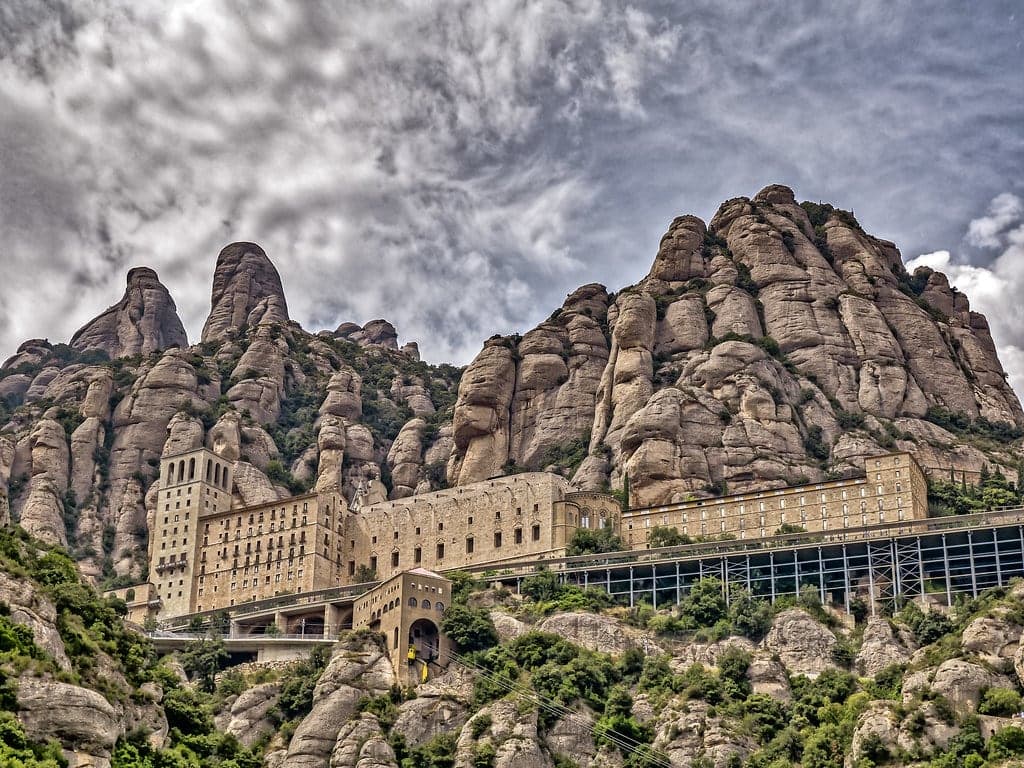
Santa Maria de Montserrat Abbey
Where the Black Madonna chose to dwell, and Catalonia's soul finds its mountain home
Monistrol de Montserrat, Catalonia, Spain
At A Glance
- Coordinates
- 41.5933, 1.8381
- Suggested Duration
- A rushed visit takes two to three hours: basilica, Madonna, perhaps the Escolania. A meaningful visit requires at least half a day—arrive before 10:00 AM, see the Madonna with morning calm, hear the choir, and walk at least partway toward Santa Cova. A full day allows the complete Santa Cova path and exploration of the mountain. Those serious about Montserrat's spiritual dimension often return multiple times, discovering what emerges when novelty subsides.
Pilgrim Tips
- Modest dress is required in the basilica. Shoulders and midriff must be covered. Shorts and skirts should extend at least to mid-thigh. Cropped tops, plunging necklines, and transparent fabrics are not appropriate. Women are advised to carry a scarf for covering shoulders if needed. Remove hats and caps before entering the basilica. For the mountain hikes, dress practically—comfortable walking shoes, layers for changing weather—but have modest options available for returning to the sacred spaces.
- Photography is permitted in most areas of the monastery complex but should be practiced with discretion. During religious services, do not photograph. When visiting the Black Madonna at the Throne, photography is not permitted—the encounter is meant to be present, not captured. Flash photography is discouraged throughout the basilica. Consider whether you need to photograph at all. The image of La Moreneta is reproduced in countless places; your presence before her is irreproducible.
- Montserrat is an active monastery and pilgrimage site, not a spiritual theme park. The monks have balanced hospitality with contemplative life for a millennium, but that balance requires visitor cooperation. Do not treat the basilica as a photography venue; do not speak loudly during liturgical hours; do not approach monks seeking selfies or extended conversation. The touching of the Black Madonna's hand is the traditional devotional act. Do not attempt to bring objects to touch to the statue or leave offerings at the shrine—these are not part of the tradition and may be removed. If you wish to light a candle, use the designated areas. Those seeking 'energy work' or esoteric ceremony should understand that Montserrat is a Catholic monastery. The monks welcome seekers of all backgrounds but do not facilitate practices outside their tradition. If you come from another path, approach with respect for the tradition that has tended this place for a thousand years.
Overview
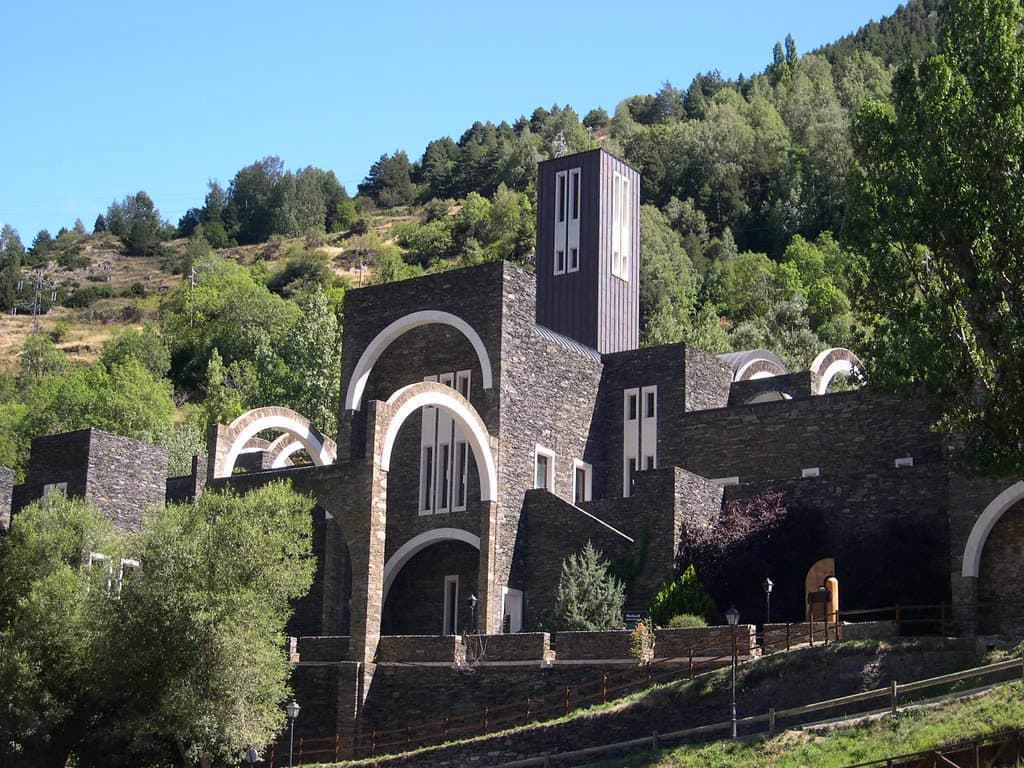
Rising from the serrated peaks that give this mountain its name, Santa Maria de Montserrat has drawn pilgrims for over a thousand years. The Black Madonna—La Moreneta—presides over an active Benedictine community, while the Escolania boys' choir continues a musical tradition unbroken since the 13th century. Here the sacred mountain and the sacred feminine meet, and seekers still find the veil remarkably thin.
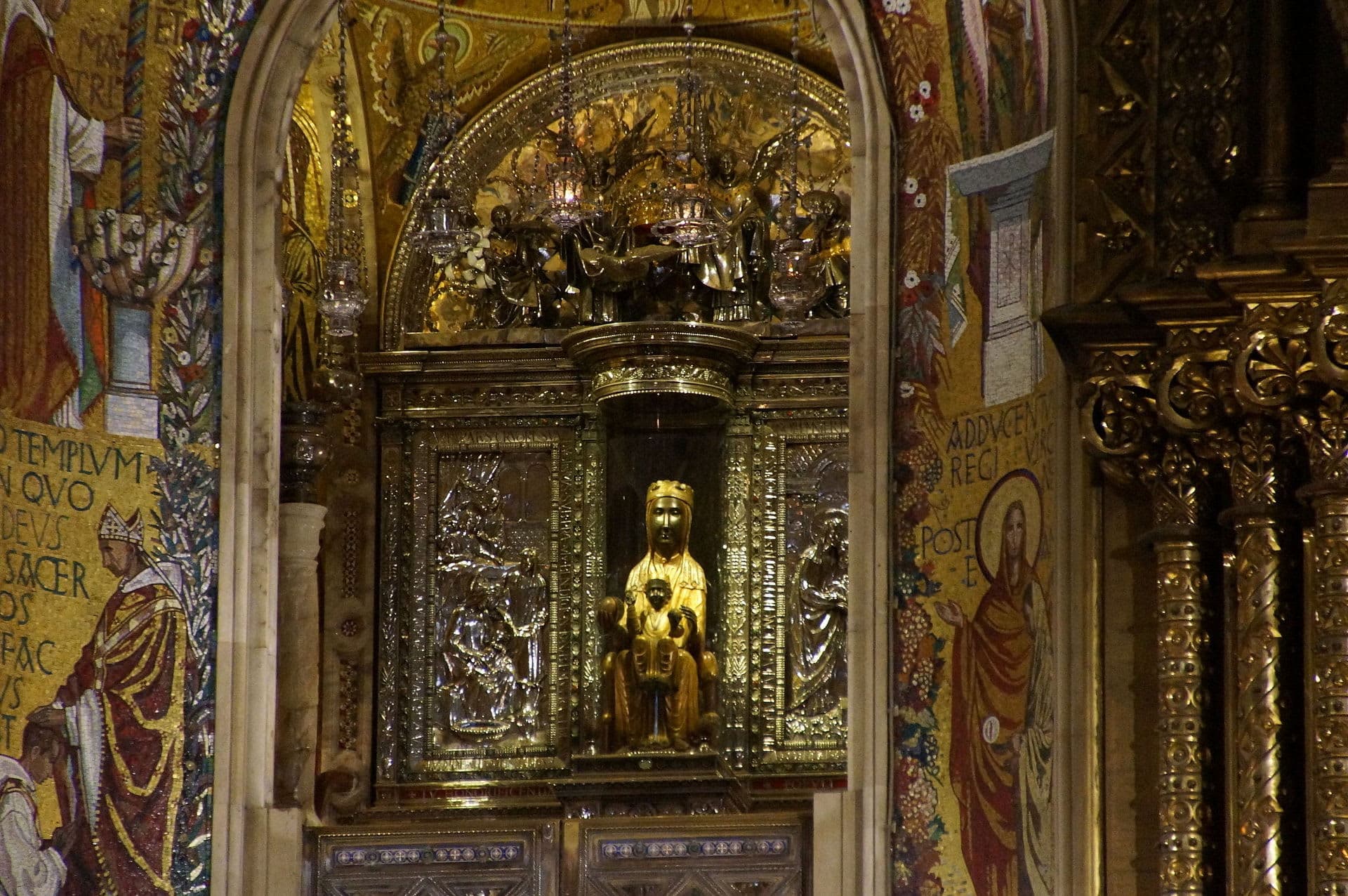
Something happens when you touch her hand. Pilgrims have been doing so for centuries—approaching La Moreneta, the Black Madonna of Montserrat, her dark face serene above a globe she holds as though cradling the cosmos itself. The only part of the ancient statue not enclosed behind glass, her right hand has been worn smooth by millions of seekers reaching across the boundary between ordinary and holy.
The Benedictine monks who have tended this place since 1025 understand it as chosen ground. According to the founding narrative, when shepherds discovered the Virgin's image in a cave in 880 AD and attempted to carry it to the cathedral, it became impossibly heavy. She had selected this mountain. A thousand years later, the monastery continues its rhythm of prayer and work, while over a million visitors annually climb toward these peaks seeking something they cannot quite name.
Montserrat means 'serrated mountain,' and the landscape itself seems to reach for the transcendent—bizarre rock formations rising like fingers pointing toward heaven, caves where hermits have sought God for centuries, a biodiversity so dense that half of Catalonia's plant species grow within twenty-five square kilometers. For Catalans, this is the spiritual heart of their nation. For seekers of any background, it offers encounter with one of Europe's most powerful thin places, where the accumulated weight of devotion and the strangeness of the land conspire to open something that ordinary life keeps closed.
Context And Lineage
Founded in 1025 by Abbot Oliba to house the miraculous Black Madonna discovered in 880 AD, Montserrat has served as a center of pilgrimage, monastic life, and Catalan cultural preservation for a millennium. Saints including Ignatius of Loyola were transformed here. The monastery has survived destruction by Napoleon and persecution under Franco, emerging as one of Europe's most significant Marian shrines.
One Saturday evening in 880 AD, young shepherds tending their flocks saw something impossible. A great light descended from heaven to settle partway up the mountain, accompanied by music no earthly instrument could make. The vision returned for several weeks. When the local priest informed the Bishop of Manresa, an expedition climbed into the wild peaks and found a cave containing an image of the Virgin Mary.
The bishop ordered the statue brought to the cathedral in Manresa. But as the procession descended, the image became heavier and heavier, until no number of men could move it. The Virgin had chosen her dwelling place. She would not leave Montserrat.
A chapel was built at the site, tended first by hermits and then, from 1025, by Benedictine monks under Abbot Oliba. The monastery grew around the image. Pilgrims came in growing numbers, seeking the Black Madonna's intercession for healing, for safe childbirth, for deliverance from danger. By the medieval period, Montserrat had become one of the great pilgrimage destinations of Christendom, its fame carried by travelers who named Montserrat's islands across the world—from the Caribbean to the Pacific.
The monastery's own traditions hold that the original statue was carved by Saint Luke himself in Jerusalem, at Jesus's request, and later hidden in the cave to protect it from Moorish destruction during the Islamic conquest of Spain. Whether the 12th-century Romanesque statue that now sits enthroned is the same image discovered in 880 remains one of the site's mysteries.
The Benedictine monks of Montserrat trace their tradition through an unbroken line to the Rule of Saint Benedict, written in the 6th century. The particular expression of that tradition at Montserrat has been shaped by a millennium of circumstance: the presence of the Black Madonna, the Catalan cultural context, the periods of destruction and rebuilding, the role of resistance during Franco's dictatorship. Today approximately seventy monks maintain the monastery's rhythms of prayer and work, publishing religious texts, operating a museum, welcoming pilgrims, and sustaining the contemplative life that has continued here since 1025.
The monastery has shaped the wider Church as well as receiving from it. Bernat Boil, a hermit from Montserrat, accompanied Columbus on his second voyage and celebrated the first Mass in the Americas. The Jesuit order was born from Ignatius's vigil here. The Catalan church's survival through Franco owed much to Montserrat's defiance. This is not a monastery that has merely persisted—it has influenced the course of Catholic history.
The Virgin of Montserrat
deity
The Black Madonna enthroned above the main altar—a 12th-century Romanesque statue of the Virgin and Child, co-patroness of Catalonia. Her dark face, whether from candle smoke or original intent, has drawn pilgrims for centuries seeking her intercession.
Abbot Oliba
historical
Bishop of Vic and Abbot of Ripoll who founded Santa Maria de Montserrat in 1025, establishing the Benedictine presence that continues to this day.
Saint Ignatius of Loyola
historical
The soldier who became a saint. In 1522, after a night of prayer before the Black Madonna, he laid down his sword at her altar and changed his fine clothes for a beggar's robe, beginning the transformation that led him to found the Society of Jesus.
The Escolania
institution
One of Europe's oldest boys' choirs, documented since 1223. The Escolania sings the Salve Regina and Virolai daily, maintaining a tradition of musical devotion that has continued for eight centuries.
Why This Place Is Sacred
Montserrat's sacredness emerges from the convergence of landscape and devotion across millennia: a mountain already venerated in pre-Christian times, the miraculous discovery of the Virgin's image, over a thousand years of continuous monastic prayer, and the profound Catalan identification of place with identity. The rocks themselves seem to participate in the sacred—and the reports of visitors suggest they are not wrong.
The Romans knew this mountain was special. They built a temple to Venus here, recognizing in these strange serrated peaks a place where the divine drew near. What they sensed persisted through the centuries of transformation that followed—through the arrival of Christianity, the legendary discovery of the Black Madonna, the establishment of the monastery, the destruction and rebuilding, the political resistance and cultural preservation.
The mountain itself shapes the experience. These are not ordinary rocks. The conglomerate formations, sculpted by millions of years of erosion into fingers, towers, and impossible shapes, create a landscape that seems to belong to another world. Walking among them, visitors frequently report a quality of attention the mountain seems to demand—a sense of being watched by the peaks themselves, of the stone being somehow alive.
Within this landscape, human devotion has accumulated for over a thousand years. The monks rise before dawn for the first prayers of the Divine Office. The Escolania sings the Salve Regina at midday, continuing a tradition documented since 1223. Pilgrims queue to touch the Madonna's hand, adding their intention to the weight of centuries. Whatever thin-place quality Montserrat possesses—and visitors across belief systems consistently report something—it emerges from this layering: the pre-Christian recognition, the natural strangeness, the founding miracle, the centuries of prayer, the devotion of millions.
When Abbot Oliba founded Santa Maria de Montserrat in 1025, he was formalizing what had already begun. Hermits had been seeking God in these caves and peaks since at least the 9th century, drawn by the mountain's wild remoteness and the presence of a miracle—the image of the Virgin discovered, according to tradition, by shepherds following heavenly light. The monastery was built to house this image, to tend the pilgrims who came seeking her intercession, and to maintain the continuous rhythm of Benedictine prayer. These purposes remain unchanged a millennium later.
Montserrat has been destroyed and rebuilt, its monks killed and scattered, its very survival threatened—yet something persists. Napoleon's troops sacked and burned the monastery in 1811-1812, leaving ruins that took decades to restore. During the Spanish Civil War, twenty-two monks were killed, and only the protection of the Catalan Generalitat preserved the site from complete destruction. Under Franco's dictatorship, when the Catalan language was banned throughout Spain, Montserrat became a sanctuary of resistance—publishing in Catalan when no one else could, celebrating Mass in the forbidden language, harboring those who refused to let their culture die.
This history of survival against destruction has deepened Montserrat's significance. For Catalans, it is not merely a pilgrimage site but the keeper of their identity. For seekers from elsewhere, the weight of all that has been endured here adds to the sense of accumulated presence—the suffering and faith of generations compressed into the stones.
Traditions And Practice
Montserrat maintains the full cycle of Benedictine liturgical prayer alongside its role as a major pilgrimage destination. Visitors can participate in daily Mass and the Hours, hear the Escolania, and touch the Black Madonna's hand. Those seeking deeper engagement can arrange retreats through the monastery's pastoral center.
The Benedictine rhythm at Montserrat follows the Rule of Saint Benedict: ora et labora, prayer and work. The monks gather multiple times daily for the Liturgy of the Hours, beginning before dawn with Matins and concluding after dark with Compline. This cycle of prayer has continued at Montserrat for a thousand years, interrupted only by the periods of destruction when the monastery was burned and scattered.
For pilgrims, the traditional practice centers on the veneration of La Moreneta. Medieval pilgrims would approach the shrine, touch or kiss the Virgin's image, present their petitions, and often spend the night in prayer at the monastery. The Llibre Vermell, a 14th-century manuscript preserved in the monastery's library, contains songs composed specifically for these night vigils—'chaste and pious' alternatives to the secular music pilgrims might otherwise sing. Circle dances were part of the devotion. The path to Santa Cova, where the Virgin was discovered, has been walked by pilgrims for centuries.
The essential forms persist. Visitors today can attend Mass, celebrated in the basilica at various times throughout the day, with the Sunday liturgy at 11:00 AM being the most solemn. The Escolania sings the Salve Regina and Virolai at 1:00 PM on weekdays and at noon on Saturdays. Pilgrims queue to touch the Black Madonna's hand, now accessed through a timed ticket system that manages the flow while preserving the intimacy of the encounter.
The path to Santa Cova remains open, now enhanced with modernista sculptural stations that Gaudí and other Catalan artists created in the early 20th century. Walking this rosary path transforms a hike into a meditation. The hermitages scattered across the mountain can be visited by those willing to walk, offering glimpses of the solitary tradition that preceded the monastery.
Those seeking extended engagement can arrange spiritual retreats through the Centro de Coordinación Pastoral. The monastery welcomes individuals and groups seeking deeper encounter, whether for guided retreat or private silence. The Llibre Vermell songs are still performed—not as daily practice but in special concerts that bring the medieval tradition alive.
If you come seeking more than sightseeing, consider these invitations.
Arrive in time for the Escolania, and let the singing work on you. Position yourself where you can hear clearly and remain still. This is not performance but prayer set to music. The children's voices carry texts the monks have sung for eight centuries; receiving them is itself a practice.
When you approach the Madonna, do so with intention. The queue provides time to prepare. What are you carrying? What do you need to lay down? The touch is brief—seconds only—but it can hold whatever you bring to it.
Walk to Santa Cova if your body allows. The path is not strenuous but requires attention. Pause at the sculptural stations. Let the journey be the practice rather than the destination. When you reach the cave, sit in silence. This is where it began.
If you have more time, consider attending Vespers. The evening prayer of the monks has a different quality than the tourist-crowded midday—smaller, more intimate, the day's activity subsiding into stillness. The monastery becomes itself again as the visitors leave.
Roman Catholicism (Benedictine Monasticism)
ActiveMontserrat has been a Benedictine monastery since 1025, following the Rule of Saint Benedict's emphasis on ora et labora—prayer and work. The monastery is the spiritual heart of Catalonia, and the Black Madonna was declared patroness of the region by Pope Leo XIII in 1881. Throughout its history, Montserrat has shaped the wider Church: Saint Ignatius of Loyola was transformed here before founding the Jesuits, and a hermit from this mountain celebrated the first Mass in the Americas. During the Franco dictatorship, the monastery became a center of Catalan resistance, preserving the language and culture when they were banned elsewhere.
The monks maintain the full cycle of the Liturgy of the Hours, gathering multiple times daily for prayer. Daily Mass is celebrated in the basilica. The Escolania boys' choir, documented since 1223, sings the Salve Regina and Virolai at midday. Pilgrims venerate La Moreneta by touching her hand at the Throne of Our Lady. The monastery offers spiritual retreats for those seeking deeper encounter. The Llibre Vermell songs, composed in the 14th century for pilgrim vigils, are still performed on special occasions.
Marian Devotion (Black Madonna Veneration)
ActiveThe Virgin of Montserrat is one of Europe's most venerated Black Madonnas and co-patroness of Catalonia alongside Saint George. The 12th-century Romanesque statue depicts Mary enthroned with the Christ Child, holding a globe in her right hand—the hand pilgrims touch. Over a million visitors annually come seeking her intercession. Pope Leo XIII granted the image canonical coronation on September 11, 1881. Notable pilgrims include saints, kings, popes, and Christopher Columbus, who named the Caribbean island of Montserrat in her honor.
Pilgrims queue to approach the Throne of Our Lady, touching and kissing the Black Madonna's right hand—the only part not enclosed behind glass. The Escolania sings the Salve Regina and Virolai before the image daily. Walking the rosary path to Santa Cova, where the image was legendarily discovered, is a traditional pilgrimage within the pilgrimage. Candles are lit, prayers offered, and weddings and baptisms celebrated before La Moreneta.
Experience And Perspectives
Visitors to Montserrat consistently describe experiences that transcend ordinary tourism: unexpected emotional release when touching the Black Madonna's hand, profound peace during the choir's singing, a sense of the mountain as alive and watching, and the quality many call 'thinness'—a permeability between the ordinary and something larger. These reports come from Catholic pilgrims and secular tourists alike.
The journey itself prepares you. Whether ascending by cable car, rack railway, or walking from Barcelona in the old pilgrim tradition, the approach builds toward revelation. The mountain emerges from the landscape like nothing around it—serrated, vertical, otherworldly. By the time you arrive at the monastery, something has already shifted.
Then comes the queue for the Madonna. Pilgrims wait, sometimes for an hour or more, to climb the stairs behind the altar, pass through a small chamber, and stand before La Moreneta enclosed in her silver throne. Only her right hand extends, dark and smooth. In that moment of touching—an encounter that lasts perhaps five seconds—something frequently breaks open. Tears come. Words fail. People describe feeling seen, held, answered, though they struggle to articulate by what or whom.
If you time your visit for the early afternoon, you can experience the Escolania. For eight centuries, this boys' choir has sung the Salve Regina and the Virolai—the Catalan hymn to the Virgin—at midday. The sound rises in the basilica, voices of children carrying prayers the monks have sung since the Middle Ages. Even those who enter skeptical often leave moved. There is something about hearing these ancient texts through young voices, in a space where they have been sung countless times, that works on the listener at a level beneath thought.
The mountain offers its own experiences to those who venture beyond the main complex. The path to Santa Cova—the Holy Cave where the Virgin was discovered—takes pilgrims past fifteen sculptural stations of the rosary, several designed by Gaudí himself. Walking this path is a meditation in itself. The hermitages scattered across the peaks, some still inhabited by monks seeking deeper solitude, invite encounter with a tradition of seeking that predates the monastery. And those who climb to Sant Jeroni, the highest peak, often describe watching sunrise over Catalonia as a form of prayer they did not know they needed.
Montserrat rewards those who come prepared to receive. Rush through it as a day trip checkbox and you will see rocks, crowds, and a statue behind glass. Approach it as the pilgrims do—with intention, with patience, with something at stake—and something else becomes possible.
Consider arriving early, before the tour buses. The first light on the serrated peaks has a quality that the midday crowds obscure. If touching the Black Madonna matters to you, get a timed ticket and give yourself space on either side of the encounter—this is not a moment to sandwich between other activities.
Stay for the choir if at all possible. Plan your day around the 1:00 PM Escolania performance on weekdays, or the Sunday liturgy where they sing at Mass and Vespers. Let the sound work on you rather than recording it for later. The experience is in the listening, not the capturing.
For those seeking more than the main sanctuary, the mountain itself is the deeper pilgrimage. Walk to Santa Cova. Hike to the hermitages. If you have the stamina, climb to Sant Jeroni and watch the world open below you. The monastery is where the sacred is tended; the mountain is where it dwells.
Montserrat invites multiple modes of understanding, and honest engagement requires holding them together. The Catholic tradition that has tended this place for a millennium offers one deep reading. Scholars provide historical context that enriches without exhausting the meaning. Alternative perspectives point toward dimensions that conventional categories cannot capture. The mountain is large enough to contain them all.
Historical scholarship places the current Black Madonna statue in the late 12th century—a Romanesque polychrome wood sculpture following the 'Virgin in Majesty' iconographic model common to the period. A 2001 restoration revealed that the statue's dark coloration likely results from centuries of candle smoke and successive repaintings rather than original artistic intent, though this interpretation remains debated. The monastery's founding in 1025 by Abbot Oliba is well documented, as is its medieval development into a major pilgrimage center.
The Llibre Vermell, preserved in the monastery's library, is one of the most significant medieval musical manuscripts, containing pilgrim songs and dances from the 14th century. The monastery's role in preserving Catalan language and culture during the Franco dictatorship is extensively documented—particularly the 1970 sit-in by 300 intellectuals and the continuous publication in Catalan when the language was banned elsewhere. The Museum of Montserrat, housing works by Caravaggio, El Greco, Picasso, and Dalí, was declared a National Museum of Spain in 2006.
What scholarship cannot fully explain is the consistency of visitor experience across centuries and cultures—the reports of encounter, of thinness, of transformation that come from pilgrims of every background.
For Catholic faithful, and especially for Catalans, Montserrat is one of Europe's most powerful intercessors. La Moreneta has watched over Catalonia for a millennium, declared its patroness by Pope Leo XIII in 1881. The miracles attributed to her intercession are countless—healings, deliverances, answered prayers. Newly married couples seek her blessing; parents bring children to be dedicated; the dying ask for her prayers.
The hymn Virolai, sung daily by the Escolania, expresses the Catalan heart: 'Rosa d'abril, Morena de la serra' (April rose, Dark Lady of the mountain). The phrase 'anar a Montserrat' (to go to Montserrat) carries weight beyond mere travel—it speaks to a journey that has shaped Catalan identity for generations.
From this perspective, the Black Madonna's power is not metaphorical or psychological but real in the fullest sense. She chose this mountain. She remains. She intercedes for those who come to her.
The dramatic landscape of Montserrat has attracted interpretations beyond traditional Catholicism. Some identify the mountain with Montsalvat from the Grail legends—the mystical mountain where the Holy Grail was hidden. Richard Wagner's opera Parsifal drew on this connection, and Heinrich Himmler's 1940 search for the Grail at Montserrat reflects its persistence in esoteric imagination.
New Age practitioners describe Montserrat as the 'heart chakra of the Earth,' a major node in planetary energy grids. The Black Madonna herself has been interpreted through various lenses: as representing the Song of Songs' 'I am black but beautiful,' as a Christianization of earlier dark goddesses such as Isis or the Venus who was worshipped here in Roman times, or as embodying the divine feminine in a tradition that has often marginalized it.
These interpretations lack the institutional continuity of the Catholic tradition but often emerge from genuine experiences visitors have at the site. The language of 'energy' and 'chakras' may be attempts to describe something real that resists conventional vocabulary.
Genuine mysteries remain. Was there an original Black Madonna predating the 12th-century statue, perhaps the image discovered in 880? Why was the statue made dark—theological symbolism, artistic choice, or later darkening from candle smoke? What pre-Christian practices occurred at the Roman temple to Venus, and might they explain why this mountain was recognized as sacred?
The Grail legends present their own questions. Is there any historical basis for the connection between Montserrat and Montsalvat, or is this purely literary invention? What do the caves of Montserrat preserve from prehistoric human presence, and might these ancient ones have recognized the same quality seekers report today?
Some things may never be known. The mountain keeps its secrets.
Visit Planning
Montserrat is readily accessible from Barcelona by train and cable car or rack railway. Half a day allows time for the basilica, the Madonna, and the Escolania; a full day permits walking to Santa Cova or exploring the mountain. Those seeking deeper engagement should consider staying at nearby accommodations to experience the monastery at different hours.
The monastery itself offers limited accommodation for those making retreat—contact the Centro de Coordinación Pastoral in advance. The town of Monistrol de Montserrat at the base of the mountain has several hotels and provides easy access by rack railway. Barcelona offers every range of accommodation with the day-trip train easily accessible. For those wishing to experience the mountain in solitude, arriving by the first train and departing after most day visitors have left allows glimpses of what the monks know.
Montserrat requires the respect appropriate to an active place of worship. Dress modestly for the basilica. Maintain silence during services. Approach the Black Madonna with reverence rather than rushing. Remember that the monks live and pray here; your visit is welcomed but should not disrupt their vocation.
The most important principle is that this is a living monastery. Whatever has drawn you here—whether Catholic devotion, spiritual seeking, architectural interest, or simple tourism—you are entering a space where monks have maintained continuous prayer for a thousand years. Your presence is welcomed as the hospitality of Saint Benedict requires, but that hospitality asks something in return: that you enter as guest rather than consumer.
In the basilica, behave as you would in any place of active worship. Move quietly. Speak in whispers or not at all. If liturgy is in progress, join in spirit or sit in respectful silence—but do not treat it as background while you photograph. The monks and regular worshippers are praying; your restraint allows them to do so.
When approaching the Black Madonna, remember that for many in the queue this is a profound spiritual moment they may have anticipated for years. Do not rush, and do not rush others. Take the seconds allotted with genuine presence rather than calculating your next photograph. The encounter is with you and her—let it be that.
Modest dress is required in the basilica. Shoulders and midriff must be covered. Shorts and skirts should extend at least to mid-thigh. Cropped tops, plunging necklines, and transparent fabrics are not appropriate. Women are advised to carry a scarf for covering shoulders if needed. Remove hats and caps before entering the basilica. For the mountain hikes, dress practically—comfortable walking shoes, layers for changing weather—but have modest options available for returning to the sacred spaces.
Photography is permitted in most areas of the monastery complex but should be practiced with discretion. During religious services, do not photograph. When visiting the Black Madonna at the Throne, photography is not permitted—the encounter is meant to be present, not captured. Flash photography is discouraged throughout the basilica. Consider whether you need to photograph at all. The image of La Moreneta is reproduced in countless places; your presence before her is irreproducible.
Candles may be lit in the designated areas. Donations to the monastery's work are appreciated—baskets and boxes are provided. The traditional offering at Montserrat is not material but personal: the act of pilgrimage itself, the intention brought to the Madonna, the participation in the liturgical life of the monastery. If you wish to make a more substantial contribution, the monastery's publications support its work.
The basilica is open 7:00 AM to 8:00 PM. Visiting the Black Madonna at the Throne requires a timed ticket and is available 8:00 AM to 10:30 AM and 12:00 PM to 6:25 PM. No tourist activities during Mass or the Hours. The inhabited hermitages on the mountain should not be approached—monks who have chosen solitude deserve to keep it. Food and drink are not permitted in the basilica.
Sacred Cluster
Nearby sacred places create the location cluster described in the growth plan. This block is intentionally crawlable and links into the wider regional graph.