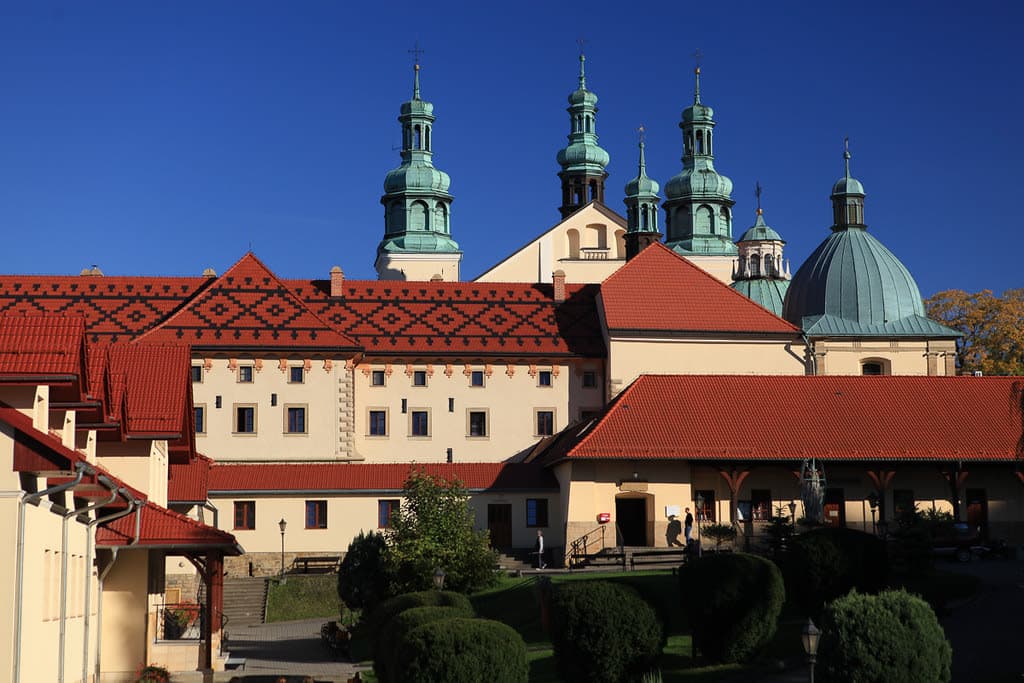
Sanctuary in Kalwaria Zebrzydowska
Where Poland built Jerusalem in the Beskid hills, and four centuries of pilgrims have worn thin the veil
Kalwaria Zebrzydowska, Lesser Poland, Poland
At A Glance
- Coordinates
- 49.8694, 19.6778
- Suggested Duration
- Each of the two main paths takes 2-3 hours to walk. A minimum meaningful visit requires half a day. A full day allows walking both paths and spending time in the basilica before the Miraculous Icon. Overnight stay at the Pilgrims Home enables experiencing the sanctuary at dawn and dusk, when its character shifts.
- Access
- The sanctuary is located at ul. Bernardynska 46, 34-130 Kalwaria Zebrzydowska. The complex sits on Mount Zarek at approximately 527 meters elevation. From Krakow (40 km northeast): By train, approximately 30 minutes to Kalwaria Zebrzydowska station, then an uphill walk of several kilometers to the sanctuary. By bus, regular service from the main bus station (Dworzec Autobusowy MDA) takes approximately one hour. From Wadowice (15 km west): Local bus or taxi. Wadowice—birthplace of Pope John Paul II—makes a natural companion visit. By car: Well-signposted from major roads. Parking available near the sanctuary. The paths and chapels are open daily. The basilica is open during Mass hours and for visitors. Guided tours run 9:00-17:00, departing on the hour. Contact: +48 33 87 66 304 or info@kalwaria.eu.
Pilgrim Tips
- The sanctuary is located at ul. Bernardynska 46, 34-130 Kalwaria Zebrzydowska. The complex sits on Mount Zarek at approximately 527 meters elevation. From Krakow (40 km northeast): By train, approximately 30 minutes to Kalwaria Zebrzydowska station, then an uphill walk of several kilometers to the sanctuary. By bus, regular service from the main bus station (Dworzec Autobusowy MDA) takes approximately one hour. From Wadowice (15 km west): Local bus or taxi. Wadowice—birthplace of Pope John Paul II—makes a natural companion visit. By car: Well-signposted from major roads. Parking available near the sanctuary. The paths and chapels are open daily. The basilica is open during Mass hours and for visitors. Guided tours run 9:00-17:00, departing on the hour. Contact: +48 33 87 66 304 or info@kalwaria.eu.
- Modest dress is required in the basilica and chapels. Cover shoulders and knees. Avoid revealing or casual beach-appropriate clothing. Hats should be removed by men inside sacred buildings. Women may cover their heads if they wish, following traditional Catholic practice, but this is not required. Practical considerations matter as much as modesty. The paths traverse several kilometers of uneven terrain. Wear sturdy, comfortable walking shoes with good grip. Layers accommodate changing weather.
- Photography is generally permitted throughout the complex. However, do not use flash inside the basilica. Do not photograph pilgrims at prayer without permission. During religious services, limit photography or refrain entirely. During Passion plays and processions, be conscious that participants are engaging in sacred practice, not performing for cameras. Photograph from the edges rather than pushing through crowds.
- Respect that this is an active site of Catholic worship. During Mass and confession, maintain appropriate silence and behavior. The Passion plays and Assumption processions are sacred events, not performances for tourists. The paths are physically demanding. Approximately 5 kilometers of steep, uneven terrain require sturdy shoes and reasonable fitness. Bring water. In poor weather, sections may be slippery. Losing your way between chapels happens easily, as the paths branch and intersect across the forested hillside. For organized groups, a guide is advisable. Solo pilgrims should obtain a map from the information center before setting out.
Overview
Rising above the Beskid foothills southwest of Krakow, Kalwaria Zebrzydowska recreates Jerusalem's sacred geography across 380 hectares of forested hills. For over four hundred years, pilgrims have walked its paths between 42 chapels, meditating on Christ's Passion and Mary's journey. Pope John Paul II attributed his spiritual formation to prayers made here from childhood.
In 1600, a Polish nobleman saw a blazing cross above a mountain on his estate. What followed was not a shrine but an entire landscape transformed—a Jerusalem transplanted to the Beskid foothills, where streams became the Cedron, hills took on names from the Gospels, and paths between dozens of chapels invited pilgrims to walk where Christ walked without ever leaving Poland.
Kalwaria Zebrzydowska is not a church. It is a devotional landscape, the most complete surviving example of the Counter-Reformation Calvary tradition. Forty-two chapels are scattered across forested hills, connected by paths that mirror the distances Christ traveled from Gethsemane to Golgotha. Pilgrims do not merely visit; they walk, sometimes for hours, their footsteps joining four centuries of predecessors who have traced these same routes.
The tradition continues unbroken. Each Holy Week, the hillsides fill with tens of thousands as actors and Bernardine friars reenact the Passion, and the crowd becomes the people of Jerusalem—not watching drama, but participating in sacred memory. Each August, processions carry a sculpture of Mary from chapel to chapel, retracing her path from death to glory.
Pope John Paul II came here as a boy, walked here as priest and bishop, returned as Pope. He said that almost none of his problems reached maturity except here, through ardent prayer. Something about this place—the accumulated weight of centuries, the intentionality of its design, the hills themselves—continues to form those who come seeking transformation.
Context And Lineage
Founded in 1600 by Mikolaj Zebrzydowski after a vision of a blazing cross, Kalwaria Zebrzydowska was designed as a replica of Jerusalem's sacred geography using a 16th-century map as reference. Built over decades by the founder and his son, the complex of 42 chapels and a Baroque basilica has been continuously served by Bernardine Friars and draws over 1.5 million pilgrims annually.
The Counter-Reformation had unleashed a wave of Calvary-building across Catholic Europe. In Poland, Mikolaj Zebrzydowski, Voivode of Krakow and one of the most powerful nobles in the realm, became the movement's most ambitious expression.
In 1600, Zebrzydowski witnessed what he understood as a blazing cross appearing above Mount Zar on his estate. Whether vision, atmospheric phenomenon, or something else entirely, he took it as divine mandate. He had been contemplating a pilgrimage to Jerusalem; now Jerusalem would come to him.
He engaged Feliks Zebrowski, a mathematician and astronomer, to survey the local landscape against Christian Kruik van Adrichem's 1584 map of Jerusalem—the most detailed rendering of the Holy City's sacred topography then available. The results were promising: the Beskid terrain offered natural correspondences to Jerusalem's hills and valleys. The project could proceed.
Construction began in 1601 with a single chapel on Mount Zar, modeled on the Golgotha Chapel in Jerusalem. By 1602, the larger vision had been formally commissioned. The Italian Jesuit architect Giovanni Maria Bernardoni designed the basilica and monastery; the Flemish architect Paolo Baudarth created the first fourteen chapels, each with distinctive ground plans—cruciform, circular, elliptical, even heart-shaped—all crowned with Mannerist domes and towers.
Zebrzydowski died in 1620, the project unfinished. His son Jan continued until 1641, adding chapels including the crucial Church of Mary's Tomb. In that same year, the Miraculous Icon of Our Lady arrived—a painting that would become the devotional heart of the sanctuary.
The Bernardine Friars have served as custodians since the sanctuary's founding, maintaining both the physical complex and the living tradition of pilgrimage. Their continuous presence for over four centuries represents an unbroken chain of stewardship rare among European sacred sites.
The tradition of Passion plays and Assumption processions has likewise never been interrupted—not during the partitions of Poland, not during wars or occupations, not during Communist rule. Each generation has passed to the next the knowledge of how these sacred dramas unfold, how pilgrims participate, what the walking between chapels requires.
Pope John Paul II's connection added a new dimension to this lineage. His childhood pilgrimages, his visits as priest and bishop, his return as Pope have woven his spiritual authority into the fabric of the place. For many Polish Catholics and pilgrims worldwide, walking these paths now means walking where John Paul walked—adding his example to the centuries of predecessors whose footsteps have formed these trails.
Mikolaj Zebrzydowski
historical
Founder of Kalwaria Zebrzydowska. Voivode of Krakow, he conceived the project after his vision of the blazing cross in 1600 and devoted his remaining years to its realization.
Our Lady of Kalwaria
venerated
The Miraculous Icon housed in the basilica's Zebrzydowski Chapel, donated in 1641 and crowned in 1887. Countless pilgrims have sought her intercession for graces and healing.
Pope John Paul II
historical/spiritual
Born nearby in Wadowice, the future pope walked these paths from childhood. His father told him after his mother's death that the Virgin of Kalwaria would now be his mother. As Pope, he elevated the church to Minor Basilica in 1979 and celebrated his final Polish Mass here in 2002.
Paolo Baudarth
historical
Flemish architect and goldsmith from Antwerp who designed the first fourteen chapels, creating the distinctive Mannerist style that defines the complex—including the heart-shaped Chapel of Mary's Heart.
Why This Place Is Sacred
Kalwaria Zebrzydowska's sacredness emerges from its deliberate design as a Holy Land replica, its four centuries of continuous pilgrimage, its miraculous icon with generations of answered prayers, and the personal testimony of Pope John Paul II regarding its spiritual power. The landscape itself was conceived as a threshold where Poland could encounter Jerusalem.
The Counter-Reformation understood something that contemporary spirituality is rediscovering: place matters. When travel to Jerusalem was dangerous or impossible, Catholic Europe built Jerusalems at home—Calvaries that replicated the Holy Land's sacred geography so that pilgrims could walk the Passion without leaving their region.
Kalwaria Zebrzydowska represents the apotheosis of this tradition. The mathematician and astronomer Feliks Zebrowski surveyed the landscape against a 16th-century map of Jerusalem, finding correspondences between the Beskid hills and the Holy City's terrain. The Skawinki Stream became the Cedron. Mount Zarek became Calvary. The hills to the east took the name Mount of Olives. Into this renamed landscape, architects placed chapels at locations corresponding to Jerusalem's sacred sites—Gethsemane, the house of Caiaphas, Pilate's Palace, the stations of the cross.
The intention was precise: a pilgrim walking these paths would cover the same distances, in the same topographical relationships, that Christ traveled during his Passion. The body's movement through space became prayer. The landscape became scripture made walkable.
Four centuries of accumulated pilgrimage have deepened what the design initiated. An estimated 1.5 million visitors come annually. Each Holy Week, approximately 150,000 pilgrims participate in the Passion plays—not as audience but as participants, taking the role of the Jerusalem crowds. The Miraculous Icon of Our Lady of Kalwaria, crowned in 1887, draws those seeking intercession for graces and healing.
Pope John Paul II's testimony carries particular weight. This was not a pope who made casual statements about spiritual experience. His declaration that his problems found resolution here, through ardent prayer, speaks to something real about what this place cultivates.
Mikolaj Zebrzydowski, Voivode of Krakow, conceived this project after seeing what he interpreted as a blazing cross above Mount Zar in 1600. His intention was to create a replica of Jerusalem that would allow Polish Catholics to undertake pilgrimage to the Holy Land without the danger and expense of actual travel—particularly relevant when the Ottoman Empire controlled Jerusalem. The project was also a statement of Counter-Reformation Catholic identity, an embodiment of devotional practice the Council of Trent had encouraged.
From the beginning, the site was entrusted to the Bernardine Friars, a branch of the Franciscans, who have served as custodians for over four centuries. The town of Zebrzydow (later Kalwaria Zebrzydowska) was established in 1617 specifically to house the growing number of pilgrims.
What began as one nobleman's vision expanded over decades. Mikolaj Zebrzydowski died in 1620 with the project incomplete; his son Jan continued building until 1641. Later centuries added chapels—the Chapel of the Third Fall in 1754, the Chapel of the Weeping Women in 1782, others into the 19th century—but the core conception remained intact.
The tradition of Passion plays and Assumption processions dates to the 17th century and has never been interrupted, surviving wars and political upheavals that might have ended lesser traditions. UNESCO inscription in 1999 recognized Kalwaria Zebrzydowska as the most complete and unaltered Calvary complex in Europe.
The 20th century brought Pope John Paul II's personal connection into global awareness. His visits as Pope in 1979 and 2002—the latter his final Mass on Polish soil, where he entrusted Poland and humanity to the Virgin Mary—transformed Kalwaria from a national pilgrimage site to one of international significance for Catholics worldwide.
Traditions And Practice
Kalwaria Zebrzydowska is an active pilgrimage site where traditional practices remain central: walking the Paths of Our Lord (24 Passion chapels) and the Paths of Our Lady (11 Marian chapels), participating in annual Holy Week Passion plays and August Assumption processions, and seeking intercession before the Miraculous Icon. Daily Mass and confession are available year-round.
The core practice is walking. The Paths of Our Lord connect 24 chapels dedicated to Christ's Passion, designed to mirror the distances and topography traveled from Gethsemane through crucifixion and burial. Pilgrims traditionally pray at each station, meditating on the corresponding event. The full path covers approximately 5 kilometers and takes two to three hours.
The Paths of Our Lady connect 11 chapels in three cycles: Mary's suffering as she accompanied Christ on the Via Dolorosa, her Dormition (falling asleep), and her Assumption and Coronation. Some chapels overlap with the Passion path. This too takes two to three hours.
The Holy Week Passion plays have been performed continuously since the 17th century. Beginning Palm Sunday and continuing through Maundy Thursday and Good Friday, Bernardine Fathers and actors portray biblical figures while pilgrims move from chapel to chapel as the Jerusalem crowds. This is understood not as theater but as sacred mystery—communal prayer enacted through bodies moving through space.
The August Assumption processions around the Feast of the Assumption (August 15) trace Mary's journey from death to glory. Pilgrims accompany a sculpture of the Mother of God along the Calvary Paths, joined by farmers, civic groups, and people in historical costumes. The processions include the symbolic funeral of the Virgin and her Assumption from the Sepulchre.
Daily Mass is celebrated in the Basilica of Our Lady of the Angels. Sunday and holiday Masses run hourly from 6:00 through 19:00. Weekday Masses are available at 6:00, 7:00, 8:00, 9:00, 12:00, 17:00, and 19:00. Confession is available throughout the day—winter hours run 6:00-17:30, summer hours 6:00-19:30.
Guided pilgrimage tours are available for groups of fifteen or more. Tours begin on the hour from 9:00 to 17:00 and last at least 45 minutes. Guides speaking English, Italian, German, or French require four days advance notice; Polish guides need one day.
Veneration of the Miraculous Icon continues as it has for centuries. Pilgrims pray before the image in the Zebrzydowski Chapel, seeking intercession for graces, healing, and guidance. The tradition of lighting candles and leaving written prayers persists.
If you come seeking spiritual engagement rather than tourism, consider these approaches.
Walk at least one of the paths in its entirety. Choose the Passion path or the Marian path depending on which speaks more strongly to your tradition or condition. Do not rush. Pause at each chapel, even briefly. Let the walking between stations do its work—this is not dead time but part of the practice.
If you come during Holy Week or August, participate rather than observe. Join the crowd. Move with the procession. Let yourself be part of what is unfolding rather than standing outside documenting it.
Spend time before the Miraculous Icon. You need not hold formal Catholic belief to approach with genuine openness. Bring whatever weight you carry. Notice what arises in the presence of an image before which millions have prayed.
If possible, stay overnight. The paths at dawn or dusk, without crowds, carry a different quality. The Pilgrims Home (Dom Pielgrzyma) offers simple accommodation adjacent to the sanctuary.
Roman Catholic
ActiveKalwaria Zebrzydowska is one of Poland's most important Catholic pilgrimage sites, second only to Jasna Gora in Czestochowa. The sanctuary combines devotion to both Christ's Passion and the Virgin Mary, offering pilgrims the opportunity to walk paths that embody the core mysteries of Catholic faith. Pope John Paul II's deep personal connection has elevated its significance for Polish Catholics and the global Church. The Miraculous Icon of Our Lady draws millions seeking intercession for graces and healing.
Walking the Paths of Our Lord connects pilgrims to Christ's Passion through physical movement across the same distances He traveled. Walking the Paths of Our Lady traces Mary's journey from suffering through glorification. The Holy Week Passion plays, performed continuously since the 17th century, immerse participants in sacred drama where they become the crowds of Jerusalem. The August Assumption processions celebrate Mary's death and triumph. Daily Mass and confession are available year-round, and veneration of the Miraculous Icon continues without interruption.
Experience And Perspectives
Pilgrims at Kalwaria Zebrzydowska consistently report a profound sense of peace while walking the forested paths, a feeling of connection to centuries of predecessors, and the physical journey facilitating inner transformation. The Passion plays and Assumption processions create immersive experiences of sacred drama that participants describe as prayer rather than performance.
The paths themselves do much of the work. Unlike a church, where sacred space is defined and contained, Kalwaria unfolds across kilometers of walking. The transition from one chapel to the next becomes a rhythm—arrival, contemplation, departure, walking, arrival again. The forests between are not empty space but part of the experience, time for whatever the previous station stirred to settle before the next one rises ahead.
Those who walk slowly report something shifting. The ordinary mental noise of travel—schedules, cameras, the urge to get somewhere—begins to quiet. The path becomes enough. Many describe a sense of being accompanied, whether by the remembered presence of centuries of pilgrims or something less nameable. The hills do not rush you.
The Holy Week Passion plays produce effects that pilgrims struggle to articulate. These are not theatrical performances to be watched. The crowd becomes the crowd—the people of Jerusalem who called for crucifixion, who lined the Via Dolorosa, who witnessed what tradition holds as the central event of history. The appearance of Judas draws genuine jeers. The progression from chapel to chapel follows Christ's journey in real time and real space. Participants describe entering something larger than themselves, a sacred drama their bodies are enacting rather than their minds merely observing.
The Miraculous Icon of Our Lady draws those with specific petitions. The side altars of the basilica are thick with candles, with written prayers, with the accumulated weight of what people have brought here. Those who pray before the icon often describe the intimacy of this encounter—the sense of being seen and heard.
Kalwaria Zebrzydowska rewards the unhurried. The paths are designed to take hours, and rushing defeats their purpose. If you come, allow time—ideally an overnight stay that permits early morning walking before crowds arrive.
Consider what you bring. The paths were designed to facilitate meditation on Christ's Passion and Mary's journey, but you need not follow prescribed meditations if they do not speak to you. Bring your own questions, your own weights, your own unsettled places. The walking will work on them regardless.
The terrain is physically demanding, with steep sections and uneven ground. Wear appropriate shoes. Bring water. The exertion is part of the experience—pilgrimage has always asked something of the body. If you cannot walk the full paths, the basilica offers its own encounter with the tradition.
Kalwaria Zebrzydowska invites multiple levels of understanding. Art historians recognize an exceptional example of Mannerist landscape architecture. Catholic tradition holds it as a place of genuine encounter with the mysteries of faith. Contemporary seekers find in its paths a walking meditation that transcends any particular belief system. These perspectives enrich rather than compete.
UNESCO's designation recognizes Kalwaria Zebrzydowska as an outstanding example of Counter-Reformation devotional landscape design. The complex represents the most complete and unaltered Calvary surviving in Europe, with its original 17th-century conception preserved across four centuries.
Art historians note the exceptional architectural variety of the chapels—heart-shaped, elliptical, cruciform, triangular—each designed by Paolo Baudarth with distinctive Mannerist creativity. The integration of these structures into natural topography demonstrates sophisticated understanding of how landscape shapes spiritual experience.
The complex fulfilled multiple purposes in Counter-Reformation Poland: it allowed pilgrimage to Jerusalem at a time when actual travel was dangerous; it demonstrated Catholic devotional practice against Protestant challenges; it reinforced the connection between Polish Catholic identity and European Christendom. Scholars debate the relative emphasis of political versus purely religious motivation, but the evidence suggests both were present.
Catholic tradition understands Kalwaria Zebrzydowska as a place where the mysteries of faith become accessible through embodied practice. The landscape is not a replica of Jerusalem but a genuine participation in its sacred geography—walking these paths, pilgrims genuinely encounter Christ's Passion and Mary's journey.
The Miraculous Icon of Our Lady has drawn millions seeking intercession. Catholic teaching holds Mary as intercessor, and the icon's crowning in 1887 represents papal recognition of graces received through devotion here. The tradition does not claim to explain how this works; it simply testifies that prayers offered before this image have been answered.
Pope John Paul II's personal witness carries particular weight. His statement that his problems found resolution here, through ardent prayer, is not casual testimony but the reflection of a theologian and pastor who knew the difference between spiritual sentiment and genuine encounter. For many Polish Catholics, his example confirms what the centuries of pilgrimage already demonstrated.
The exact nature of Mikolaj Zebrzydowski's vision in 1600 remains unresolved. Whether he witnessed a supernatural phenomenon, a natural optical effect, or something else entirely, his interpretation shaped the next four centuries.
Specific miracles attributed to the intercession of Our Lady of Kalwaria are not comprehensively documented in available sources. The tradition holds that countless graces have been received, but detailed records of individual cases were not found in the research materials.
How closely the 17th-century understanding of Jerusalem's topography—based on van Adrichem's 1584 map—matched historical reality is uncertain. The Calvary recreates a conceptual Jerusalem, filtered through Renaissance and Counter-Reformation imagination. Whether this matters to its spiritual efficacy is itself an open question.
Visit Planning
Kalwaria Zebrzydowska is located 40 kilometers southwest of Krakow, accessible by train, bus, or car. The pilgrimage paths require 2-3 hours each; a full day allows for both paths and the basilica. Holy Week and mid-August bring the largest crowds. The Pilgrims Home offers simple overnight accommodation for those wishing to experience the sanctuary without day crowds.
The sanctuary is located at ul. Bernardynska 46, 34-130 Kalwaria Zebrzydowska. The complex sits on Mount Zarek at approximately 527 meters elevation.
From Krakow (40 km northeast): By train, approximately 30 minutes to Kalwaria Zebrzydowska station, then an uphill walk of several kilometers to the sanctuary. By bus, regular service from the main bus station (Dworzec Autobusowy MDA) takes approximately one hour.
From Wadowice (15 km west): Local bus or taxi. Wadowice—birthplace of Pope John Paul II—makes a natural companion visit.
By car: Well-signposted from major roads. Parking available near the sanctuary.
The paths and chapels are open daily. The basilica is open during Mass hours and for visitors. Guided tours run 9:00-17:00, departing on the hour. Contact: +48 33 87 66 304 or info@kalwaria.eu.
The Pilgrims Home (Dom Pielgrzyma) offers simple accommodation adjacent to the sanctuary, allowing pilgrims to experience morning and evening hours without day crowds. Contact: +48 33 87 65 539.
The town of Kalwaria Zebrzydowska has limited lodging. More options are available in Wadowice (15 km) or Krakow (40 km). Those seeking to combine Kalwaria with broader pilgrimage may consider staying in Krakow, which offers access to multiple sacred sites including Divine Mercy, Wawel Cathedral, and the Jewish heritage of Kazimierz.
Kalwaria Zebrzydowska welcomes visitors of all backgrounds but requires respectful behavior appropriate to an active Catholic pilgrimage site. Modest dress is required in the basilica and chapels. Photography is permitted but should not disturb pilgrims at prayer. During religious services and processions, visitors should participate prayerfully or remain at a respectful distance.
The primary principle is awareness that you are entering an active place of worship. Over 1.5 million pilgrims visit annually, most of them Polish Catholics for whom this site holds deep spiritual significance. Your presence is welcomed—but as a privilege, not a right.
In the basilica and chapels, maintain reverent silence. Do not talk loudly, make phone calls, or engage in behavior that would disrupt those at prayer. If you do not share the faith tradition, you need not participate, but you should not interfere.
During the Passion plays and Assumption processions, the atmosphere shifts. These are participatory sacred events. If you attend, consider joining the pilgrims rather than standing aside as spectator. If you prefer to observe, position yourself at the edges rather than pushing through crowds for photographs.
The paths themselves are communal space. Greet other pilgrims simply. Do not block paths for extended photography sessions. Walk quietly when near chapels where others may be praying.
Modest dress is required in the basilica and chapels. Cover shoulders and knees. Avoid revealing or casual beach-appropriate clothing. Hats should be removed by men inside sacred buildings. Women may cover their heads if they wish, following traditional Catholic practice, but this is not required.
Practical considerations matter as much as modesty. The paths traverse several kilometers of uneven terrain. Wear sturdy, comfortable walking shoes with good grip. Layers accommodate changing weather.
Photography is generally permitted throughout the complex. However, do not use flash inside the basilica. Do not photograph pilgrims at prayer without permission. During religious services, limit photography or refrain entirely.
During Passion plays and processions, be conscious that participants are engaging in sacred practice, not performing for cameras. Photograph from the edges rather than pushing through crowds.
Candles may be lit in the basilica. Donations to the sanctuary support its maintenance and the Bernardine community. These are the traditional forms of offering.
Written prayer intentions may be left in designated areas. This practice reflects Catholic tradition of intercession through the saints and the Virgin Mary.
No specific dress code is enforced at path entrances, but modest dress remains expected in all sacred spaces. Certain chapels may have limited hours. During religious services, portions of the basilica may be reserved for participants.
The paths are physically demanding and not wheelchair accessible. Those with mobility limitations can access the basilica and some lower chapels but cannot walk the full pilgrimage routes.
Sacred Cluster
Nearby sacred places create the location cluster described in the growth plan. This block is intentionally crawlable and links into the wider regional graph.
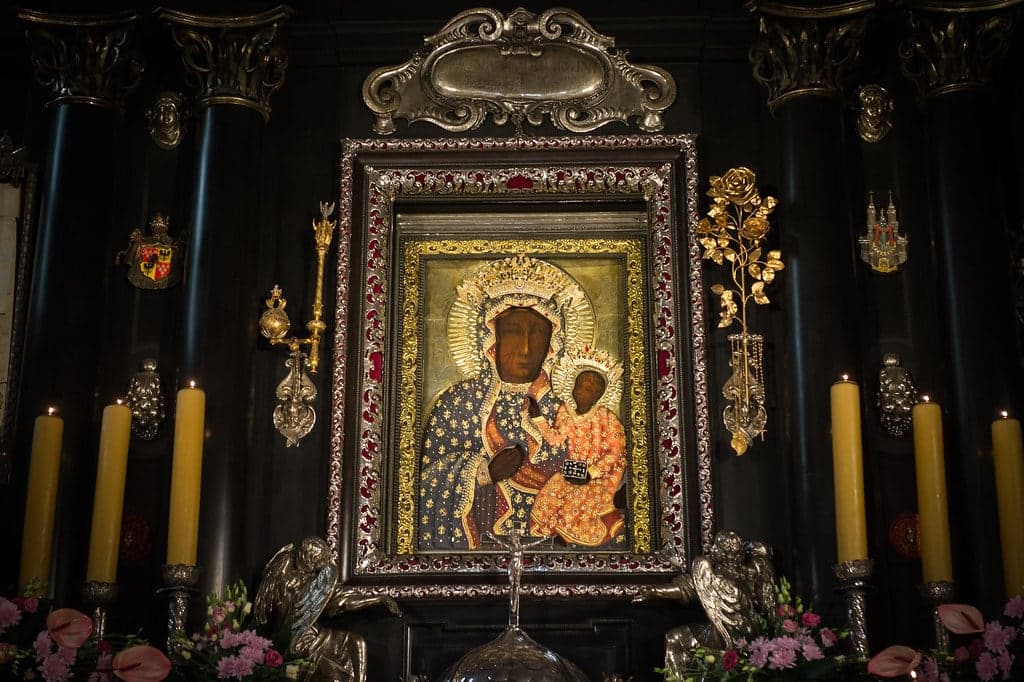
Our Lady of Częstochowa
Częstochowa, Silesian Voivodeship, Poland
112.7 km away
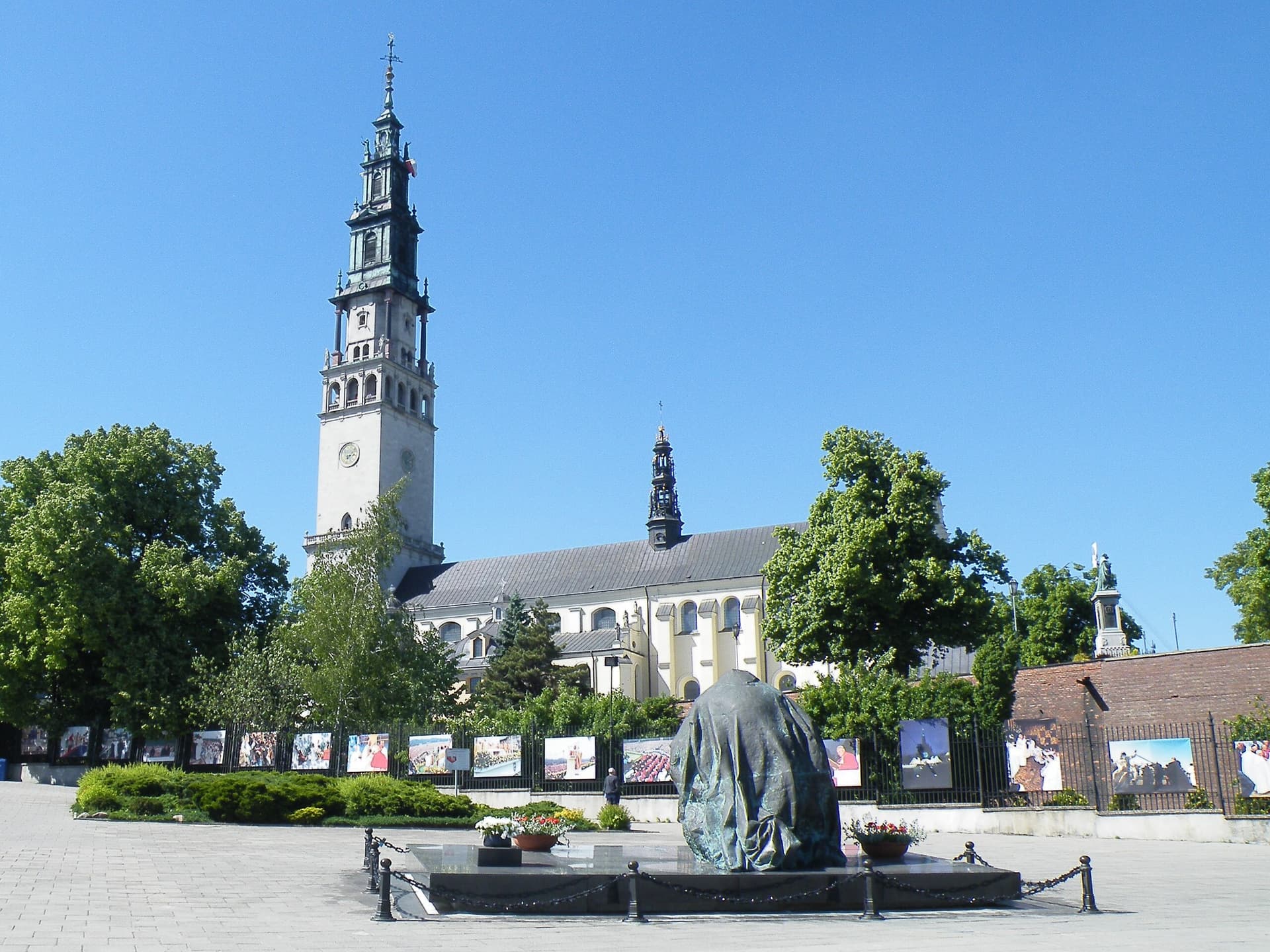
Jasna Góra Monastery
Częstochowa, Silesian Voivodeship, Poland
112.7 km away
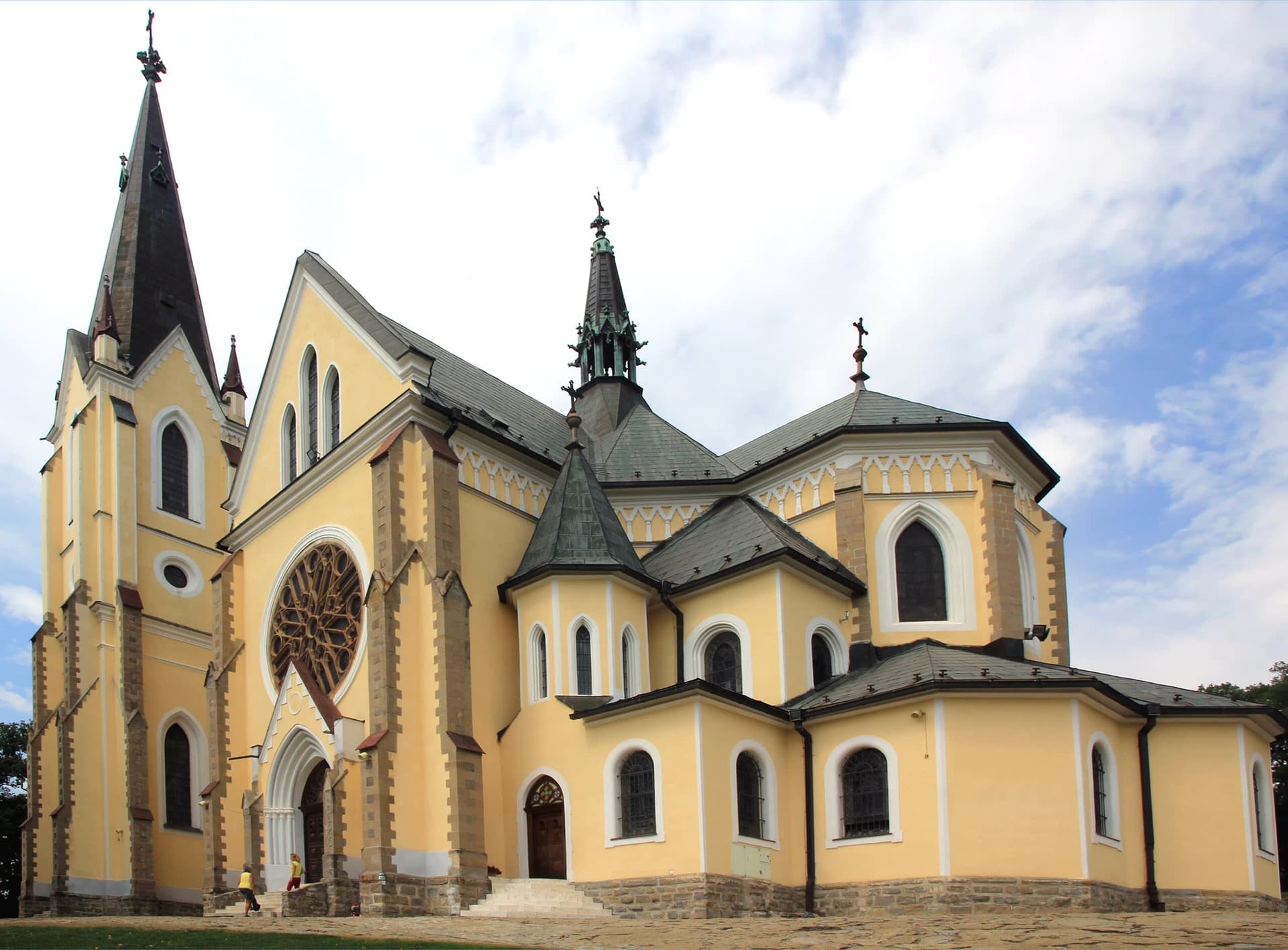
Basilica of the Visitation of the Blessed Virgin Mary, Marian Hill in Levoča, Slovakia
Levoča, Prešov Region, Slovakia
114.5 km away
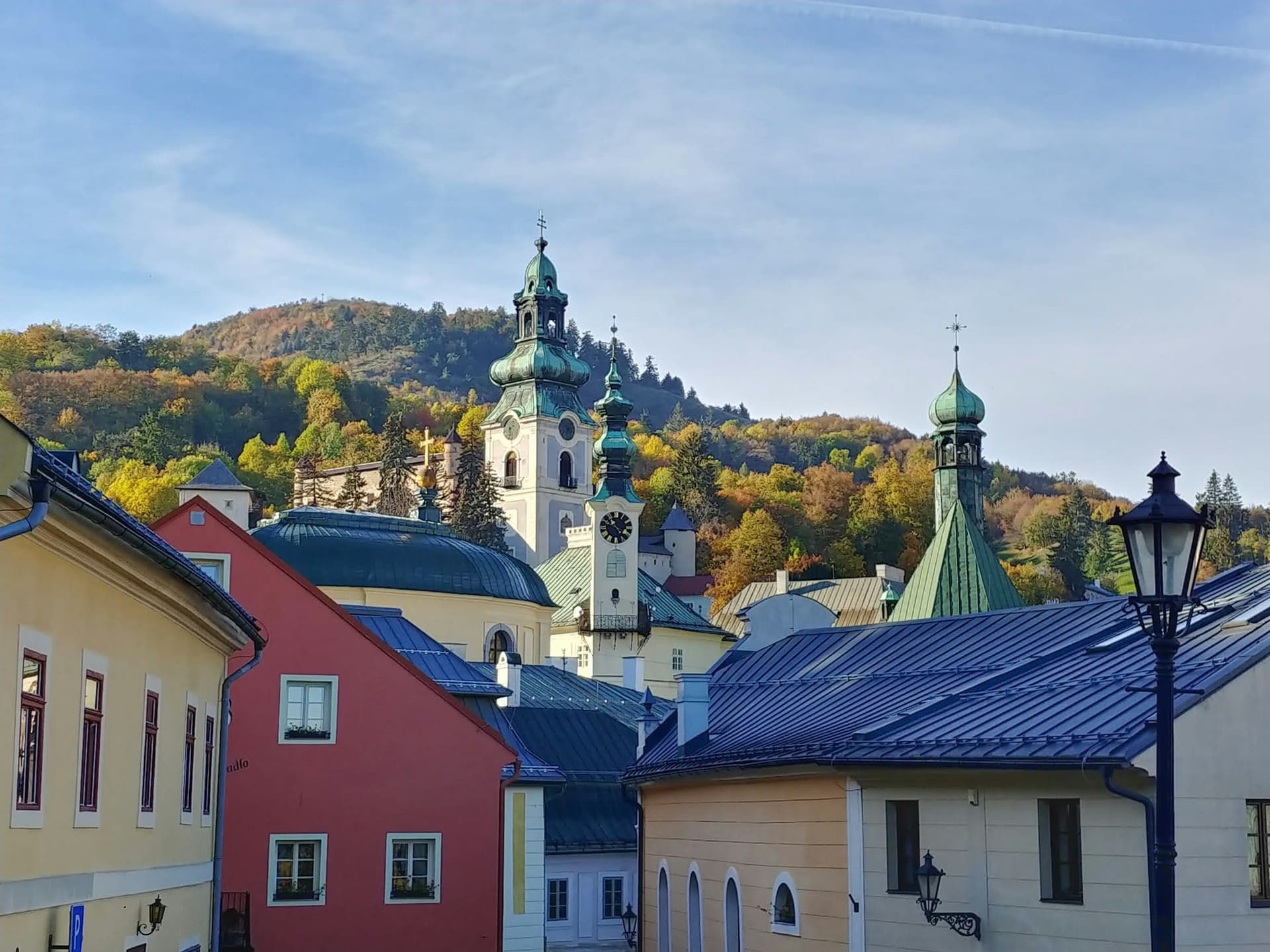
Banská Stiavnica, Calvary
Banská Štiavnica, Region of Banská Bystrica, Slovakia
166.1 km away