Pyramid of Menkaure
The grandson's completion—smallest in scale, most elaborate within, its sarcophagus lost to the sea
Giza, Giza, Egypt
At A Glance
- Coordinates
- 29.9725, 31.1284
- Suggested Duration
- Interior visit takes approximately 30-45 minutes including time in each chamber. Allow 3-4 hours minimum for the full Giza Plateau including all three main pyramids, the Sphinx, and associated temples.
Pilgrim Tips
- Conservative dress is recommended out of respect for Egyptian culture and for practical comfort. The interior is warm and humid; light, breathable clothing works best. Comfortable shoes with good grip are essential for the steep passages. Avoid loose scarves or accessories that might catch on stone.
- Exterior photography is permitted throughout the Giza Plateau. Interior photography policies vary and should be verified at the ticket office. Even when permitted, the dim lighting makes photography challenging without additional equipment.
- The passages are steep and the interior warm and humid. Those with claustrophobia or mobility limitations should consider carefully before entering. Photography policies vary and should be verified on arrival.
Overview
The Pyramid of Menkaure completes what three generations of pyramid builders began at Giza. Though smallest of the three great pyramids, its interior is the most elaborate—pink granite chambers, carved decorative panels, a vaulted ceiling. Menkaure's basalt sarcophagus was discovered here in 1837 but lies now at the bottom of the Mediterranean, lost when the ship carrying it to England sank. The empty chamber asks what endures when even stone cannot preserve what we most valued.
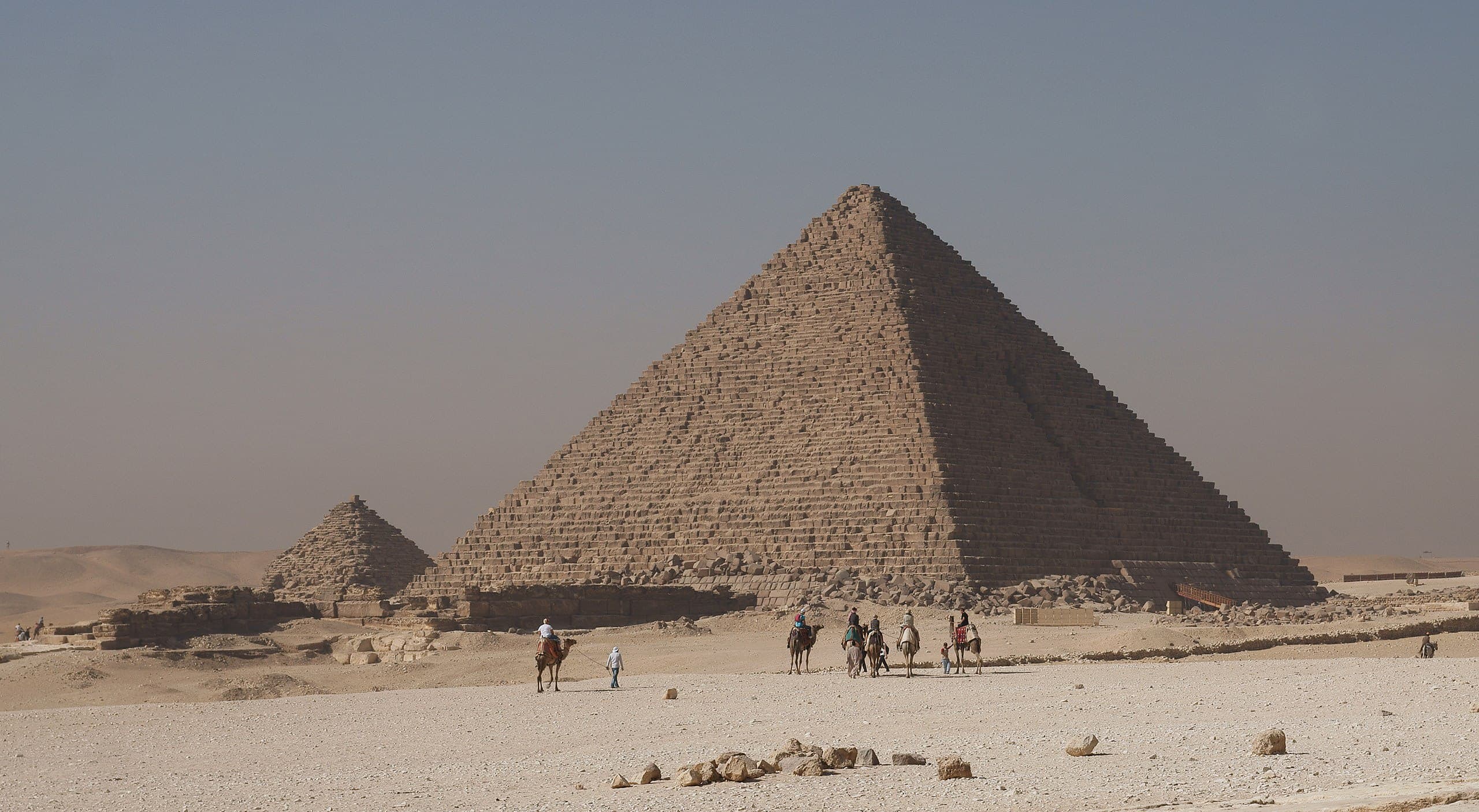
Stand at the southwestern corner of the Giza plateau and the Pyramid of Menkaure rises before you—smaller than its neighbors, yet somehow more approachable. This was the final great pyramid, completing a three-generation family necropolis: grandfather Khufu's overwhelming monument to the north, father Khafre's answer beside it, and here, Menkaure's own statement in stone. Whether the smaller scale reflects resource depletion after decades of massive construction or a deliberate choice to emphasize elaboration over enormity remains debated. What is certain: the interior surpasses both predecessors. Pink granite lines the passages and burial chamber. Decorative carved panels adorn the antechamber—the first such ornamentation in a pyramid since Djoser's step pyramid a century earlier. The ceiling of the burial chamber is vaulted, not flat. Against the west wall once stood Menkaure's basalt sarcophagus, carved with the palace facade pattern that marked royal burials. In 1837, Colonel Howard Vyse discovered it and shipped it toward England. The ship Beatrice sank off the Spanish coast, carrying the sarcophagus to the bottom of the Mediterranean where it presumably remains. The empty chamber confronts visitors with loss doubled: Menkaure's body never found, his sarcophagus never recovered. Yet the pyramid endures, 4,500 years of standing witness to what can and cannot be preserved.
Context And Lineage
Built c. 2510 BCE by Pharaoh Menkaure, grandson of Khufu, this pyramid completed a three-generation family necropolis. Associated with some of the finest Old Kingdom sculpture discovered in its valley temple.
Menkaure ruled Egypt approximately 2530-2510 BCE, the fifth king of the Fourth Dynasty. Son of Khafre, grandson of Khufu, he was the last of the great pyramid builders. The Greek historian Herodotus, writing two thousand years later, described him as a pious and just king, more benevolent than his predecessors—though how much this reflects genuine tradition versus Greek interpretation remains debated. The pyramid's ancient name, Netjer-er-Menkaure, proclaimed him divine. Whether Menkaure chose smaller scale deliberately—emphasizing interior elaboration over exterior enormity, perhaps reflecting pious modesty—or whether resources were simply depleted after two generations of massive construction, scholars cannot determine. The mortuary temple was unfinished at Menkaure's death, completed in mudbrick rather than stone by his son and successor Shepseskaf. Notably, Shepseskaf did not build a pyramid for himself but chose a mastaba, signaling the end of the great pyramid age. Something shifted with Menkaure. Whether it was religious emphasis, economic constraint, or cultural change, the pyramids built after his were smaller, simpler, eventually declining to the mudbrick structures of the Middle Kingdom before the form was abandoned entirely.
The pyramid completes a three-generation family necropolis at Giza: Khufu (the Great Pyramid), Khafre (with its preserved limestone cap), and Menkaure. This father-son-grandson sequence spanning approximately 2560-2510 BCE represents the apex of Egyptian pyramid construction. After Menkaure, no subsequent ruler achieved anything comparable. His successor Shepseskaf built only a mastaba. The Fifth Dynasty returned to pyramid building but on a smaller scale. By the Middle Kingdom, pyramids were constructed in mudbrick rather than stone. The great pyramids of Giza remained forever unmatched, and Menkaure's stands as the completion of that singular achievement.
Menkaure (Mycerinus)
Shepseskaf
Howard Vyse
George Andrew Reisner
Why This Place Is Sacred
The smallest of the three main Giza pyramids paradoxically holds the most elaborate interior, connecting visitors to themes of completion, loss, and the limits of preservation.
The Pyramid of Menkaure occupies a curious position in the Giza complex. It completes the trio without dominating it. The scale is human enough that visitors can walk around its base in minutes rather than the extended circuit required by Khufu's monument. Yet inside, the pyramid reveals unexpected elaboration. The burial chamber is lined entirely with pink granite from Aswan, its ceiling vaulted rather than flat. The antechamber features decorative carved panels—the first such interior ornamentation since the Step Pyramid of Djoser, built a century earlier. Six mysterious niches cut into the walls of an upper chamber remain unexplained. This inverse relationship between exterior scale and interior complexity creates a particular quality of encounter. Where the Great Pyramid overwhelms with size and the Pyramid of Khafre impresses with its preserved limestone cap, Menkaure's reveals its significance to those who enter. The empty chamber where the sarcophagus once stood intensifies this intimacy. The loss is specific and documented: we know the sarcophagus existed, know it was carved from basalt with the palace facade pattern, know it was loaded onto the ship Beatrice in Alexandria in 1838, know the ship sank off the Spanish coast. The absence is not the void of the unknown but the presence of documented loss. Somewhere beneath the Mediterranean, Menkaure's sarcophagus presumably lies still. The burial chamber becomes a meditation on what preservation means when even our attempts to preserve cause loss.
The pyramid served as Menkaure's resurrection machine, designed to ensure his transformation from mortal pharaoh to divine being who would join the imperishable stars and sail eternally with Ra. Its ancient name, Netjer-er-Menkaure—'Menkaure is Divine'—explicitly proclaimed this transformation. The elaborate interior may have reflected Menkaure's emphasis on the transformation process itself rather than the external monument visible to the living.
The pyramid's mortuary cult continued for at least two centuries after Menkaure's death, as evidenced by two stelae from the Sixth Dynasty found in the complex. In 1196 CE, Saladin's son Al-Aziz Uthman attempted to demolish the pyramids, beginning with Menkaure's. After eight months of effort, workers had removed only a few stones per day, and the attempt was abandoned. The gash they created remains visible on the north face. George Reisner's 1908-1910 excavation of the valley temple revealed some of the finest Old Kingdom sculpture: triads depicting Menkaure with Hathor and regional deities, and the famous diad of Menkaure with his queen, now in Boston. In 2025, the ScanPyramids project discovered two hidden air-filled voids behind the eastern facade, suggesting possible undiscovered chambers or even a second entrance. The pyramid continues to reveal secrets after 4,500 years.
Traditions And Practice
Ancient mortuary rituals ceased millennia ago. No formal religious practices continue today. The pyramid is administered as cultural heritage and archaeological site.
Upon Menkaure's death around 2510 BCE, his body would have been received at the Valley Temple where priests conducted purification rituals using sacred oils, incense, and natron. The Opening of the Mouth ceremony, performed with specialized implements, restored his senses for the afterlife—allowing him to see, hear, eat, and drink in the eternal realm. The body processed along the 608-meter causeway to the mortuary temple, where final rites occurred before interment in the granite-lined burial chamber. An ongoing mortuary cult provided daily offerings of bread, beer, meat, and incense to sustain Menkaure's ka—his life force—eternally. Two stelae from the Sixth Dynasty, roughly two centuries after Menkaure's death, indicate this cult was maintained or periodically renewed long after his burial. The prominence of Hathor in the valley temple statuary—appearing in all the discovered triads—suggests special devotion to this goddess of the sky, motherhood, and rebirth.
No formal religious ceremonies continue at the pyramid. The site is administered by Egypt's Ministry of Tourism and Antiquities as a UNESCO World Heritage Site and tourist destination. Individual visitors may engage in private contemplation inside the burial chamber, but this represents personal practice rather than any transmitted tradition. The pyramid is primarily encountered as historical and archaeological heritage rather than active sacred site.
The interior experience benefits from unhurried attention. Allow time in each chamber. The carved decorative panels in the first chamber reward close observation—notice how they differ from the rough stone of other pyramid interiors. In the chamber with six niches, consider what might have occupied these spaces and why they were created. In the burial chamber, the vaulted ceiling and the empty space where the sarcophagus stood create a meditation on loss and preservation. The solitude often available here—in contrast to the crowded Great Pyramid—permits contemplative practice difficult elsewhere in the complex.
Ancient Egyptian Religion
HistoricalThe pyramid served as Menkaure's resurrection machine, designed to ensure his transformation from mortal pharaoh to divine being. Its name Netjer-er-Menkaure proclaimed this divinity. The pyramid shape represented both the sun's rays guiding the soul to Ra and the Benben stone of creation mythology. The entire complex—valley temple, causeway, mortuary temple, and pyramid—formed an integrated system for resurrection. The prominence of Hathor in the valley temple statuary connected the site to this goddess of the sky, motherhood, and rebirth. The mortuary cult that maintained daily offerings to Menkaure's ka continued for at least two centuries after his death, as evidenced by Sixth Dynasty stelae found in the complex.
Menkaure's funeral began at the Valley Temple with purification rituals using sacred oils and natron. The Opening of the Mouth ceremony restored his senses for afterlife existence. The body then processed along the causeway to the mortuary temple for final rites before interment. The ongoing mortuary cult provided daily offerings of bread, beer, meat, and incense to sustain his ka eternally. Priests maintained the cult, perhaps renewed periodically, for generations after his death.
Experience And Perspectives
The interior offers intimate encounter with pink granite chambers and carved panels, often experienced alone, the empty burial chamber raising questions about loss and what endures.
Entering the Pyramid of Menkaure differs from the more famous Great Pyramid experience. The passages are steep but shorter, the interior more elaborate, and—crucially—the crowds far fewer. Visitors frequently find themselves alone or with only a few others, creating space for contemplation unavailable in Khufu's monument. The descent begins at the north face, through a passage partially lined with pink granite. The texture of the stone, its warmth in the dim light, creates an immediate sense of entering worked space rather than raw cavity. The first chamber features carved decorative panels—a surprising elaboration, the first pyramid interior decoration since Djoser a century before. Beyond lies the chamber with six large niches cut into the walls. Their purpose remains unknown. What were they meant to hold? Offerings? Canopic jars? The questions have no answers. The burial chamber itself is lined entirely with pink granite, its ceiling uniquely vaulted among Giza pyramid interiors. Against the west wall is the space where Menkaure's sarcophagus stood for millennia before Vyse removed it in 1837. The basalt block, carved with the palace facade pattern marking royal burials, would have been the chamber's focal point. Now there is only the absence where it was. This documented loss creates a different meditation than the other pyramids offer. Khufu's sarcophagus remains in place, broken and empty. Khafre's sits partially embedded in the floor. But Menkaure's was removed, shipped, lost. Somewhere beneath the Mediterranean it presumably waits, basalt resisting saltwater corrosion. The emptiness here has a story, a ship's name, a date, a location. The chamber becomes a place for contemplating not just mortality but the fate of our attempts to preserve anything at all.
Before descending into the pyramid, spend time approaching from different directions around the Giza plateau. Notice how the three pyramids relate to each other—Menkaure completing the southwestern corner, smaller but integral to the whole. Consider visiting the valley temple site where Reisner discovered the triads and diad, imagining those sculptures before their removal to Cairo and Boston. Inside, allow time in each chamber. The carved panels reward close attention. The six niches invite wondering. The burial chamber's vaulted ceiling is unique and worth contemplating. Bring a small flashlight to supplement the interior lighting and better appreciate the granite's color and texture. After exiting, the three subsidiary pyramids to the south—built for Menkaure's queens—offer further context on royal burial practices.
The Pyramid of Menkaure invites multiple interpretations—as the culmination of pyramid building, as a study in interior elaboration over exterior scale, as a meditation on documented loss, and as ongoing archaeological mystery with hidden chambers discovered as recently as 2025.
Egyptologists generally agree the pyramid was completed around 2510 BCE, with the mortuary temple finished posthumously in mudbrick by Menkaure's successor Shepseskaf. The smaller scale, approximately one-tenth the volume of Khufu's pyramid, may reflect resource depletion after two generations of massive construction—as James Henry Breasted argued—or a deliberate choice to emphasize interior elaboration. The pink granite chambers and decorative carved panels represent the most complex pyramid interior at Giza. George Reisner's 1908-1910 excavation of the valley temple revealed some of the finest Old Kingdom sculpture, including triads and the Menkaure-queen diad. In 2025, the ScanPyramids project detected two hidden air-filled voids behind the eastern facade using non-invasive scanning techniques. Researchers propose these may indicate a second entrance, though further investigation with methods like muon imaging is needed to determine their extent and purpose.
Ancient Egyptians understood the pyramid as Menkaure's gateway to eternal existence. The name Netjer-er-Menkaure—'Menkaure is Divine'—proclaimed his transformation from mortal ruler to divine being. The pyramid shape represented the sun's rays descending to earth and the Benben stone of creation mythology. The elaborate interior, lined with granite and featuring the first decorative panels since Djoser, may have reflected emphasis on the transformation process itself. Herodotus, writing two millennia later, recorded that Menkaure was remembered as a pious and just king, more benevolent than his predecessors. Whether this represents genuine ancient tradition or Greek interpretation of Egyptian sources cannot be determined.
The Orion correlation theory proposed by Robert Bauval suggests the three Giza pyramids mirror Orion's Belt, with Menkaure's smaller pyramid representing the smaller star Mintaka. This theory places the pyramids within a grand astronomical program connecting the complex to Osiris, lord of the dead associated with Orion. However, this interpretation lacks support from mainstream Egyptology, and Menkaure's pyramid receives less attention in alternative literature than the Great Pyramid. Most alternative theories focus on the larger monuments rather than developing detailed interpretations of Menkaure's specific significance.
Several mysteries remain unsolved. The purpose of the six large niches in the antechamber is unknown—what were they meant to contain? Whether Menkaure chose smaller scale deliberately or was constrained by depleted resources cannot be determined from surviving evidence. The body of Menkaure has never been found; the remains Vyse discovered dated to the Christian period. The original contents of the sarcophagus, lost when the ship Beatrice sank in 1838, will likely never be known. Most intriguingly, the 2025 discovery of hidden voids behind the eastern facade raises new questions: is there a second entrance? What might these spaces contain? The pyramid continues to hold secrets after 4,500 years.
Visit Planning
Open 7am-4pm daily. Interior access 100 EGP plus 700 EGP plateau entry. Less crowded than other pyramids. October-April best for weather.
The Marriott Mena House offers luxury accommodation with pyramid views and early access to the plateau. Budget options are available in central Cairo with taxi or tour transport to Giza. Staying near the plateau allows for multiple visits at different times of day.
Standard heritage site protocols apply. Conservative dress recommended. No climbing on exterior. Interior access requires separate ticket.
Visiting the Pyramid of Menkaure requires the general Giza Plateau entry ticket plus a separate interior access ticket. Unlike the Great Pyramid, where interior tickets sell out quickly, Menkaure's interior tickets are generally available throughout the day but purchasing at the main gate is still recommended. The pyramid is administered as cultural heritage rather than active religious site, so no specific religious protocols apply. General respect for the monument and fellow visitors is expected.
Conservative dress is recommended out of respect for Egyptian culture and for practical comfort. The interior is warm and humid; light, breathable clothing works best. Comfortable shoes with good grip are essential for the steep passages. Avoid loose scarves or accessories that might catch on stone.
Exterior photography is permitted throughout the Giza Plateau. Interior photography policies vary and should be verified at the ticket office. Even when permitted, the dim lighting makes photography challenging without additional equipment.
No offering tradition continues at the pyramid. Unlike active temples or shrines, leaving offerings is not expected or appropriate.
Climbing on the pyramid exterior is prohibited. Interior access is limited by ticket availability. Touching walls and carved panels should be avoided to prevent damage to the ancient stone. Those with claustrophobia, cardiac conditions, or mobility limitations should carefully consider whether interior access is appropriate. Follow all instructions from site staff.
Sacred Cluster
Nearby sacred places create the location cluster described in the growth plan. This block is intentionally crawlable and links into the wider regional graph.