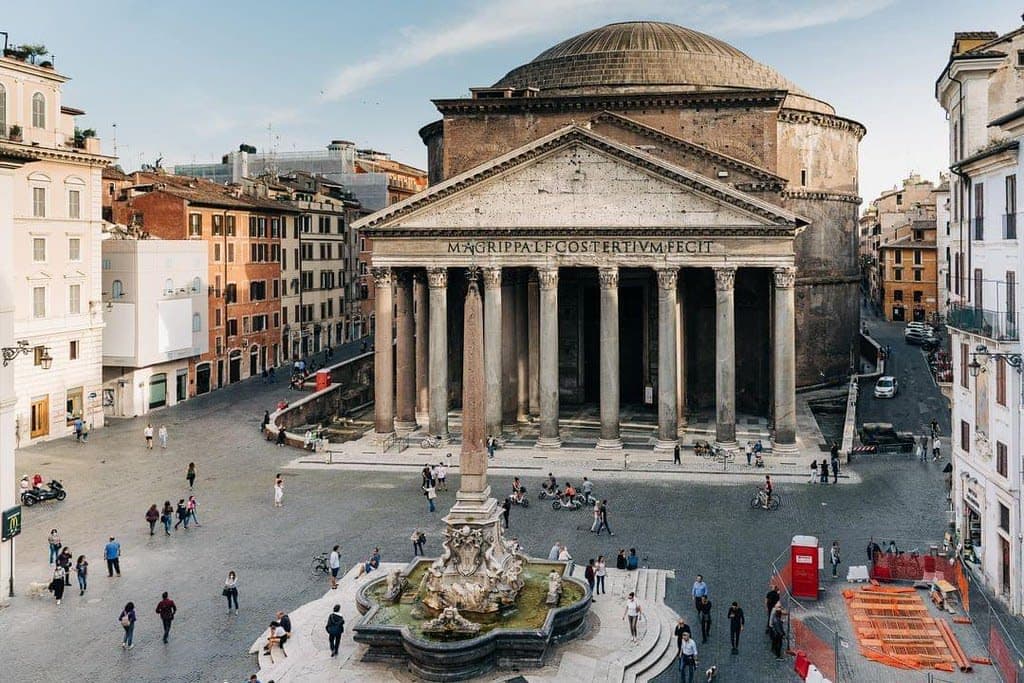
Pantheon, Rome, Italy
Rome's most perfect building: temple to all gods, church of all martyrs
Rome, Lazio, Italy
At A Glance
- Coordinates
- 41.8986, 12.4769
- Suggested Duration
- 1-2 hours for thoughtful visit. Minimum 30 minutes to experience the space.
- Access
- Metro Line A to Barberini (700m walk) or Spagna. Buses 30, 70, 81, 87, 628 to Rinascimento (350m west). Walking from Piazza Navona (5 min) or Trevi Fountain (10 min).
Pilgrim Tips
- Metro Line A to Barberini (700m walk) or Spagna. Buses 30, 70, 81, 87, 628 to Rinascimento (350m west). Walking from Piazza Navona (5 min) or Trevi Fountain (10 min).
- Shoulders and knees must be covered. No short shorts, miniskirts, sleeveless or backless tops. Guards enforce the dress code at entrance.
- Photography permitted without flash. No tripods. No photography during Mass.
- Crowds are constant except at opening. Dress code strictly enforced. The building closes during Mass—check schedule. Audio guides available. No restrooms inside.
Overview
The Pantheon stands as ancient Rome's most complete survival—a temple to all gods that became a church to Mary and the martyrs, preserved through continuous use for nearly two thousand years. The 43-meter concrete dome, still the world's largest unreinforced span, opens at its apex to the sky. Light falls through this oculus, moving across marble walls as the day turns. Mathematics made sacred.
In the heart of Rome, on the same spot where Marcus Agrippa built a temple in the age of Augustus, Emperor Hadrian created something unprecedented around 126 CE: a perfect geometric space topped by the largest dome in history. Height equals diameter—43.3 meters in every dimension, a sphere inscribed within a cube. At the apex, an oculus nearly nine meters across opens to the sky. Rain falls through. Light enters. The cosmos itself illuminates the temple.
When Christianity became Rome's religion, most pagan temples were abandoned, cannibalized for building stone, or destroyed. The Pantheon survived because in 609 CE, Byzantine Emperor Phocas gave it to Pope Boniface IV, who brought twenty-eight cartloads of martyrs' bones from the catacombs and consecrated the building to Santa Maria ad Martyres—the Virgin Mary and all Christian martyrs. The celebration of this dedication on November 1st may have contributed to the establishment of All Saints' Day. What had been sacred to all gods became sacred to all who died for the faith.
Today the Pantheon is Italy's most-visited monument. Tourists pour through its bronze doors throughout the day. But it remains an active church—Mass is celebrated, weddings and funerals mark life passages, Raphael lies buried beneath the marble. The crowds cannot diminish the dome's overwhelming presence, the oculus's cosmic opening, the moving light that connects this ancient space to the turning heavens.
Context And Lineage
Hadrian built the current Pantheon around 126 CE on the site of Agrippa's earlier temple. In 609, Pope Boniface IV consecrated it as a church dedicated to Mary and the martyrs, saving it from destruction. It remains the best-preserved ancient Roman building.
Marcus Agrippa, son-in-law of Emperor Augustus, built the first Pantheon in 27-25 BCE. Fire destroyed it twice. Emperor Hadrian, known for his passion for architecture, rebuilt it around 118-126 CE in its current revolutionary form. Hadrian modestly retained Agrippa's inscription on the portico, though the dome and rotunda are entirely his creation. The building's original religious function is debated—probably a temple to all gods, possibly focused on the divine protectors of the Julian dynasty. With Christianity's triumph, the temple fell silent. In 609 CE, Byzantine Emperor Phocas gave the building to Pope Boniface IV, who brought twenty-eight cartloads of martyrs' bones from the catacombs and consecrated it as Sancta Maria ad Martyres. This Christian use preserved what would otherwise have been destroyed.
The Pantheon functions as a titular church (basilica minor) of the Roman Catholic Church while also serving as a national monument of Italy. It is part of the UNESCO World Heritage Site 'Historic Centre of Rome' (inscribed 1980). The building has influenced architecture for two millennia—from Hagia Sophia to the U.S. Capitol dome.
Marcus Vipsanius Agrippa
Emperor Hadrian
Pope Boniface IV
Raphael
Vittorio Emanuele II
Why This Place Is Sacred
The Pantheon's thinness derives from its perfect geometry, its cosmic oculus opening to the sky, and nearly two millennia of continuous sacred use as temple and then church.
No other ancient building so fully embodies the Roman genius for making mathematics serve transcendence. The Pantheon's dome, 43.3 meters in diameter, was the largest in the world for over 1,300 years—larger than anything built until the Duomo in Florence, larger than St. Peter's. The dome's height exactly equals its diameter, meaning a perfect sphere could fit within the space. The engineers achieved this by gradually decreasing the dome's thickness and using progressively lighter materials as it rises—dense basite at the base, lightweight volcanic pumice at the oculus. The result seems to float, impossible, overhead.
The oculus itself creates continuous drama. At 8.95 meters in diameter, this opening to the sky admits rain and sun alike. Rainwater flows through 22 nearly invisible holes in the floor. The sun enters and moves across the walls throughout the day, a beam of light traveling the interior like a sundial's shadow. On April 21, Rome's traditional founding date, noon light falls precisely on the main entrance—evidence, perhaps, of intentional astronomical alignment.
The building's survival through two millennia of continuous sacred use constitutes its deepest thinness. Other ancient temples fell to Christian destruction, neglect, or stone-robbing. The Pantheon's transformation into Santa Maria ad Martyres in 609 preserved it. What had been a temple to all gods became a church honoring all who died for the faith. The structure that housed Roman cosmic religion now holds Christian martyrs' relics and Raphael's bones. Sacred purpose, continuous if transformed, has maintained these walls since Hadrian's architects laid the first stones.
Visitors today experience this accumulation—pagan mathematical perfection, Christian consecration, two thousand years of human wonder at the dome's impossible span and the sky's presence through the oculus. The crowds that fill the space cannot diminish it. Light still falls. Rain still enters. The geometry still overwhelms.
Built by Emperor Hadrian c. 118-126 CE, replacing an earlier temple by Marcus Agrippa (27-25 BCE), as a temple to all the Roman gods (Pantheum/Pantheion from Greek 'pan' = all + 'theon' = gods).
Functioned as Roman temple until 609 CE. Byzantine Emperor Phocas gave building to Pope Boniface IV, who consecrated it as Basilica di Santa Maria ad Martyres. Martyrs' relics brought from catacombs. Has served continuously as Catholic church since. Became burial place for Italian kings and notable artists (Raphael). Minor alterations over centuries but essential Roman structure preserved intact.
Traditions And Practice
Regular Mass continues (Saturday 5pm, Sunday 10:30am). The building primarily functions as tourist attraction but remains a consecrated church. Raphael's tomb draws pilgrims. The Italian monarchy's graves make it a national shrine.
The Pantheon served as a Roman temple to multiple gods until 609 CE. After consecration as Santa Maria ad Martyres, it became a site of Christian pilgrimage, especially honoring the martyrs whose relics were brought from the catacombs. All Martyrs' Day, celebrated on the dedication anniversary, may have contributed to All Saints' Day.
Mass is celebrated Saturday at 5pm and Sunday/holidays at 10:30am. Funeral Masses for notable Italians. Occasional weddings by special permission. Pilgrimage to Raphael's tomb and the royal tombs. Tourist visitation (Italy's most-visited monument).
Enter through the bronze doors and pause to let the dome's scale register. Walk the perimeter, examining the seven niches. Find Raphael's tomb in the second niche to the left. Stand in the center and look up at the oculus. If sunlight is entering, watch how it moves across the walls. If rain is falling, watch it fall through and drain. Consider attending Mass to experience the building in its liturgical function.
Roman Catholicism
ActiveBasilica di Santa Maria ad Martyres since 609 CE. Consecrated by Pope Boniface IV with martyrs' relics from the catacombs. Dedicated to the Virgin Mary and all Christian martyrs. All Martyrs' Day celebration may have contributed to All Saints' Day. Contains tombs of Raphael and Italian kings.
Regular Mass (Saturday 5pm, Sunday 10:30am), funerals, occasional weddings, pilgrimage.
Roman Paganism
HistoricalOriginally a temple to all Roman gods (Pantheum). Built by Agrippa in Augustan era, rebuilt by Hadrian. Served as imperial temple until Christianization of Rome.
Pagan worship ceased in the 4th-5th centuries with Christianization of the Empire.
Experience And Perspectives
Visitors enter through massive bronze doors into a circular space crowned by the largest ancient dome. The oculus opens to sky; light moves across marble walls. Despite crowds, the geometry overwhelms. Raphael's tomb lies in a side chapel. Mass interrupts tourism with liturgy.
The approach across Piazza della Rotonda prepares visitors for antiquity. The portico of Corinthian columns—eight across the front—rises with imperial authority, bearing Agrippa's inscription crediting his earlier temple. But the bronze doors, among the oldest in Rome, open onto Hadrian's revolutionary space.
The interior stuns. The dome soars overhead, its coffered ceiling reducing weight while creating visual rhythm. The oculus opens at the apex, a nine-meter circle of sky. Clouds drift past. Light streams through. If rain falls, it falls inside, draining through imperceptible holes in the marble floor. This opening to the elements, unique in ancient architecture, fills the space with natural light and connects the interior to the cosmos.
Seven niches ring the circular wall—once holding statues of gods, now holding altars and tombs. In the second niche to the left, Raphael lies buried, his epitaph reading: 'Here lies Raphael, by whom Nature herself feared to be outdone while he lived, and when he died, feared that she herself would die.' The painter chose this site for his tomb; the church that was once a temple seemed fitting for Renaissance genius.
The Italian kings Vittorio Emanuele II and Umberto I rest in massive tombs on opposite sides of the building. The Pantheon serves as national sanctuary as well as church.
Despite the crowds that fill the space throughout the day, the architecture asserts itself. Standing in the center, looking up at the oculus, watching light move across the walls as the sun turns outside—this experience connects visitors to two millennia of humans who have stood in this same spot, looking up at the same opening, finding something transcendent in mathematical perfection.
Mass is celebrated on Saturdays at 5pm and Sundays at 10:30am. Tourism stops; liturgy begins. The bronze doors close, and for an hour the ancient temple resumes its present purpose as a church.
The Pantheon faces the Piazza della Rotonda in Rome's historic center. The Trevi Fountain lies about 700 meters northeast; Piazza Navona about 400 meters west. The building stands in the dense fabric of medieval and Renaissance Rome, approached through narrow streets that emphasize the surprise of its scale.
The Pantheon offers encounter with Rome at its peak—pagan engineering perfection preserved through Christian transformation. The dome, the oculus, the moving light create a space that speaks of transcendence across two millennia of sacred use.
Architectural historians consider the Pantheon the greatest surviving example of Roman imperial architecture. The unreinforced concrete dome remained the world's largest until the Renaissance. The building's preservation results from its continuous use as a church since 609 CE. Structural analysis continues to reveal Hadrian's engineering innovations—graded materials, geometric perfection, stress distribution.
Catholic tradition honors the Pantheon as Basilica di Santa Maria ad Martyres, consecrated with martyrs' relics in 609. The transformation of pagan temple to Christian church represents Christianity's triumph while preserving Rome's heritage. The space sanctified by martyrs' blood (figuratively) serves as national and spiritual shrine.
The oculus has attracted interpretation as cosmic symbolism—the eye of heaven, the axis mundi connecting earthly and celestial realms. The perfect geometry has been read as Pythagorean or Platonic architecture encoding universal harmonies. The April 21 light alignment (Rome's founding date) suggests astronomical intention. The continuity from pagan temple to Christian church interests those studying sacred space across traditions.
The exact gods to whom the original Pantheon was dedicated. The construction methods that prevented the dome from cracking during curing. Whether astronomical alignments were intentional. The original interior decoration. The meaning of Hadrian's decision to retain Agrippa's inscription rather than credit himself.
Visit Planning
Central Rome location on Piazza della Rotonda. Open daily 9am-7pm except major holidays. Tickets €5 adult (free under 18 and first Sunday monthly). Accessible by Metro Line A to Barberini (700m walk). Extremely crowded; morning opening best.
Metro Line A to Barberini (700m walk) or Spagna. Buses 30, 70, 81, 87, 628 to Rinascimento (350m west). Walking from Piazza Navona (5 min) or Trevi Fountain (10 min).
Excellent accommodation options throughout Rome's historic center. The Pantheon area has numerous hotels in all categories.
Strict dress code enforced—shoulders and knees covered. Active church despite tourist function. Photography permitted without flash. Quiet voices. Closed during Mass times.
The Pantheon is an active Catholic church that also functions as Italy's most-visited monument. Both identities require respect. Dress codes are enforced at the entrance; those in shorts, sleeveless tops, or backless attire may be denied entry. Photography is permitted except during Mass. Speaking voices should be kept low. Do not block access to altars, tombs, or chapels.
Shoulders and knees must be covered. No short shorts, miniskirts, sleeveless or backless tops. Guards enforce the dress code at entrance.
Photography permitted without flash. No tripods. No photography during Mass.
Candles available at side altars. Donations appreciated.
Closed during Mass (Saturday 5pm, Sunday 10:30am) | Closed January 1, August 15, December 25 | Strict dress code enforced | No food or drink
Sacred Cluster
Nearby sacred places create the location cluster described in the growth plan. This block is intentionally crawlable and links into the wider regional graph.