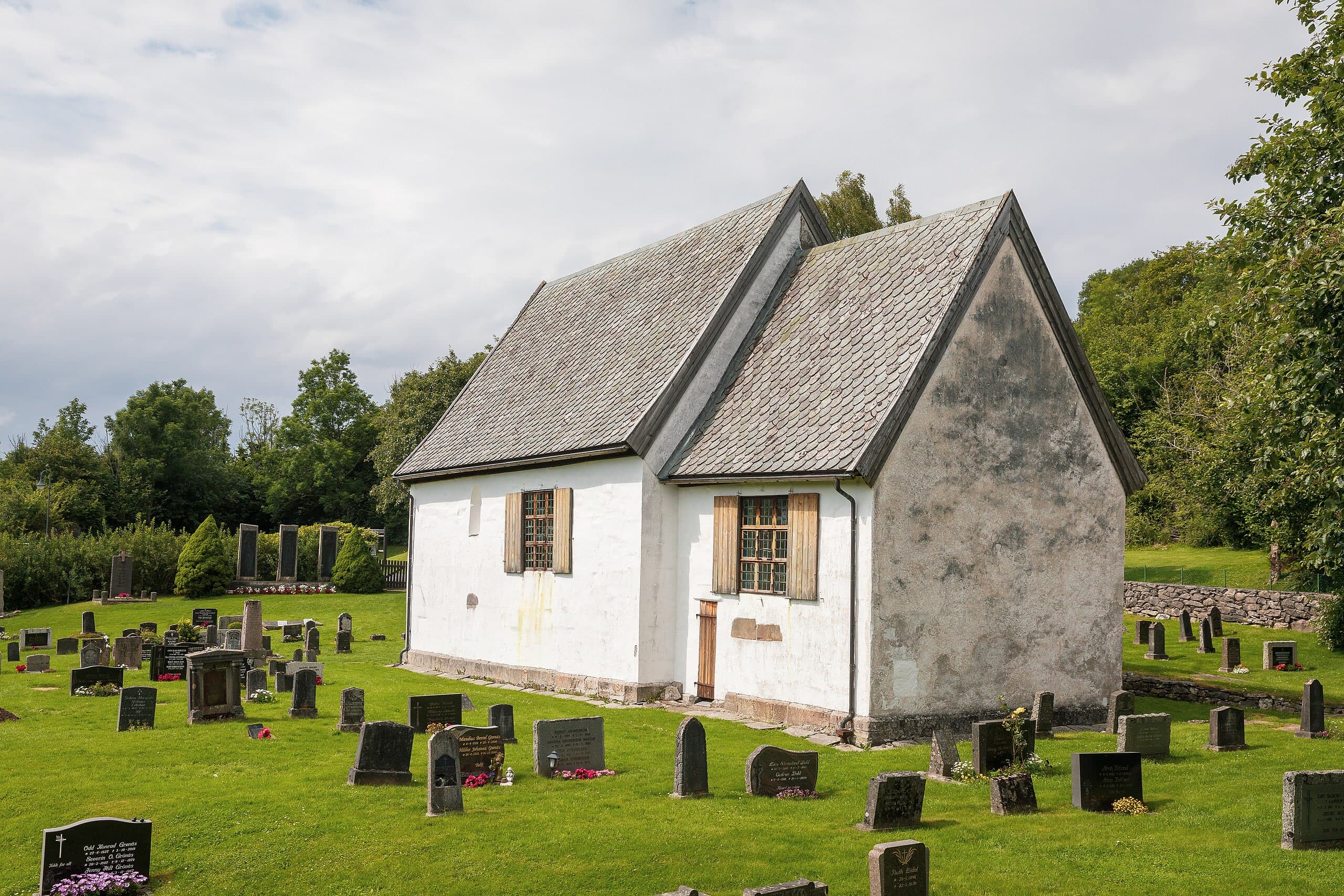
Old Moster Church
Where Christianity first took root in Norway, over a thousand years ago
Bomlo, Vestland, Norway
At A Glance
- Coordinates
- 59.7016, 5.3821
- Suggested Duration
- Two to three hours to visit the church, explore the Moster Amfi exhibitions including 'From Heathendom to Christianity,' and walk the culture route through Mosterhamn.
- Access
- The church is located in Mosterhamn on the island of Moster, Bomlo Municipality, Vestland county, Norway. Coordinates are approximately 59.7022 degrees north, 5.3472 degrees east. Moster is connected to the mainland by road via bridges and the Bomlafjord tunnel. The nearest major city is Haugesund, approximately forty kilometres by road. For tour arrangements, contact Moster Amfi by telephone at +47 53 42 66 20 or by email at post@mosteramfi.no.
Pilgrim Tips
- The church is located in Mosterhamn on the island of Moster, Bomlo Municipality, Vestland county, Norway. Coordinates are approximately 59.7022 degrees north, 5.3472 degrees east. Moster is connected to the mainland by road via bridges and the Bomlafjord tunnel. The nearest major city is Haugesund, approximately forty kilometres by road. For tour arrangements, contact Moster Amfi by telephone at +47 53 42 66 20 or by email at post@mosteramfi.no.
- No specific dress code is required. As a heritage site and consecrated church, modest attire is appropriate. Comfortable walking shoes are advisable for the culture route through Mosterhamn.
- Photography is permitted inside the church and on the grounds. Be mindful of lighting conditions within the Romanesque interior, which relies on natural light through narrow windows. During any special services, photography should be unobtrusive.
- Access to the church interior is through guided tours arranged via Moster Amfi. Visitors should not attempt to enter the building independently, as it is a preserved heritage structure. While photography is permitted, avoid touching the medieval furnishings, the chalk paintings, or the church bell. The building is both a museum and a consecrated church space; conduct appropriate to both is expected.
Overview
On the island of Moster, a small stone church stands where an entire nation's spiritual identity was born. Here, around 995 CE, King Olav Tryggvason built one of the first Christian churches in Norway. Three decades later, the Mostratinget assembly proclaimed the first Christian laws, transforming the kingdom from pagan custom to codified faith. The stone walls that replaced the original timber structure have held this history for nearly nine centuries.
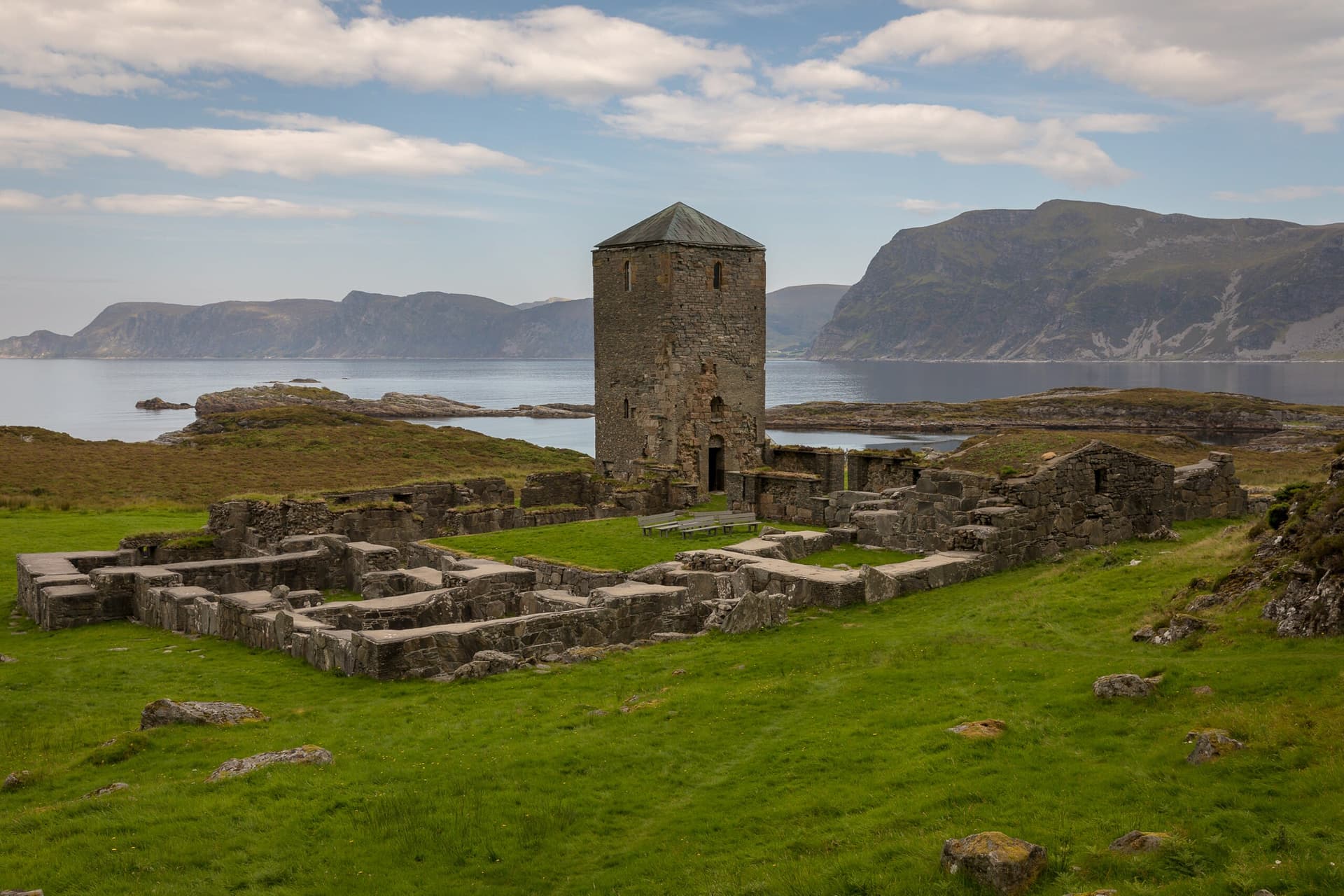
The stone is white and the lines are plain. Old Moster Church does not announce itself with towers or ornament. It sits low against the Sunnhordland landscape, a Romanesque rectangle of ashlar masonry dating to the mid-twelfth century, its rounded arches and narrow windows reflecting the architectural language of medieval Christendom at its most restrained.
What happened here, however, was anything but restrained. According to the Icelandic historian Snorri Sturluson, King Olav Tryggvason arrived at Moster around 995 CE with English priests in his retinue and built one of the first Christian churches on Norwegian soil. Mass was celebrated. A new faith took its first tentative hold on a land shaped by the old Norse gods.
Thirty years later, King Olav Haraldsson and Bishop Grimkjell returned to Moster for the assembly known as Mostratinget. In 1024, they proclaimed the Kristenretten, the first Christian laws of Norway, formally converting the kingdom and establishing legal protections for individuals that marked what later generations would call the transition from a society of power to a society of law. The 2024 national jubilee celebrating the thousandth anniversary of Mostratinget affirmed that this small church on an island in western Norway remains central to Norwegian identity and self-understanding.
Context And Lineage
Old Moster Church stands at the intersection of three defining moments in Norwegian history. Around 995 CE, King Olav Tryggvason built one of the first Christian churches in Norway on this site. In 1024, King Olav Haraldsson and Bishop Grimkjell proclaimed the Kristenretten at Mostratinget, establishing Christian law as the law of the land. And in 1814, the church served as an election site for the constitutional assembly that gave Norway its modern democratic identity. All three kings associated with the Christianization of Norway can be linked to Moster, making this site the single most important location in the story of Norwegian Christianity.
According to Snorri Sturluson's Heimskringla, composed around 1230, Olav Tryggvason reached the Norwegian coast and landed first at Moster in Sunnhordland in 995. He brought English priests with him and built one of his first churches on Norwegian soil. Mass was celebrated, and the Christianization of Norway began in earnest. Whether Olav Tryggvason personally oversaw the construction or merely commissioned it remains unclear from the sources, but the association between the king and this site is deeply embedded in Norwegian historical memory.
Three decades later, a second king arrived at Moster. Olav Haraldsson, who would later be canonized as Saint Olav and become Norway's patron saint, convened the national law assembly known as Mostratinget in 1024. Together with Bishop Grimkjell, an English-born churchman, he introduced the Kristenretten, the first Christian laws of Norway. These laws did not merely establish Christianity as the official religion. They created a framework for individual rights and legal protections, regulated baptism, marriage, and burial, and formally replaced the pagan customs that had governed Norwegian society. Later generations described this transformation as the transition from a society of power to a society of law.
The date of the Mostratinget assembly has been subject to minor scholarly debate. Most sources, including the official Moster 2024 jubilee and the Church of Norway, identify 1024 as the year. At least one source suggests 1022. The weight of evidence and institutional consensus supports 1024.
The lineage of practice at Old Moster Church spans the full arc of Norwegian Christianity. Beginning with the missionary Christianity of Olav Tryggvason around 995, the site served the Roman Catholic faith through the medieval period, surviving the Reformation of 1537 to continue as a Lutheran parish church. The church witnessed the proclamation of Christian law in 1024, hosted centuries of sacramental worship, and participated in the birth of Norwegian democracy in 1814. When parish worship moved to the new church in 1874, the building's role shifted from active worship to heritage preservation. Today, the Church of Norway continues to use the site for special commemorative services, and the Coastal Pilgrim Route to Nidaros passes through Moster, connecting the church to a living pilgrimage tradition. The 2024 national jubilee demonstrated that the lineage remains unbroken, with ecumenical worship attended by the Norwegian Crown Prince, the Prime Minister, and international religious leaders.
King Olav Tryggvason (Olav I)
King Olav Haraldsson (Olav II / Saint Olav)
Bishop Grimkjell (Grimketel)
Snorri Sturluson
Fortidsminneforeningen (National Trust of Norway)
Why This Place Is Sacred
Old Moster Church carries over a millennium of accumulated sacred history in a space of uncommon simplicity. The site marks the geographic origin of Norwegian Christianity, the birthplace of the nation's first Christian laws, and a stop on the Coastal Pilgrim Route to Nidaros. Its thinness resides in the layering of time: a twelfth-century stone church built over the foundations of a tenth-century timber structure, chalk paintings from the 1600s covering Romanesque walls, a medieval bell bearing the relief of Saint Olav still hanging where it was placed eight centuries ago. The island setting and the quietness of the building strip away modern distraction, creating conditions where the weight of what happened here becomes tangible.
Thin places, in the Celtic and broader contemplative tradition, are locations where the distance between the ordinary and the sacred seems to narrow. Old Moster Church qualifies not through any reported supernatural quality but through the sheer density of its historical significance, concentrated in a space of deliberate plainness.
The church is small. The nave measures just over twelve metres by eight. The choir is smaller still. There is no grandeur, no Gothic aspiration toward height. The Romanesque arches are rounded and modest. The walls, once whitewashed, bear post-Reformation chalk paintings from around 1600, devotional images layered over stone that has stood since the reign of King Sigurd Jorsalfar. This is a building that has accumulated meaning rather than projecting it.
What the space holds is considerable. Here, Christianity entered Norway. Here, the legal foundation of Norwegian society was laid. Here, the transition from one cosmology to another was made formal and binding. The Kristenretten proclaimed at Mostratinget in 1024 did not merely replace one set of gods with another. It introduced a framework of individual rights and legal protections, established rules for baptism, burial, and marriage, and fundamentally altered how Norwegian society understood justice and human dignity.
The medieval church bell, cast in the first half of the thirteenth century and bearing a relief of Saint Olav, creates a tangible link to the patron saint whose legacy this site helped establish. To hear accounts of that bell ringing across the centuries, calling the faithful of Moster to worship, is to grasp the continuity of practice that gives sacred sites their depth.
The island setting contributes its own quality. Moster lies in the Sunnhordland fjord landscape, now part of the Sunnhordland UNESCO Global Geopark. The approach by road, crossing bridges and passing through tunnels that connect the island to the mainland, carries a sense of crossing over, of leaving the ordinary behind. The church sits in the village of Mosterhamn, surrounded by a landscape that has changed far less than the centuries might suggest. Wind and water and stone remain the dominant elements, as they were when Olav Tryggvason first stepped ashore.
The original timber church built around 995 CE served as one of the first sites of organized Christian worship in Norway. King Olav Tryggvason erected it as part of his campaign to Christianize the Norwegian coast, bringing English priests to celebrate mass and establish the new faith. The current stone church, built around 1100 to 1150, replaced the timber structure and served as the parish church for the community of Moster for over seven centuries, until the new Moster Church was constructed nearby in 1874.
The site's function has evolved across distinct phases. The original timber church of around 995 served the immediate purposes of missionary Christianity. The stone church that replaced it in the twelfth century became a settled parish church, serving the sacramental and communal needs of Moster's population through the medieval Catholic period, the Reformation of 1537, and the subsequent centuries of Lutheran worship. Major interior renovation in the 1600s added the chalk paintings that now cover the walls. A pulpit was installed in 1637. In 1722, officers of the Danish East Indiaman Anna Sophia, sheltering in the harbour, donated a silver plate, baptismal booth, and baptismal font to the church, items that remain among its treasured furnishings.
The church served as an election church for the 1814 Norwegian Constituent Assembly, linking it to the birth of modern Norwegian democracy as well as the birth of Norwegian Christianity. When the new Moster Church was built in 1874, the old church was scheduled for demolition. Fortidsminneforeningen, the National Trust of Norway, purchased and preserved the building, transforming it from active parish church to heritage monument. Today it functions as both museum and occasional worship space, hosting special services and commemorative events including the 2024 national jubilee celebrations.
Traditions And Practice
Old Moster Church functions primarily as a museum under Fortidsminneforeningen, but it continues to host special religious services and commemorative worship. The 2024 jubilee saw ecumenical services attended by Norwegian royalty and international church leaders. The church is a recognized point on the Pilegrimsleden, the Coastal Pilgrim Route to Nidaros, maintaining its connection to active pilgrimage tradition.
For over seven centuries, the church served as the parish church of Moster, hosting the full cycle of Christian worship: baptism, communion, marriage, and burial. The Mostratinget assembly of 1024 was itself a ritual-legal event of profound significance, where the Kristenretten was proclaimed before a gathered assembly, formally establishing the rites and obligations of the Christian faith as the law of the kingdom. The medieval church bell, cast in the first half of the thirteenth century, marked the hours of worship and called the community to prayer. Catholic mass was celebrated from the church's founding until the Reformation of 1537, after which Lutheran liturgy replaced Catholic practice while the rhythms of weekly worship continued unbroken.
The church hosts special commemorative services on significant occasions. During the 2024 national jubilee marking the thousandth anniversary of Mostratinget, ecumenical worship services were held at the church with participation from the Church of Norway, the Anglican Communion represented by the Archbishop of York, and the Lutheran World Federation. Crown Prince Haakon and Prime Minister Jonas Gahr Store attended the celebrations, underscoring the site's ongoing national significance. Pilgrim walkers on the Pilegrimsleden pass through Moster as a recognized stop on the Coastal Pilgrim Route to Nidaros Cathedral in Trondheim, the shrine of Saint Olav. Guided tours through Moster Amfi provide interpretive access to the church and its history, including the exhibition 'Fra Heidendom til Kristendom' documenting the transition from paganism to Christianity.
For visitors seeking contemplative engagement, approach the church slowly through Mosterhamn, allowing the culture route to build context before you enter the building. Inside, give your eyes time to adjust and take in the post-Reformation chalk paintings that cover the walls. These are devotional images applied by hands that worked nearly five centuries ago, and they reward close attention. Stand beneath the medieval bell with its relief of Saint Olav and consider the continuity it represents: eight hundred years of ringing across the same landscape, calling communities that changed in every way except their attachment to this place.
The intimate scale of the church makes silence natural. The nave holds perhaps forty people. In the quiet, the thickness of the walls becomes noticeable, the way sound changes within the Romanesque enclosure. If you have walked part of the Pilegrimsleden to reach Moster, the church serves as a resting point in the deeper sense, a place where the purpose of pilgrimage becomes legible through the accumulated weight of ten centuries of Christian practice.
Consider visiting the exhibition at Moster Amfi before entering the church. Understanding the pagan world that the Mostratinget assembly replaced gives the Christian space its full meaning. The contrast between what came before and what was established here is the story of this site, and it is best appreciated when both halves are held together.
Church of Norway (Lutheran)
ActiveOld Moster Church is one of the most historically significant churches in the Church of Norway, marking the site where Christianity was first established in the country. The church served the Lutheran faith from the Reformation of 1537 until 1874, and continues to host special commemorative services. The 2024 national jubilee celebrating the thousandth anniversary of Mostratinget brought the Presiding Bishop of the Church of Norway together with international religious leaders for worship at the site, affirming its ongoing significance within the Lutheran tradition.
Special commemorative worship services are held at the church on significant occasions. During the 2024 jubilee, ecumenical services were conducted with participation from the Church of Norway, the Anglican Communion, and the Lutheran World Federation. The church is a recognized point on the Pilegrimsleden, the Coastal Pilgrim Route to Nidaros, connecting it to the active pilgrimage tradition centred on the shrine of Saint Olav.
Roman Catholic Christianity (medieval)
HistoricalThe original church was established under the auspices of Roman Catholic Christianity around 995 CE, and the site served the Catholic faith for over five centuries until the Reformation of 1537. The Kristenretten proclaimed at Mostratinget in 1024 was a Catholic legal code, reflecting the ecclesiastical structures and sacramental theology of medieval Western Christendom. Bishop Grimkjell, who co-authored the laws, was an English-born Catholic churchman. The stone church built around 1100 to 1150 is a product of the Romanesque architectural tradition that spread across Catholic Europe during this period.
Catholic mass, baptism, marriage, burial, and the administration of Christian law according to the Kristenretten were the defining practices at the site during the medieval period. The church bell from the first half of the thirteenth century, bearing the relief of Saint Olav, reflects the medieval cult of saints that was central to Catholic devotion. The sacramental life of the parish continued unbroken from the site's founding until the Reformation brought Lutheran worship in 1537.
Norse paganism (pre-Christian)
HistoricalBefore the arrival of Christianity, the people of Moster and the broader Sunnhordland region lived within the framework of Norse pagan religion. The Mostratinget assembly of 1024 explicitly marked the formal end of pagan custom and its replacement by Christian law. The exhibition at Moster Amfi documents this transition, presenting the pre-Christian world that the Kristenretten replaced.
Pre-Christian practices on Moster included worship of the Norse gods, traditional burial customs, and governance through the assembly system known as the thing. The Kristenretten specifically replaced pagan customs around burial, marriage, and worship with Christian equivalents. Whether the site of Moster itself held specific pre-Christian sacred significance remains an open question.
Heritage Conservation
ActiveFortidsminneforeningen's acquisition of Old Moster Church in 1874, saving it from demolition, represents one of the earliest acts of heritage conservation in Norway. The ongoing stewardship of the building as both museum and occasional worship space has preserved not only the physical structure but also its significance as a national symbol.
Fortidsminneforeningen maintains the church fabric, manages access through Moster Amfi, and supports guided interpretation of the building and its history. The Moster Amfi heritage centre provides exhibition space, an outdoor amphitheatre for historical performances, and the Moster Senter for Religious and Church History. The 2024 national jubilee brought renewed attention and resources to the site's preservation and interpretation.
Experience And Perspectives
Visitors approach Old Moster Church through the village of Mosterhamn, where a culture route connects the church to the broader Moster Amfi heritage centre. The building is intimate rather than imposing, its white Romanesque stone weathered to a quiet dignity. Inside, the chalk paintings on the walls, the medieval bell, and the sparse furnishings create a contemplative atmosphere intensified by the knowledge of what this place witnessed. Guided tours through Moster Amfi provide historical context, while the exhibition 'From Heathendom to Christianity' frames the larger story of Norway's religious transformation.
The church does not dominate the landscape. It emerges gradually as you walk through Mosterhamn, a low stone building that could almost be mistaken for a farmstead were it not for the form of the windows and the recognizable proportions of nave and choir. This modesty is itself instructive. The Christianity that took root here was not the Christianity of cathedrals and papal grandeur. It was a coastal, frontier faith, brought by kings and English priests to a people whose religious world was populated by Odin, Thor, and the spirits of land and sea.
Step inside and the scale shifts from historical to personal. The nave is not much larger than a generous living room. The Romanesque arches frame a space where every surface carries evidence of centuries of use and devotion. The post-Reformation chalk paintings, dating to around 1600, cover the walls with imagery that subsequent generations of worshippers would have contemplated during services. These are not the refined frescoes of Mediterranean churches but something rougher, more immediate, painted by hands that knew North Sea winters.
The medieval church bell, cast in the first half of the thirteenth century, bears a relief of Saint Olav, the king who proclaimed the Kristenretten at Mostratinget and who would be canonized after his death at the Battle of Stiklestad in 1030. To stand beneath this bell is to occupy the same acoustic space where it has rung for eight hundred years, calling communities to worship across generations that span the medieval period, the Reformation, the Enlightenment, and the modern era.
The furnishings from the Anna Sophia shipwreck of 1722 add an unexpected layer. The silver plate and baptismal items donated by Danish officers are artifacts of maritime encounter, reminders that Moster's history has always been shaped by the sea and by those who arrived from it, beginning with Olav Tryggvason himself.
Visitors who arrive through the Moster Amfi heritage centre gain the benefit of the exhibition 'Fra Heidendom til Kristendom,' which reconstructs the world the church replaced. The contrast between the pagan customs described in the exhibition and the quiet Christian space of the church itself makes the magnitude of the Mostratinget transformation palpable in a way that reading about it cannot achieve.
Old Moster Church is accessed via guided tours arranged through Moster Amfi. The heritage centre, located adjacent to the church in Mosterhamn, serves as the starting point for visits. A culture route through the village connects the church, the amphitheatre, and other historical sites on foot. Visitors should contact Moster Amfi in advance to confirm tour availability, particularly outside the summer season. The church interior, the medieval bell, the chalk paintings, and the Anna Sophia furnishings are all included in the guided experience.
Old Moster Church invites engagement from multiple angles: as a site of religious history, as a milestone in the development of Norwegian law and democracy, as an architectural monument, and as a place of ongoing spiritual significance. The perspectives that follow hold these dimensions together without forcing them into a single narrative.
Historians broadly accept, based on Snorri Sturluson's Heimskringla, that Moster was among the first sites where Christianity was formally established in Norway, with Olav Tryggvason building a church there around 995 CE. The date of his landing is subject to minor debate, with most sources favoring 995 and some citing 996. The Mostratinget assembly of 1024 is well-documented as the event where the first Christian laws were introduced by King Olav Haraldsson and Bishop Grimkjell. The current stone church is securely dated to approximately 1100 to 1150 based on architectural analysis of the ashlar masonry and Romanesque features. The 2024 national jubilee, supported by the Church of Norway, the Norwegian government, and international religious bodies including the Anglican Communion and the Lutheran World Federation, affirmed the scholarly consensus on the significance of Mostratinget.
The relationship between the current stone church and the original timber structure built by Olav Tryggvason remains a matter of inference. No archaeological evidence of the original wooden church has been published in accessible sources, and whether the stone church was built on the precise site of the timber predecessor or merely in the same area is not definitively established. Limited English-language archaeological reports on excavations beneath the current structure present a gap in the available scholarship.
In Norwegian Christian tradition, Moster holds a status comparable to Canterbury in England or Iona in Scotland: it is the place where the faith arrived and took root. The founding narrative tells of Olav Tryggvason arriving from across the sea with English priests, building a church, and celebrating the first mass. This narrative carries the weight of national origin story, linking the birth of Norwegian Christianity to the physical landscape of Moster. The Kristenretten proclaimed at Mostratinget in 1024 is understood within the Church of Norway not merely as a historical event but as the founding act of Christian civilization in the nation, the moment when the values of human dignity, legal protection, and spiritual community were formally established.
The pre-Christian Norse traditions that the Kristenretten replaced are documented through saga literature and presented in the Moster Amfi exhibition. The assembly explicitly marked the transition from pagan customs to Christian law, covering burial, marriage, and worship practices. In Norwegian historical memory, this transition is characterized as moving from heathendom to Christianity, a phrase that serves as the title of the exhibition at Moster Amfi.
Several questions about Old Moster Church remain open. Whether Moster held specific pre-Christian sacred significance that influenced Olav Tryggvason's choice to land and build a church there, or whether the location was selected for practical maritime reasons, is not known. The exact form and location of the original 995 timber church, and whether it occupied the precise site of the current stone building, remain unestablished. The identity of the architect and builders of the stone church, and whether they were local craftsmen or brought from England or the Continent, is unknown. Whether any physical remains of the Mostratinget assembly site, the outdoor gathering place where the laws were proclaimed, survive beneath or near the current structures has not been determined. The full content of the original Kristenretten as proclaimed in 1024 is lost; only later compilations survive.
Visit Planning
Old Moster Church is located in the village of Mosterhamn on the island of Moster, Bomlo Municipality, Vestland county, western Norway. The island is connected to the mainland by bridge and undersea tunnel. Visits are arranged through the adjacent Moster Amfi heritage centre. The nearest major city is Haugesund, approximately forty kilometres by road.
The church is located in Mosterhamn on the island of Moster, Bomlo Municipality, Vestland county, Norway. Coordinates are approximately 59.7022 degrees north, 5.3472 degrees east. Moster is connected to the mainland by road via bridges and the Bomlafjord tunnel. The nearest major city is Haugesund, approximately forty kilometres by road. For tour arrangements, contact Moster Amfi by telephone at +47 53 42 66 20 or by email at post@mosteramfi.no.
Accommodation is available in Bomlo Municipality and the surrounding Sunnhordland region. Haugesund, approximately forty kilometres to the north, offers a wider range of hotels, guesthouses, and rental properties. The Sunnhordland region caters to tourism with options ranging from traditional guesthouses to modern holiday rentals.
Old Moster Church is a publicly promoted heritage site that also retains its identity as consecrated church space. Visitors are welcome through guided tours arranged via Moster Amfi. Modest behaviour and respect for the building's dual identity as museum and sacred space are appropriate.
The church welcomes visitors as part of guided tours through Moster Amfi. It is not a private or restricted site, and the organizations responsible for it, Fortidsminneforeningen and Moster Amfi, actively encourage public engagement. However, the building's age, its fragile interior features, and its status as a consecrated church all require a degree of care.
During guided tours, follow the instructions of your guide regarding which areas are accessible and what may be touched or photographed at close range. The chalk paintings on the walls date to around 1600 and are vulnerable to contact. The medieval furnishings, including the church bell with Saint Olav's relief and the items donated by the officers of the Anna Sophia in 1722, are irreplaceable artifacts.
If you visit during a special service or commemorative event, you are entering an act of worship. Quiet respect is expected. Seating is limited in the small nave, and worshippers take priority over observers.
The broader Moster Amfi complex, including the outdoor amphitheatre and exhibitions, operates on its own schedule. Check availability before visiting, particularly outside the main summer season.
No specific dress code is required. As a heritage site and consecrated church, modest attire is appropriate. Comfortable walking shoes are advisable for the culture route through Mosterhamn.
Photography is permitted inside the church and on the grounds. Be mindful of lighting conditions within the Romanesque interior, which relies on natural light through narrow windows. During any special services, photography should be unobtrusive.
Not applicable. The church functions primarily as a museum. Donations to Fortidsminneforeningen for the ongoing preservation of the building may be welcomed.
Access is through guided tours arranged via Moster Amfi. Do not attempt to enter the building independently. Avoid touching the medieval furnishings, chalk paintings, and interior surfaces. Respect the building as both a heritage monument and a consecrated church space.
Sacred Cluster
Nearby sacred places create the location cluster described in the growth plan. This block is intentionally crawlable and links into the wider regional graph.