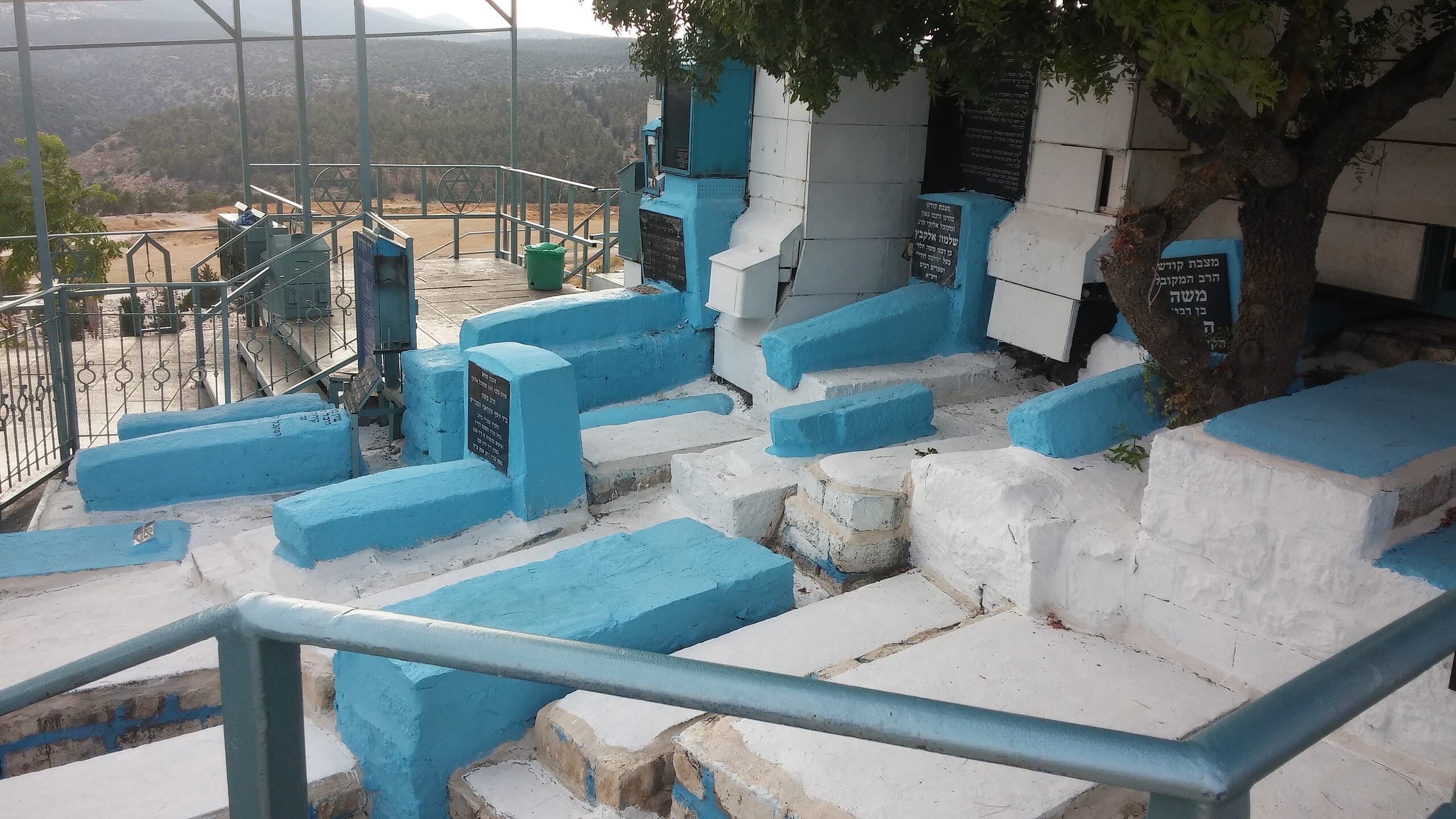
Old Cemetery, Safed
The hillside where Kabbalah's greatest masters rest, painted the blue of heaven
Safed, North District, Israel
At A Glance
- Coordinates
- 32.9685, 35.4891
- Suggested Duration
- Allow 1-2 hours for a meaningful visit that includes the major graves and the ARI Mikveh. A guided tour takes approximately 1.5-2 hours. Those wishing to spend extended time in prayer should allow additional hours.
- Access
- The cemetery is on the western slope below the Old Jewish Quarter. Accessible via paths descending from below the ARI Sephardi Synagogue or from the Military Cemetery. Approximately 30 acres of hillside terrain with uneven paths. Sturdy footwear essential. Parking available in the Old City area above. Safed is approximately 3 hours from Tel Aviv, 1.5 hours from Haifa by car, and accessible by bus. The ARI Mikveh is located at the upper entrance near the ARI Sephardi Synagogue. Mobile phone signal is available throughout Safed.
Pilgrim Tips
- The cemetery is on the western slope below the Old Jewish Quarter. Accessible via paths descending from below the ARI Sephardi Synagogue or from the Military Cemetery. Approximately 30 acres of hillside terrain with uneven paths. Sturdy footwear essential. Parking available in the Old City area above. Safed is approximately 3 hours from Tel Aviv, 1.5 hours from Haifa by car, and accessible by bus. The ARI Mikveh is located at the upper entrance near the ARI Sephardi Synagogue. Mobile phone signal is available throughout Safed.
- Modest dress is expected. For men, a head covering (kippah or yarmulke) is appropriate and may be expected at the prayer areas. For women, sleeves covering elbows and skirts or pants covering knees are expected. At the separated prayer areas, traditional dress norms apply more strictly.
- Photography is generally permitted in the cemetery, but visitors should be sensitive about photographing people in prayer. Some Orthodox visitors may object to being photographed. Photography is prohibited on Shabbat and Jewish holidays under Jewish law, and visitors should respect this even if they do not personally observe.
- The cemetery covers approximately 30 acres of hillside terrain with uneven paths. Sturdy footwear is essential. Summer temperatures can be extreme. The ARI Mikveh water is very cold, even in summer. Kohanim, members of the Jewish priestly class, are traditionally prohibited from entering cemeteries.
Overview
On the western slope below Safed's Old Jewish Quarter, a cemetery of blue-painted graves holds the remains of some of the most influential figures in Jewish law and mysticism. Isaac Luria, Joseph Karo, Moses Cordovero, and dozens of their students and contemporaries rest here. Hundreds of thousands of pilgrims come annually to pray, recite psalms, and leave written petitions at graves that are understood not as memorials but as living channels of spiritual power.
Safed occupies the highest elevation of any city in the Galilee, and its old cemetery occupies the slope below, cascading westward down the hillside in terraces of stone and earth. The graves are painted blue, a striking visual choice that transforms a place of burial into something closer to a garden of the sky. In Kabbalistic understanding, the blue evokes the color of God's Throne of Glory, the boundary between the visible and the invisible. It is a declaration that these dead are not simply dead.
The cemetery's significance is inseparable from the extraordinary period that produced most of its burials. In the sixteenth century, following the expulsion of Jews from Spain in 1492, waves of scholars and mystics settled in Safed, drawn by traditions linking the Galilee to messianic revelation. Within a few decades, the small mountain city became the world capital of Jewish mysticism. Isaac Luria, known as the ARI, arrived in 1570 and in barely two years transformed Kabbalah from a scholarly pursuit into a living spiritual path. Joseph Karo, who had already codified all of Jewish law in the Shulchan Aruch, lived and taught here. When these men and their students died, the hillside received them, and pilgrimage began almost immediately.
Today the cemetery draws visitors who range from Ultra-Orthodox Jews performing centuries-old devotional practices to secular tourists moved by the atmosphere of accumulated faith. The graves of the ARI and Rabbi Joseph Karo are the most visited, with separated prayer areas for men and women, candle-lighting stations, and charity boxes. Pilgrims leave kvitlach, small written prayer requests, tucked into the stone borders of the graves. They recite psalms, sometimes spending hours at a single gravesite. Some prostrate themselves in the manner that Luria himself developed, a practice he called hishtatchut, lying flat at the graves of earlier sages to commune with their souls.
Nearby, fed by a natural spring, the ARI Mikveh offers ritual immersion in water so cold it takes your breath. This is the mikveh where Luria himself immersed before teaching, and pilgrims continue to use it as preparation for visiting his grave. The cold is not incidental. It is the point. Something shifts when the water closes over your head.
Context And Lineage
The Old Cemetery of Safed holds the graves of the most important figures of the sixteenth-century Kabbalistic revolution, including Isaac Luria and Joseph Karo, who transformed this Galilean mountain city into the world capital of Jewish mysticism and law.
According to Safed tradition, the cemetery's antiquity is attested by the traditional burial sites of Hannah and her Seven Sons, martyred by the Hellenistic ruler Antiochus during the Maccabean revolt in the second century BCE, and of the prophet Hosea. While these attributions cannot be archaeologically verified, they establish the cemetery's self-understanding as a place of ancient and continuous Jewish presence.
The cemetery's transformation into a major pilgrimage site began after 1492, when the expulsion of Jews from Spain sent waves of scholars and mystics to the Galilee. Kabbalistic traditions linking the northern mountains to messianic prophecy drew them specifically to Safed, and within a generation the city became the center of a spiritual revolution. Isaac Luria arrived from Egypt in 1570 and in barely two years transformed Kabbalah from an esoteric scholarly discipline into a living mystical path. His innovations, including new prayer liturgies, meditative techniques, and the practice of grave visitation itself, reshaped Jewish spirituality worldwide. When Luria died of plague in 1572 at the age of 38, his burial in this cemetery initiated the pilgrimage tradition that continues today.
The Old Cemetery of Safed belongs to the broader Jewish tradition of visiting the graves of the righteous as a means of spiritual connection and intercession. This practice, while ancient, was given its fullest theological and practical elaboration by Isaac Luria in Safed itself, making this cemetery both the site and the source of one of Judaism's most important devotional practices.
Isaac Luria (the ARI, 1534-1572)
Father of modern Kabbalah whose revolutionary mystical system, developed during barely two years in Safed, transformed Jewish spirituality worldwide. His grave is the most visited in the cemetery. He developed the practice of hishtatchut (grave prostration) as a mystical technique and reportedly identified unmarked graves through clairvoyant perception.
Rabbi Joseph Karo (1488-1575)
Author of the Shulchan Aruch, the definitive Code of Jewish Law that remains the authoritative legal guide for observant Jews. His grave draws pilgrims seeking connection to the source of Jewish legal tradition.
Moses Cordovero (1522-1570)
Systematic Kabbalist and teacher of Isaac Luria whose philosophical work Pardes Rimonim provided the intellectual framework for Safed's mystical renaissance. Buried in the cemetery alongside his students.
Shlomo HaLevi Alkabetz (c. 1500-1576)
Kabbalist and poet who composed Lecha Dodi, the Sabbath hymn sung every Friday evening in Jewish communities worldwide. His grave connects visitors to a living liturgical tradition.
Why This Place Is Sacred
The concentrated presence of dozens of Judaism's most revered spiritual masters, combined with centuries of accumulated prayer and pilgrimage, creates a site where the boundary between the living and the dead is understood to be exceptionally permeable.
Kabbalistic tradition identifies Safed as the City of Air among Judaism's four holy cities, each corresponding to a classical element. Air represents the ethereal, the spiritual, the dimension that cannot be grasped. The cemetery embodies this designation. It is a place where the material and spiritual are understood to overlap, where the merit of the righteous dead can be accessed by the living, and where prayers ascend more readily than elsewhere.
The thin-place quality is anchored in the theology of the tzaddik. In Jewish tradition, the souls of the righteous do not simply depart at death. They maintain a continuing presence, a connection to both the divine and the human worlds. The grave of a tzaddik is understood as a conduit, a place where the veil between realms thins to the point of transparency. When dozens of the most revered tzaddikim in Jewish history lie within a single hillside, the cumulative effect is understood as extraordinary.
Isaac Luria, who lies at the cemetery's heart, did not merely teach about the permeability of the boundary between worlds. He practiced it. The ARI developed hishtatchut, prostrating at the graves of earlier sages, as a technique for receiving mystical insights from the departed. He reportedly used clairvoyant perception to identify unmarked graves of figures from centuries before his time. For Luria, the cemetery was not a resting place but a school, and the dead were the teachers.
The physical setting reinforces the spiritual claim. The cemetery faces west toward Jerusalem, the holy city from which, in Safed's understanding, the Messiah will eventually come. The blue-painted graves against the green hillside create a visual landscape that seems halfway between earth and sky. The tradition that the dead of Safed will be the first resurrected when the Messiah arrives imbues each grave with messianic anticipation. Visiting here is not retrospective. It is oriented toward a future that the faithful understand as imminent.
The cemetery served the Jewish community of Safed for burial over a period spanning more than two millennia, with the oldest graves traditionally attributed to the late BCE era. Its primary function was and remains burial, but the presence of extraordinary spiritual figures transformed it into one of Judaism's most important pilgrimage destinations.
The cemetery's transformation from a community burial ground to a major pilgrimage site occurred during the sixteenth century, when the influx of Kabbalists following the Spanish Expulsion created a concentration of spiritual genius unparalleled in Jewish history. The deaths of Luria (1572), Karo (1575), Cordovero (1570), and their contemporaries turned the hillside into a sacred geography. Pilgrimage practices developed almost immediately and have continued without interruption. Burial in the old section ceased in 1962, but the site's role as a pilgrimage destination has only intensified.
Traditions And Practice
Pilgrims recite psalms, light memorial candles, leave written prayer requests, and prostrate at the graves of the tzaddikim. Immersion in the ARI Mikveh is practiced as spiritual preparation.
Isaac Luria developed hishtatchut, the practice of prostrating at the graves of the righteous, as a technique for communing with the souls of the departed and receiving mystical insights. The practice involves lying flat on the grave, emptying the mind, and opening to whatever the soul of the tzaddik transmits. This was not a metaphor for Luria. He taught that the souls of the buried sages maintained a continuing presence and could communicate with those who approached correctly.
Recitation of specific psalms at individual graves follows traditional patterns. Psalms 33 and 119 are among the most commonly recited. The custom of leaving kvitlach, written prayer requests, at the graves reflects the belief that the merit of the tzaddik can elevate the petitioner's prayers. Lighting memorial candles, giving charity in memory of the deceased, and placing small stones on the graves are all established elements of the visit.
Hundreds of thousands of pilgrims visit annually. The largest gathering occurs on the 5th of Av, the anniversary of Luria's death, which typically falls in July or August and draws tens of thousands. Daily visitors come to pray at the graves of the ARI, Joseph Karo, and other prominent rabbis. Prayer quorums form spontaneously at the major graves. The ARI Mikveh remains in active use, with many visitors immersing in the cold spring water before entering the cemetery. Tour groups visit for historical and spiritual education. Candle-lighting stations and charity boxes are maintained at the major graves.
Before entering the cemetery, consider immersing in the ARI Mikveh. The cold water creates a physical shift that many find prepares them for a different quality of attention. The immersion is available primarily for Jewish men, though practices may vary.
At the graves, slow down. The pilgrims who come here are not sightseeing. They are engaged in prayer that may be the most important act of their day or their year. Observing their devotion, their intensity, their physical engagement with the graves is itself instructive. If you choose to recite psalms, the traditional selections are available in printed guides near the entrance. If prayer is not your practice, simply standing in quiet attention at the grave of someone whose intellectual and spiritual work has shaped millions of lives can be its own form of engagement.
Spend time in the cemetery beyond the major graves. The lesser-known burial sites of Luria's students and contemporaries are often unvisited and offer a quieter experience of the same sacred ground.
Judaism
ActiveThe Old Cemetery is one of the holiest Jewish cemeteries in the world, integral to Safed's identity as one of Judaism's four holy cities. It contains the graves of figures whose legal and mystical writings continue to shape daily Jewish life worldwide. The tradition holds that the buried saints will be among the first resurrected when the Messiah arrives.
Pilgrims recite psalms, light memorial candles, leave written prayer requests, and give charity at the graves. Prayer areas at the most prominent graves have separated sections for men and women. Many visitors immerse in the ARI Mikveh before visiting. The 5th of Av draws the largest annual pilgrimage gathering. Small stones are placed on graves in the traditional Jewish manner of honoring the dead.
Kabbalah (Jewish Mysticism)
ActiveThe cemetery is the epicenter of Kabbalistic pilgrimage. Isaac Luria, the father of modern Kabbalah, is buried here, and his grave is the most visited. Luria himself practiced grave visitation as a spiritual technique, and the cemetery is understood as a place where the veil between worlds is thin. Safed is the City of Air in the Kabbalistic elemental system, representing the spiritual and ethereal dimension.
Kabbalistic practitioners visit to meditate at specific graves using Lurianic techniques including kavanot and yichudim, mystical unifications. Hishtatchut, prostrating at graves, was developed by the ARI himself as a method for communing with departed souls. The ARI Mikveh is used for purification before mystical practice. Some seek spiritual guidance from the buried sages through contemplative openness.
Experience And Perspectives
The descent from the Old City into the terraced cemetery, the blue-painted graves against the Galilee hillside, the sound of psalms being recited at the graves of the great rabbis, and the cold shock of the ARI Mikveh create an immersive experience of living devotion.
The paths into the cemetery descend from the Old Jewish Quarter above, and the descent itself shifts the register of attention. Leaving the narrow stone streets of the artist's colony and the historic synagogues, you step down into a landscape of graves, trees, and hillside that feels both older and more open than the city above.
The blue of the graves is the first thing that registers. It is not a uniform shade but a spectrum, from pale sky blue to deep cobalt, applied to the stone borders and sometimes the headstones themselves. The effect, especially in morning light, is of a field of miniature heavens scattered across the slope. The visual breaks the association of cemetery with somber gray. Here, the dead are dressed in the color of transcendence.
Approaching the grave of the ARI, the atmosphere changes. Other graves are visited individually and quietly. The ARI's grave is a destination. Prayer areas are divided for men and women by low partitions. Candles burn in holders fixed to the stone. Pilgrims stand with prayer books open, or sit on low chairs, reciting psalms at a pace that suggests they have been here for a while and intend to stay. Some press their foreheads against the grave. Others weave slowly, bodies moving with the rhythm of their prayers. Kvitlach, small folded papers bearing written requests, are tucked into the crevices of the stone border.
The grave of Rabbi Joseph Karo lies nearby, more modestly visited but no less significant. Karo codified all of Jewish law into a single comprehensive work, the Shulchan Aruch, which remains the definitive legal authority for observant Jews worldwide. To stand at his grave is to stand at the source of a legal tradition that shapes the daily lives of millions.
The ARI Mikveh sits at the upper entrance of the cemetery, fed by a natural spring. The pool is small, the water cold even in summer. Immersion here is understood as both physical purification and spiritual preparation. Many pilgrims immerse before visiting the graves, entering the cemetery in a state of ritual readiness. The cold water, the brief submersion, the return to air and light produce an alertness that some describe as clarifying, others as initiatory.
The afternoon light on the cemetery is different from the morning. Shadows lengthen across the graves. The hillside catches the western sun, and the blue-painted stone takes on a warmer tone. Visitors who remain through the shift from morning to afternoon witness the cemetery change character, from a place of active pilgrimage to something quieter, more reflective, more intimate.
Enter from the path below the ARI Sephardi Synagogue. Consider immersing in the ARI Mikveh before entering the cemetery. Visit the grave of the ARI first, then walk downhill to the graves of Joseph Karo, Moses Cordovero, and Shlomo Alkabetz. Allow the hillside to guide your pace. Sturdy footwear is essential on the uneven terrain.
The Old Cemetery of Safed sits at the intersection of Jewish law, mystical practice, communal memory, and living pilgrimage, each dimension adding depth to the others.
Historians recognize the cemetery as one of the most important Jewish burial sites in the world, reflecting Safed's extraordinary sixteenth-century transformation into the center of Kabbalistic innovation and legal codification. Academic studies, including those by Lawrence Fine and Moshe Idel, analyze the Lurianic emphasis on grave visitation as a distinctly innovative spiritual practice that transformed earlier Jewish attitudes toward the dead. The practice of hishtatchut, as Luria developed it, represented a new form of communion with deceased saints that influenced subsequent mystical practice worldwide, including the later Hasidic tradition's emphasis on the tzaddik as spiritual intermediary.
In traditional Jewish understanding, the cemetery is sacred because the souls of the righteous maintain a continuing presence at their graves. The concept of the tzaddik having ongoing spiritual power after death is deeply embedded in Jewish tradition. The graves serve as conduits for prayer, with the merit of the buried saints elevating the prayers of visitors. The tradition that Safed's dead will be the first resurrected by the Messiah reflects the city's self-understanding as uniquely proximate to the messianic era. The blue paint on the graves connects to the Kabbalistic association of blue with the divine sefira of malchut and the sky as a reminder of heavenly realms.
In Kabbalistic interpretation, the cemetery functions as a place where the boundary between physical and spiritual worlds is uniquely permeable. Lurianic Kabbalah teaches that the souls of the buried mystics can be contacted through specific meditative techniques, and that their wisdom flows from the spiritual realm to receptive seekers. The ARI's grave is understood as a portal for mystical insights. Some interpret the concentration of so many holy souls in one place as creating an extraordinary spiritual field. The ARI Mikveh's cold spring water is considered to have purifying properties beyond ordinary ritual function.
The exact locations and identifications of many ancient graves remain uncertain, as inscriptions have weathered over centuries. The traditions attributing certain graves to biblical figures like the prophet Hosea and Hannah and her Seven Sons cannot be archaeologically verified. The precise dating of the earliest burials is debated. The mechanisms by which Luria reportedly identified unmarked graves through mystical perception fall outside the scope of historical verification. The relationship between the cemetery's physical geography and Safed's Kabbalistic designation as the City of Air remains a matter of spiritual interpretation.
Visit Planning
Open year-round and always accessible. Located on the western slope below Safed's Old Jewish Quarter. Allow 1-2 hours. The 5th of Av is the largest annual pilgrimage date.
The cemetery is on the western slope below the Old Jewish Quarter. Accessible via paths descending from below the ARI Sephardi Synagogue or from the Military Cemetery. Approximately 30 acres of hillside terrain with uneven paths. Sturdy footwear essential. Parking available in the Old City area above. Safed is approximately 3 hours from Tel Aviv, 1.5 hours from Haifa by car, and accessible by bus. The ARI Mikveh is located at the upper entrance near the ARI Sephardi Synagogue. Mobile phone signal is available throughout Safed.
Safed offers accommodations ranging from hostels to bed-and-breakfasts in the Old City and artist's quarter. The city's compact size means most accommodations are within walking distance of the cemetery. Tiberias (35 km) provides additional options near the Sea of Galilee.
Modest dress expected. Head covering appropriate for men. Quiet and respectful behavior throughout. Do not step on graves. Observe Shabbat restrictions if visiting on Saturday.
The Old Cemetery is both a historic site and an active place of intense devotion. The etiquette that applies is shaped by Jewish law and custom, though visitors of all backgrounds are welcome. The cemetery's atmosphere is set by the pilgrims themselves: their quiet intensity, their focused prayer, and their physical engagement with the graves establish a standard of seriousness that most visitors naturally follow.
The separated prayer areas at the graves of the ARI and Joseph Karo divide by gender in accordance with Orthodox practice. Visitors should observe these divisions. At other graves, no separation exists, and visitors of any gender can approach freely.
Placing stones on graves is a traditional Jewish custom signifying a visit. Flowers are not part of Jewish cemetery tradition and should not be left. Written prayer requests may be left at the graves of the major rabbis but should be on clean paper, folded neatly.
Modest dress is expected. For men, a head covering (kippah or yarmulke) is appropriate and may be expected at the prayer areas. For women, sleeves covering elbows and skirts or pants covering knees are expected. At the separated prayer areas, traditional dress norms apply more strictly.
Photography is generally permitted in the cemetery, but visitors should be sensitive about photographing people in prayer. Some Orthodox visitors may object to being photographed. Photography is prohibited on Shabbat and Jewish holidays under Jewish law, and visitors should respect this even if they do not personally observe.
Small stones placed on graves mark a visit in Jewish tradition. Memorial candles may be lit at designated areas. Written prayer requests can be left at the major graves. Charity donations can be placed in boxes at the site. Fresh flowers are not part of Jewish cemetery tradition.
Kohanim traditionally may not enter the cemetery. Respectful silence or quiet prayer expected throughout. No eating or drinking in the cemetery. Shabbat and holiday observance should be respected. Separate prayer areas at some graves for men and women. No stepping on graves.
Sacred Cluster
Nearby sacred places create the location cluster described in the growth plan. This block is intentionally crawlable and links into the wider regional graph.
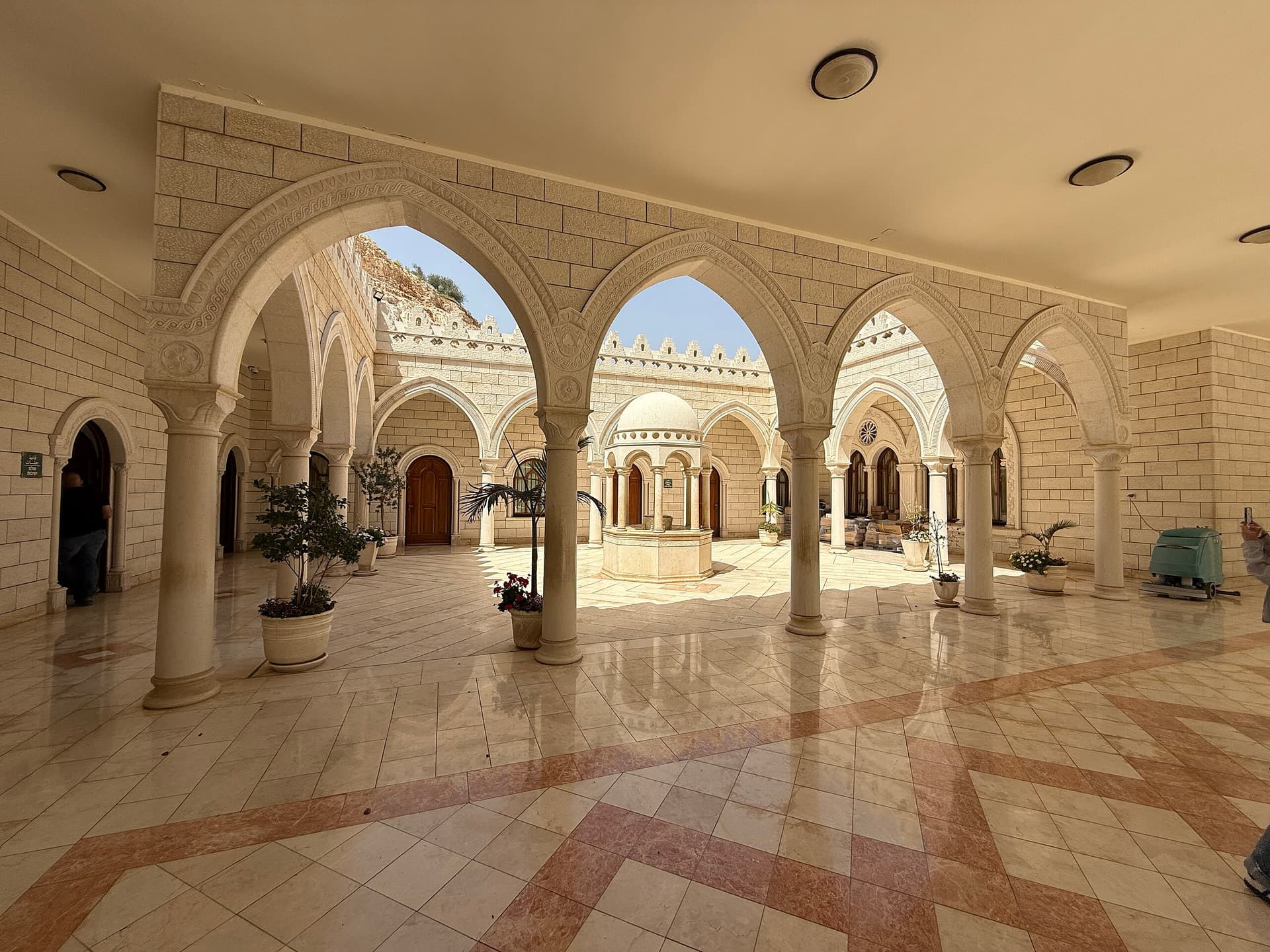
Shrine of Nabi Shuʿayb, near Kfar Zeitim, not far from Tiberias, Israel
Galil Tachton Regional Council, North District, Israel
18.5 km away
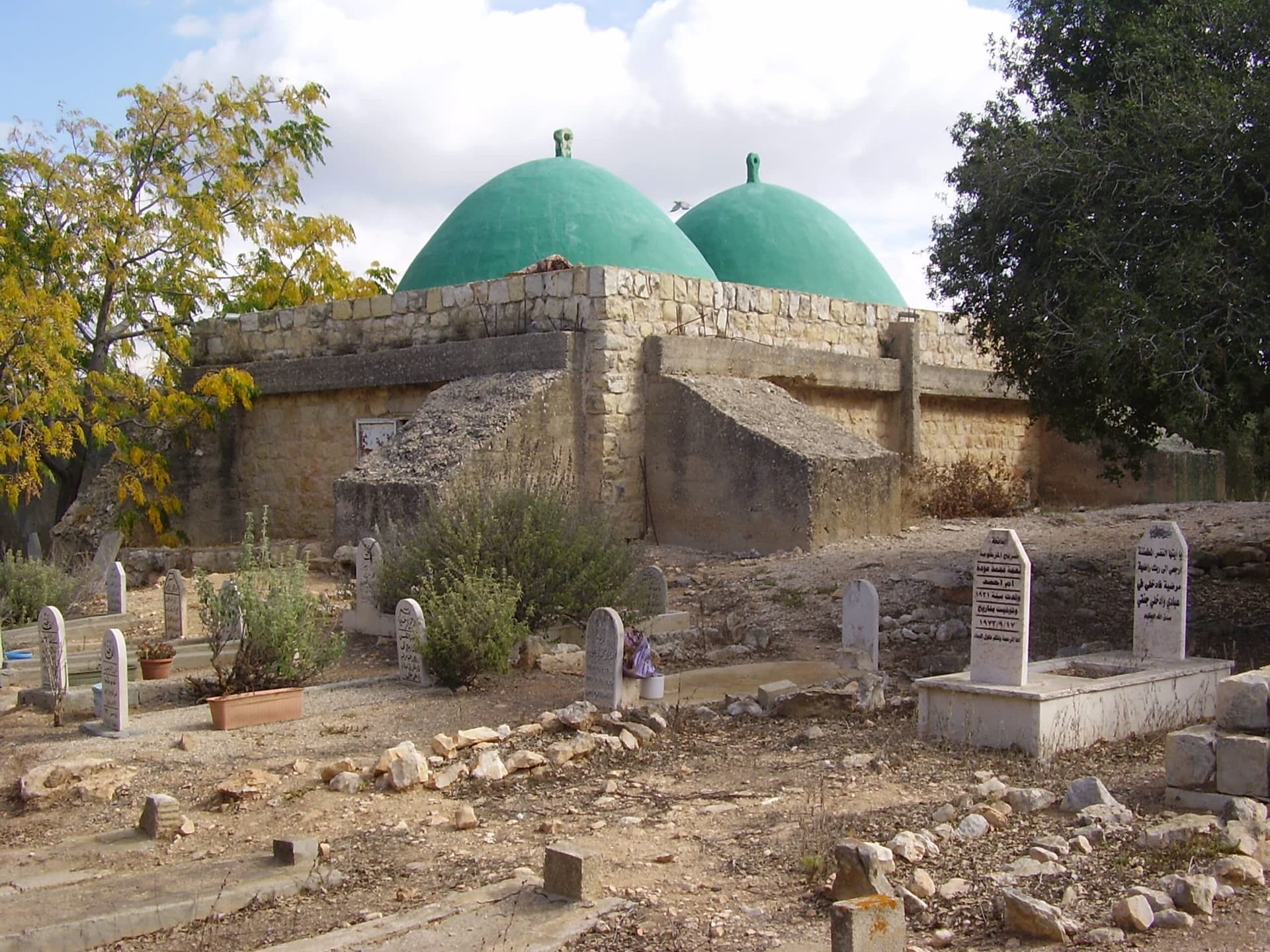
The tomb of Sheikh Abu Al-Hija, Israel
Misgav Regional Council, North District, Israel
26.5 km away
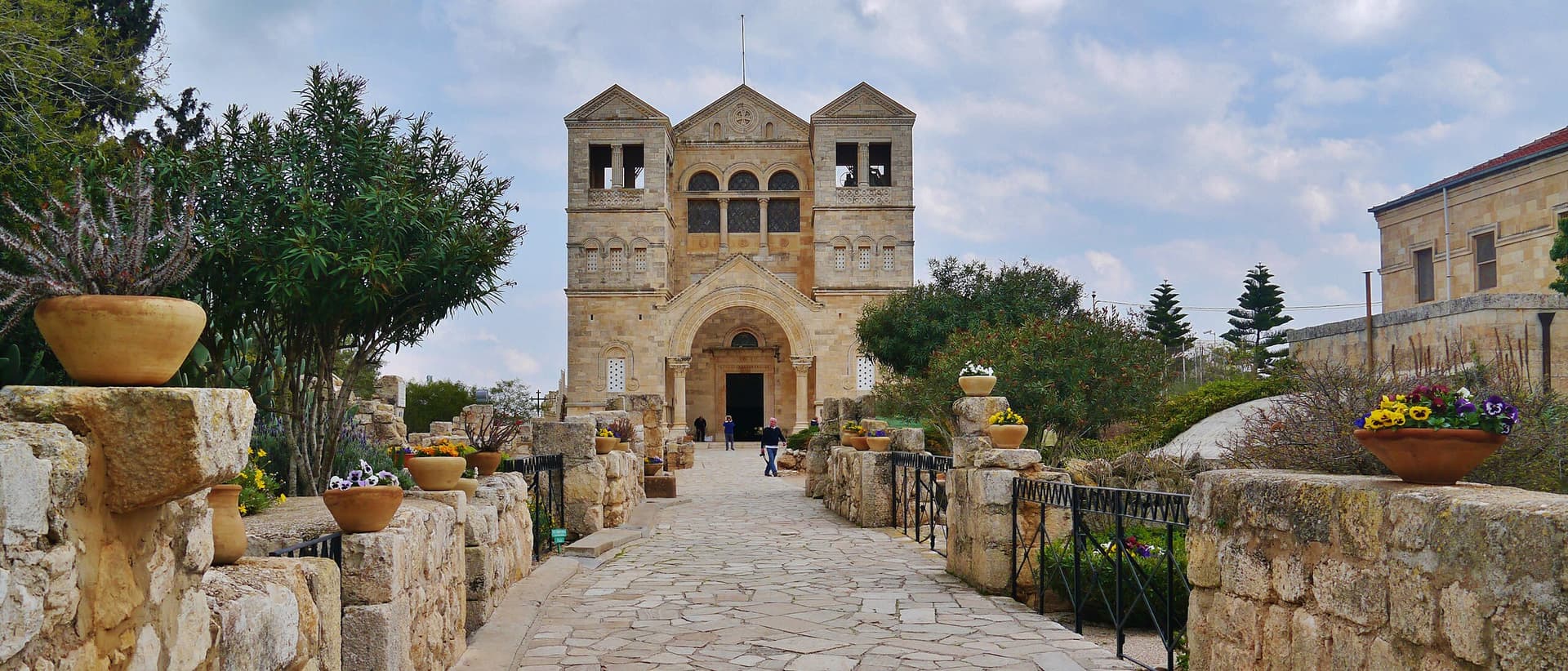
Church of the Transfiguration Mount Tabor
Shibli - Umm el Ghanam, North District, Israel
32.6 km away
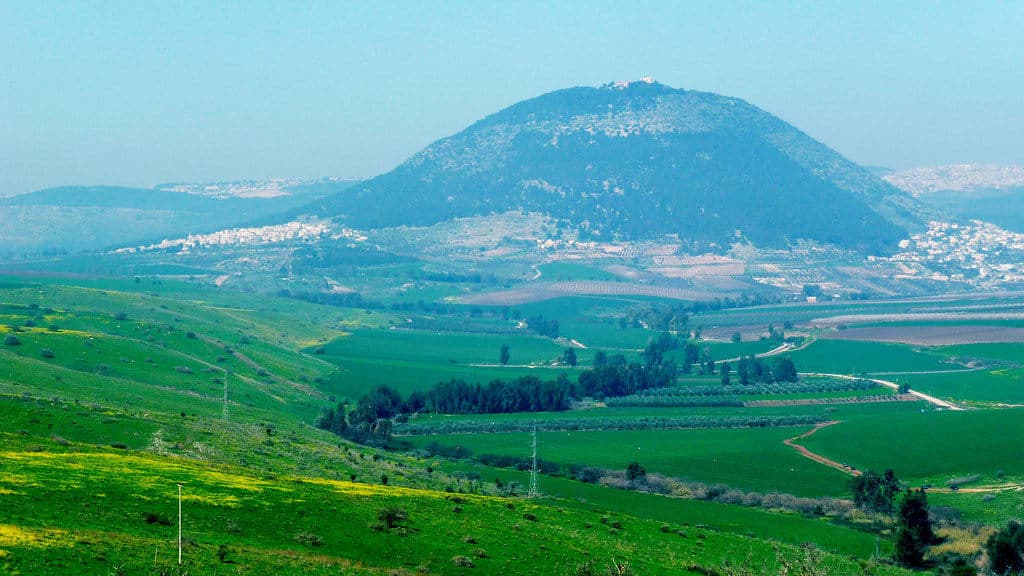
Mt. Tabor
Shibli - Umm el Ghanam, North District, Israel
32.6 km away