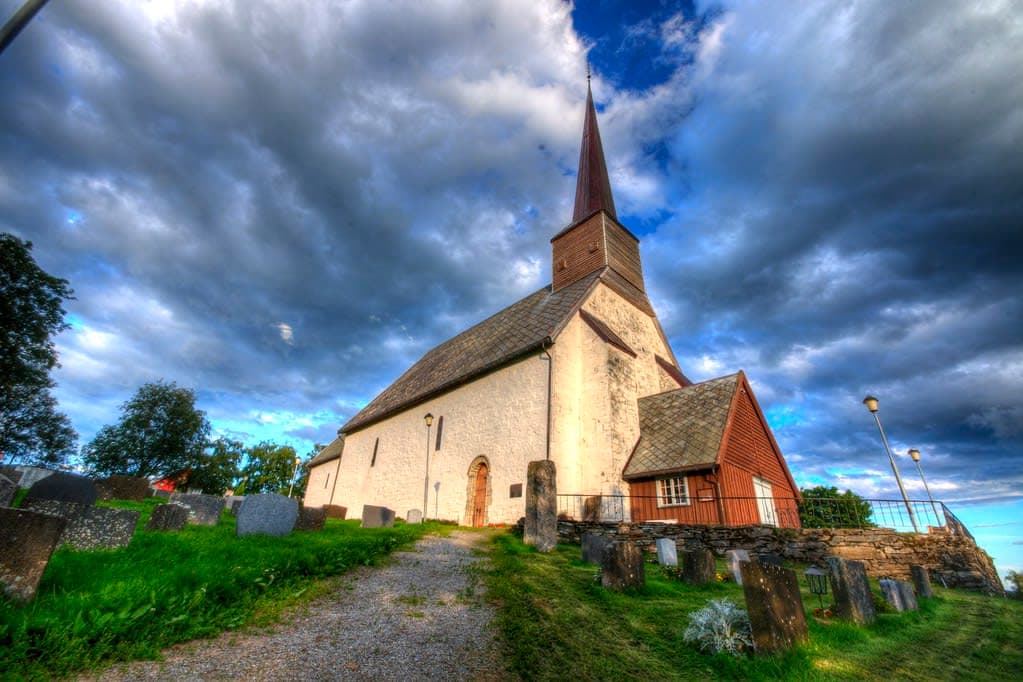
Mære Church Site
Where Norse gods fell and Christian prayers rose on the same Trøndelag hilltop for fifteen centuries
Steinkjer, Trøndelag, Norway
At A Glance
- Coordinates
- 63.9333, 11.4000
- Suggested Duration
- One hour to explore the church, its medieval artworks, the exterior carvings, and the hilltop views from Mærehaugen.
- Access
- Located in the village of Mære, approximately ten kilometres south of Steinkjer town centre in Trøndelag county. Accessible by car via European route E6. The Nordlandsbanen railway line passes nearby, with Steinkjer as the closest major station; local transport or taxi required from there. Coordinates are approximately 63.87 degrees north, 11.38 degrees east. The church sits on the hilltop of Mærehaugen with views over farmland and toward Borgenfjorden.
Pilgrim Tips
- Located in the village of Mære, approximately ten kilometres south of Steinkjer town centre in Trøndelag county. Accessible by car via European route E6. The Nordlandsbanen railway line passes nearby, with Steinkjer as the closest major station; local transport or taxi required from there. Coordinates are approximately 63.87 degrees north, 11.38 degrees east. The church sits on the hilltop of Mærehaugen with views over farmland and toward Borgenfjorden.
- Standard modest attire appropriate for a Scandinavian church. No specific dress code is enforced, but respectful clothing is expected when entering during services. Casual dress is acceptable during general visiting hours.
- Photography is generally permitted inside the church when services are not in progress. Visitors should check for any posted restrictions and refrain from using flash near historic artworks. Exterior photography is unrestricted.
- Mære Church is an active place of worship. Visitors should time their arrival to avoid disrupting services. During services, the church is for congregants rather than tourists. Check locally for service schedules, particularly on Sundays and religious holidays. The church interior contains historic artworks including a thirteenth-century crucifix; refrain from touching or using flash photography near these objects. The archaeological site beneath the floor is not accessible to visitors; the postholes and gullgubber were reburied after excavation.
Overview
Beneath the white-plastered walls of a Romanesque parish church in central Norway, postholes still hold gold offerings to gods that Christianity displaced. Mære Church Site is one of Scandinavia's most striking examples of sacred continuity, a hilltop where blót ceremonies honoured Thor and Freyr for five centuries before King Olav Tryggvason struck the idol from its stand and ordered a church raised in its place. The church that stands today, built around 1150, continues to hold Lutheran services above the archaeology of the old religion.
On a low rise called Mærehaugen, overlooking farmland and the distant glint of Borgenfjorden, two religions have claimed the same ground. The first arrived around AD 500, when Norse communities established a cult site that would become one of Inner Trøndelag's most important ceremonial centres. For nearly five hundred years, chieftains gathered here for blót, the communal sacrificial feasts that bound communities to their gods. Nineteen gullgubber, tiny gold foil figures pressed with images of embracing pairs, were deposited as votive offerings in the structural postholes, tangible evidence of devotion to deities of fertility and order.
The second religion arrived with kings and swords. According to Snorri Sturluson's Heimskringla, King Olav Tryggvason entered the Mære temple around 995 and personally struck the gold-and-silver-decorated idol of Thor from its stand while his men destroyed the remaining god figures. He commanded a church built on the site. The charcoal layer sealing the old postholes aligns with this account of deliberate destruction, though scholars continue to debate the precise nature of what burned.
The stone church that stands today dates to around 1150, its Romanesque granite walls rising over the same ground where the cult structure once stood. It remains an active parish church of the Church of Norway, part of the Stiklestad deanery within the Diocese of Nidaros. Sunday services continue in a building whose foundations rest upon the evidence of an older devotion. This layering is not metaphorical. It is literal, confirmed by Hans-Emil Lidén's 1969 excavation, which found the postholes and gold foils directly beneath the church floor. Mære is the only confirmed case in Norway of a heathen cult structure found under a medieval church.
Context And Lineage
Mære Church Site sits at the intersection of Norse pagan and Christian history in one of Norway's most historically significant regions. The site's documentation in Snorri Sturluson's Heimskringla, combined with the archaeological confirmation provided by Lidén's 1969 excavation, makes it exceptionally well-attested for a site of religious transition. The gullgubber found beneath the church connect Mære to broader Scandinavian networks of ritual practice, while the saga accounts place it at the centre of the political and spiritual struggle that defined Norway's conversion period.
According to Snorri Sturluson's Heimskringla, written in Iceland around 1230 but drawing on earlier sources, the temple at Mære was one of the great ceremonial centres of Trøndelag. In the Saga of Haakon the Good, the Christian-raised king arrives in Trøndelag to find eight chieftains controlling the blót ceremonies for the entire region from Mære. The chieftains confront Haakon and demand his participation in the traditional sacrificial feast, threatening violence if he refuses. The king, unable to impose his faith on the powerful farmers, reluctantly complies.
The decisive episode comes in the Saga of Olav Tryggvason. Around 995, the king enters the Mære temple and finds Thor sitting in his place of honour, decorated with gold and silver. Olav lifts a gold-decorated axe and strikes Thor from his stand. His men destroy all remaining god figures. The king commands the local people to accept baptism and orders a church built on the temple site.
A generation later, King Olav Haraldsson learned that pagan sacrifices were still being performed in the region. In 1021, he sailed to Mære with five ships and three hundred men. He captured the chieftain Olve of Egge, who had led the resistance to Christianity, and had him executed. The confrontation contributed to the tensions that culminated in the Battle of Stiklestad on 29 July 1030, where Olav fell and subsequently became Norway's patron saint.
Archaeological evidence corroborates the saga narratives in broad outline. The postholes beneath the church date the cult structure to around AD 500, the charcoal sealing layer is consistent with destruction by fire, and the gullgubber confirm ritual activity at the site. This convergence of literary and material evidence is unusual in Scandinavian archaeology and gives Mære its particular authority.
The lineage at Mære is one of rupture and replacement rather than gradual evolution. Norse pagan practice at the site, spanning roughly AD 500 to 1000, was actively and violently suppressed by Christian kings. The transition was not peaceful accommodation but forced conversion, carried out at sword-point over several generations. The wooden stave church built in the eleventh century represented the physical assertion of the new religion over the old. The stone church that replaced it around 1150 made that assertion permanent in granite.
Yet the choice to build the church on the same hilltop, over the same ground, represents its own kind of continuity. The site's sacredness was not denied but redirected. The god in the building changed; the conviction that this particular hilltop was a place where the divine could be encountered did not. Today, the Church of Norway maintains the parish, and Lutheran services continue in the same tradition of gathered worship, different in theology but not in the basic human impulse that draws communities to this ground.
Snorri Sturluson
King Olav Tryggvason
King Olav Haraldsson (St. Olav)
Håkon Sigurdsson (Håkon Jarl)
Hans-Emil Lidén
Why This Place Is Sacred
Mære's quality as a thin place derives from something rarer than antiquity or beauty. It is the physical superimposition of two radically different sacred worlds on a single hilltop, where the archaeological evidence of one lies directly beneath the living practice of the other. Fifteen centuries of continuous devotion, shifting in form and theology but never in location, suggest something in this landscape that has drawn human worship regardless of the name given to the divine.
Thin places are often described as locations where the boundary between ordinary experience and something deeper grows permeable. At Mære, the thinness operates on multiple registers simultaneously.
The first is temporal. Standing inside the church, you are positioned directly above postholes that held the structural elements of a pre-Christian cult site dating to around AD 500. The gold foil figures found in those postholes depict embracing pairs, widely interpreted as representations of the god Freyr and the giantess Gerðr, whose union ensured the fertility of the land. Those offerings remain in the soil beneath the church floor. The distance between the communion table and the gullgubber is measured in metres, and in a thousand years of theological transformation.
The second register is narrative. The sagas preserve accounts of confrontation at this exact location. King Haakon the Good, a Christian raised in England, was forced by eight Trøndelag chieftains to participate in blót at Mære under threat of violence. Decades later, King Olav Tryggvason walked into the same temple and brought the old religion crashing down with a gold-decorated axe. These are not abstract histories. They happened here, on this hilltop, in this soil.
The third register is landscape. Mærehaugen commands views over the surrounding farmland and toward Borgenfjorden. The elevation is modest but deliberate, the kind of prominence that communities across cultures have chosen for their most important sacred structures. The site was not incidentally holy. It was chosen, built upon, fought over, destroyed, and rebuilt, always in the same place.
Visitors who know the site's history often describe a sense of layered presence, an awareness that the ground holds more than what the eye can see. The white-plastered church appears calm, even ordinary, from the outside. The knowledge of what lies beneath transforms it.
The earliest purpose of the Mære site was as a Norse cult centre, established around AD 500 during the Migration Period. Archaeological evidence and saga literature together indicate it served as a location for blót ceremonies, communal sacrificial feasts presided over by regional chieftains. According to Snorri Sturluson, eight chieftains controlled the blót at Mære for all of Inner Trøndelag, making it the ceremonial centre of the region. A statue of Thor, decorated with gold and silver, stood within the cult structure. The deposition of gullgubber in postholes suggests votive practice connected to fertility and divine blessing.
The site's evolution traces one of the most dramatic religious transitions in Scandinavian history. From its establishment around AD 500 as a Norse cult centre, it served the old religion for approximately five centuries. The crisis came in stages. In the 960s, King Haakon the Good was forced to participate in blót here, demonstrating the site's continuing importance and the resistance of Trøndelag chieftains to Christianity. Around 995, King Olav Tryggvason destroyed the temple's contents and ordered a church built. In 1021, King Olav Haraldsson arrived with ships and soldiers to suppress lingering pagan practice, executing the chieftain Olve of Egge. A wooden stave church was built in the eleventh century, replaced by the current Romanesque stone church around 1150. The building underwent significant modification in the seventeenth century and comprehensive restoration between 1966 and 1969, when the archaeological excavation beneath the floor revealed the pre-Christian cult structure. Today the church functions as a parish of the Church of Norway while simultaneously serving as a heritage site and destination for those drawn to the archaeology of religious transition.
Traditions And Practice
Mære Church serves as an active parish of the Church of Norway, holding regular Lutheran worship services, baptisms, confirmations, weddings, and funerals. The pre-Christian practices of blót and votive offering that once animated the site ceased over a thousand years ago, known now only through saga literature and archaeological evidence. Visitors during summer can enter the church during open hours and explore the hilltop setting.
The pre-Christian practices at Mære centred on the blót, the communal sacrificial feast that was the primary ritual of Norse religion. According to Snorri Sturluson, the blót at Mære was presided over by eight chieftains who controlled the ceremonies for all of Inner Trøndelag. Farmers gathered for feasting and sacrifice to the gods, particularly Thor, whose gold-and-silver-decorated idol occupied the place of honour in the cult structure. The scale and political significance of these gatherings is evident in the saga account of King Haakon the Good's confrontation with the chieftains, who threatened violence unless the king participated.
The gullgubber found in the postholes represent a different register of practice. These tiny gold foil figures, depicting embracing pairs widely interpreted as the god Freyr and the giantess Gerðr, were deposited as votive offerings, possibly to consecrate the building or to invoke the sacred marriage that ensured fertility and cosmic order. The act of pressing these delicate figures and placing them in the earth speaks to a devotion that was both personal and communal, both material and symbolic. The nineteen gullgubber at Mære connect the site to a broader Scandinavian practice found at elite sites from Sweden to Denmark.
Regular Lutheran church services are held as the parish church for Mære within the Stiklestad deanery of the Diocese of Nidaros. The full cycle of Christian liturgical life continues: Sunday worship, baptisms, confirmations, weddings, and funerals. The church functions as a living centre of community spiritual life, as it has for roughly nine centuries, since the first wooden church was raised on the hilltop.
During the summer season, the church opens to visitors and cultural tourists. Guided tours can be arranged for groups, offering interpretation of both the medieval church and its pre-Christian substrate. The church is also connected to the broader Stiklestad pilgrimage landscape, particularly around St. Olav's Day on 29 July, when the region commemorates the battle that made Olav Haraldsson a saint.
For visitors seeking contemplative engagement, allow the approach to Mærehaugen to serve as preparation. Notice the surrounding farmland, the same landscape that Trøndelag's chieftains surveyed when they gathered for blót. Stand on the hilltop and orient yourself to the views before entering the church.
Inside, spend time with the medieval art, particularly the thirteenth-century crucifix. Consider the hands that made it, working within a few generations of the religious transition. The choir, built first around 1150, occupies the oldest part of the stone structure. Sit here if the church is quiet and let the space speak.
The archaeological site beneath the floor is not visible, but knowing it is there transforms the experience. The postholes, the charcoal, the gold foils, all lie directly below. Some visitors find it meaningful to acknowledge this silently, to hold awareness of both the church above and the cult site below as two expressions of the same human impulse toward the sacred.
Outside, the medieval roof carvings of human, animal, and mythological heads projecting from the walls reward close observation. These figures, carved during the centuries after conversion, may carry echoes of the older imagery that once occupied the site.
Norse Paganism
HistoricalMære was one of Inner Trøndelag's most important pre-Christian cult sites, active from approximately AD 500 to 1000. The site served as the ceremonial centre for the region, where eight chieftains presided over blót ceremonies on behalf of the farming communities. The discovery of nineteen gullgubber in the structural postholes provides material evidence of votive practice, while the saga accounts in Snorri Sturluson's Heimskringla describe a temple housing a gold-and-silver-decorated idol of Thor. The site's prominence in the sagas reflects its real significance in the political and religious landscape of pre-Christian Norway.
Blót, the communal sacrificial feast, was the central practice at Mære. These were major gatherings where farmers and chieftains came together for feasting and sacrifice to the Norse gods. The deposition of gullgubber, tiny gold foil figures depicting embracing pairs interpreted as Freyr and Gerðr, served as votive offerings possibly connected to sacred marriage rituals ensuring fertility and cosmic order. Whether these ceremonies took place within a roofed building or around ceremonial poles remains debated, but the ritual character of the site is not in question.
Lutheran Christianity (Church of Norway)
ActiveMære Church has functioned as a Christian place of worship since the eleventh century, making it one of the oldest continuously active church sites in Trøndelag. The current Romanesque stone church, built around 1150, replaced an earlier wooden stave church and contains significant medieval art including a thirteenth-century crucifix and fifteenth-century choir chairs. The church is part of the Stiklestad deanery within the Diocese of Nidaros and serves as the parish church for Mære local parish. Its connection to the Christianization narratives of Norway's missionary kings gives it historical significance beyond its local pastoral role.
Regular Lutheran worship services, baptisms, confirmations, weddings, and funerals take place throughout the year. The church follows the liturgical calendar of the Church of Norway. During summer, the church opens to visitors and provides cultural tourism programming including guided tours. The site's connection to the Stiklestad pilgrimage landscape adds a dimension of heritage pilgrimage to its ongoing religious function.
Archaeological and Heritage Scholarship
ActiveMære is the only confirmed case in Norway of a heathen cult structure found beneath a medieval church, making it a site of exceptional scholarly importance. Hans-Emil Lidén's 1969 excavation established the archaeological basis for understanding the site's pre-Christian past, and subsequent scholarly debate has refined but not overturned his fundamental finding. The site occupies a central place in academic discussions of Christianization, sacred continuity, and the relationship between saga literature and archaeological evidence.
Ongoing scholarly research, publication, and debate continue to generate new understanding of the site. The 1969 excavation report remains a foundational text. Academic visitors and researchers study the site within broader frameworks of Scandinavian Christianization and ritual landscape analysis. Heritage interpretation at the site and in regional tourism materials presents the archaeological significance alongside the church's religious function.
Experience And Perspectives
Approaching Mære Church, the visitor encounters what appears to be a handsome but unremarkable Norwegian parish church, white-plastered and set on a gentle rise. The power of the site reveals itself through knowledge rather than spectacle. Knowing that the church floor covers postholes containing gold offerings to Norse gods, that Snorri Sturluson described a statue of Thor standing where the altar now stands, that kings destroyed and built and killed on this ground, transforms every surface into a palimpsest.
The drive to Mære passes through the agricultural landscape of Inner Trøndelag, roughly ten kilometres south of Steinkjer. The church sits on Mærehaugen, a low hill that provides views over surrounding farmland and, in the distance, the waters of Borgenfjorden. The setting is pastoral rather than dramatic, which makes the site's history all the more striking in contrast.
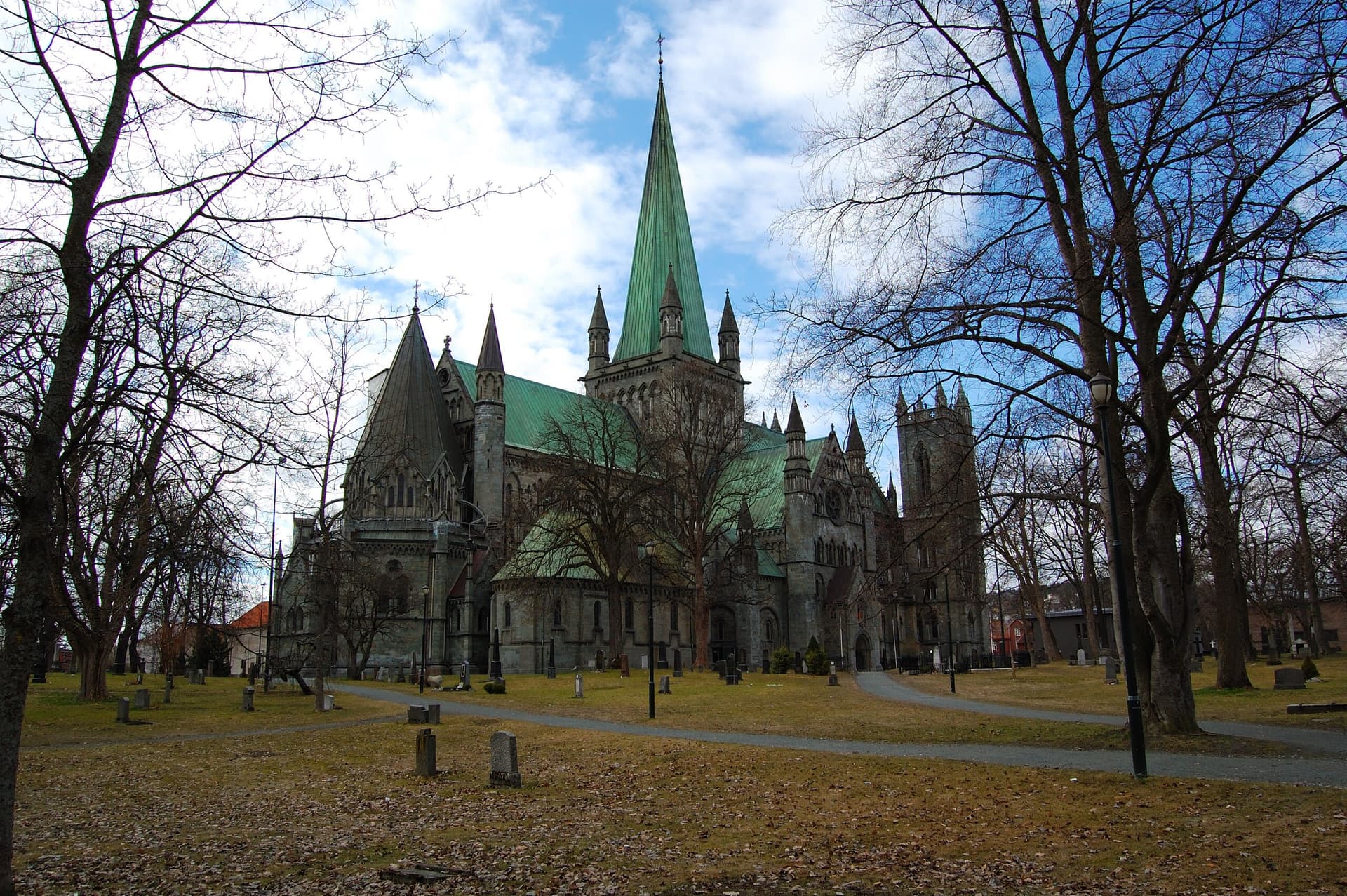
From the outside, the church presents itself as a solid Romanesque granite structure, white-plastered in the Norwegian tradition. Medieval roof carvings project from the walls, heads of humans, beasts, and figures from mythology that hint at the building's deep roots. The tower and nave date to the late twelfth century, though the overall appearance reflects seventeenth-century modifications and the 1966-1969 restoration.
Inside, the church holds significant medieval art, including a thirteenth-century crucifix of Christ and fifteenth-century choir chairs. The space seats approximately 250 to 310 people and retains the proportions of the original Romanesque design in the choir, which was built first around 1150. Light enters through windows restored to their seventeenth-century form. The atmosphere is that of a living church, cared for and actively used.
What the eye cannot see is what gives the site its deeper resonance. Directly beneath the church floor lie the postholes excavated by Hans-Emil Lidén in 1969, containing nineteen gullgubber and sealed by a layer of charcoal that may represent the burning described in the sagas. The archaeological site is not visible to visitors, which paradoxically heightens its effect. You must hold the knowledge in mind, allowing the invisible past to charge the visible present with meaning.
Step outside and stand on Mærehaugen. The farmland spreads in every direction. This is the landscape that Trøndelag's chieftains surveyed when they gathered for blót, the same vista that King Olav Tryggvason saw when he approached the temple with his gold-decorated axe. The hilltop's modest elevation carries an outsized historical weight. Those who visit with awareness of the site's layered past consistently describe a deepened sense of standing at a crossroads, not of roads but of worlds.
Mære Church lies in the village of Mære, approximately ten kilometres south of Steinkjer in Trøndelag county. It is accessible by car via European route E6 and lies near the Nordlandsbanen railway line. The church sits on the hilltop of Mærehaugen, visible from the surrounding roads. Visitors arriving during summer can enter the church during open hours; guided tours can be booked for groups. Those wishing to connect the site with the broader pilgrimage landscape of the region can combine a visit with Stiklestad Church, approximately thirty kilometres northeast, where St. Olav fell in 1030.
Mære Church Site invites engagement from multiple directions, each illuminating a different facet of what happened on this hilltop and what it means. Archaeological evidence, saga literature, and ongoing theological life all converge here without fully resolving into a single story. The site holds its complexity without apology.
There is strong scholarly consensus that Mære was a significant pre-Christian cult site in Inner Trøndelag. The 1969 excavation by Hans-Emil Lidén discovered postholes and nineteen gullgubber beneath the church floor, confirming ritual activity predating Christianity. However, the nature of the cult structure remains debated. Lidén interpreted the postholes as remains of a roofed hof building, a temple in the conventional sense. Olaf Olsen challenged this interpretation, arguing the postholes indicated a site for ceremonial pole worship rather than an enclosed structure. Sæbjørg Walaker Nordeide, reviewing the evidence in 2011, supported the ceremonial pole interpretation, comparing Mære to the similar site at Hove in Åsen.
The dating adds further complexity. The earliest postholes suggest establishment around AD 500 during the Migration Period, while the gullgubber are dated to the Merovingian era, roughly 550 to 800. This span of several centuries indicates multiple phases of use and possible modification of the cult structure over time. The charcoal layer sealing the postholes is consistent with destruction by fire, which aligns with the saga account of Olav Tryggvason's destruction of the temple around 995, though direct dating of the charcoal to that specific event has not been established.
Despite the disagreement about the physical form of the cult structure, scholars agree that Mære represents a rare and significant case of archaeologically confirmed sacred continuity from pagan to Christian times. The convergence of literary and material evidence at the site is exceptional in Norwegian archaeology.
Norse pagan understanding of Mære, as preserved in the sagas, presents the site as one of the great ceremonial centres of Trøndelag. In this framework, the temple housed Thor in his place of honour, decorated with gold and silver, and the blót ceremonies conducted there maintained the relationship between human communities and the gods who sustained them. The chieftains who presided over the blót were performing essential cosmic maintenance, ensuring fertility, prosperity, and the continuation of the ordered world.
From the Christian perspective that superseded it, the destruction of the Thor idol and the raising of a church on the same ground represented the triumph of the true God over false idols. The sagas, though written by Christians, preserve enough of the older understanding to suggest that the transition was understood by both sides as a contest of spiritual powers rather than merely a political act. King Olav Tryggvason's destruction of the idol was, in the saga framing, a demonstration that the Christian God was more powerful than Thor.
The Lutheran tradition that now holds the site understands it as evidence of God's providence working through history, bringing the light of the Gospel to a land that had worshipped in darkness. The church's continuity on the same ground is seen as redemptive rather than merely coincidental.
Some modern Heathen and Asatru practitioners regard Mære as one of the most significant documented Norse sacred sites in Scandinavia. For these practitioners, the archaeological confirmation of a cult structure beneath the church validates their tradition's claims about the historical reality of Norse temple worship. The gullgubber, with their possible depiction of the Freyr-Gerðr sacred marriage, are understood as evidence of fertility cult practices central to pre-Christian Scandinavian religion.
Broader perspectives on sacred landscape continuity observe that Mære exemplifies a pattern found across Europe and beyond, where Christian churches were deliberately built on pre-Christian sacred sites. This pattern raises questions about whether certain locations possess qualities that attract devotion regardless of the theological framework brought to them, whether the sacredness inheres in the place itself rather than in any particular tradition's claim upon it.
Several significant questions about Mære remain unresolved. Whether the pre-Christian structure was a roofed hof building or an open-air ceremonial pole site continues to be debated, with competent scholars on both sides. The exact dates of the cult site's active use span a range of five centuries, and the specific phases of construction, modification, and use within that span are not well understood. The precise iconographic content and ritual significance of all nineteen gullgubber have not been fully published in accessible scholarship. Whether the charcoal layer sealing the postholes represents the deliberate destruction described in the sagas, an accidental fire, or a ritual closing of the site remains an open question. The original extent of the cult site beyond what was found under the church floor is unknown, and the hilltop of Mærehaugen may contain additional undiscovered features. The relationship between the saga accounts, written more than two centuries after the events, and the actual historical sequence continues to be refined by scholars.
Visit Planning
Mære Church is located in the village of Mære, approximately ten kilometres south of Steinkjer in Trøndelag county, Norway. The church is accessible by car via the E6 highway and lies near the Nordlandsbanen railway line. It is open to visitors during the summer season, with guided tours available for groups. The site can be combined with visits to Stiklestad and other significant sites in the Trøndelag pilgrimage landscape.
Located in the village of Mære, approximately ten kilometres south of Steinkjer town centre in Trøndelag county. Accessible by car via European route E6. The Nordlandsbanen railway line passes nearby, with Steinkjer as the closest major station; local transport or taxi required from there. Coordinates are approximately 63.87 degrees north, 11.38 degrees east. The church sits on the hilltop of Mærehaugen with views over farmland and toward Borgenfjorden.
Steinkjer, approximately ten kilometres north, offers hotels, guesthouses, and restaurants. The town serves as a practical base for exploring the Mære and Stiklestad area. During the St. Olav's Day period in late July, accommodation should be booked well in advance due to the festival at Stiklestad.
As an active parish church, Mære requires the standard respect accorded to a place of ongoing worship. Visitors are welcome during summer opening hours and at services, but the church's primary function is as a spiritual home for its congregation. Modest attire, quiet behaviour, and awareness of service schedules are the key considerations.
Mære Church is first and foremost an active Lutheran parish church. Visitors are welcome but should approach with awareness that this is a living place of worship where baptisms, funerals, and weekly services take place. During services, remain at the back or refrain from entering unless you intend to participate in worship.
Between services, the church is open during the summer season for self-guided visits. The interior contains medieval art and furnishings of considerable age and value, including a thirteenth-century crucifix and fifteenth-century choir chairs. These should be observed but not touched. Move through the space quietly and with care.
The hilltop of Mærehaugen and the surrounding area are accessible without restriction. The views over the farmland and toward Borgenfjorden are part of the site's character and can be appreciated at any time.
Standard modest attire appropriate for a Scandinavian church. No specific dress code is enforced, but respectful clothing is expected when entering during services. Casual dress is acceptable during general visiting hours.
Photography is generally permitted inside the church when services are not in progress. Visitors should check for any posted restrictions and refrain from using flash near historic artworks. Exterior photography is unrestricted.
No specific offering traditions for visitors. Standard church collection during services.
The church is open to visitors primarily during the summer season. Services follow the Church of Norway schedule. The archaeological site beneath the church floor is not visible or accessible to visitors. Standard church etiquette applies at all times: quiet behaviour, phones silenced, no disruption of services or private prayer.
Sacred Cluster
Nearby sacred places create the location cluster described in the growth plan. This block is intentionally crawlable and links into the wider regional graph.