Dolmen of Sorginetxe
The House of Witches, where Basque pre-Christian memory meets Neolithic stone
Agurain/Salvatierra, Autonomous Community of the Basque Country, Spain
At A Glance
- Coordinates
- 42.8296, -2.3782
- Suggested Duration
- 30 minutes to one hour for the dolmen itself. Combining with the nearby Aizkomendi dolmen and other Alava megaliths makes a half-day excursion.
- Access
- Located 600 meters from Arrizala village, near Salvatierra/Agurain. From the A-1 motorway, take the Salvatierra exit and follow signs toward the Opakua pass on the A-2128. After 2.5 km, a crossroads indicates Arrizala. The dolmen has its own parking area. Free access at all times. Vitoria-Gasteiz is approximately 30 km west.
Pilgrim Tips
- Located 600 meters from Arrizala village, near Salvatierra/Agurain. From the A-1 motorway, take the Salvatierra exit and follow signs toward the Opakua pass on the A-2128. After 2.5 km, a crossroads indicates Arrizala. The dolmen has its own parking area. Free access at all times. Vitoria-Gasteiz is approximately 30 km west.
- No specific dress code. Comfortable outdoor walking shoes recommended. Weather on the Alava Plain can be changeable; layers and rain protection are advisable.
- Photography is freely permitted. The open setting and quality of light make the site rewarding for photography at various times of day.
- The site is in an open field with no shade or shelter. Weather on the Alava Plain can change quickly. Bring appropriate clothing and water.
Overview
On the Alava Plain where the cultivated lowlands meet the rising slopes of the Entzia range, a dolmen of massive limestone slabs has stood for four and a half millennia. The Basques call it Sorginetxe, the House of Witches, preserving in that name a memory of pre-Christian feminine spiritual power that stretches back far beyond the Christian era. According to legend, the sorginak, priestesses of the goddess Mari, built the monument by carrying its stones on the tips of their spinning wheels.
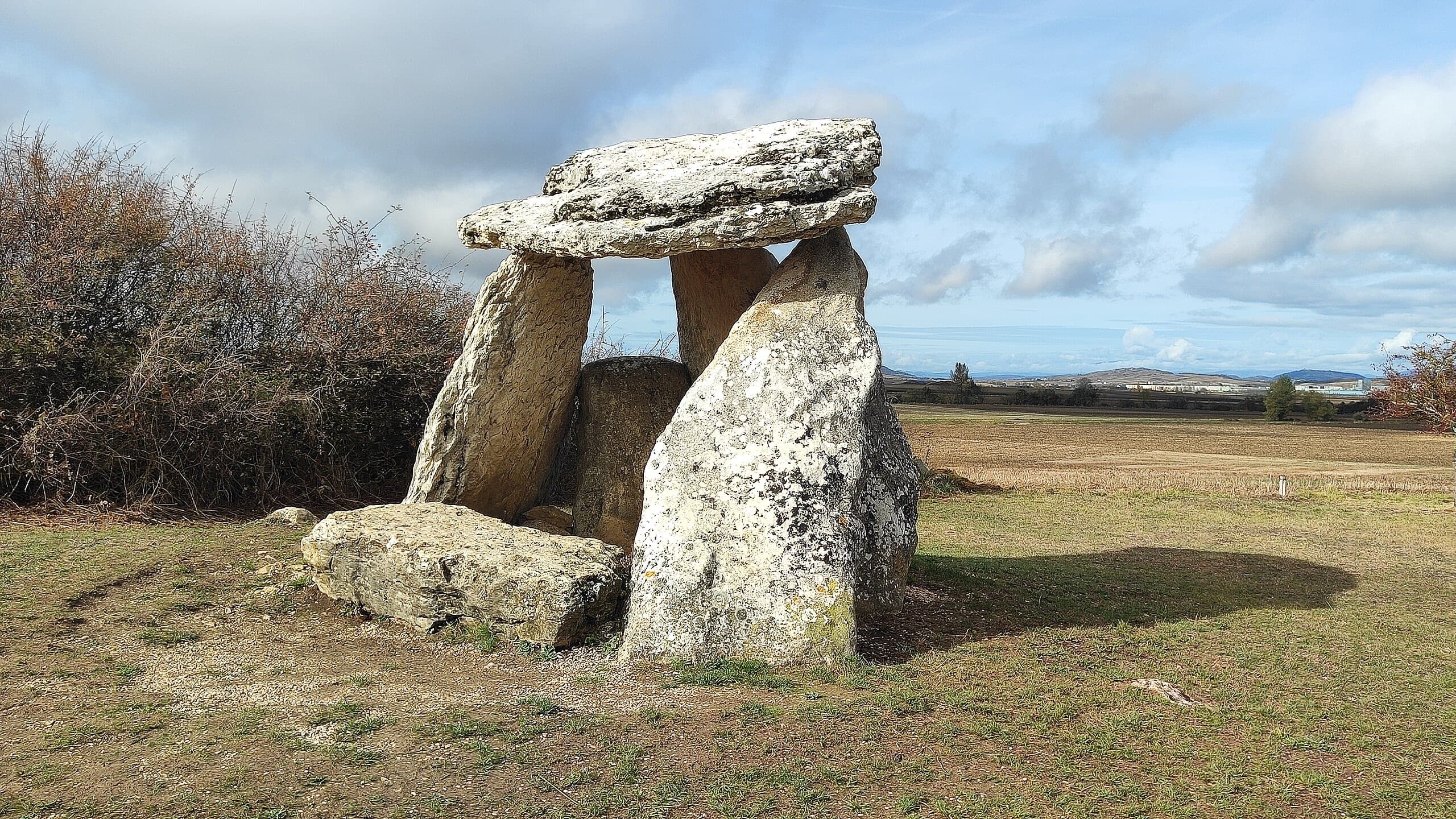
The dolmen stands in an open field near the village of Arrizala, with the Alava Plain stretching north and the Entzia mountains rising to the south. There is no monumental entrance, no interpretive center, no crowd. A few information boards. A parking area. And the stones.
Six or seven massive limestone slabs, depending on how you count the fragmentary pieces, form a polygonal chamber roughly 2.3 meters at its highest point, capped by a single massive stone. The slabs were quarried from Mount Arrigorrista in the Entzia range and transported here approximately 4,500 years ago. Inside the chamber, human remains and a barbed and tanged arrowhead were found during an 1890 excavation, confirming what the architecture suggests: this was a house for the dead.
But the Basques gave it a different name. Sorginetxe, the House of Witches. In Basque pre-Christian religion, the sorginak were not the evil witches of Christian demonology. They were assistants and priestesses of Mari, the supreme deity of Basque mythology, a goddess who dwelt in caves in high mountains, controlled weather, and met her consort Sugaar on Friday nights. The sorginak gathered at sacred sites to practice their knowledge of healing, divination, and the natural world.
The legend tells that the sorginak built this dolmen by carrying its multi-ton limestone slabs down from the mountains balanced on the tips of their spinning wheels. On Friday nights, they gathered here for their akelarre, with a goat seated atop the capstone presiding over the ceremonies. When Christianity arrived and the Inquisition followed, these gatherings were demonized. The sorginak became witches. The akelarre became the sabbath. But the name persisted, encoding in two syllables a memory of feminine spiritual authority that the historical record tried to erase.
Sorginetxe is thus a palimpsest: a Neolithic burial chamber overlaid with Basque pre-Christian mythology, glossed by Christian demonization, and now reclaimed as a symbol of Basque cultural identity and deep-time connection to the land.
Context And Lineage
Sorginetxe was built approximately 2500 BCE by the pastoral communities of the Alava Plain. It was the first dolmen scientifically documented in the Iberian Peninsula (1831) and one of over 100 identified megalithic monuments in the Alava province.
According to Basque folk tradition, the sorginak built the dolmen by carrying its massive limestone slabs down from Mount Atokolarri in the Entzia range, balanced on the tips of their spinning wheels. On Friday nights, the sorginak gathered at the dolmen for their akelarre, with a goat seated atop the capstone presiding over ceremonies of healing, divination, and communion with the forces of the natural world. A second legend tells of a bull's skin filled with gold buried very close to the dolmen, though no one has found it.
These legends are not mere fairy tales. Scholar Andre Pena Grana and others have argued that they preserve, in compressed narrative form, memories of pre-Christian Basque religious practices centered on the goddess Mari and her attendant sorginak, practices that persisted into the historical period and were violently suppressed during the witch trials of the 16th and 17th centuries.
Sorginetxe belongs to the broader Iberian megalithic tradition while carrying a specifically Basque overlay of pre-Christian mythology. It is one of 16 megalithic monuments in Alava declared as Qualified Cultural Properties by the Basque Government, part of a dense megalithic landscape that spans more than 100 identified sites in the province.
Unknown Neolithic/Chalcolithic builders
Pastoral communities who constructed the dolmen as a collective burial site
Julian de Apraiz
Conducted the first excavation in 1890, recovering human remains and an arrowhead
Provincial Council of Alava
Purchased the monument for conservation
Why This Place Is Sacred
Sorginetxe thins the boundary between eras. Standing before it, you encounter simultaneously a Neolithic burial chamber, a pre-Christian ceremonial site, a persecuted tradition, and a living symbol of Basque identity. The layers accumulate on a single set of stones.
The thinness of Sorginetxe is not dramatic. There is no cathedral, no waterfall, no crowd of devotees. The dolmen sits in an open field, unprotected by fence or shelter, exposed to the same wind and rain it has endured for 4,500 years. The simplicity is the point.
Approach the stones and the first thinning is temporal. The slabs were placed here before the pyramids of Egypt, before Stonehenge reached its current form, before any civilization of the historical record existed in this part of the world. The people who quarried these stones from Mount Arrigorrista and transported them across the plain left no texts, no names, no explanation. They left the stones.
The second thinning is mythological. The name Sorginetxe tells you that subsequent generations did not simply inherit these stones as mute relics. They wove them into a living mythology. The sorginak who built the dolmen on their spinning wheels, the goat who presided on the capstone, the Friday-night akelarres: these are not mere fairy tales. They are the compressed residue of a pre-Christian spiritual system in which powerful feminine figures inhabited the landscape and shaped it through supernatural means.
The third thinning is political. When the Inquisition arrived in the Basque Country in the 16th and 17th centuries, the sorginak were recast as agents of the devil. Their gatherings became demonic sabbaths. Their knowledge became witchcraft. Yet the name of this dolmen persisted through the centuries of persecution. Someone kept calling it the House of Witches even when doing so was dangerous. The persistence of the name is itself an act of cultural resistance.
The fourth thinning is geological. The dolmen sits at the boundary between the flat cultivated lowlands and the rising wild uplands, a threshold between the human-shaped landscape and the mountain terrain associated with Mari and the old gods. The Aizkorri-Aratz range visible to the south contains caves traditionally identified as dwelling places of Mari herself.
The quiet of the site amplifies all these layers. Without the mediation of guided tours, museum displays, or interpretive infrastructure, the encounter is direct. You and the stones. Whatever you bring to the encounter is what you will find.
Sorginetxe functioned as a collective burial monument for the pastoral communities of the Llanada Alavesa around 2500 BCE. Human remains and a barbed and tanged arrowhead recovered in the 1890 excavation confirm funerary use.
The site's cultural evolution is remarkable: from Neolithic burial chamber to pre-Christian ceremonial site to persecuted witches' gathering place to protected archaeological monument to symbol of Basque cultural identity. Each era deposited new meaning on the same stones without erasing the earlier layers.
Traditions And Practice
No active religious practices occur at the dolmen. The site functions as a heritage monument within the Basque cultural landscape. The legends of the sorginak and Mari provide a mythological framework for contemplative engagement.
The original Neolithic practices involved collective burial with grave goods. Evidence from the 1890 excavation includes human remains and a barbed and tanged arrowhead. Evidence from the nearby Aizkomendi dolmen of ritual bonfires over burial mounds suggests fire may have been part of the megalithic tradition in this region.
The legendary practices attributed to the sorginak, Friday-night akelarres with a goat presiding, represent either genuine pre-Christian ritual practices preserved in folk memory or later mythological elaboration. The distinction may be less important than the continuity: the site has never been forgotten as a place of ceremony.
Free public visitation with information boards provides historical and cultural context. The dolmen is part of regional megalithic heritage routes connecting it with other dolmens in Alava. Cultural tourism programs organized by the Basque Government and local municipalities promote the site as part of the region's deep heritage.
Visit in the late afternoon when the Entzia mountains cast long shadows across the plain and the quality of light on the stones shifts toward gold. Bring knowledge of the Moura legends and the figure of Mari. Stand beside the stones and consider the layers of meaning deposited here across four and a half millennia: the dead, the sorginak, the goat on the capstone, the gold that turns to coal. The silence of the field is not emptiness but accumulated significance.
Neolithic-Chalcolithic Funerary Tradition
HistoricalSorginetxe was a collective burial monument used by pastoral communities around 2500 BCE. It is part of a dense megalithic landscape: more than 100 megaliths have been identified in the Alava province. The construction required organized communal effort and implies beliefs about death and ancestral veneration linked to the land.
Collective burial with grave goods including arrowheads. Construction of polygonal stone chambers from large limestone slabs quarried from the nearby Entzia range.
Basque Pre-Christian Tradition (Sorginak and Mari)
HistoricalThe name Sorginetxe preserves folk memory of pre-Christian Basque religion. The sorginak were assistants of the goddess Mari, the supreme feminine deity of Basque mythology. The legend that the sorginak built the dolmen attributes the monument's creation to supernatural feminine power, inverting the Christian narrative that cast these figures as evil.
According to legend, Friday-night akelarre gatherings at the dolmen. These accounts blend mythological narrative with possible memories of pre-Christian ritual practices that were suppressed during the witch trials of the 16th-17th centuries.
Experience And Perspectives
The experience of Sorginetxe is one of simplicity and solitude. The dolmen stands in an open field with mountains behind it, unmediated by infrastructure, offering a direct encounter with ancient stone and deep cultural memory.
From Salvatierra, drive south toward the Opakua pass on the A-2128. After approximately 2.5 kilometers, a crossroads indicates Arrizala. Follow the sign. A small parking area appears beside the road, and the dolmen is visible in the adjacent field.
Walk to the stones. The approach takes only a few minutes across level ground. The dolmen emerges from its surroundings with the directness of all megalithic monuments: no context is needed, no preparation is required. The stones are present.
Stand close enough to appreciate the scale. The slabs are not colossal by the standards of European megaliths, but they are substantial: the capstone alone weighs several tons, and the chamber walls reach 2.3 meters. The construction is polygonal, with interlocking slabs creating a roughly enclosed space. The absence of a roof or covering tumulus means the interior is open to the sky, though originally the chamber was enclosed and buried beneath an earthen mound.
Look south toward the Entzia range. Mount Arrigorrista, from which the limestone slabs were quarried, is visible on the horizon. The effort of quarrying and transporting these stones across the plain, 4,500 years ago without metal tools or wheeled transport, becomes tangible when you can see both the source and the destination.
Now consider the legends. On this spot, according to Basque folk tradition, the sorginak gathered on Friday nights. A goat sat atop the capstone. The ceremonies that took place here, whether real or mythological, were expressions of a spiritual system older than any historical religion in the region. The wind that crosses the plain, the silence of the field, the weight of the stones: these are the raw materials of the experience.
If time permits, drive 10 kilometers west to the Dolmen of Aizkomendi, the first dolmen identified in the Iberian Peninsula in 1831. The two monuments together provide a sense of the dense megalithic landscape that once characterized this plain.
The dolmen is 600 meters from Arrizala village, with its own parking area. No facilities at the site. The nearby town of Salvatierra/Agurain offers restaurants and services. Vitoria-Gasteiz is approximately 30 km west.
Sorginetxe invites interpretation through archaeology, Basque mythology, the history of witch persecution, and contemporary cultural identity politics. The convergence of these frameworks on a single set of stones makes the site richer than its modest scale might suggest.
Archaeologists classify Sorginetxe as a Late Neolithic or Chalcolithic polygonal dolmen dating to approximately 2500 BCE. The 1890 excavation confirmed funerary use. The monument is one of over 100 identified megaliths in Alava, reflecting a dense prehistoric settlement pattern linked to pastoral economy. The limestone slabs were quarried from Mount Arrigorrista in the Entzia range.
In Basque oral tradition, the dolmen is the creation and gathering place of the sorginak, priestesses who served the goddess Mari. The name preserves a pre-Christian cosmology in which powerful feminine figures inhabited the landscape and could reshape it through supernatural means. For Basque cultural nationalists, the site represents the depth of Basque presence in the land, predating all other cultures of the peninsula.
Practitioners of neo-paganism and earth-based spirituality see Sorginetxe as a surviving link to pre-Christian European goddess worship. The association with Mari, a chthonic feminine deity who dwells in caves and controls weather, is read as evidence of an indigenous European goddess religion that survived in the Basque Country longer than anywhere else in Western Europe.
The identity of the builders and their relationship to the historical Basques remains unknown. Were the builders ancestors of today's Basque-speaking population? How and when did the dolmen acquire its association with witchcraft and the goddess Mari? Is the folk legend a continuous memory reaching back to the monument's original ritual function, or a later attribution?
Visit Planning
Sorginetxe is freely accessible year-round near the village of Arrizala in the Alava province of the Basque Country. No admission fee, no set hours. Vitoria-Gasteiz is approximately 30 km west.
Located 600 meters from Arrizala village, near Salvatierra/Agurain. From the A-1 motorway, take the Salvatierra exit and follow signs toward the Opakua pass on the A-2128. After 2.5 km, a crossroads indicates Arrizala. The dolmen has its own parking area. Free access at all times. Vitoria-Gasteiz is approximately 30 km west.
Salvatierra/Agurain offers basic accommodation. Vitoria-Gasteiz, 30 km west, provides a full range of hotels and restaurants.
Sorginetxe is a protected archaeological monument. Do not climb on or touch the stones. Leave nothing behind. Respect the surrounding agricultural land.
The dolmen's openness and accessibility make respectful behavior especially important. There are no barriers, no guards, no entry system. The monument trusts its visitors.
Do not climb on the stones. The weight of visitors accelerates weathering and can cause structural damage to a 4,500-year-old monument. Do not chip, scratch, or mark the stones. Do not remove any material from the site or the surrounding field.
The agricultural land surrounding the dolmen is privately owned. Stay on the path to the monument and do not disturb crops or livestock. Leave no trace of your visit.
No specific dress code. Comfortable outdoor walking shoes recommended. Weather on the Alava Plain can be changeable; layers and rain protection are advisable.
Photography is freely permitted. The open setting and quality of light make the site rewarding for photography at various times of day.
No offerings should be left at the site. This is a protected archaeological monument.
Do not climb on or touch the stones. Do not remove any material. Respect the surrounding agricultural land.
Sacred Cluster
Nearby sacred places create the location cluster described in the growth plan. This block is intentionally crawlable and links into the wider regional graph.