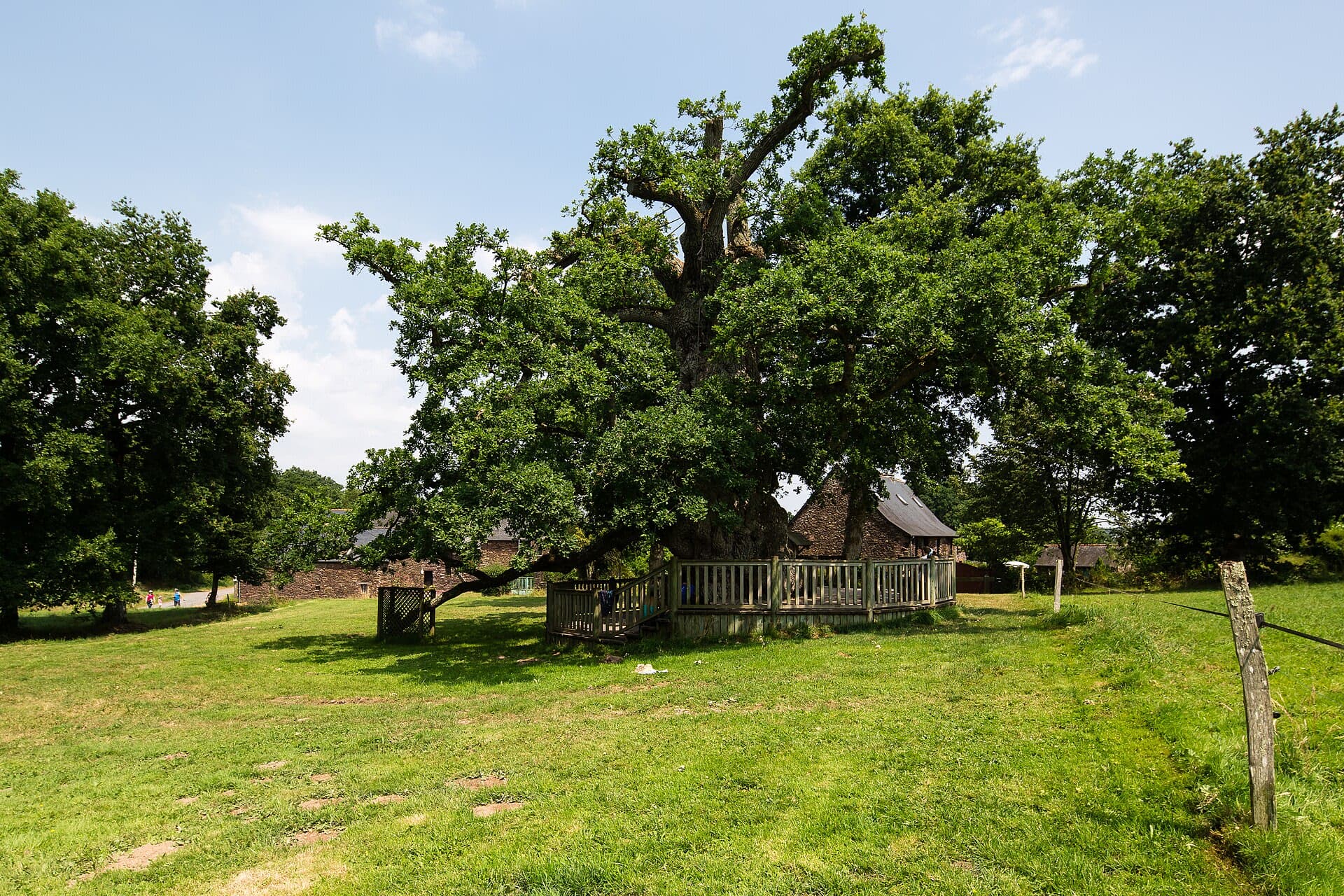
Chêne à Guillotin
The thousand-year oak where a miraculous spider saved a priest, and seekers still come for healing
Concoret, Bretagne, France
At A Glance
- Coordinates
- 48.0169, -2.1675
- Suggested Duration
- Thirty minutes to an hour allows time for contemplation and healing practice. Many visitors combine the tree with other Broceliande sites, extending the overall visit.
- Access
- Located on the D141 between Concoret and Trehorenteuc, near the hamlet of La Rue-Eon, at the edge of Broceliande forest. Parking is available nearby. The tree is visible from the road and accessible without significant hiking.
Pilgrim Tips
- Located on the D141 between Concoret and Trehorenteuc, near the hamlet of La Rue-Eon, at the edge of Broceliande forest. Parking is available nearby. The tree is visible from the road and accessible without significant hiking.
- Outdoor walking attire is appropriate. No formal requirements apply.
- Permitted. Be mindful of others who may be engaged in healing practice or meditation. Consider whether your documentation serves encounter or replaces it.
- Do not enter the hollow trunk. The tree's interior is fragile; entry damages both the tree and its ability to serve future visitors. Do not remove bark, wood, or other material as souvenirs. The tree's healing capacity depends on its wholeness; removing pieces takes from everyone. Be skeptical of practitioners who claim to offer 'authentic rituals' for money. The tree gives freely to those who approach sincerely; no intermediary is necessary.
Overview
On the edge of Broceliande forest stands an oak that may be a thousand years old, its hollow trunk blackened with age yet still alive. During the French Revolution, tradition holds, a refractory priest hid inside while Our Lady of Paimpont transformed into a spider, weaving a web across the entrance that convinced pursuing soldiers no one could have entered. Today, people suffering from illness come to touch the ancient bark, seeking to borrow the tree's enduring vigor.
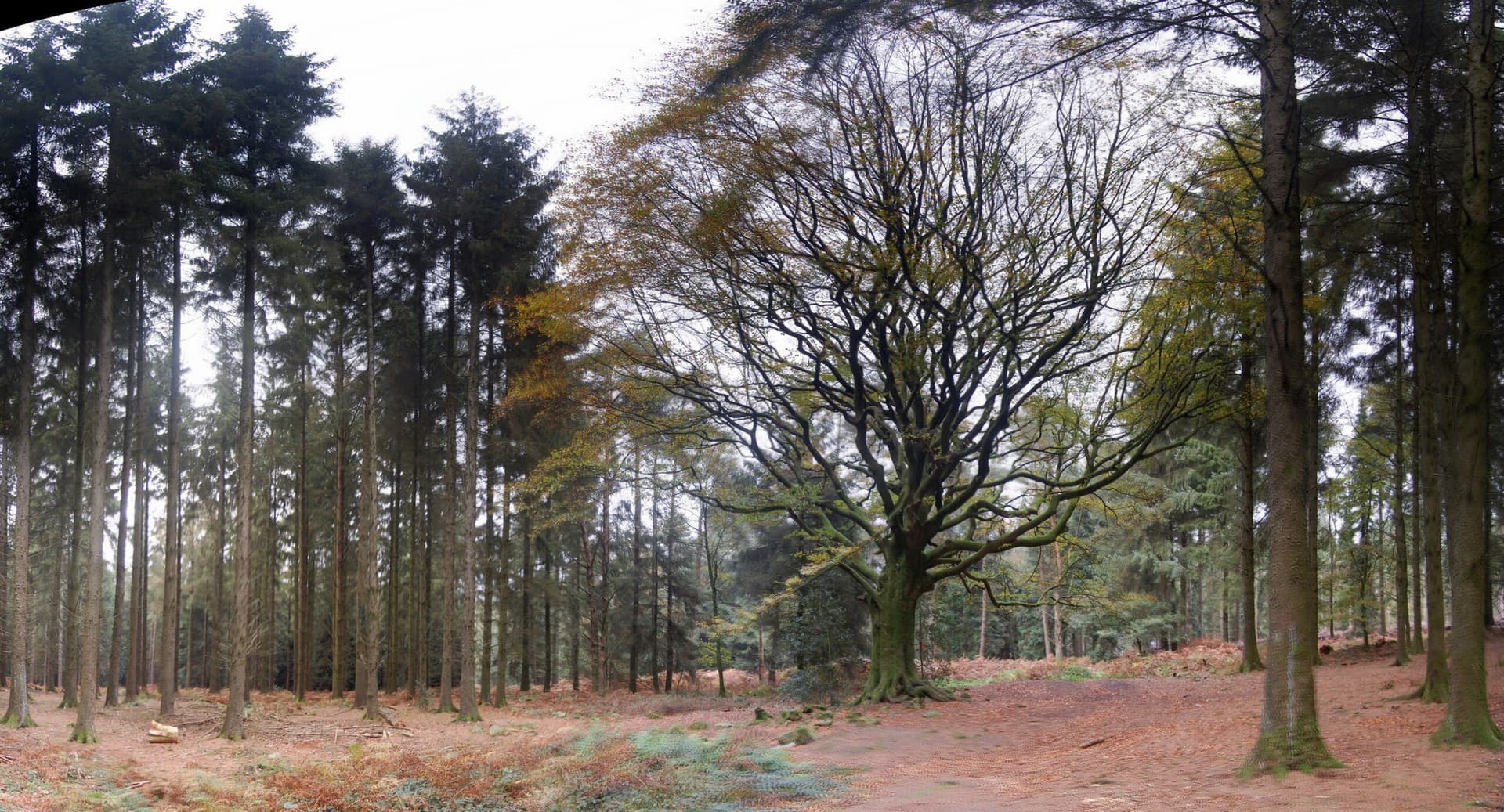
The Chene a Guillotin has witnessed centuries that would fell lesser trees. Estimated between five hundred and a thousand years old, it stands as the ancestor of Broceliande's remarkable trees—a pedunculate oak whose massive girth (nearly ten meters in circumference) and hollow, blackened trunk embody persistence through apparent decay.
The tree's most famous story dates to the Revolution. A refractory priest—refusing to swear loyalty to the Civil Constitution of the Clergy—fled Republican soldiers and hid in the hollow trunk. In two hours, a spider wove a web across the entrance, convincing the soldiers that no one could have entered recently. They passed by; the priest escaped. The miracle was attributed to Our Lady of Paimpont, who transformed herself into a spider to protect the faithful.
But the tree held significance before the Revolution. An earlier tradition connects it to Eon de l'Etoile, a twelfth-century heretic who led outlaws through Broceliande before his capture. The tree was once called the Chene des Rues-Eon after him. Layer upon layer of meaning has accumulated in this wood.
Today, the tree draws visitors seeking healing. The tradition holds that those suffering from illness or weakness may borrow vigor from the ancient bark. Whether through touch, prayer, or simple presence, something in this tree—its extreme age, its miraculous protection, its persistence through what should have killed it—offers what seekers need. Protected as a Remarkable Tree of France since 2017, the oak continues what it has always done: endure, witness, and give.
Context And Lineage
The Chene a Guillotin is a pedunculate oak estimated between five hundred and a thousand years old, standing at the edge of Broceliande forest. Its most famous legend involves the miraculous protection of a refractory priest during the French Revolution. The tree continues to serve as a site of healing pilgrimage.
The tree's most celebrated story dates to the Revolutionary Terror of the 1790s. A refractory priest—accounts name either Pierre-Paul Guillotin or Joachim Masson—refused to swear the oath required by the Civil Constitution of the Clergy. Pursued by Republican soldiers, he fled into the forest and hid in the hollow trunk of an ancient oak.
With the soldiers approaching, a spider appeared and began to weave. In merely two hours—an impossibly short time for such work—the spider completed a web across the entrance. When the soldiers arrived, they saw the unbroken web and concluded that no one could have entered recently. They moved on; the priest escaped.
The miracle was attributed to Our Lady of Paimpont, who transformed herself into a spider to protect the faithful. The story links the tree to Marian devotion and positions it as a site where divine intervention occurred within living memory (at the time the story circulated).
An earlier tradition associates the tree with Eon de l'Etoile, a twelfth-century heretic who led a band of outlaws through Broceliande before his capture and imprisonment in Reims. This layer connects the tree to older currents of resistance and refuge.
The tree carries no institutional lineage; no religious order maintains it, no church claims it. Its sacred significance developed through folk tradition and continues through informal practice.
The 2017 designation as Remarkable Tree of France represents official recognition, but the tree's significance to visitors depends not on certification but on centuries of accumulated meaning—miraculous protection, healing touch, simple persistence through time.
Our Lady of Paimpont
divine
The Virgin Mary under her local Breton title. According to tradition, she transformed into a spider to save a faithful priest from Revolutionary soldiers. The miracle demonstrates her protection of those who remain loyal to the Church.
Eon de l'Etoile
historical
A twelfth-century heretic who claimed divine authority and led a band of outlaws terrorizing Brittany before his capture. The tree's earlier name, Chene des Rues-Eon, connects it to his legend.
Why This Place Is Sacred
The Chene a Guillotin marks a threshold where extreme age meets miraculous legend meets ongoing healing practice. The tree has persisted for half a millennium or more, surviving what should have killed it repeatedly. This persistence becomes itself the message: whatever keeps this tree alive may be available to those who approach with need.
The tree's thinness derives from three converging factors: extreme antiquity, miraculous narrative, and active healing tradition.
First, age. Whether five hundred or a thousand years old—estimates vary—the oak has witnessed more than any human visitor can comprehend. Generations of seekers, pilgrims, outlaws, and soldiers have passed beneath its branches. The tree predates the modern state, the Reformation, the printing press. Standing before it confronts visitors with time scales that dwarf ordinary concern. This confrontation itself can be therapeutic; personal troubles shrink against such backdrop.
Second, miracle. The spider web story transforms the tree from impressive specimen to site of divine intervention. Our Lady of Paimpont, taking spider form to protect a faithful priest, chose this tree as the instrument of salvation. The hollow trunk that might seem merely decay becomes womb, sanctuary, place where heaven reaches into hiding places. The story charges the tree with sacred significance beyond its botanical status.
Third, healing. The tradition of receiving vigor from the bark represents active, ongoing practice. Visitors do not merely observe; they participate. The touch that seeks healing acknowledges both personal need and trust in the tree's capacity to give. This transaction—request and response, need and provision—structures encounter with the sacred in concrete, embodied form.
The hollow trunk intensifies all three factors. The tree is literally empty at its center yet continues to live. What remains is bark, cambium, the thin living layer beneath the surface. The tree teaches that life can persist at the margins, that hollowness need not mean death, that vigor can flow through what appears depleted.
The tree had no original human purpose; it grew naturally from an acorn sometime between the tenth and fifteenth centuries. Its sacred significance developed through accumulated legend and practice rather than intentional construction. The hollow trunk, which became so central to its meaning, resulted from natural decay rather than design.
The tree's history unfolds through shifting names and meanings. Before the Revolution, it was called the Chene des Rues-Eon, associated with the twelfth-century heretic Eon de l'Etoile. After the miraculous protection of the priest in 1797, new stories attached to it. In 1979, Alain Cottin coined the current name, Chene a Guillotin, linking it to one of the legendary priests.
The twentieth century brought both conservation and threat. In 2000, the commune purchased the tree; the Office National des Forets conducted consolidation work. A walkway was installed around the trunk for protection, then removed in 2019 when it was found to be damaging the tree. In 2017, the association A.R.B.R.E.S. granted the tree Remarkable Tree of France status—official recognition of what visitors had long known.
Throughout these changes, the healing tradition has continued. People suffering from illness, weakness, or distress come to touch the bark, seeking what the tree offers. This practice appears to predate the Revolution, to have survived it, and to continue without interruption into the present.
Traditions And Practice
The central practice at the Chene a Guillotin is healing touch: visitors approach the tree seeking to receive vigor and energy from its ancient bark. The tree also draws visitors for meditation, photography, and contemplation of its legendary history.
The healing touch tradition predates documentation but appears to have continued for generations. Those suffering from illness, weakness, or distress come to the tree seeking its vigor. The practice assumes that the tree's remarkable persistence—surviving centuries, surviving interior decay, surviving all that should have killed it—represents a quality that can be shared.
Exact forms of the traditional practice are not well documented. Touching the bark appears central. Some accounts mention specific prayers or intentions; others describe the touch alone as sufficient.
Contemporary visitors engage the healing tradition in varied ways. Some approach with specific illness or difficulty, holding clear intention as they touch the bark. Others come seeking general vitality or peace without naming particular needs. Still others touch the tree as gesture of connection, without expectation of concrete benefit.
Meditation at the tree is common. Visitors sit beneath the branches, allowing the tree's age and presence to work on awareness. The practice requires nothing beyond presence and attention.
Photography has become a significant contemporary practice. The tree's appearance—massive trunk, hollow interior, twisted branches—invites documentation. Some visitors find that photographing becomes a way of not seeing; others use it as meditation in its own right, attending closely through the lens.
If you come seeking healing, approach with honesty about your need. The tree has no use for pretense; it has seen too much. Name your difficulty—to yourself, if not aloud—and let the naming be part of the asking.
When you touch the bark, touch slowly. Let your palm rest rather than pressing. The tree is old; gentleness is appropriate.
If you do not come for healing, come for witness. The tree has stood here while empires rose and fell, while belief systems transformed, while the very composition of the air changed. What survives such duration deserves attention.
After your visit, notice the days that follow. Some report that the tree's effects are not immediate but gradual—shifts in energy, mood, or circumstance that emerge over time.
Healing Tree Veneration
ActiveThe Chene a Guillotin is understood as a healing tree whose remarkable persistence—surviving centuries and interior decay—represents vigor that can be shared with those who approach sincerely. People suffering from illness, weakness, or distress come to touch the bark, seeking to borrow the tree's enduring vitality.
Touching the bark while holding intention for healing; meditation at the tree; return visits to maintain connection. The practice is informal, without institutional structure or required ritual.
Miraculous Spider Web Legend
HistoricalDuring the French Revolution, tradition holds that a refractory priest hid in the hollow trunk while Our Lady of Paimpont transformed into a spider, weaving a web that convinced pursuing soldiers no one could have entered. The miracle positions the tree as a site of divine intervention and Marian protection.
The story is told and retold; visitors come partly to see the site where the miracle occurred. The hollow trunk that sheltered the priest remains, though entry is no longer permitted.
Eon de l'Etoile Legend
HistoricalBefore the Revolutionary legend, the tree was known as Chene des Rues-Eon, associated with a twelfth-century heretic who led outlaws through Broceliande. This earlier tradition connects the tree to currents of resistance and refuge predating the priest's escape.
Historical memory rather than active practice. The legend adds depth to the tree's significance as place of hiding and protection.
Experience And Perspectives
Visitors to the Chene a Guillotin commonly report awe at the tree's age and size, followed by more subtle experiences of connection, peace, and for some, a sense of received energy or healing. The act of touching the bark while holding intention creates participatory engagement rather than mere observation.
The first response is almost always scale. The trunk's girth—9.65 meters—exceeds expectation. Photographs do not prepare visitors for standing before something so massive, so old, so persistently alive despite apparent decay. The hollow interior, blackened with centuries, invites contemplation: how does life continue when the center is gone?
After the initial impact settles, subtler experiences emerge. Many visitors describe a quality of presence—the tree seems to attend to those who attend to it. Whether this reflects psychological projection or something more, the effect is consistent enough across accounts to take seriously.
Those who touch the bark with intention to receive healing report varying experiences. Some describe a sense of warmth or tingling. Others feel nothing physical but notice shifts in mood, clarity, or energy levels in the hours following. Still others experience the touch as gesture rather than transaction—a way of asking that requires no specific answer.
The hollow interior, though no longer accessible, exerts imaginative pull. Visitors imagine the priest hiding there, the spider weaving, the soldiers passing by. The cavity becomes stage for sacred drama, a space where impossible things happened. Even without entering, visitors participate in the story by standing where it unfolded.
Time at the tree often produces unexpected emotion. Some report tears without clear cause. Others describe a sense of reassurance—as if the tree's survival through centuries of difficulty demonstrates that survival is possible, that endurance yields something worth having. The tree teaches not through words but through being.
Approach the tree with awareness of what you bring. If you carry illness, exhaustion, or distress, acknowledge these as you approach. The tree does not require you to hide your need.
When you arrive, take time before touching. Let the scale register. Let the centuries compress into the moment of encounter. The tree has time; so should you.
When you touch the bark, hold your intention clearly. You need not formulate it in words; the need itself is enough. Let the touch be both request and reception—asking and, simultaneously, trusting that something is given.
After touching, remain. Do not immediately photograph, check your phone, or move on. Give the encounter time to settle. What the tree offers may not be apparent until later.
If you feel nothing, accept that too. Not every visit produces dramatic experience. The tree has been here for centuries; it will be here when you return.
The Chene a Guillotin invites multiple readings: botanical specimen, miraculous site, healing resource. Each perspective captures something genuine; none captures everything. The tree exceeds its interpretations, as trees tend to do.
Dendrochronological estimates place the tree's age between five hundred and a thousand years, making it one of the oldest trees in Brittany. Its girth of 9.65 meters and hollow trunk are documented in regional inventories. The tree is a pedunculate oak (Quercus robur), a species common to Atlantic Europe.
The Revolutionary-era legend was popularized in 1979 when Alain Cottin coined the current name. The story's historical accuracy cannot be verified; it belongs to folk tradition rather than documented history. The earlier association with Eon de l'Etoile also lacks historical confirmation.
From a conservation perspective, the tree's recognition as Remarkable Tree of France in 2017 provides official protection and acknowledges its cultural significance.
Catholic tradition understands the miraculous spider web as divine intervention through Marian agency. Our Lady of Paimpont, protecting a priest who remained faithful during persecution, demonstrated that the holy can work through any creature, even a spider. The story positions the tree as a site of grace.
The healing tradition holds that the tree's exceptional vigor—surviving centuries, surviving interior decay—represents a quality available to those who approach sincerely. This view does not require specific theological commitment; it merely observes that something persists here and that touching it may help.
Some visitors understand the tree as a conscious being with awareness and will. In this view, the tree chooses what to give and to whom. The relationship is not mechanical but personal—a meeting between intelligences of radically different kinds.
Others see the tree as a node on earth energy lines, a natural accumulator of forces that flow through the landscape. The hollow trunk, in this interpretation, concentrates and amplifies these energies.
Still others approach the tree as symbol rather than agent—a representation of endurance, persistence, and life's capacity to continue through apparent destruction. The healing that results from encounter may be psychological rather than mystical, but no less real for that.
The tree's exact age remains uncertain. Whether the Revolutionary-era legend describes actual events cannot be determined. The identity of the priest—Guillotin, Masson, or someone else—is unclear.
What produces the healing that visitors report is also unknown. Whether the tree possesses some quality science has not measured, whether accumulated human intention creates a placebo effect, whether the encounter with extreme age produces psychological shifts that register as physical improvement—these questions remain open.
Visit Planning
The Chene a Guillotin stands at the edge of Broceliande forest, accessible from the road between Concoret and Trehorenteuc. Parking is available nearby. The tree can be visited year-round and is typically combined with visits to other legendary sites in the forest.
Located on the D141 between Concoret and Trehorenteuc, near the hamlet of La Rue-Eon, at the edge of Broceliande forest. Parking is available nearby. The tree is visible from the road and accessible without significant hiking.
Hotels and guesthouses are available in Paimpont and Concoret. No accommodation exists at the tree itself.
The Chene a Guillotin requires respectful treatment befitting both a protected natural monument and an active site of healing practice. Visitors should avoid damaging the tree, respect others' spiritual experiences, and maintain a contemplative atmosphere.
The tree is protected as a Remarkable Tree of France, carrying both ecological and cultural significance. Behavior at the site should reflect this dual protection.
Do not enter the hollow trunk. Though it once sheltered a priest, entry now damages the fragile interior. Stay outside; the touch that matters happens at the bark.
Do not remove any part of the tree. Bark, wood fragments, fallen leaves—leave all of it. The tree's integrity depends on visitors taking nothing.
Respect others' experiences. The tree draws visitors seeking healing; they may be in vulnerable states. Loud conversation, intrusive photography, or dismissive behavior diminishes their experience.
Maintain contemplative atmosphere. The tree has stood for centuries in something like silence. Honor that quality.
Stay on designated paths. Conservation measures exist to protect both the tree and the surrounding area.
Outdoor walking attire is appropriate. No formal requirements apply.
Permitted. Be mindful of others who may be engaged in healing practice or meditation. Consider whether your documentation serves encounter or replaces it.
No established offering tradition exists at this tree. If moved to leave something, ensure it is biodegradable. Natural materials are appropriate; manufactured items are not.
Do not enter the hollow trunk. Do not remove bark or other material. Do not damage the tree in any way. The walkway that once surrounded the trunk has been removed; stay on current designated paths.
Sacred Cluster
Nearby sacred places create the location cluster described in the growth plan. This block is intentionally crawlable and links into the wider regional graph.