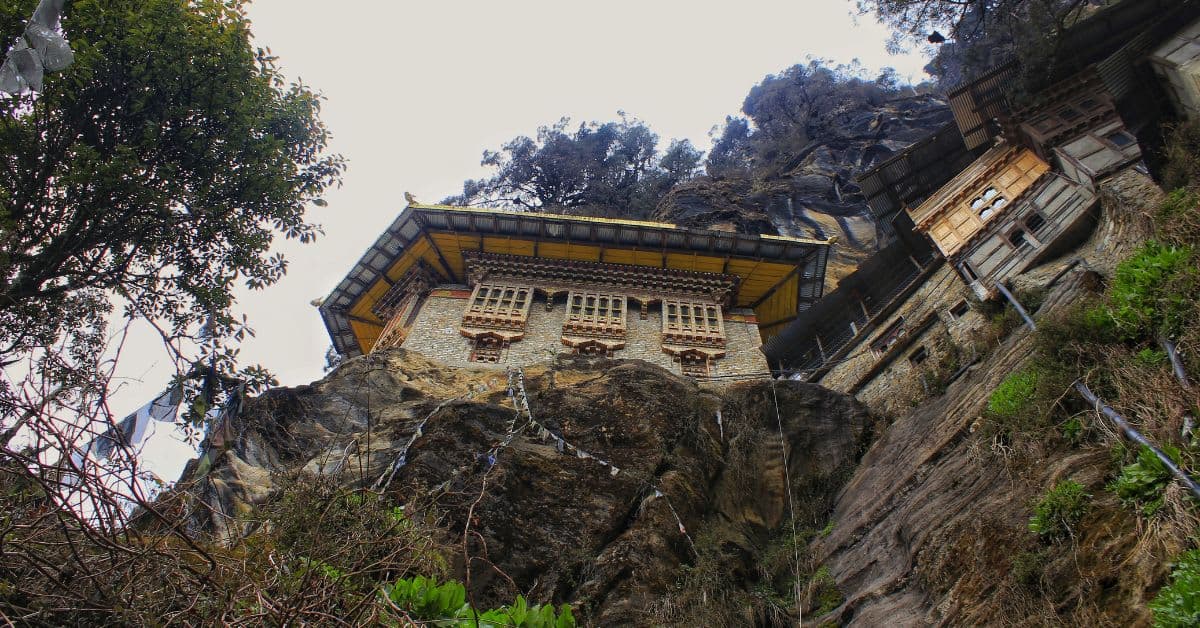
Baylangdra Temple
Where Guru Rinpoche subdued the bull spirit and planted his staff, which grows still as a cypress
Lengbi, Wangdue Phodrang District, Bhutan
At A Glance
- Coordinates
- 27.6238, 90.0365
- Suggested Duration
- A full day is the minimum for a meaningful visit, including travel from Wangdue Phodrang and the round-trip hike. One to two days is recommended to allow adequate time for the site itself and for contemplation. Extended retreat stays at Drupdra Ozer Samtenling center are possible for those with established practice and appropriate arrangements.
- Access
- From Wangdue Phodrang town, drive through and take the left dirt road toward Chuzomsa. Allow approximately one hour on rough roads through the Sha villages' ravines to reach the road's end. From there, the hike to the sacred site takes approximately ninety minutes. The trail passes through forest with crystal-clear streams, past the Zhabja Lhakhang temple where Guru Rinpoche's footprint can be viewed, through caves, and along beautiful forest scenery. Two temples mark the trailhead area: the upper meditation retreat and the lower Yoser Namseling Lhakhang. The hike is moderately strenuous, with a steep climb up the cliffside in the final approach. Good physical fitness is recommended. Sturdy hiking shoes with good ankle support and traction are essential. Bring sufficient water, though streams along the trail can provide refills.
Pilgrim Tips
- From Wangdue Phodrang town, drive through and take the left dirt road toward Chuzomsa. Allow approximately one hour on rough roads through the Sha villages' ravines to reach the road's end. From there, the hike to the sacred site takes approximately ninety minutes. The trail passes through forest with crystal-clear streams, past the Zhabja Lhakhang temple where Guru Rinpoche's footprint can be viewed, through caves, and along beautiful forest scenery. Two temples mark the trailhead area: the upper meditation retreat and the lower Yoser Namseling Lhakhang. The hike is moderately strenuous, with a steep climb up the cliffside in the final approach. Good physical fitness is recommended. Sturdy hiking shoes with good ankle support and traction are essential. Bring sufficient water, though streams along the trail can provide refills.
- Dress modestly, with shoulders and knees covered. This applies to all genders. The hike requires comfortable walking shoes with good traction, but have clean socks or indoor shoes for the temple. Practical hiking attire is appropriate for the trail, but carry a shawl or light covering to add modesty when you arrive at the sacred site.
- Photography inside the temple requires explicit permission and should be approached with great sensitivity. Ask before photographing monks, statues, or ritual objects. Exterior photography is generally permitted, but consider whether each photograph is truly necessary. The impulse to document can interfere with the direct experience that is the real gift of pilgrimage. When you do photograph, do so quietly and without disrupting others.
- Baylangdra is a site of active practice and devotion, not a cultural museum. The resident practitioners and local community hold this place as genuinely sacred. Approach accordingly. Do not treat sacred objects as photography props. If you photograph, do so with reverence and only after asking permission where appropriate. Extended retreat at the center requires proper preparation and ideally a connection to the Buddhist tradition. This is not the place for casual experimentation with intensive practice. Those interested in retreat should make appropriate inquiries and ensure they have the foundation such practice requires. The prophecy that seeing Baylangdra liberates from samsara should not be taken as license for spiritual tourism. The tradition understands such statements within a framework of sincere practice and proper motivation. The benefit promised is real, but it operates through genuine encounter, not mere consumption.
Overview
Hidden for centuries and revealed only in 1988, Baylangdra is one of the three holiest pilgrimage sites of Guru Rinpoche in Bhutan. Here, where the master meditated for seven days and concealed more than sixty spiritual treasures, pilgrims encounter a site remarkably undefiled by time. The sacred cypress that grew from his walking staff still stands, watched over by practitioners who continue the ancient retreat traditions.
Some places remain hidden until the world is ready to receive them. Baylangdra waited twelve hundred years.
In the 8th century, Guru Rinpoche came to this cliff above Wangdue Phodrang and encountered the fierce spirit Lhatsen Langdra, who attacked him in the form of a red bull. The master subdued the spirit, appointed him guardian of the site, and then planted his walking staff in the ground. If the treasures I conceal here are destined to be found, he declared, let this staff grow into a tree. The staff became a cypress. It stands today, the fork where he placed his palm still visible at its crown.
For centuries, only prophecy remembered this place. Then in 1988, Kyabje Chatral Rinpoche, guided by the treasure revealer tradition, formally revealed the site to the world. He called it one of the most sacred places in Bhutan, noting that its centuries of concealment had kept it remarkably pure. Those who visit now, he taught, possess more merit than all the generations who passed before its discovery.
The climb takes ninety minutes from the road's end, through forest and past streams of startling clarity. At the top, a two-storied temple houses a ten-foot statue of Guru Rinpoche in his wrathful form as Guru Ugyen Dorji Gur. Behind it rises the cliff where he meditated, bearing still the impression of his footprint and seal. In Nyingma understanding, merely seeing this place liberates from cyclic existence. Visiting purifies all defilements. Practicing here brings realization. Making offerings fulfills aspirations across all lifetimes.
The prophecy does not require belief. But the cypress still grows, and pilgrims still climb, and something in this hidden valley continues to receive those who come.
Context And Lineage
Baylangdra's history spans twelve centuries, from Guru Rinpoche's 8th-century meditation and concealment of spiritual treasures, through blessings by great masters including Longchenpa and Pema Lingpa, to its formal revelation in 1988 by Kyabje Chatral Rinpoche. The site represents a living thread in Tibetan Buddhism's treasure revelation tradition, with its temple constructed in 2000 and its retreat center actively serving practitioners today.
In the 8th century, when Guru Rinpoche traveled through the Himalayan kingdoms establishing Buddhism against the resistance of local spirits, he came to a cliff above what is now Wangdue Phodrang. Here dwelt Lhatsen Langdra, a powerful spirit who had long claimed the territory.
The spirit, seeing the Buddhist master approach, transformed into a ferocious red bull and attacked. He performed miracles intended to disturb Guru Rinpoche's concentration and drive him away. But the master was unmoved. He manifested as Pejung Dorji Gurden, a wrathful protector form, and with his reldri sword cut the bull into pieces. Overcome by pain and the master's superior power, Lhatsen Langdra submitted.
Guru Rinpoche did not destroy the spirit but transformed him. He bound him by oath to protect the dharma and serve practitioners who would come to this place. The former attacker became Genyen Langdrakpa, guardian of the cliff that would forever bear his name: Beyul Langdra, the Hidden Treasure of the Bull Cliff.
Before departing, Guru Rinpoche wished to know whether the spiritual treasures he planned to conceal here would ever be discovered. He planted his walking staff in the ground and made a declaration: if the treasures are destined to be found, let this staff grow into a tree. Immediately, the staff put forth branches and leaves, becoming a fresh cypress. Satisfied with this sign, the master entered deep meditation in a nearby cave for seven days. At the end of this period, he concealed approximately sixty terma in various forms and departed in a rainbow.
The lineage of Baylangdra is the lineage of the Nyingma school itself, stretching from Guru Rinpoche through an unbroken succession of masters who recognized and maintained the site's significance. Longchenpa's 1356 visit placed the site within the intellectual and contemplative traditions he synthesized. The tertons Dorje Lingpa, Pema Lingpa, and Sherab Mebar each added their blessing. Chatral Rinpoche's 1988 revelation brought the site into its current phase of accessibility.
The temple constructed by Lungten Tulku in 2000 houses the tradition's presence in physical form. The retreat center Drupdra Ozer Samtenling continues to serve practitioners who undertake extended practice in the manner of Guru Rinpoche's original seven-day meditation. The local community of Bay Chiwog maintains the annual Tsenden Tsechu festival. This is not a lineage of texts alone but of living practice, the transmission passed from teacher to student and from generation to generation in the community that holds this place sacred.
Guru Rinpoche (Padmasambhava)
founder
The 8th-century master who brought Buddhism to the Himalayas, subduing local spirits and establishing the tradition. At Baylangdra, he manifested as Guru Ugyen Dorji Gur to subdue the bull spirit, then planted his staff and concealed more than sixty spiritual treasures.
Longchen Rabjampa (Longchenpa)
historical
One of the greatest philosophers and meditation masters of Tibetan Buddhism, who visited and blessed the site in 1356. His son Tersay Drakpo Ozer also visited. Longchenpa's influence helped establish the site's significance within the treasure revelation tradition.
Dorje Lingpa
historical
A 14th-century treasure revealer who visited Baylangdra and experienced a vision of Guru Rinpoche manifested as an eight-year-old boy, emanating from a rainbow on the cliff face. His visit confirmed the site's spiritual potency.
Pema Lingpa
historical
Bhutan's most celebrated treasure revealer, born in the 15th century. He blessed and consecrated Baylangdra, adding his spiritual imprint to the lineage of masters connected to this site.
Kyabje Chatral Rinpoche
historical
One of the most revered Buddhist masters of the 20th century and a treasure revealer in his own right. In 1988, he formally revealed and confirmed Baylangdra's identity as a major sacred site. In 2000, he appointed Lungten Tulku to construct the temple.
Genyen Langdrakpa
deity
The guardian deity of Baylangdra, originally the fierce spirit Lhatsen Langdra who attacked Guru Rinpoche as a red bull. After his submission, he was transformed into the protector of the site, guarding its treasures and practitioners.
Why This Place Is Sacred
Baylangdra's sanctity flows from multiple converging factors: Guru Rinpoche's seven-day meditation and victory over the local spirit, the concealment of more than sixty spiritual treasures awaiting discovery, the miraculous cypress tree as living proof of prophecy, and centuries of intentional hiddenness that preserved the site's purity. In Tibetan Buddhist understanding, this is a beyul, a sacred hidden valley where the boundary between worlds grows thin.
The Tibetan Buddhist tradition recognizes certain places as beyul, hidden valleys blessed by Padmasambhava as refuges where spiritual practice becomes especially potent. These are not merely remote locations but points where ordinary geography opens into something larger. Baylangdra is counted among the most sacred of such places in Bhutan, standing alongside Paro Taktsang and Singye Dzong as the three holiest Nye, or power places, of Guru Rinpoche.
The site's thinness begins with its founding event. When Guru Rinpoche arrived in the 8th century, the local spirit Lhatsen Langdra transformed into a ferocious red bull and attacked him with supernatural displays. The master responded by manifesting as Pejung Dorji Gurden, his wrathful protector form, and subdued the spirit utterly. The former adversary became the site's guardian, Genyen Langdrakpa, his fierce energy now channeled toward protecting practitioners rather than disturbing them.
After this victory, Guru Rinpoche remained in meditation for seven days. During this period, he concealed approximately sixty terma, spiritual treasures encoded in various forms and destined to be discovered by future treasure revealers when the time was right. The walking staff planted to test whether these treasures would ever emerge became the sacred cypress that marks the site today. The tree itself is both witness and confirmation: the prophecy continues to unfold.
The site's late discovery amplifies its power in traditional understanding. Chatral Rinpoche emphasized that twelve centuries of hiddenness meant Baylangdra remained undefiled, its sacred charge undiluted by the accumulation of worldly disturbance that affects more accessible holy places. When practitioners circumambulate the cypress tree today, when they offer prostrations before Guru Rinpoche's footprint pressed into living rock, they encounter a potency that has been, in some sense, waiting for them.
Contemporary visitors, whether or not they hold the traditional cosmology, consistently describe an unusual quality to this place. The hike itself functions as preparation, the forest and streams and physical effort stripping away the mental clutter of ordinary life. What remains at the top is harder to name. Some call it peace. Some call it presence. The tradition has more specific language: this is where the veil between samsara and liberation grows thin enough to see through.
In Guru Rinpoche's intention, Baylangdra was established as a place of future discovery, a hidden storehouse of spiritual treasures sealed until the world would need them. The concealment was strategic: certain teachings and transmissions require specific conditions to be received properly. By embedding them in a beyul and leaving prophecy as their key, Guru Rinpoche ensured that the treasures would emerge precisely when and how they were needed, revealed by tertons born with the karmic connection to unlock them.
For most of its history, Baylangdra existed primarily in prophecy and the awareness of spiritually realized masters. Longchen Rabjampa, one of the greatest philosophers of Tibetan Buddhism, visited and blessed the site in 1356. The treasure revealer Dorje Lingpa came in the 14th century and had a vision of Guru Rinpoche as an eight-year-old boy emanating from a rainbow on the cliff face. Pema Lingpa, the most celebrated terton of Bhutan, also blessed and consecrated the site. Each of these figures recognized the place's significance while it remained hidden from the wider world.
The formal revelation came in 1988 when Lungten Tulku approached Kyabje Chatral Rinpoche about the site. Chatral Rinpoche, one of the most revered Buddhist masters of the 20th century and a terton himself, confirmed the site's identity and importance. In 2000, he appointed Lungten Tulku to construct the temple that now stands there. The retreat center Drupdra Ozer Samtenling was established to support practitioners who wished to undertake extended practice in this charged location.
Today, Baylangdra receives a growing stream of pilgrims, though it remains far less visited than better-known sites like Taktsang. The annual Tsenden Tsechu festival, celebrating Guru Rinpoche's planting of his staff, brings the 35 households of Bay Chiwog together around the cypress tree in an unbroken continuation of devotion. The site is neither archaeological ruin nor museum: it is a living pilgrimage destination where the tradition that founded it continues to practice.
Traditions And Practice
Baylangdra supports both established Buddhist practices, including meditation retreat, circumambulation, prostrations, and offerings, and the annual Tsenden Tsechu festival celebrating Guru Rinpoche's planting of the sacred cypress. Visitors may participate in circumambulation and temple offerings while more intensive retreat practice is available through the on-site center.
The foundational practice at Baylangdra is the seven-day retreat modeled on Guru Rinpoche's original meditation. Practitioners withdraw from ordinary activity to focus entirely on contemplative practice, following the master's example in this charged environment. The retreat center Drupdra Ozer Samtenling was established specifically to support this practice.
Circumambulation of the sacred cypress tree follows the ancient pattern of walking meditation around a holy object. The prayer wheels surrounding the tree allow practitioners to set dharmic activity in motion with each step. This practice is understood to accumulate merit and purify obscurations, but its deeper function is the transformation of ordinary walking into contemplative practice.
Prostrations before the temple and before Guru Rinpoche's footprint and seal on the cliff are physical expressions of devotion that simultaneously work on the practitioner's mind. The body's humility before the sacred reflects and reinforces the attitude that allows teaching to be received.
The viewing of sacred objects, particularly the rock impressions left by Guru Rinpoche, constitutes a practice in itself. In Nyingma understanding, seeing such objects creates a karmic connection that ripens into spiritual benefit. Guru Rinpoche's own prophecy promises that merely seeing Baylangdra liberates from cyclic existence.
Daily temple practices continue under the care of resident practitioners. Visitors may observe these practices and offer butter lamps, incense, or khatags, the ceremonial scarves that express devotion and respect.
The annual Tsenden Tsechu festival on the fifteenth day of the eighth Bhutanese month brings the entire community of Bay Chiwog together. All 35 households gather in the flat area around the cypress tree to commemorate Guru Rinpoche's planting of his staff. The community circumambulates the prayer wheels, and sponsorship rotates annually among community members. This festival represents the intersection of formal Buddhist practice with local community celebration.
Extended retreats at Drupdra Ozer Samtenling allow serious practitioners to undertake sustained practice in this powerful environment. The retreat center operates according to traditional protocols, offering support for practitioners while maintaining the contemplative atmosphere essential to the work.
For those seeking meaningful engagement with Baylangdra, several approaches merit consideration.
Begin with the hike itself as practice. Walk in silence if possible, or at least in a mode of attention that treats the journey as preparation rather than obstacle. Let the forest and streams work on you.
Upon arrival at the cypress tree, spend time simply being present with it before engaging in any formal practice. This tree has grown from Guru Rinpoche's walking staff for twelve centuries. It has something to teach about patience and about the slow unfolding of prophecy.
Circumambulate the tree and prayer wheels with intention. Each step can be an offering. Each turn of a wheel sets merit in motion. The practice is simple, but simplicity is not the same as superficiality.
Inside the temple, sit before the statue of Guru Ugyen Dorji Gur and let his wrathful gaze meet you. This is not anger but fierce compassion, the energy that cuts through obstacles. If it unsettles you, stay with that feeling.
At the cliff, standing before the footprint and seal, let yourself receive whatever arises. You have come a long way, both today and through whatever journey brought you to seek out such places. This is a moment of arrival. Honor it.
If time and circumstances permit, consider participating in the Tsenden Tsechu festival, held annually in September or October. The opportunity to join the local community in their celebration offers a dimension of connection that solitary pilgrimage cannot provide.
Nyingma Buddhism
ActiveBaylangdra stands as one of the three holiest Nye, or sacred power places, of Guru Rinpoche in Bhutan, alongside Paro Taktsang and Singye Dzong. The site represents a beyul, a sacred hidden valley blessed by Padmasambhava where spiritual practice becomes especially potent. Here Guru Rinpoche meditated for seven days, subdued the local spirit who became its guardian, and concealed more than sixty terma, spiritual treasures that will be revealed when the time is right. The sacred cypress growing from his walking staff stands as living proof of prophecy. The site's late discovery in 1988 preserved its purity through centuries of intentional hiddenness. According to Guru Rinpoche's prophecy recorded in the tradition, merely seeing Baylangdra liberates from cyclic existence, visiting purifies all defilements, practicing here brings spiritual fulfillment and realization, and making offerings fulfills aspirations across all lifetimes.
Traditional practices at Baylangdra include extended meditation retreat in the manner of Guru Rinpoche's original seven-day practice, circumambulation of the sacred cypress tree and prayer wheels, prostrations and offerings at the temple, receiving blessings from Guru Rinpoche's footprint and seal imprinted on the rock, and participation in the annual Tsenden Tsechu festival. The retreat center Drupdra Ozer Samtenling supports practitioners undertaking intensive practice, while the temple Yoser Namseling Lhakhang serves daily devotional activities. The festival, held on the fifteenth day of the eighth Bhutanese month, gathers all 35 households of Bay Chiwog around the cypress tree to commemorate Guru Rinpoche's planting of his staff.
Experience And Perspectives
Visitors to Baylangdra commonly report a profound sense of peace and spiritual presence that begins to build during the hike and intensifies upon reaching the sacred site. The physical effort required, the pristine natural environment, and the encounter with centuries-old devotion combine to produce experiences of unusual depth, regardless of the visitor's prior beliefs.
The experience of Baylangdra begins before you arrive. The ninety-minute hike from the road's end passes through forest alive with birdsong, alongside streams so clear that the water seems to have no color at all. The physical exertion serves a purpose beyond transportation: it quiets the mind, burns off the restlessness of travel, prepares the body and attention for what lies ahead. Many pilgrims report that by the time they reach the sacred site, something has already shifted.
At the top, the cypress tree commands attention. It is not especially tall by western standards, but there is something in its presence, in knowing what it represents, that stops visitors in their tracks. The fork at its crown where Guru Rinpoche placed his palm is still visible after twelve centuries. Some spend long minutes simply standing before it, not praying in any formal sense, but allowing something to settle.
The temple itself houses a ten-foot statue of Guru Ugyen Dorji Gur, the wrathful form in which the master subdued the local spirit. On either side stand six-foot statues of his two principal consorts, Khandro Yeshe Tsogyal and Khandro Mandarawa. Visitors consistently describe a sense of being received when they enter this space, as though the statues were not merely representations but presences.
Behind the temple, the cliff where Guru Rinpoche meditated bears physical marks of his presence: a footprint and seal imprinted on the rock. Whether one understands these literally or symbolically, the experience of standing before them tends to produce a quality of stillness. Pilgrims report feeling closer to something they struggle to name, a sense of blessing that does not depend on intellectual understanding.
The site's remoteness and the effort required to reach it filter the visitor population. Those who come here tend to come with intention. This creates an atmosphere quite different from more accessible pilgrimage sites, where tourism and devotion mix uneasily. At Baylangdra, the predominant mood is one of quiet reverence, and it is contagious. Even visitors who arrive as curious tourists often find themselves moved in ways they did not anticipate.
Approach Baylangdra as pilgrimage rather than excursion. The hike is not merely transportation but preparation, and rushing it diminishes what awaits at the top. Allow the forest and streams to do their work on your attention.
When you arrive at the sacred cypress, pause before doing anything else. Let the travel drain out of you. The tree has been here twelve centuries. There is no hurry.
Inside the temple, take time with the statues. The wrathful form of Guru Rinpoche is not anger but fierce compassion, the energy that cuts through obstacles to liberation. If you find it unsettling, that may be part of the point.
At the cliff behind the temple, standing before Guru Rinpoche's footprint and seal, you might ask yourself what you came for. Not the surface answer about seeing a sacred site, but the deeper question underneath it. This is a place that has been receiving seekers for a long time. It knows how to meet sincere inquiry.
If possible, circumambulate the prayer wheels surrounding the cypress tree. The physical movement combined with the turning of the wheels creates a rhythm that carries its own teaching. You do not have to believe anything in particular about what the wheels accomplish. Let the practice do its work.
The greatest gift you can give yourself at Baylangdra is time. Those who rush through miss something essential. Those who sit, who stay, who let the place reveal itself gradually, tend to leave with something they did not have when they arrived.
Baylangdra invites engagement from multiple angles. The Nyingma Buddhist tradition offers the most developed framework for understanding this site, as it was established within that tradition and continues as a place of practice. Scholarly perspectives provide historical and comparative context. The site's late discovery and the mysteries surrounding its hidden treasures leave much genuinely unknown. Holding these perspectives together, without forcing resolution, honors the complexity of what this place represents.
Limited Western academic study exists specifically on Baylangdra, likely due to its remote location and relatively recent public discovery in 1988. However, the site is well documented within Bhutanese religious scholarship as one of the three holiest Nye of Guru Rinpoche.
The historical connections to major figures in Tibetan Buddhism are attested in Buddhist biographical literature. Longchenpa's presence in 14th-century Bhutan is documented, as are the activities of the various treasure revealers who visited the site. The Treasury of Lives, a scholarly biographical encyclopedia of Himalayan Buddhist figures, provides reliable information on figures like Dorje Lingpa.
From a religious studies perspective, Baylangdra represents a classic example of a beyul, the hidden valley concept in Tibetan Buddhist sacred geography. The tradition of terma, or hidden treasures, and the tertons who reveal them has received significant scholarly attention, providing context for understanding the site's role within this system.
Archaeological study of the site remains limited. The physical evidence, including the rock impressions attributed to Guru Rinpoche and the sacred cypress, has not been subjected to the kind of scientific analysis common at other sacred sites. This gap in the scholarly record reflects both the site's remoteness and the sensitivity surrounding investigation of active religious sites.
In Nyingma Buddhist understanding, Baylangdra is not merely a historically significant location but a place where spiritual transformation is especially accessible. The beyul concept frames certain hidden valleys as refuges blessed by Guru Rinpoche, where practice is more effective and the boundary between ordinary reality and enlightened awareness grows thin.
The site's power derives from multiple sources: Guru Rinpoche's presence and seven-day meditation, the subjugation of the local spirit who became its guardian, the concealment of more than sixty terma awaiting discovery, the sacred cypress as living proof of continuing prophecy, and the blessings of the great masters who followed. This accumulated charge, preserved through centuries of hiddenness, remains potent for practitioners today.
Guru Rinpoche's prophecy articulates graduated levels of benefit: seeing the site liberates from cyclic existence; visiting purifies defilements; practicing here brings spiritual fulfillment and realization; making offerings fulfills aspirations across all lifetimes. These are not metaphorical statements but descriptions of how the site functions in traditional understanding.
Chatral Rinpoche's emphasis on the site's purity reflects a traditional principle that sacred places can be defiled by improper activity and accumulated negative karma. Baylangdra's centuries of concealment meant it escaped this fate. The practitioners who received it from his revelation inherited a sacred site in its original condition.
Genuine mysteries surround Baylangdra and deserve acknowledgment rather than premature resolution.
The exact nature and contents of the sixty or more terma concealed by Guru Rinpoche remain largely unknown. Which treasures have already been discovered, and by which tertons? Which remain hidden, awaiting the right revealer at the right time? The tradition holds that these treasures will emerge when needed, but the timeline and details remain in the realm of prophecy rather than knowledge.
The full extent of the cave system and any undiscovered sacred features at the site have not been systematically documented. What lies hidden in the cliff where Guru Rinpoche meditated?
The specific meditation practices that may be unique to this site, as distinct from general Nyingma practice, are not well documented in available sources. What particular methods did masters develop for practice at Baylangdra?
The current state of the caretaker lineage beyond Lungten Tulku is not fully documented in available sources. Who continues the work of maintaining this site and transmitting its traditions?
These unknowns are not failures of research but features of a living tradition that holds much in transmission rather than publication. Some knowledge passes from teacher to student, some awaits the right time for revelation, and some may be genuinely lost. The honest acknowledgment of uncertainty is more respectful than false confidence.
Visit Planning
Baylangdra lies in Kazhi Gewog, Wangdue Phodrang district, approximately 105 km from Thimphu. Access requires a one-hour drive on dirt roads from Chuzomsa followed by a ninety-minute moderately strenuous hike. The best visiting period is September to November, particularly during the Tsenden Tsechu festival. Facilities include the temple, retreat center, and prayer wheels on site, with accommodations available in Wangdue Phodrang town.
From Wangdue Phodrang town, drive through and take the left dirt road toward Chuzomsa. Allow approximately one hour on rough roads through the Sha villages' ravines to reach the road's end. From there, the hike to the sacred site takes approximately ninety minutes. The trail passes through forest with crystal-clear streams, past the Zhabja Lhakhang temple where Guru Rinpoche's footprint can be viewed, through caves, and along beautiful forest scenery. Two temples mark the trailhead area: the upper meditation retreat and the lower Yoser Namseling Lhakhang.
The hike is moderately strenuous, with a steep climb up the cliffside in the final approach. Good physical fitness is recommended. Sturdy hiking shoes with good ankle support and traction are essential. Bring sufficient water, though streams along the trail can provide refills.
Accommodations and supplies are available in Wangdue Phodrang town. Options range from simple guesthouses to more comfortable hotels. Stock up on any supplies, including offerings like butter lamps and khatags, before departing for the site, as nothing is available at the road's end or along the trail. For extended retreat at Drupdra Ozer Samtenling, special arrangements must be made in advance through appropriate channels.
Baylangdra is an active site of Nyingma Buddhist worship requiring respectful behavior. Remove shoes before entering the temple, maintain a quiet and contemplative demeanor, walk clockwise around sacred objects, and do not touch statues or rock impressions without permission. The site's purity has been preserved through centuries of protection, and visitors bear responsibility for its continued preservation.
The most fundamental principle at Baylangdra is respect for a living tradition. This is not a historical monument but a place where practitioners continue the work Guru Rinpoche began twelve centuries ago. Your presence is welcome, but it is a privilege extended by those for whom this is sacred ground.
Remove your shoes before entering the temple. This gesture of respect is universal in Buddhist sacred spaces and should be observed without exception.
Maintain a quiet, contemplative demeanor throughout the site. Loud conversation, laughter, and disruptive behavior are inappropriate here. The atmosphere of reverence is not merely a cultural preference but a necessary condition for the practices that take place.
Walk clockwise around sacred objects, including the cypress tree, stupas, and the temple itself. This follows the direction of the sun and is the prescribed direction for circumambulation in Tibetan Buddhist tradition. Counter-clockwise movement is considered inauspicious.
Do not point your feet toward statues, sacred objects, or practitioners in meditation. In Tibetan Buddhist culture, the feet are considered the lowest part of the body, and directing them toward what is sacred shows disrespect.
Do not touch sacred objects, including statues and the rock impressions of Guru Rinpoche's footprint and seal, without explicit permission. These objects have been preserved for centuries, and casual touching contributes to their degradation.
Show respect to monks and resident practitioners. Do not interrupt their practice or demand their attention. If you have questions, wait for an appropriate moment and approach with humility.
Do not disturb wildlife or damage the natural environment. The pristine quality of this site is not accidental but the result of centuries of protection. Carry out everything you bring in.
Dress modestly, with shoulders and knees covered. This applies to all genders. The hike requires comfortable walking shoes with good traction, but have clean socks or indoor shoes for the temple. Practical hiking attire is appropriate for the trail, but carry a shawl or light covering to add modesty when you arrive at the sacred site.
Photography inside the temple requires explicit permission and should be approached with great sensitivity. Ask before photographing monks, statues, or ritual objects. Exterior photography is generally permitted, but consider whether each photograph is truly necessary. The impulse to document can interfere with the direct experience that is the real gift of pilgrimage. When you do photograph, do so quietly and without disrupting others.
Traditional offerings include butter lamps, incense, and khatags, the white ceremonial scarves that express devotion and respect. These may be available at the site or can be purchased in Wangdue Phodrang before your visit. If you are unfamiliar with offering protocols, observe what others do or ask quietly for guidance. The intention behind the offering matters more than its material value.
Certain areas may require special permission to enter. Follow any posted guidelines or verbal instructions from resident practitioners. Hunting and fighting are considered particularly inappropriate in beyul areas, as they generate negative karma in a place consecrated for spiritual benefit. Do not remove anything from the site, including stones, plants, or other natural objects.
Sacred Cluster
Nearby sacred places create the location cluster described in the growth plan. This block is intentionally crawlable and links into the wider regional graph.