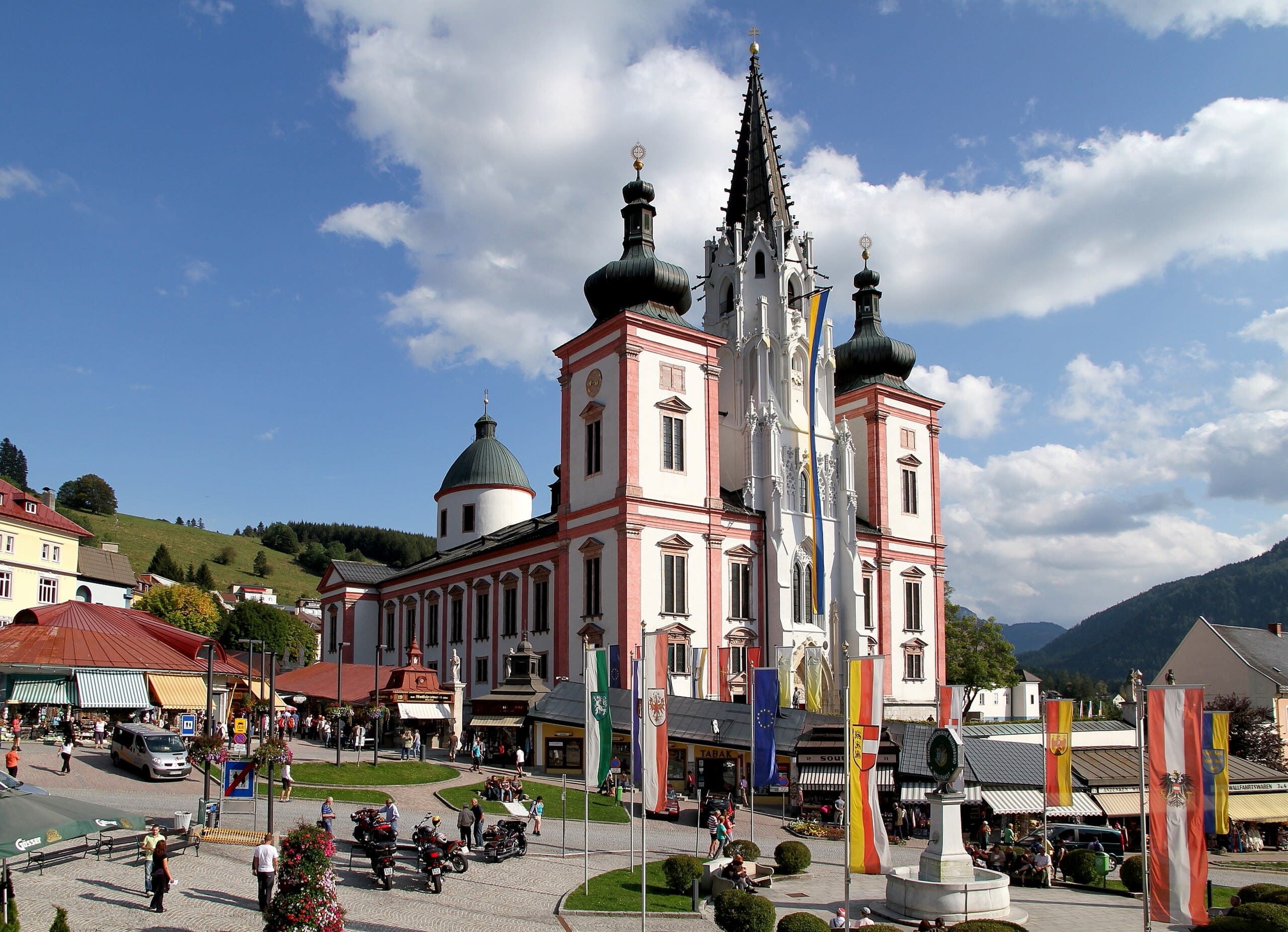
Basilica of the Virgin Mary, Mariazell
Central Europe's great Marian shrine, where nations converge in nine centuries of pilgrimage
Mariazell, Steiermark, Austria
At A Glance
- Coordinates
- 47.7728, 15.3186
- Suggested Duration
- Two to three hours for the basilica, Gnadenkapelle, and treasury. A full day for the town and surrounding mountain landscape. Those walking traditional pilgrimage routes should plan multiple days for the approach.
- Access
- Located in Mariazell, Styria (Steiermark), Austria, approximately 150 km southwest of Vienna. Accessible by car via alpine roads. The Mariazellerbahn railway connects to St. Polten, offering a scenic approach. Multiple traditional pilgrimage routes lead to Mariazell on foot, the most popular being the route from Vienna (approximately 120 km). The town is well equipped with hotels, guesthouses, restaurants, and visitor services.
Pilgrim Tips
- Located in Mariazell, Styria (Steiermark), Austria, approximately 150 km southwest of Vienna. Accessible by car via alpine roads. The Mariazellerbahn railway connects to St. Polten, offering a scenic approach. Multiple traditional pilgrimage routes lead to Mariazell on foot, the most popular being the route from Vienna (approximately 120 km). The town is well equipped with hotels, guesthouses, restaurants, and visitor services.
- Modest dress appropriate for a Catholic basilica. Cover shoulders and knees.
- Photography is generally permitted but may be restricted in the Gnadenkapelle. No flash during services.
- Mariazell is an active pilgrimage site where worship takes precedence over tourism. During mass and devotional services, the basilica is a place of prayer. Visitors who do not share the Catholic tradition are welcome but should approach with the awareness that they are guests in a living house of worship.
Overview
Set among the forested peaks of the Styrian Alps, the Basilica of the Virgin Mary in Mariazell has drawn pilgrims from across Central Europe for nearly nine hundred years. At its heart stands a small linden-wood statuette of the Virgin and Child, barely 48 centimeters tall, known as the Magna Mater Austriae. This modest carving has united Austrians, Hungarians, Czechs, Poles, and Croats in a shared devotion that transcends borders and centuries of turbulent history. Up to one million visitors arrive each year, making Mariazell Austria's most important pilgrimage destination and one of Europe's most visited Marian shrines.
Something about scale persists at Mariazell. The Baroque basilica rises imposingly above a small alpine town of two thousand souls, its spires visible for miles across the Styrian valleys. Inside, the nave opens into vaulted grandeur. Yet the object that draws the multitudes is startlingly small: a 48-centimeter statuette of the Virgin Mary cradling the Christ child, carved in linden wood during the Romanesque period and housed in a silver shrine within the Gnadenkapelle, the Chapel of Grace.
This contrast between the vast and the intimate defines the experience of Mariazell. The basilica's architecture proclaims power — Habsburg power, Counter-Reformation confidence, institutional permanence. The statuette whispers something quieter. Pilgrims who have walked for days or weeks along traditional routes from Vienna, Budapest, or Prague arrive not to admire architecture but to stand before this small wooden figure and pray.
The founding narrative places the origin in 1157, when a Benedictine monk named Magnus was sent from the monastery of St. Lambert to minister to the people of the surrounding highlands. He carried with him a small carved image of the Virgin. According to the tradition, when a massive rock blocked his path on the night of December 21, Magnus prayed to the Virgin for help. The rock split in two, clearing the way. Grateful, he settled on a nearby hill, built a wooden cell for himself and the statuette, and began his ministry. The place came to be called Maria-Zell — Mary in the Cell.
Nearly nine centuries later, pilgrims still come. They come from Austria and Hungary, from the Czech lands and Poland, from Croatia and Slovakia. They come on foot along routes that predate motorways and railways, and they come by bus and car along those modern roads. They come because the Magna Mater Austriae — the Great Mother of Austria, also venerated as the Magna Domina Hungarorum and the Mater Gentium Slavorum — remains for them a living source of grace. The political borders of Central Europe have shifted repeatedly since 1157. The pilgrimage has not ceased.
Context And Lineage
Founded in 1157 by Benedictine monk Magnus, Mariazell grew from a wooden cell to a Gothic church to a Baroque basilica through the patronage of Moravian, Hungarian, and Habsburg rulers, becoming Central Europe's foremost Marian pilgrimage site.
The founding narrative begins in 1157, when a Benedictine monk named Magnus was sent from the monastery of St. Lambert to minister to the inhabitants of the Styrian highlands. He carried a small statuette of the Virgin Mary carved in linden wood. On the night of December 21, a massive rock blocked his path through the forest. Magnus prayed to the Virgin for help. According to the tradition, the rock split in two, clearing his way. Grateful for this intercession, Magnus settled on a nearby hill and built a wooden cell that served as both chapel and dwelling. He placed the statuette inside and began his work. The name Mariazell — Mary in the Cell — preserves this origin.
The site's growth beyond a hermit's chapel came through healing. Around 1200, Henry, Margrave of Moravia, and his wife suffered from severe gout. They prayed to Our Lady of Mariazell for relief and, upon being healed, made a pilgrimage of gratitude. Henry funded the construction of the first stone church on the site of the wooden cell, establishing the pattern that would define Mariazell's history: personal encounter with divine grace, followed by public expression of gratitude.
The shrine's international dimension was established in the fourteenth century when King Louis of Hungary, ruler of both Hungary and Poland, commissioned a Gothic church as a votive offering after his military victories against the Ottoman Turks. From this point forward, Mariazell belonged not to Austria alone but to Central Europe. The Baroque conversion of the seventeenth century gave the basilica substantially its present form, and the Habsburg dynasty made the shrine central to their state cult of the Virgin Mary.
In 1907, Pope Pius X designated Mariazell the first Basilica Minor in Austria. The following year, the Marian image received its papal coronation. In 1983, Pope John Paul II visited the shrine. In 2007, Pope Benedict XVI followed, awarding Mariazell the Golden Rose — among the highest honors the Vatican can bestow upon a sacred site.
The basilica has been administered within the Roman Catholic tradition since its founding. The Benedictine connection runs through monk Magnus's origins at the monastery of St. Lambert. The Habsburg dynasty served as the shrine's most powerful patrons for centuries, promoting the cult of the Magna Mater Austriae as a unifying spiritual force across their diverse empire. Today the basilica functions as the national sanctuary of Austria and is recognized as such by all German-speaking countries.
Monk Magnus
Benedictine monk from St. Lambert who founded Mariazell in 1157, carrying the miraculous statuette and building the original wooden cell
Henry, Margrave of Moravia
Built the first stone church around 1200 as a votive offering after being healed through the Virgin's intercession
King Louis of Hungary
Commissioned the Gothic church in the 14th century after military victory, establishing Mariazell's international significance
Emperor Leopold I
Habsburg emperor who declared himself the 'lowest and least worthy servant of the Blessed Virgin Mary,' embedding the shrine in Habsburg state identity
Pope Benedict XVI
Awarded the basilica the Golden Rose during his 2007 visit, recognizing its exceptional spiritual significance
Why This Place Is Sacred
Mariazell's thinness derives from nearly nine centuries of concentrated Marian devotion, the convergence of multiple national pilgrimage traditions at a single shrine, and the potent contrast between the intimate miraculous image and the vast basilica that houses it.
Several dimensions contribute to the concentrated spiritual density of Mariazell. The most immediate is sheer duration. The Magna Mater Austriae has occupied this site since the mid-twelfth century, accumulating the prayers and hopes of countless pilgrims over roughly 870 years. Each generation has added its devotion to the one before, creating a layered spiritual deposit that visitors often sense before they can articulate it.
The multinational character of the pilgrimage amplifies this effect. Mariazell is not the shrine of a single people. Austrians venerate the image as the Magna Mater Austriae, Hungarians as the Magna Domina Hungarorum, and Slavic peoples as the Mater Gentium Slavorum. A ceremonial gown in the treasury bears the embroidered coats of arms of multiple nations — the Austrian eagle, the Hungarian double cross, the Polish White Eagle, the Czech and Moravian emblems. This convergence of traditions at a single point creates a spiritual intensity that few European shrines can match.
The Gnadenkapelle itself functions as a thin place within a thin place. This small chapel, built on the site where Magnus constructed his original wooden cell, preserves the exact location of the shrine's founding. Entering the chapel from the Baroque grandeur of the main basilica produces a spatial shift — from public spectacle to private encounter, from institutional religion to personal devotion. The silver-encased statuette sits at the center, dressed in one of the elaborate mercy gowns that have been donated to the image over centuries. More than 150 of these gowns survive, each representing a moment of intense human hope or gratitude.
Two popes have recognized the site's exceptional character. Pope John Paul II visited in 1983, and Pope Benedict XVI came in 2007, awarding the basilica the Golden Rose — one of the highest papal honors a church can receive. The designation as a Basilica Minor in 1907 by Pope Pius X made Mariazell the first Austrian church to receive this distinction.
The mountain setting contributes its own quality. The Styrian Alps surround the town with forested ridges and open valleys, and the traditional pilgrimage routes approach through landscapes that prepare the body and mind for arrival. Those who walk report that the gradual ascent through alpine terrain functions as a natural threshold — each step strips away the distractions of ordinary life, so that by the time the basilica's spires appear, the pilgrim is already in a different state of attention.
The site was established as a place of Marian devotion when monk Magnus built his wooden cell to house the miraculous statuette of the Virgin Mary in 1157, creating a chapel and dwelling that became the seed of one of Europe's great pilgrimage shrines.
From a solitary monk's cell, Mariazell grew through successive waves of devotion and patronage. Henry, Margrave of Moravia, built the first stone church around 1200 after being healed through the Virgin's intercession. King Louis of Hungary commissioned a Gothic church in the fourteenth century. The Baroque conversion of the seventeenth century gave the basilica its current form. The Habsburg dynasty elevated the shrine to a state cult, with emperors declaring themselves servants of the Blessed Virgin. Through the fall of empires and the redrawing of borders, the pilgrimage has continued without interruption.
Traditions And Practice
Pilgrimage processions from across Central Europe, veneration of the Magna Mater Austriae, mass and devotional services, the annual changing of the mercy dress, and votive offerings form the core of practice at Mariazell.
The pilgrimage itself is the primary practice at Mariazell — not merely arriving but the act of traveling to the shrine, often on foot along routes that have been walked for centuries. The most established routes lead from Vienna, Budapest, Prague, and other Central European cities, passing through alpine landscapes that serve as preparation for the encounter ahead. Historically, the pilgrimage to Mariazell, known as the Zellfahrt, could be imposed by courts as a form of penitential atonement, giving the practice a juridical as well as devotional dimension.
Upon arrival, pilgrims enter the basilica and make their way to the Gnadenkapelle, where the Magna Mater Austriae waits in her silver shrine. Veneration of the miraculous image is the central act. Pilgrims kneel, pray, and bring their petitions — for healing, for guidance, for gratitude. Many leave votive offerings: small metal or wax figures representing their prayers, candles, or written intentions.
The mercy dress tradition represents one of Mariazell's most distinctive practices. Each year the statuette receives an elaborately designed gown, often donated by a prominent family, institution, or nation. Over 150 of these mercy dresses are preserved in the treasury, spanning centuries of devotion. The gown embroidered with the coats of arms of Austria, Hungary, Poland, and other nations holds particular significance as a symbol of the shrine's supranational character.
Candlelight processions, communal rosary, and pilgrimage masses mark the rhythm of devotional life. The patronal feast of the Birth of the Blessed Virgin Mary on September 8 draws the largest gatherings of the year.
Daily masses and devotional services continue throughout the year, maintaining the basilica's function as a living place of worship. Organized pilgrimage groups arrive regularly from across Central Europe, received by the basilica's pilgrimage office with programs adapted to each group's needs. Guided tours of the basilica and treasury offer historical and spiritual context. The town provides pilgrimage infrastructure including accommodations, restaurants, and devotional shops.
The traditional pilgrimage routes have experienced a revival in recent decades, as walking pilgrimage gains renewed popularity across Europe. The route from Vienna to Mariazell, approximately 120 kilometers, is among the most frequently walked. Modern pilgrims describe the experience of arriving on foot as qualitatively different from arriving by vehicle — the physical effort creates a readiness that the body communicates to the spirit.
Attend mass in the basilica, which is open to all visitors. Spend time in the Gnadenkapelle before the miraculous statuette — even a few minutes of quiet attention in this space reveals something of why pilgrims have come here for centuries. Visit the treasury to see the mercy dresses and votive offerings, which provide a tangible record of devotion across generations. If time allows, walk one of the paths leading into the surrounding alpine landscape, allowing the natural setting to complement the spiritual experience within the basilica.
For those seeking a deeper engagement, walking one of the traditional pilgrimage routes to Mariazell transforms the visit from a stop into a practice. The approach on foot, through forested hills and open valleys, follows the steps of centuries of pilgrims and arrives with a momentum that no other mode of transport provides.
Christianity (Roman Catholic — Marian Pilgrimage)
ActiveMariazell is the foremost Marian pilgrimage site in Austria and one of the most important in all of Europe. The basilica houses the Magna Mater Austriae, a Late Romanesque statuette of the Virgin Mary and Child venerated simultaneously as the patron of Austria, Hungary, and the Slavic peoples. The shrine functions as a supranational devotional center that has united Central European Catholics across linguistic and political boundaries for nearly nine centuries. The Habsburg dynasty made Mariazell the center of their state cult of the Virgin Mary, and the shrine was the first Austrian church designated a Basilica Minor. Two popes have visited, and the site holds the Vatican's Golden Rose.
Pilgrimage processions from across Central Europe, veneration of the Magna Mater Austriae in the Gnadenkapelle, daily mass and devotional services, annual changing of the mercy dress, candlelight processions, votive offerings, communal rosary, penitential pilgrimage, parish and community worship.
Experience And Perspectives
Mariazell offers the experience of joining a pilgrimage stream that has flowed for centuries, moving from the grand Baroque nave to the intimate Chapel of Grace, where the small miraculous statuette creates a powerful encounter between the humble and the transcendent.
The approach matters at Mariazell. Whether arriving on foot along one of the traditional pilgrimage routes or by the Mariazellerbahn railway from St. Polten, the town reveals itself gradually — first the spires rising above alpine forest, then the rooftops of a small community organized entirely around the fact of the basilica at its center.
The exterior prepares you for grandeur, and the interior delivers. The Baroque nave opens high and wide, decorated with the confidence of Counter-Reformation Catholicism. Frescoes, gilt, marble, and carved wood compete for attention. The scale is meant to overwhelm, and it does — but it also serves a subtler purpose. It makes the arrival at the Gnadenkapelle all the more striking.
The Chapel of Grace sits within the basilica like a room within a room. Here the space contracts. The silver shrine housing the Magna Mater Austriae draws the eye and holds it. The statuette is small — 48 centimeters — and dressed in one of the elaborate mercy gowns that devotees have donated over centuries. The current gown changes periodically, and each carries its own history. Pilgrims press close, some kneeling, some standing with hands clasped, some simply looking. The quality of attention in this space is palpable.
What strikes many visitors is the multinational character of the crowd. Austrian German mingles with Hungarian, Czech, Polish, and Croatian. The pilgrimage routes that converge on Mariazell draw from across Central Europe, and on any given day, the Chapel of Grace holds a congregation that spans borders and languages. This convergence is not accidental — it is the defining feature of Mariazell's spiritual identity. The small wooden figure serves as a mother to many peoples, and her chapel is the room where they gather as one family.
The treasury deepens the experience for those who visit it. Here the centuries of devotion become tangible. The collection of over 150 mercy dresses spans generations, each gown representing a moment of intense human devotion — a prayer answered, a vow fulfilled, a nation's gratitude given material form. The votive offerings tell similar stories in miniature: small metal or wax figures representing healed limbs, grateful hearts, answered prayers. Taken together, these objects form an archive of human hope.
Outside the basilica, the town of Mariazell provides context. With roughly two thousand permanent residents, it is a place whose existence revolves around the shrine. Shops sell devotional items. Hotels and guesthouses cater to pilgrims. The surrounding mountains offer walking paths that connect the spiritual and the natural. For those who have walked the traditional routes to arrive here — sometimes over days — the town represents not a tourist destination but a culmination.
Sunrise and sunset illuminate the basilica's facade in shifting light, and the evening atmosphere brings a particular stillness. When the day visitors have departed and only pilgrims and townsfolk remain, Mariazell becomes quieter, more intimate — closer, perhaps, to what monk Magnus knew when his only companions were the statuette and the forest.
The basilica dominates the town center of Mariazell. The main entrance opens into the Baroque nave, from which visitors can access the Gnadenkapelle (Chapel of Grace) housing the miraculous statuette. The treasury is accessible within the basilica complex. The town surrounds the basilica with pilgrim-oriented services, and the alpine landscape opens in all directions beyond.
Mariazell sits at the intersection of medieval pilgrimage tradition, Habsburg political history, and living Central European Catholic devotion. Each lens reveals a different dimension of the shrine's significance, and none alone captures the whole.
Scholars recognize Mariazell as the most important Marian pilgrimage site in Central Europe, with a documented history spanning nearly nine centuries. The shrine's role as a supranational devotional center — simultaneously serving Austria, Hungary, and the Slavic peoples — is a subject of particular scholarly interest. Historians trace this function to the deliberate promotion of the Magna Mater Austriae cult by the Habsburg dynasty, who used Marian devotion as a unifying force across their linguistically and ethnically diverse empire. The Counter-Reformation period was critical in establishing Mariazell as a national sanctuary, as Catholic rulers promoted pilgrimage as both spiritual practice and political statement.
The basilica's architectural evolution from Romanesque origins through Gothic expansion to Baroque transformation mirrors the broader trajectory of Central European Christianity. Each phase left material traces that can be read as a record of changing devotional priorities, aesthetic sensibilities, and political relationships. The mercy dress collection, with its accumulation of textile art across centuries, constitutes a distinctive primary source for the history of devotional material culture.
For Catholic pilgrims across Central Europe, Mariazell is a living source of divine grace. The Magna Mater Austriae is understood not as a carved object but as a vessel through which the Blessed Virgin Mary exercises her compassion and intercession. Centuries of documented healings, answered prayers, and votive offerings preserved in the treasury confirm — for those who share this framework — the image's miraculous power.
The multinational character of the devotion is understood as evidence of the universal reach of the Blessed Virgin's maternal care. She is simultaneously the mother of Austrians, Hungarians, Czechs, Poles, Croats, and all who seek her aid. The gown bearing the coats of arms of multiple nations is not merely a political symbol but a theological statement: Mary's compassion knows no borders.
The founding narrative of monk Magnus and the splitting rock is received within this tradition as a miracle — an act of divine intervention that cleared the way, both literally and figuratively, for one of Europe's great shrines to come into being.
Some interpret Mariazell's power as deriving from the concentrated devotional energy of millions of pilgrims over centuries — a spiritual accumulation effect in which intention, repeated and layered over nearly nine hundred years, saturates a location with palpable presence. The mountain setting may be understood as contributing a natural quality associated with high places across traditions. The intimate scale of the miraculous statuette within the vast basilica echoes a principle found in many spiritual systems: that the greatest power may reside in the humblest vessel, and that the sacred often manifests not in the grandiose but in the small and unassuming.
The exact identity of the artist who carved the original Magna Mater Austriae statuette remains unknown, as does the precise date of its creation — it is attributed to the Romanesque period on stylistic grounds. The nature of the experience monk Magnus described as the splitting of the rock cannot be historically verified, belonging to the realm of founding narrative rather than documented event. Whether a pre-Christian sacred site existed at the location of Mariazell is undocumented; the possibility remains an open question, as many European pilgrimage sites occupy locations with earlier layers of sanctity.
Visit Planning
Mariazell is located in Styria, approximately 150 km southwest of Vienna. The basilica is open year-round, with the patronal feast of September 8 and the spring-to-autumn pilgrimage season offering the fullest experience.
Located in Mariazell, Styria (Steiermark), Austria, approximately 150 km southwest of Vienna. Accessible by car via alpine roads. The Mariazellerbahn railway connects to St. Polten, offering a scenic approach. Multiple traditional pilgrimage routes lead to Mariazell on foot, the most popular being the route from Vienna (approximately 120 km). The town is well equipped with hotels, guesthouses, restaurants, and visitor services.
Mariazell offers a range of accommodations oriented toward pilgrims and visitors, from simple guesthouses to comfortable hotels. The town's infrastructure is built around the fact of the basilica, and hospitality is a local tradition. Booking in advance is advisable around the September 8 patronal feast and during peak pilgrimage season.
Standard Catholic basilica etiquette applies. Modest dress, quiet during services, and respectful behavior in the Chapel of Grace are expected. The shrine welcomes visitors of all backgrounds.
Mariazell is among Europe's most welcoming pilgrimage destinations, and visitors of every background are received warmly. The town's economy centers on pilgrimage, and hospitality is deeply embedded in local culture. This openness does not diminish the site's sacred character — it expresses it. The Magna Mater Austriae is venerated as a mother to all who seek her, and the basilica extends that welcome in practical terms.
Modest attire is expected: shoulders and knees should be covered. During mass and devotional services, quiet is essential. The Gnadenkapelle, as the most sacred space within the basilica, calls for particular reverence. Pilgrims who are kneeling in prayer before the miraculous image should not be disturbed. Moving through the chapel with awareness of others' devotion is both courteous and, for the attentive visitor, part of the experience itself.
The miraculous statuette and other sacred objects should not be touched. Photography is generally permitted within the basilica but may be restricted in the Gnadenkapelle. Flash photography during services is not appropriate. When in doubt, observe what others are doing and follow their lead.
Candles, votive offerings, and donations are traditional expressions of devotion and are welcomed. The donation of a mercy dress for the Magna Mater Austriae is considered a great honor, though this is by arrangement with the basilica rather than a spontaneous act.
Modest dress appropriate for a Catholic basilica. Cover shoulders and knees.
Photography is generally permitted but may be restricted in the Gnadenkapelle. No flash during services.
Candles, votive offerings, and donations are traditional. Mercy dress donations are considered a great honor and are arranged through the basilica.
{"Quiet during mass and devotional services","Do not touch the miraculous image or sacred objects","No flash photography during services","Respectful behavior in the Gnadenkapelle at all times"}
Sacred Cluster
Nearby sacred places create the location cluster described in the growth plan. This block is intentionally crawlable and links into the wider regional graph.

Teufelstein (Devil’s rock)
Fischbach, Steiermark, Austria
42.6 km away
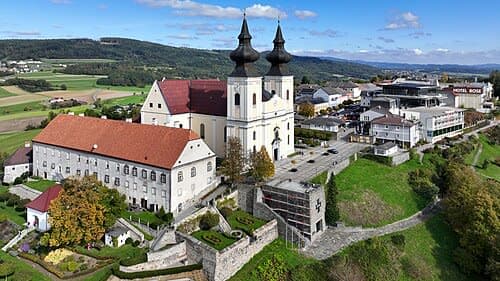
Pilgrimage church of Mary, Maria Taferl
Maria Taferl, Niederösterreich, Austria
51.7 km away
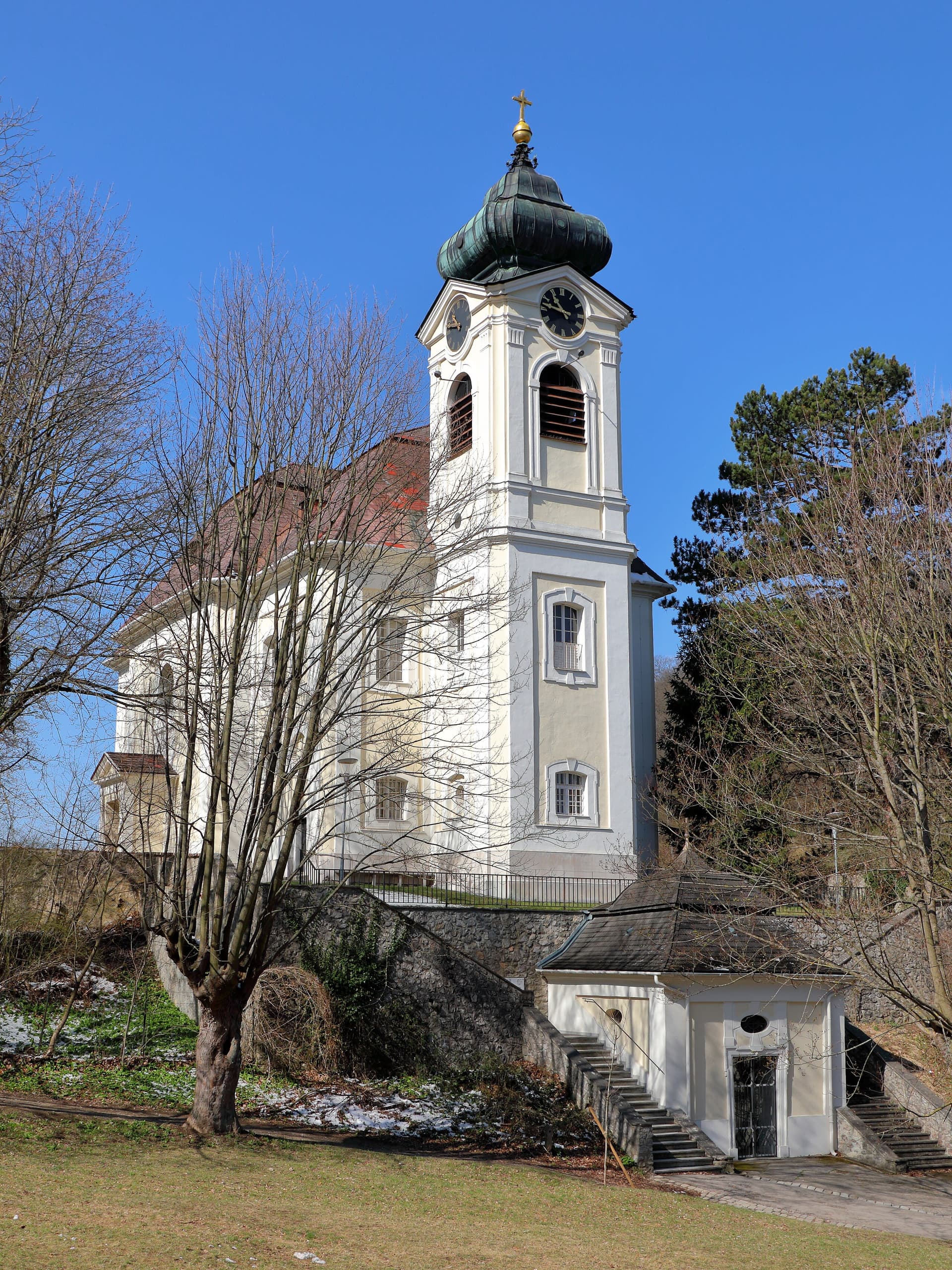
Black Madonna of Kaltenleutgeben
Kaltenleutgeben, Lower Austria, Austria
76.0 km away
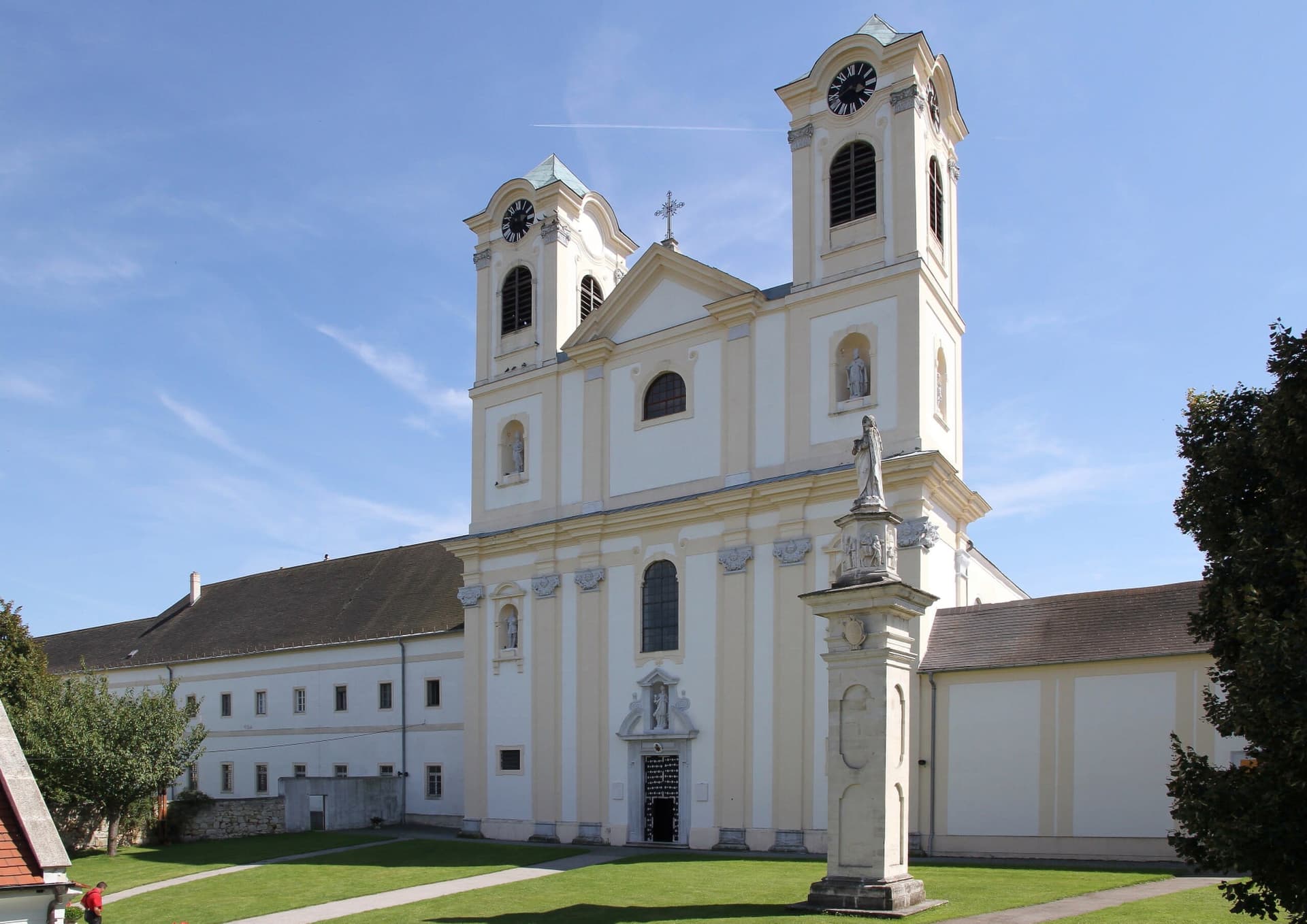
Basilica of Maria Loretto in Burgenland
Loretto, Burgenland, Austria
90.8 km away