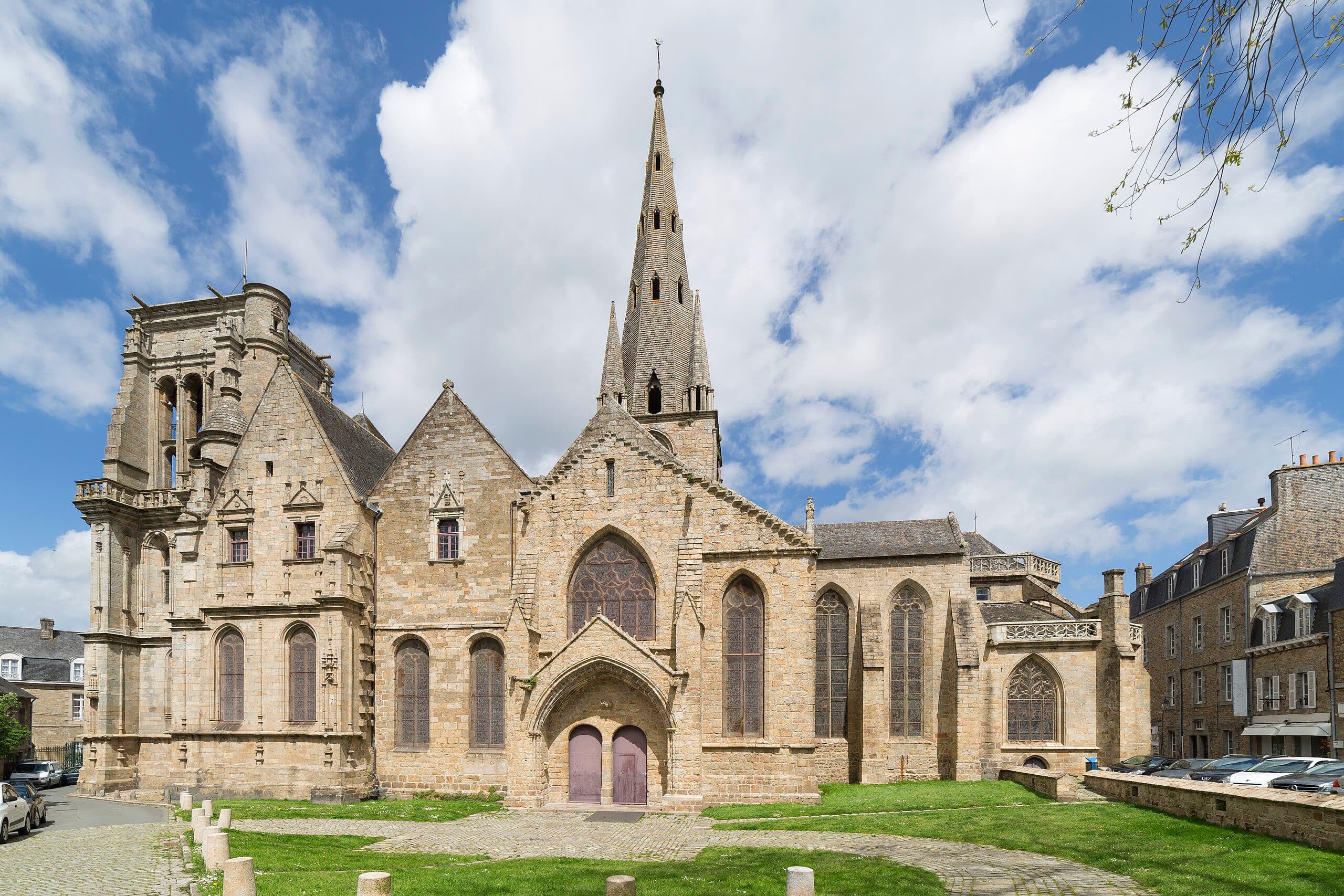
Basilica of Notre-Dame-de-Bon-Secours, Guingamp
Brittany's great pilgrimage basilica, where a Black Madonna from the East awaits beneath labyrinth and Gothic stone
Guingamp, Brittany, France
At A Glance
- Coordinates
- 48.5633, -3.1494
- Suggested Duration
- A contemplative visit to the basilica takes 30 to 60 minutes. The labyrinth walk adds 15 to 20 minutes. Those wishing to attend mass should check service times and allow accordingly. For the Pardon, plan a full day or more—the celebrations span multiple days.
- Access
- The basilica is located in the center of Guingamp, in the Côtes-d'Armor department of Brittany. Guingamp has a train station with connections to Paris and Rennes. By car, it is accessible via the N12. The basilica is open daily during normal daylight hours.
Pilgrim Tips
- The basilica is located in the center of Guingamp, in the Côtes-d'Armor department of Brittany. Guingamp has a train station with connections to Paris and Rennes. By car, it is accessible via the N12. The basilica is open daily during normal daylight hours.
- Modest dress appropriate for a Catholic church. Shoulders and knees should be covered. Shoes appropriate for walking on stone floors.
- Permitted outside services. Discretion during worship. No flash near the Black Madonna or other sacred images.
- During masses and other services, maintain appropriate reverence. The basilica is first and foremost an active place of worship. Photography is welcome outside of services but should be discrete during them. The Black Madonna is a sacred image for those who venerate her; approach with respect regardless of your own beliefs.
Overview
For nearly a millennium, pilgrims have journeyed to Guingamp seeking the intercession of Notre-Dame de Bon-Secours, Our Lady of Good Help. The basilica houses a Black Madonna with origins shrouded in Crusader legend, a floor labyrinth unique in Brittany, and the living tradition of the Pardon—a distinctly Breton celebration where faith, culture, and community interweave beneath torchlight each July.
Three architectural styles meet in this basilica—Romanesque arches surviving from the earliest construction, Gothic heights reaching toward heaven, Renaissance stonework filling what fire once destroyed. This architectural layering mirrors something deeper: centuries of pilgrimage accumulated in a single place, each generation adding its devotion to what came before.
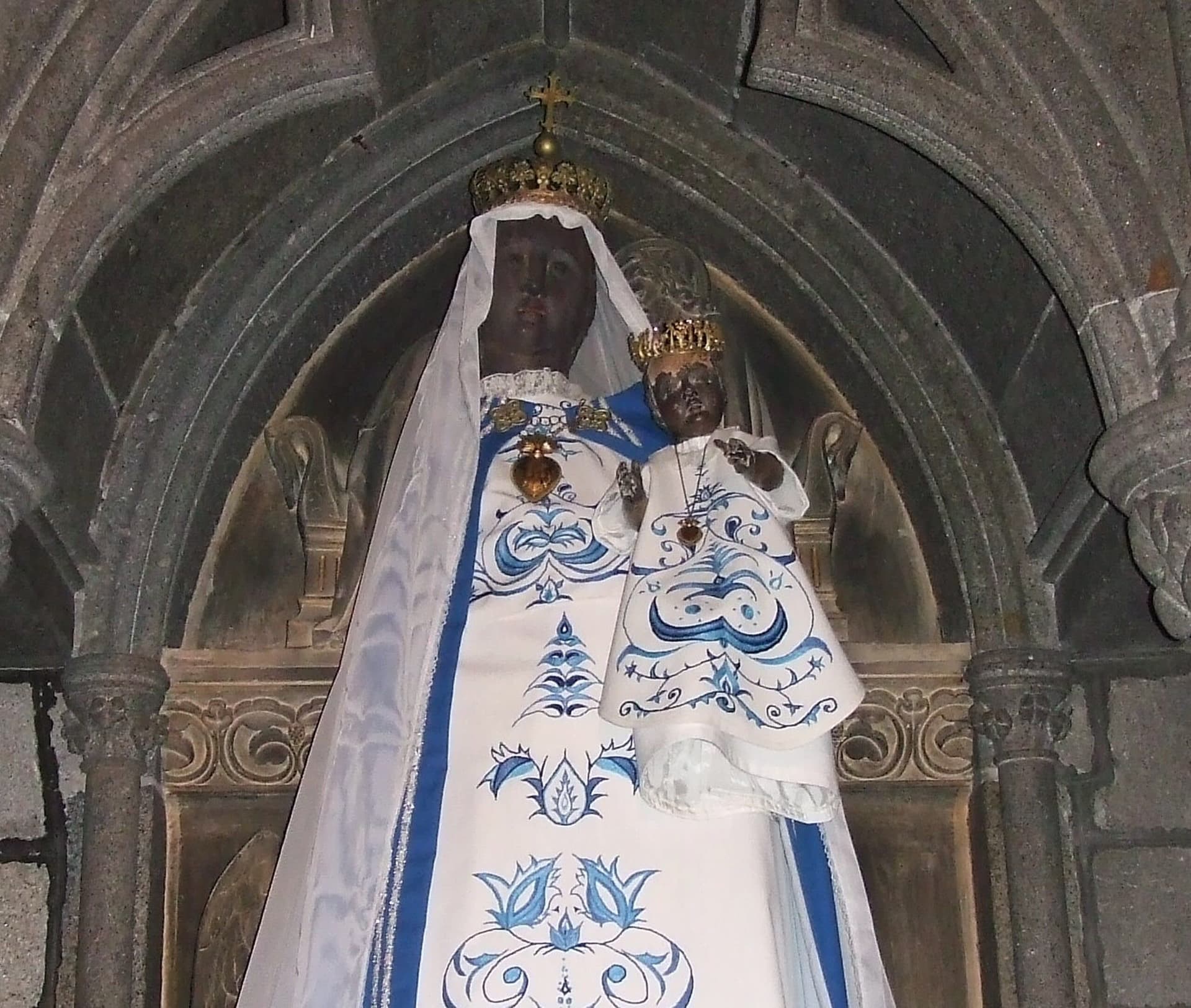
At the heart of it all sits the Black Madonna, known in Breton as Itron Varia Gwir Zicour—Lady Mary of True Help. Tradition claims a Crusader brought her from the East in the 12th century, though only the heads of Mother and Child survive from the earliest known statue. Her original title, Notre-Dame du Halgouët, translates as Our Lady from under the earth, a name that whispers of something older, something the Church received and transformed.
Walking the labyrinth—installed in 1854 but echoing far more ancient patterns—pilgrims trace a path that generations before them have worn smooth. The Pardon de Notre-Dame, celebrated on the first Saturday of July, fills these stones with torchlight, traditional Breton music, and the particular joy of a faith that has never separated itself from the land and people who hold it.
Some come seeking healing. Some come seeking the distinctive spirituality of Brittany, where Celtic currents still run beneath Christian practice. Some come simply because they have heard there is something here. All find a basilica that has been holding such seekers for a very long time.
Context And Lineage
The basilica's foundations date to the 11th century, with the Black Madonna tradition established in the 12th. Duke Charles de Blois significantly expanded the cult in the 14th century after attributing his release from English captivity to her intercession. Papal indulgences in 1448 and 1619 recognized the site's importance. The devotion was formalized in Breton identity in 1676.
The founding narrative speaks of a Crusader who brought a Black Madonna from the East—from the Holy Land via Marseille—to this corner of Brittany in the 12th century. Where exactly he obtained her, and why he brought her to Guingamp rather than elsewhere, the tradition does not specify. What it preserves is the sense of the statue as foreign, Eastern, carrying something from closer to the sources of Christianity into this Celtic far west.
The Madonna's original title, Notre-Dame du Halgouët—Our Lady from under the earth—adds another layer. This is not standard Marian epithet. It suggests something chthonic, something rising from below rather than descending from above. Whether this reflects a pre-Christian devotion that the Black Madonna absorbed, or simply an unusual theological emphasis on Mary's earthly origins, remains unclear. The ambiguity itself is part of what makes the site compelling.
The devotion received dramatic amplification in 1356 when Charles de Blois, Duke of Brittany, was released from English captivity. He had been imprisoned since his capture at the Battle of La Roche-Derrien in 1347. During his imprisonment, he prayed constantly to the Black Madonna of Guingamp. When he was finally freed, he attributed his release entirely to her intercession and made substantial donations to her shrine. A duke's patronage carried weight. The cult grew significantly in the following years.
The Black Madonna has been venerated at Guingamp for nearly nine centuries, making it one of the oldest continuous Marian devotions in Brittany. The tradition has survived the Hundred Years' War, the Wars of Religion, the French Revolution, and two World Wars. Each crisis tested the faith; each time the devotion persisted.
The formalization in 1676 as Itron Varia Gwir Zicour marked the cult's full integration into Breton identity. The title is in Breton, not Latin or French—a deliberate choice that rooted the devotion in the local language and culture. This integration has continued through the present day. The Pardon tradition, distinctively Breton, keeps the faith communal and embodied in a way that purely individual devotion cannot.
Charles de Blois
patron
Duke of Brittany from 1341 to 1364, captured by the English in 1347 and released in 1356. He attributed his release to the Black Madonna's intercession and became the cult's major patron, significantly expanding the shrine.
Our Lady of Good Help
sacred figure
The Black Madonna venerated at the basilica. Her titles span cultures: the French 'Notre-Dame de Bon-Secours,' the Breton 'Itron Varia Gwir Zicour,' and the mysterious original 'Notre-Dame du Halgouët' (Our Lady from under the earth).
Why This Place Is Sacred
The basilica's thinness emerges from convergent factors: a Black Madonna with mysterious Eastern origins, nearly a millennium of pilgrimage, papal recognition through multiple indulgences, a labyrinth unique in Brittany, and the persistence of the Pardon tradition that keeps the faith embodied and communal. The very title of the original devotion—Our Lady from under the earth—suggests pre-Christian roots transformed into Christian veneration.
Something persists here that resists easy explanation. Pilgrims have felt it since at least the 12th century, when a Crusader reportedly brought a Black Madonna from the East and installed her in what would become one of Brittany's most important shrines. The title she originally bore—Notre-Dame du Halgouët, Our Lady from under the earth—hints at a devotion that may predate Christianity, an earth-mother veneration that the Church received and clothed in Marian dress.
The Black Madonna phenomenon itself remains partly mysterious to scholars. Dark-skinned Virgins appear throughout Europe, often at sites with documented pre-Christian sacredness. Whether the darkness represents Eastern iconographic tradition, candle smoke accumulated over centuries, or something deliberately intended from the beginning varies by site and scholar. At Guingamp, the Eastern origin story and the chthonic title combine to suggest a figure who carries more than one layer of meaning.
The basilica itself holds centuries of intentional sacredness. In 1448, Pope Nicholas V granted indulgences to visitors, formal recognition that something of value happened here. In 1619, Pope Paul V granted a plenary indulgence—the fullest spiritual benefit the Church could offer. By 1669, Notre-Dame de Bon-Secours had become the primary pilgrimage of the entire diocese. These are not casual honors; they represent centuries of reported experiences significant enough to draw papal attention.
The labyrinth, installed in 1854, adds another dimension. While relatively recent by medieval standards, labyrinths carry ancient weight. Walking one is a practice that predates Christianity and continues within it, a form of moving meditation that has helped pilgrims prepare for encounter. That Guingamp possesses Brittany's only such labyrinth marks it as a site where the bodily journey of pilgrimage continues even after arrival.
Most tangibly, the Pardon tradition keeps the faith alive in a way that purely historical sites cannot match. Each July, when townspeople and pilgrims process by torchlight, wearing traditional Breton dress, singing prayers in a mix of French and Breton, the basilica reveals itself as what it has been all along: a place where the veil between ordinary life and something greater grows thin.
The earliest church on this site was constructed in the 11th century, though records do not specify its original dedication. The Black Madonna's arrival in the 12th century established the Marian devotion that would define the basilica's purpose. By the 14th century, when Duke Charles de Blois credited his release from English captivity to the Madonna's intercession, the site had become a center of petition and thanksgiving—a place where the faithful brought their needs and returned to offer gratitude when those needs were met.
Fire and war have repeatedly tested the basilica, and each time reconstruction blended what survived with contemporary style. Romanesque arches from the earliest construction still stand in the transept. Gothic additions soared upward in the characteristic medieval reach toward heaven. When a section collapsed, Renaissance builders filled the gap with their own aesthetic. This architectural layering creates a visual record of persistence—the faith maintained despite destruction.
The devotion formalized in 1676 as Itron Varia Gwir Zicour represented the baptism of the cult in Breton identity. The Latinized title became local, personal, Brittany's own. Today, the basilica serves both as active parish church and pilgrimage destination, holding daily masses alongside annual celebrations that draw visitors from throughout the region and beyond.
Traditions And Practice
The basilica offers daily mass, personal devotion to the Black Madonna, labyrinth walking, and the annual Pardon de Notre-Dame with its torchlight procession. Visitors can participate in regular worship or simply sit in the presence of the Madonna.
The core traditional practices center on veneration of the Black Madonna and participation in the Pardon. Veneration involves approaching the statue with reverence, offering prayers of petition or thanksgiving, and often lighting a candle. The torchlight procession during the Pardon creates a communal embodiment of faith that has continued for centuries. Walking the labyrinth, while the labyrinth itself dates only to 1854, connects to far older practices of ambulatory prayer.
Daily masses continue in the basilica, maintaining its function as an active parish church. Personal devotion to the Black Madonna happens throughout the year, with visitors from across the world coming to sit in her presence. The Pardon remains the spiritual high point, drawing Bretons home and visitors to witness a living tradition. Some pilgrims walk to Guingamp from elsewhere in Brittany, maintaining the physical dimension of pilgrimage that modern transportation often eliminates.
Begin with the labyrinth if you arrive with a busy mind. Walk it slowly, allowing the prescribed path to quiet the impulse to navigate. You need not understand what you are doing; the practice works through the body rather than the intellect.
Then approach the Black Madonna. Sit with her as long as feels right. Bring whatever questions or needs you carry, but hold them lightly—sometimes what we think we came to ask shifts in the actual presence. Light a candle if the practice resonates with you.
If possible, time your visit for the first Saturday of July. The Pardon reveals dimensions of the site that remain dormant during the rest of the year. The torchlight procession the night before is particularly moving—a river of flame through Guingamp's streets, carrying the accumulated faith of centuries.
Roman Catholicism
ActiveThe basilica is an active Catholic church with daily masses and regular parish life. The Black Madonna is venerated as the Virgin Mary in a particular local manifestation. Papal indulgences granted in 1448 and 1619 recognize the site's importance within the universal Church. The devotion formalized in 1676 as 'Itron Varia Gwir Zicour' integrates Catholic faith with Breton identity.
Daily masses in the basilica. Personal devotion to the Black Madonna through prayer and candle lighting. Participation in the annual Pardon de Notre-Dame, including the torchlight procession and community celebration. Walking the labyrinth as a form of moving prayer.
Breton Pardon Tradition
ActiveThe Pardon de Notre-Dame de Bon-Secours is one of the most important pardons in Brittany. Pardons are distinctively Breton religious celebrations that combine Catholic devotion with traditional culture, music, dress, and community gathering. In 1669, the Guingamp pardon became the primary pilgrimage of the entire diocese.
The Pardon occurs on the first Saturday of July. A torchlight procession the night before winds through Guingamp's streets. Traditional Breton dress—coiffes, costumes passed through generations—connects participants to ancestors who made the same procession. Singing mixes French and Breton. The celebration continues through the following day with mass, procession, and community gathering.
Black Madonna Veneration
ActiveThe Black Madonna of Guingamp, originally known as Notre-Dame du Halgouët (Our Lady from under the earth), represents the mysterious dimension of Marian devotion. Her dark coloring, Eastern origin story, and chthonic title connect her to traditions that may predate Christianity. Duke Charles de Blois significantly expanded her cult after attributing his release from English captivity to her intercession in 1356.
Veneration before the statue. Prayers of petition and thanksgiving. Lighting candles. For some, seeking the feminine divine in her dark aspect—the earth-mother, the goddess below, transformed but not eliminated by Christian devotion.
Experience And Perspectives
Visitors describe profound peace in the presence of the Black Madonna, contemplative walking of the labyrinth, and—for those present in July—full immersion in the Pardon tradition. The basilica's architectural complexity creates varied spaces for encounter: intimate side chapels, soaring Gothic heights, and the labyrinth's circular path.
The first impression is often architectural dissonance that somehow resolves into harmony. Three distinct building styles occupy the same space, yet the effect is less confusion than accumulated time made visible. The Romanesque arches ground the space in weight and permanence. The Gothic elements lift the eye and spirit. The Renaissance section, added after fire destroyed an earlier wall, brings light and proportion. Walking through the basilica means walking through centuries.
The Black Madonna awaits in her chapel, smaller than many expect—a life-sized figure whose power resides not in scale but in presence. The heads of Mother and Child carry the dark hue that gives the tradition its name. Visitors often describe a quality of attention when sitting with her, as though something watches back. The candles lit by generations of petitioners create a flickering luminosity that softens the space.
The labyrinth offers a different kind of encounter. Walking its path requires slowing down, following turns that seem to lead away from the center before finally arriving. Those who complete it speak of the practice's effect on the restless mind—the way following a prescribed path frees attention from navigating and allows it to settle into simpler presence. The labyrinth is not a maze; there are no wrong turns. There is only the walking, the breathing, the gradual arrival.
For visitors present on the first Saturday of July, the Pardon transforms understanding of what this site is. The torchlight procession the night before creates a river of fire through Guingamp's streets. Traditional Breton dress—coiffes, costumes preserved through generations—links the present to the past. The singing mixes French and Breton, faith and culture inseparable. The next day's celebration continues the integration. Those who experience the Pardon often describe it as a high point of their spiritual lives, not despite its cultural particularity but because of it.
Approach the basilica with enough time to move slowly. The architectural complexity rewards attention; rushing through misses the way the building tells its own story. Consider beginning with the labyrinth if your mind is full from travel—the walking practice can settle attention before you approach the Black Madonna.
In her presence, simply sit. You need not pray in any formal sense, though many do. Simply attending—being present without agenda—allows whatever wants to arise to arise. Many find that the petitions they thought they came to make shift or clarify in the actual encounter.
If you can time your visit for the Pardon in July, do so. The basilica reveals dimensions during the Pardon that remain dormant at other times. If not, the site rewards any season—though the light through the stained glass varies, and winter's lower sun creates effects that summer cannot.
The basilica invites multiple interpretations, from orthodox Catholic understanding through Breton cultural identity to speculation about pre-Christian origins. These perspectives need not compete; the site is large enough to hold them all.
Historians confirm the basilica's origins in the 11th century and the Black Madonna tradition from the 12th. The cult's significant expansion under Charles de Blois in the 14th century is documented. The papal indulgences of 1448 and 1619 are matters of record. The labyrinth's installation in 1854 is known precisely.
What remains less certain is the statue's true age and provenance. The Crusader origin story is tradition rather than documented history. The heads that survive may date to the 14th century original or a 17th century copy—scholarship has not definitively established which. The title 'Our Lady from under the earth' is suggestive but its meaning remains debated.
For Catholic believers, the Black Madonna is the Virgin Mary in a particular local manifestation. Her intercession is real; the documented history of answered prayers and reported miracles testifies to her power. The Pardon is not cultural performance but genuine religious celebration—an opportunity for spiritual renewal and connection to a living tradition.
The statue's darkness matters less in this understanding than her identity as the Mother of God who hears and responds to prayer. Whether the color came from the East, from candle smoke, or from deliberate artistic choice is secondary to her role as intercessor.
The title 'Notre-Dame du Halgouët' opens alternative readings. 'Our Lady from under the earth' is not standard Marian epithet. Some see in it the trace of pre-Christian goddess worship—an earth-mother veneration that the Church absorbed and redirected. The Black Madonna tradition more broadly is sometimes read as preserving the dark goddess, the feminine divine in her chthonic aspect, within Christian dress.
The labyrinth, though relatively recent, connects to practices far older than Christianity. Some understand it as a tool for accessing altered states of consciousness, a technology for shifting perception. From this view, the basilica offers layers of spiritual technology from multiple eras, all available to those who know how to engage them.
Genuine mysteries remain. The original age and provenance of the Black Madonna cannot be established with certainty. The meaning of the 'from under the earth' title—whether it reflects pre-Christian origins, local geology, or theological emphasis—remains unclear. The relationship between the Guingamp Black Madonna tradition and similar devotions at Chartres and elsewhere invites speculation but resists definitive answer.
The labyrinth's history before 1854 is unknown—whether there was an earlier labyrinth, or some other sacred feature at that location, or simply a decision to add one in keeping with broader 19th century religious revival. These gaps in knowledge are not failures but invitations to hold the site with appropriate humility.
Visit Planning
The basilica is located in the center of Guingamp, Brittany, and is open daily. The Pardon de Notre-Dame occurs on the first Saturday of July and includes a torchlight procession the night before. Accommodations are available in Guingamp and the surrounding area.
The basilica is located in the center of Guingamp, in the Côtes-d'Armor department of Brittany. Guingamp has a train station with connections to Paris and Rennes. By car, it is accessible via the N12. The basilica is open daily during normal daylight hours.
Guingamp offers hotels and guesthouses in various price ranges. During the Pardon, book well in advance. The surrounding countryside has additional options for those willing to drive.
The basilica is an active Catholic church requiring modest dress and respectful behavior. Photography is permitted outside services. Candles are available for offering. The labyrinth is open for walking during visiting hours.
This is first and foremost a functioning Catholic church, and behavior should reflect that reality. When services are in progress, either participate appropriately or wait quietly until they conclude. Conversation should be hushed. The space is not a museum but a living sanctuary where people come to pray.
Modest dress is expected—nothing revealing, no beachwear or athletic clothing. This is not about judgment but about maintaining an atmosphere appropriate to sacred space. In summer, light layers that cover shoulders and knees are appropriate.
Photography is generally welcome when services are not in progress, but use discretion. The Black Madonna can be photographed, but consider whether the person praying before her wants to appear in your images. The same respect applies throughout the basilica.
The labyrinth is available for walking during visiting hours. Others may be walking it simultaneously; the practice is silent and the path is shared. Wait at the entrance until a reasonable space opens between you and the previous walker.
Modest dress appropriate for a Catholic church. Shoulders and knees should be covered. Shoes appropriate for walking on stone floors.
Permitted outside services. Discretion during worship. No flash near the Black Madonna or other sacred images.
Candles are available near the Black Madonna. A small donation is customary. Some visitors leave written prayers or petitions, though the practice is less formalized here than at some sites.
Respectful behavior and silence during services. No food or drink in the basilica. The labyrinth should be walked, not crossed.
Sacred Cluster
Nearby sacred places create the location cluster described in the growth plan. This block is intentionally crawlable and links into the wider regional graph.