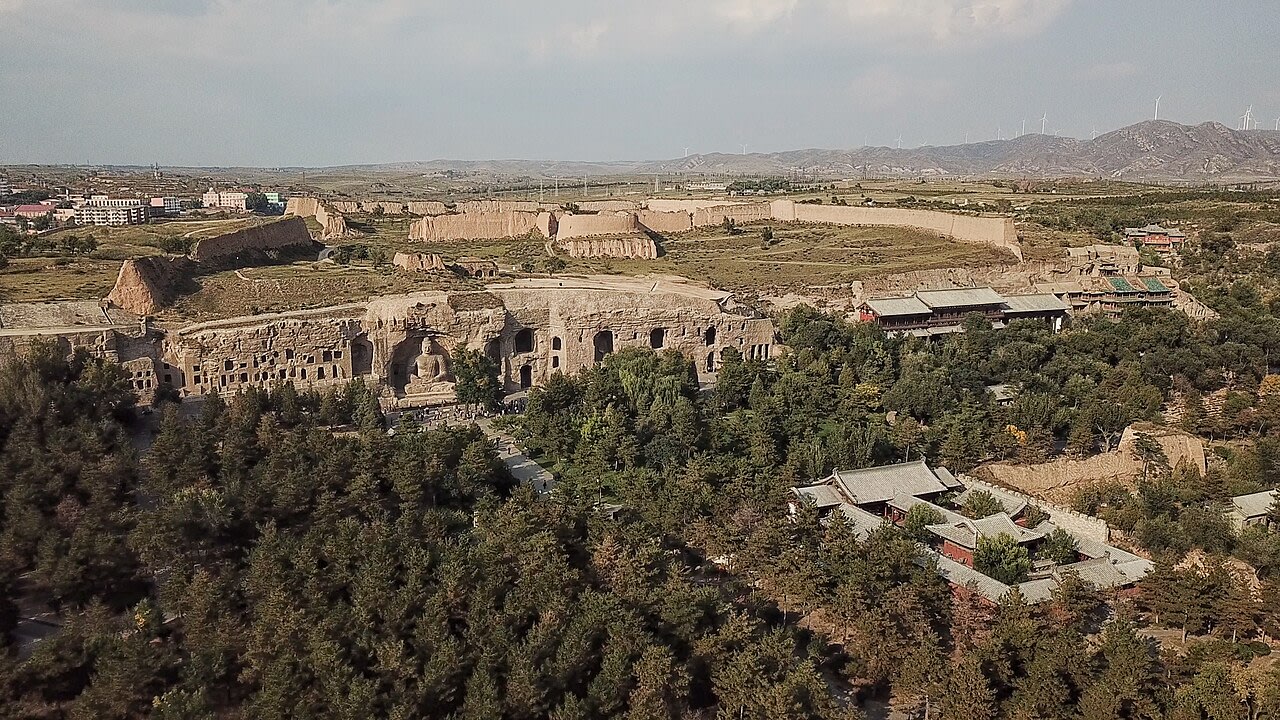
"Fifty-one thousand Buddhas carved into stone so they could never be burned"
Yungang Grottoes
Datong, Shanxi, China
The Yungang Grottoes stretch for a kilometer along a sandstone cliff face near Datong, Shanxi Province, a procession of 252 caves containing over 51,000 carved Buddhist statues. Begun in 460 CE by the Northern Wei dynasty after a devastating persecution of Buddhism, the caves were carved directly into the living rock so that the dharma could never again be destroyed by fire. The artistic evolution visible across six decades of carving documents the moment Buddhism became Chinese.
Weather & Best Time
Plan Your Visit
Save this site and start planning your journey.
Quick Facts
Location
Datong, Shanxi, China
Coordinates
40.1115, 113.1325
Last Updated
Mar 29, 2026
Learn More
The Yungang Grottoes were carved beginning in 460 CE as a response to the persecution of Buddhism by the Northern Wei dynasty, creating an indestructible monument that merged imperial and religious authority.
Origin Story
After Emperor Taiwu's persecution of Buddhism in 446 CE destroyed monasteries and killed monks across the Northern Wei empire, the monk Tan Yao petitioned the new Emperor Wencheng to sponsor a Buddhist monument that could never be burned or dismantled. He proposed carving colossal Buddhas directly into the sandstone cliff at Wuzhou Shan. The emperor agreed, and Tan Yao supervised the first five caves, each containing a figure representing a Northern Wei emperor as a Buddha. This established the radical principle that political and spiritual authority were one, and the project expanded over sixty years into the vast complex that survives today.
Key Figures
Tan Yao
Monk who proposed and supervised the initial five caves under Emperor Wencheng, beginning in 460 CE
Emperor Wencheng
Northern Wei emperor (r. 452-465) who reversed the Buddhist persecution and sponsored the Yungang project
Emperor Taiwu
Northern Wei emperor whose 446 CE persecution of Buddhism was the catastrophe that motivated the caves' creation
Tuoba Xianbei artisans
Thousands of artisans and laborers who carved the caves over six decades, drawing from Gandharan, Central Asian, and Chinese artistic traditions
Spiritual Lineage
Yungang is one of China's three greatest Buddhist cave complexes, alongside the Mogao Caves at Dunhuang and the Longmen Grottoes at Luoyang. The Longmen Grottoes were begun after the Northern Wei capital moved from Datong to Luoyang in 494 CE, making Longmen the direct continuation of the Yungang project. Together, the three sites document the entire arc of Chinese Buddhist cave art.
Know a Sacred Site We Should Include?
Help us expand our collection of sacred sites. Share your knowledge and contribute to preserving the world's spiritual heritage.