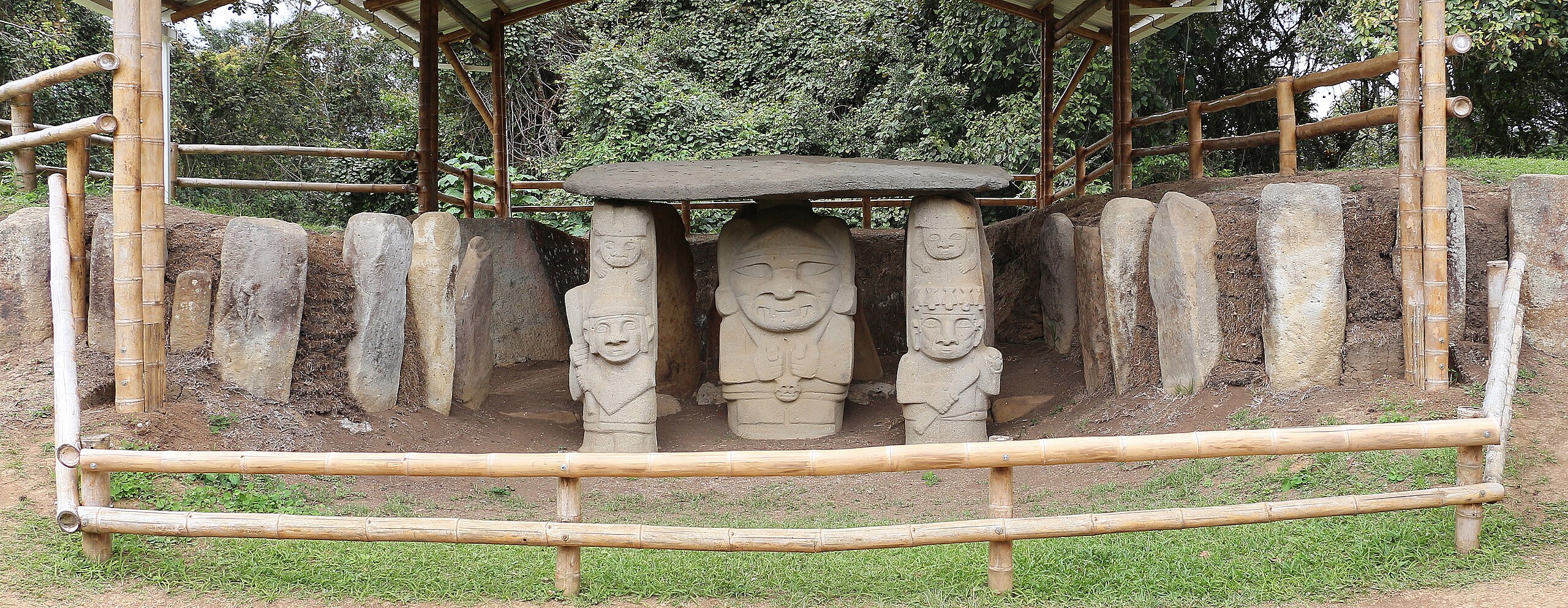
"Sixty-three statues encoding a cosmos: where the eagle holds the snake and the maternity mound bridges life and death"
San Augustin Terrace B
Huila, Huila, Colombia
Mesita B is where the San Agustin culture speaks most fluently. Three burial mounds, approximately one hundred and six tombs, and sixty-three statues constitute the most elaborate single site in the complex. Here the eagle grasps the snake, connecting the upper and lower realms. A maternity figure flanked by serpentine guardians holds birth and death in the same embrace. A teeth-counting system, six for jaguar, four for monkey, none for snake, reveals that these carvings follow a precise cosmological grammar.
Weather & Best Time
Plan Your Visit
Save this site and start planning your journey.
Quick Facts
Location
Huila, Huila, Colombia
Tradition
Site Type
Coordinates
1.8840, -76.2840
Last Updated
Mar 29, 2026
Mesita B is the most archaeologically and artistically significant of the Mesitas in San Agustin Archaeological Park, containing the highest concentration of statues and the most systematic iconographic program in the complex.
Origin Story
Mesita B's ground was first occupied as a settlement approximately five thousand years ago, making it one of the oldest habitation sites in the Upper Magdalena region. Over time, the community began burying their important dead here. By the first century CE, the site had been entirely transformed from settlement to sacred burial ground. Over the next eight hundred years, three major mounds were built and filled with tombs, each accompanied by newly carved guardian statues. When Preuss arrived in 1914, he found sixty-three statues arranged in a cosmological program that revealed the San Agustin culture's understanding of the universe as a system of interconnected realms guarded by spirit beings.
Key Figures
San Agustin master sculptors
original artists
The sculptors who created and maintained the systematic iconographic program over eight centuries, developing the teeth-counting code and the compositional vocabulary of the eagle-snake, maternity, and warrior arrangements.
Konrad Theodor Preuss
archaeologist
German archaeologist who discovered and documented the three funerary mounds and sixty-three statues at Mesita B in 1914, providing the foundational record of the most important single site in the San Agustin complex.
Spiritual Lineage
The lineage at Mesita B spans five thousand years of human presence, from the earliest settlement through eight centuries of systematic sculptural production to the modern era of archaeological study and conservation. The sculptural lineage itself, the formal transmission of the iconographic code across generations of carvers, represents one of the most sustained artistic traditions in the pre-Columbian Americas.
Know a Sacred Site We Should Include?
Help us expand our collection of sacred sites. Share your knowledge and contribute to preserving the world's spiritual heritage.