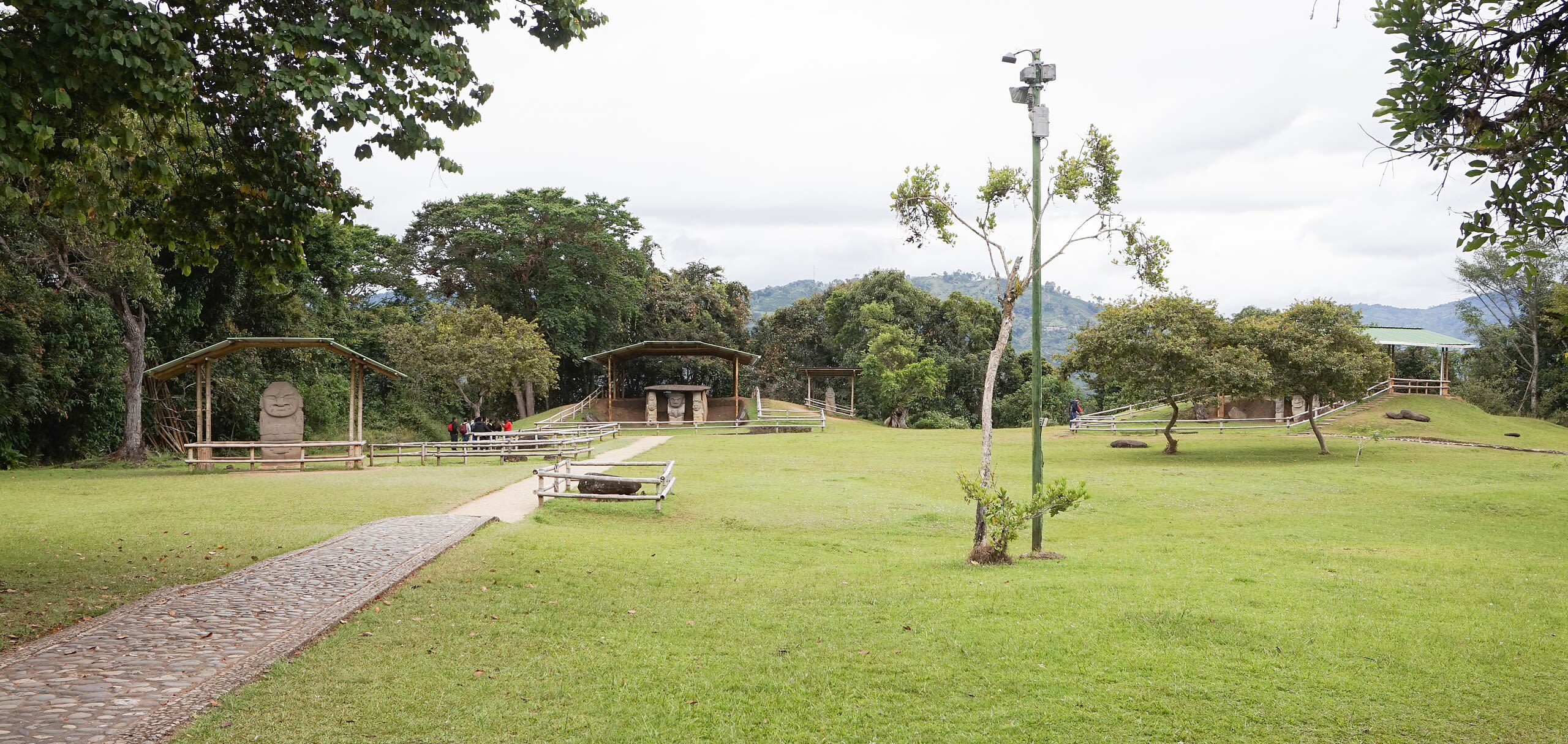
"The Americas' greatest necropolis, where three hundred stone guardians still watch over the dead they were carved to protect"
San Agustín Archaeological Park
Huila, Huila, Colombia
In the Colombian highlands where the Andes split and the Magdalena River begins, a civilization whose own name is lost created the largest collection of megalithic funerary sculpture in the Americas. Over a thousand years, they carved approximately three hundred guardians from volcanic stone and stationed them at the graves of their dead. The Fuente de Lavapatas, a ceremonial feature carved into a living stream, unites water and stone in a cosmological statement that no museum could contain.
Weather & Best Time
Plan Your Visit
Save this site and start planning your journey.
Quick Facts
Location
Huila, Huila, Colombia
Tradition
Site Type
Coordinates
1.9170, -76.2330
Last Updated
Mar 29, 2026
San Agustin Archaeological Park preserves the largest collection of megalithic funerary sculpture in the Americas, created by a culture that occupied the Colombian Massif from at least 300 BCE through the ninth century CE. UNESCO inscribed the site in 1995.
Origin Story
The San Agustin culture developed in the Colombian Massif, the mountainous knot where the Andes divide into three cordilleras and where the Magdalena River begins. In this place of geographical convergence, they created a civilization centered on the relationship between the living and the dead. Over more than a millennium, they carved hundreds of monumental statues to guard their dead, built mortuary temples to honor their ancestors, and carved ceremonial features into the living rock of stream beds.
The culture's own name is lost. San Agustin is a colonial designation, applied by the Spanish after the modern town. Their language is unknown. What survives is the stone record of their cosmology: a world divided into three realms, sky and earth and underworld, connected by the transformative power of beings who could cross between them.
People from across the Upper Magdalena region traveled to San Agustin to bury their important dead, making it a pilgrimage destination in the most literal sense: a place to which the dead were carried across distances, because this ground was understood as the proper threshold between worlds.
Key Figures
San Agustin culture sculptors
original builders
The unnamed artists and communities who created the largest body of megalithic funerary sculpture in the Americas over a period exceeding a thousand years. Their language, their name for themselves, and the specific details of their rituals are entirely lost; what survives is the cosmological vision they encoded in stone.
Friar Juan de Santa Gertrudis
first European documenter
Spanish friar who described the statues in 1758, providing the first written European account of the site. His report initiated the outside world's awareness of what the San Agustin people had created.
Konrad Theodor Preuss
archaeologist
German archaeologist who conducted the first systematic archaeological study of San Agustin in 1914. His documentation of the Mesitas and their statues remains foundational to the field.
ICANH
Instituto Colombiano de Antropologia e Historia
conservation steward
The Colombian government institution responsible for managing the park, overseeing archaeological research, and ensuring the preservation of the statues and burial mounds.
Spiritual Lineage
The lineage runs from unknown origins through approximately two millennia of active sculptural and funerary practice, then through silence, then through colonial encounter, then through modern archaeology. The culture itself left no written lineage, no succession of named leaders or artists. The lineage that exists is in the stone: early, simpler carvings giving way to increasingly complex iconographic programs, suggesting a tradition that developed, refined, and eventually ceased. The modern lineage of custodianship, from Preuss's documentation through the 1935 national park designation through UNESCO inscription, ensures that the culture's stone legacy persists even as its human context remains irrecoverable.
Know a Sacred Site We Should Include?
Help us expand our collection of sacred sites. Share your knowledge and contribute to preserving the world's spiritual heritage.