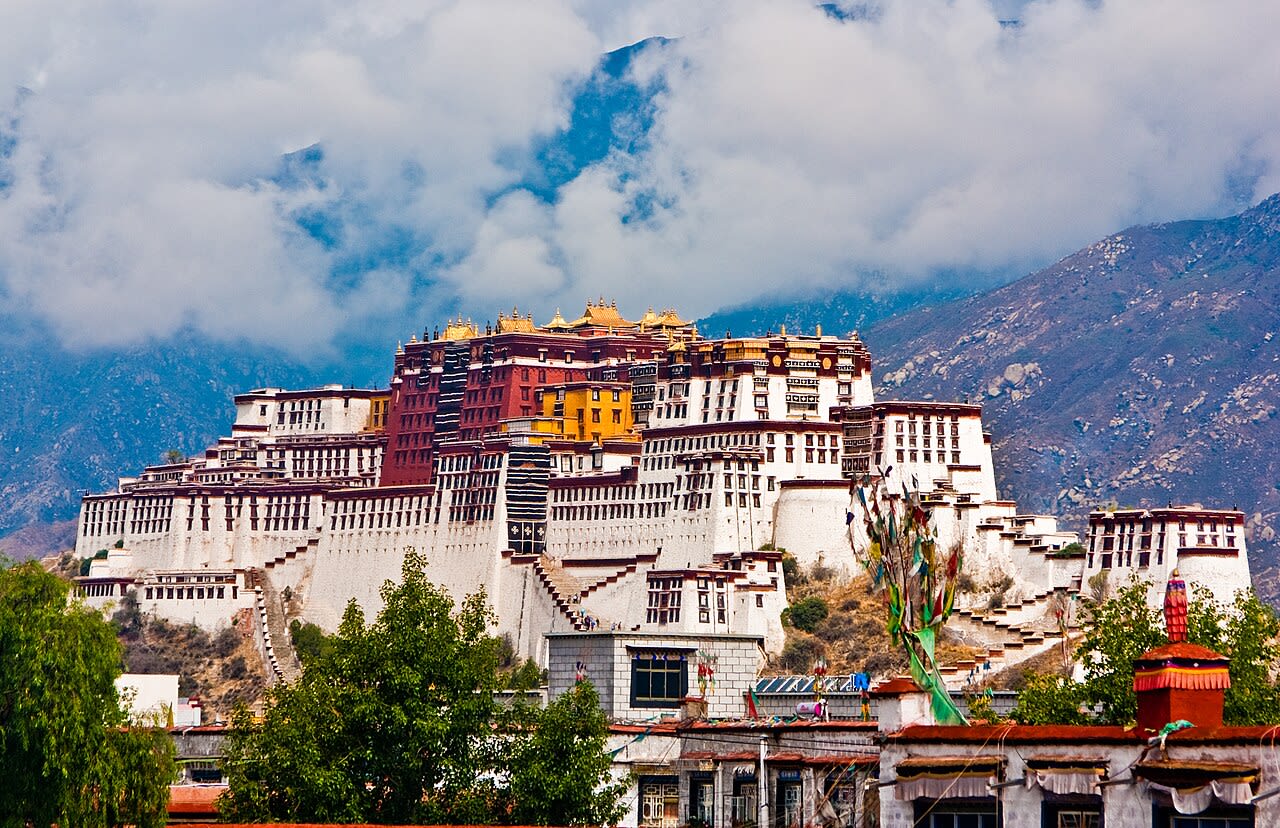
"The earthly seat of Avalokiteshvara, where compassion took architectural form above the Lhasa Valley"
Potala Palace
Chengguan District, Tibet, China
The Potala Palace rises 117 meters above the Lhasa Valley on the Red Hill, named for Avalokiteshvara's mythical abode, Mount Potalaka. For three centuries it was the winter residence of the Dalai Lamas, each understood as a living emanation of the bodhisattva of compassion. The Red Palace contains the gilded tomb stupas of eight Dalai Lamas. Since the 14th Dalai Lama's exile in 1959, the palace has functioned primarily as a museum, but Tibetan pilgrims continue to circle it daily, spinning prayer wheels and murmuring mantras.
Weather & Best Time
Plan Your Visit
Save this site and start planning your journey.
Quick Facts
Location
Chengguan District, Tibet, China
Coordinates
29.6555, 91.1186
Last Updated
Mar 29, 2026
Learn More
The Potala Palace was the winter residence of the Dalai Lamas from the 17th century until 1959, named for Avalokiteshvara's mythical abode. It contains the gilded tomb stupas of eight Dalai Lamas and one of the most important collections of Tibetan Buddhist art in the world.
Origin Story
King Songtsen Gampo, the first great Buddhist king of Tibet and himself regarded as an emanation of Avalokiteshvara, built a palace on the Red Hill in the seventh century to honor his bride, Princess Wencheng of Tang China, who brought a precious Jowo Buddha statue to Tibet. When the 5th Dalai Lama rebuilt the palace a millennium later, he consciously reconnected with this origin, establishing the Potala as the seat where Avalokiteshvara's compassion continually manifests in the world.
The Red Hill itself is understood as a natural sacred formation, one of three sacred hills in the Lhasa Valley. Tibetan tradition holds that the hill is a manifestation of Avalokiteshvara's spiritual presence, the deity having chosen this point on the earth's surface as a gateway between the human and enlightened realms.
Key Figures
King Songtsen Gampo
སྲོང་བཙན་སྒམ་པོ
founder
First great Buddhist king of Tibet, regarded as an emanation of Avalokiteshvara. Built the original palace on Red Hill in 637 CE.
5th Dalai Lama, Lobsang Gyatso
ངག་དབང་བློ་བཟང་རྒྱ་མཚོ
builder
The Great Fifth Dalai Lama who reunified Tibet and commissioned the current White Palace beginning in 1645.
Desi Sangye Gyatso
builder
Regent who completed the Red Palace by 1694, concealing the 5th Dalai Lama's death for fifteen years to ensure the construction's completion.
14th Dalai Lama, Tenzin Gyatso
བསྟན་འཛིན་རྒྱ་མཚོ
spiritual_leader
The current Dalai Lama who fled the Potala in March 1959 during the Tibetan uprising and has lived in exile in India since. His absence defines the palace's contemporary significance.
Spiritual Lineage
The Dalai Lama lineage traces from the 1st Dalai Lama, a disciple of Tsongkhapa, through fourteen incarnations to the present. The Potala was the seat of this lineage from the 5th Dalai Lama until 1959. The palace continues to hold the remains of eight Dalai Lamas, making it the most concentrated repository of the lineage's physical heritage.
Know a Sacred Site We Should Include?
Help us expand our collection of sacred sites. Share your knowledge and contribute to preserving the world's spiritual heritage.