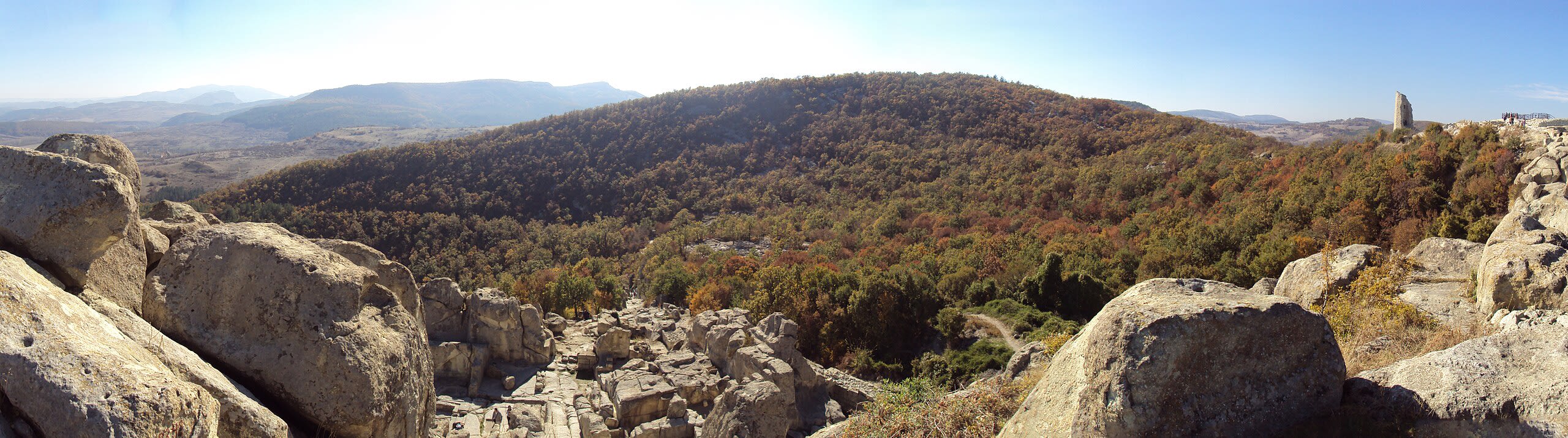
"A sacred city carved from volcanic rock where an oracle counseled Alexander the Great"
Perperikon
Gorna Krepost, Kardzhali, Bulgaria
Perperikon is a city carved entirely from volcanic rock, rising from a hilltop in the eastern Rhodope Mountains. For seven thousand years, from the Neolithic period through the medieval era, human hands shaped this stone into temples, palaces, streets, and altars. Identified as the likely Temple of Dionysus described by Herodotus, it housed a fire and wine oracle that reportedly prophesied the conquests of Alexander the Great and the rise of Emperor Augustus.
Weather & Best Time
Plan Your Visit
Save this site and start planning your journey.
Quick Facts
Location
Gorna Krepost, Kardzhali, Bulgaria
Coordinates
41.7166, 25.4686
Last Updated
Mar 29, 2026
Learn More
Perperikon has been inhabited since approximately 5000 BC. The Bessi tribe operated a fire and wine oracle here that is identified as the Temple of Dionysus described by Herodotus. Alexander the Great reportedly visited in 334 BC. The site transitioned through Roman and medieval periods before abandonment in 1362. Systematic excavation began in 2000.
Origin Story
Herodotus, writing in the 5th century BC, described a temple of Dionysus in the Rhodope Mountains maintained by the Bessi tribe, where a priestess delivered oracles as at Delphi. The identification of Perperikon as this temple, while not universally accepted, is supported by the archaeological evidence: carved altars with basins for wine offerings, a summit position matching the literary descriptions, and a location in Bessi tribal territory.
The oracle's method was elemental. Wine was poured on a sacred fire. The behavior of the resulting flames carried the messages of Dionysus. When the flames leaped high and burned bright, the oracle was favorable. The simplicity of the medium belied the theological sophistication behind it. Dionysus, in Thracian understanding, was the god of ecstasy and transformation, and the fire-wine ritual enacted his power.
The oracle's reputation extended beyond Thracian lands. Suetonius records that Octavian's father visited and received a prophecy of world rule for his son. The Alexander tradition, though less well documented, claims the Macedonian king received a prophecy of universal conquest before crossing into Asia in 334 BC. Whether literally true, these stories testify to the oracle's international reputation.
Key Figures
Professor Nikolay Ovcharov
Excavator and site champion
The Bessi tribe
Oracle keepers
Herodotus
Ancient chronicler
Alexander the Great
Famous consultant
Spiritual Lineage
Perperikon represents the longest continuous sacred occupation in the Balkans, spanning from Neolithic settlement through Thracian oracle through Roman settlement through medieval Christian fortress. The Thracian oracle tradition connects to the broader Greek Dionysian religion, though the relationship between Thracian and Greek Dionysian worship remains debated. The medieval Christian phase represents the pattern, common across the ancient world, of Christian communities building on pre-Christian sacred sites.
Know a Sacred Site We Should Include?
Help us expand our collection of sacred sites. Share your knowledge and contribute to preserving the world's spiritual heritage.