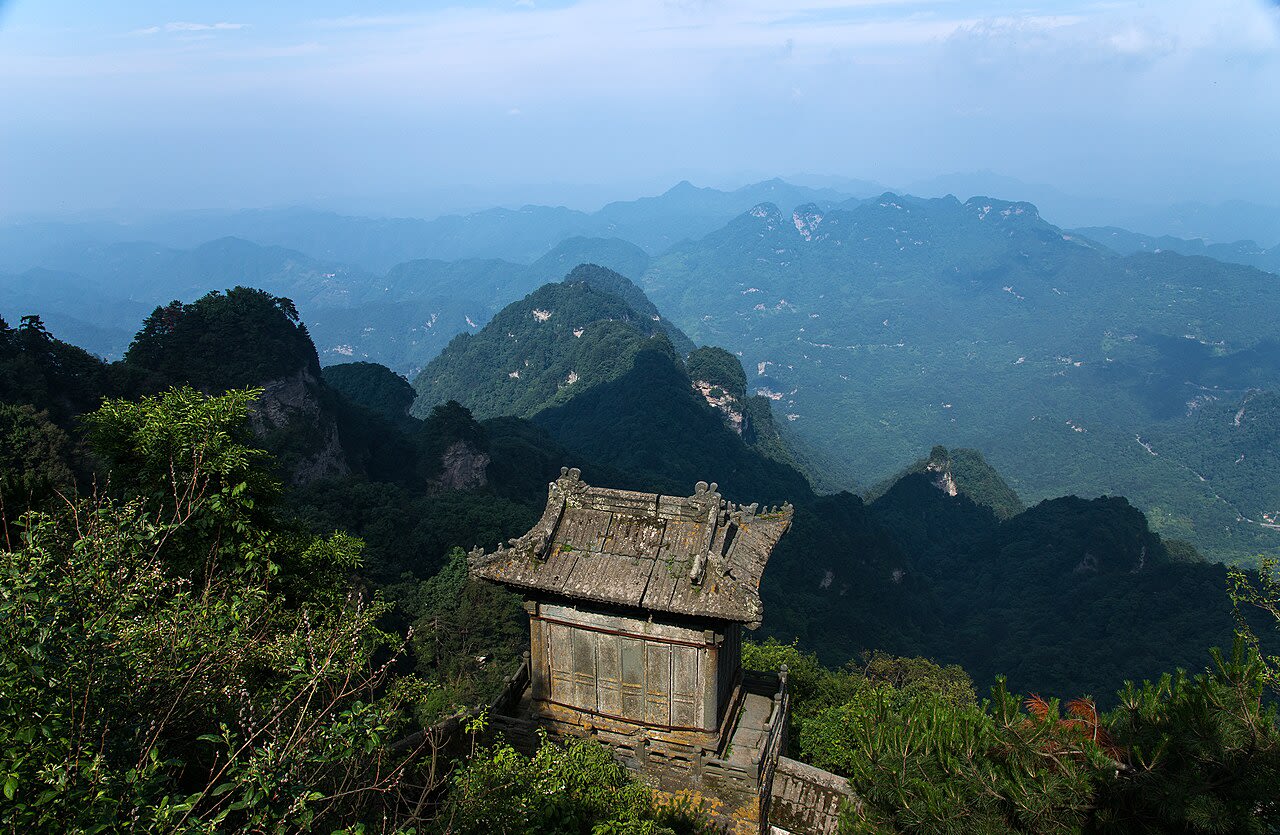
"Where the Perfected Warrior attained immortality and softness learned to overcome hardness"
Mt. Wu Tang Shan
Danjiangkou City, Hubei, China
Wudangshan is one of the Four Sacred Mountains of Taoism, the dwelling place of Zhenwu, the Perfected Warrior who governs the northern quarter of heaven. Its seventy-two peaks, bowing toward the central summit like courtiers before a throne, form a natural mandala that the Ming Emperor Yongle transformed into a cosmic diagram in stone. Three hundred thousand workers spent twelve years building the temple complex. The mountain is also the birthplace of tai chi and the internal martial arts, where Zhang Sanfeng observed a crane fighting a snake and derived the principle that softness overcomes hardness.
Weather & Best Time
Plan Your Visit
Save this site and start planning your journey.
Quick Facts
Location
Danjiangkou City, Hubei, China
Coordinates
32.3985, 111.0103
Last Updated
Mar 29, 2026
Learn More
Wudangshan is one of the Four Sacred Mountains of Taoism, built by Emperor Yongle of the Ming Dynasty with 300,000 workers over twelve years. The mountain is the traditional birthplace of tai chi and the internal martial arts. UNESCO recognized the ancient building complex in 1994.
Origin Story
A crown prince of the ancient kingdom of Jingle renounced his throne to cultivate the Tao on Wudang Mountain. After forty-two years of arduous practice, he attained enlightenment and ascended to heaven as the deity Zhenwu, the Perfected Warrior. The Jade Emperor appointed him guardian of the northern heavens. His cultivation site at the summit became the holiest point.
Zhang Sanfeng, a Taoist immortal of uncertain historicity, observed a crane fighting a snake on Wudang Mountain. From the snake's yielding, coiling movements that deflected the crane's hard strikes, he derived the principle of softness overcoming hardness. This observation became the foundation of tai chi and the internal martial arts. Zhang Sanfeng is said to have lived over two hundred years. Emperor Yongle sent envoys to find him on Wudang but failed.
Key Figures
Zhenwu (Xuantian Shangdi)
真武 (玄天上帝)
deity
The Perfected Warrior, guardian of the northern heavens, who attained immortality on Wudang Mountain after forty-two years of cultivation. The mountain's primary object of worship.
Emperor Yongle (Zhu Di)
永乐帝 (朱棣)
patron
Ming Dynasty emperor who commissioned the massive temple building program with 300,000 workers over twelve years, believing Zhenwu had assisted his rise to power.
Zhang Sanfeng
张三丰
legendary_founder
Legendary or semi-legendary Taoist immortal credited with founding tai chi and the internal martial arts on Wudang Mountain. His historicity is debated by scholars, but the tradition he represents is foundational.
Spiritual Lineage
The Taoist lineage at Wudangshan extends from the Tang Dynasty through the Ming imperial construction to the present monastic community. The martial arts lineage traces from Zhang Sanfeng through generations of Wudang practitioners to contemporary schools. Both continue as living traditions.
Know a Sacred Site We Should Include?
Help us expand our collection of sacred sites. Share your knowledge and contribute to preserving the world's spiritual heritage.