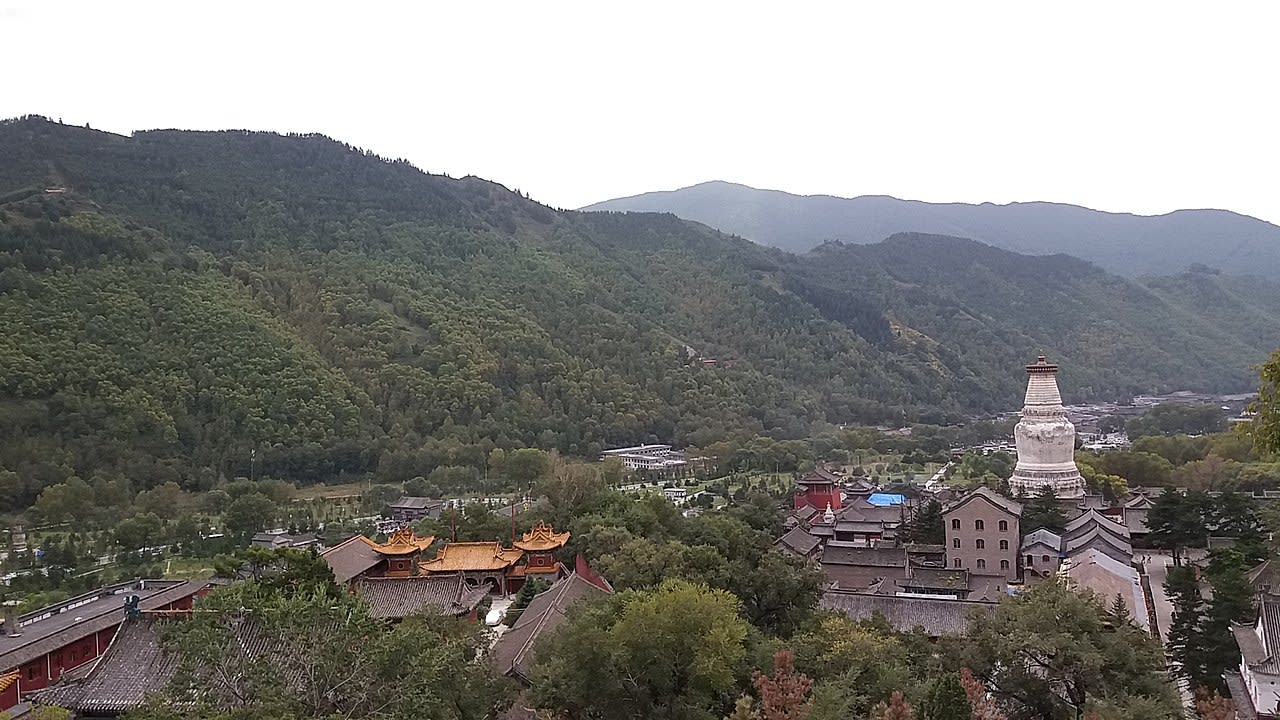
"Dwelling place of Manjushri, where Chinese and Tibetan Buddhism worship the same wisdom on the same mountain"
Mt. Wu Tai Shan
Taihuai, Shanxi, China
Mount Wutai is the earthly home of Manjushri, the Bodhisattva of Wisdom, identified in the Avatamsaka Sutra as residing on a Clear Cool Mountain in the northeast. Five flat-topped peaks represent the five aspects of perfect understanding. Approximately forty to fifty functioning monasteries maintain daily services, with Chinese and Tibetan Buddhist traditions practicing side by side, a coexistence found nowhere else in China. The Tang Dynasty East Main Hall of Foguang Temple, from 857 CE, is one of the oldest surviving wooden structures in China.
Weather & Best Time
Plan Your Visit
Save this site and start planning your journey.
Quick Facts
Location
Taihuai, Shanxi, China
Coordinates
39.0299, 113.5627
Last Updated
Mar 29, 2026
Learn More
Mount Wutai is the dwelling place of Manjushri, Bodhisattva of Wisdom, one of the Four Sacred Buddhist Mountains of China, and the only one with UNESCO World Heritage status. The coexistence of Chinese and Tibetan Buddhist traditions over seven centuries is unique in Chinese Buddhism.
Origin Story
The Avatamsaka Sutra describes a Clear Cool Mountain in the northeast where Manjushri dwells with an assembly of ten thousand bodhisattvas. Chinese Buddhists identified this mountain as Wutaishan, its five flat-topped peaks matching the description, its cool climate contrasting with the surrounding lowlands.
Throughout the mountain's history, pilgrims have reported Manjushri apparitions: lights on the peaks, monks encountered on the path who vanish, visions during meditation. The Tang Dynasty master Amoghavajra received a vision of Manjushri that led him to establish esoteric Buddhist practice on the mountain.
Key Figures
Manjushri (Wenshu Pusa)
文殊菩萨
deity
Bodhisattva of Wisdom who dwells on Mount Wutai with ten thousand bodhisattvas. Depicted wielding the sword of insight that cuts through delusion. Central figure of devotion for all traditions on the mountain.
Amoghavajra
不空金刚
tantric_master
Tang Dynasty tantric master who established esoteric Buddhist practice at Wutaishan following a vision of Manjushri.
Liang Sicheng
梁思成
architectural_historian
Chinese architectural historian who rediscovered the Tang Dynasty East Main Hall of Foguang Temple in 1937, identifying one of the oldest surviving wooden buildings in China.
Spiritual Lineage
Chinese Buddhist presence from the Northern Wei Dynasty. Tibetan Buddhist presence from the Yuan Dynasty. The mountain has been a pan-Asian pilgrimage destination for over 1,500 years, with documented visitors from Japan, Korea, India, and Tibet. The UNESCO inscription recognizes 1,600 years of continuous Buddhist architectural and spiritual development.
Know a Sacred Site We Should Include?
Help us expand our collection of sacred sites. Share your knowledge and contribute to preserving the world's spiritual heritage.