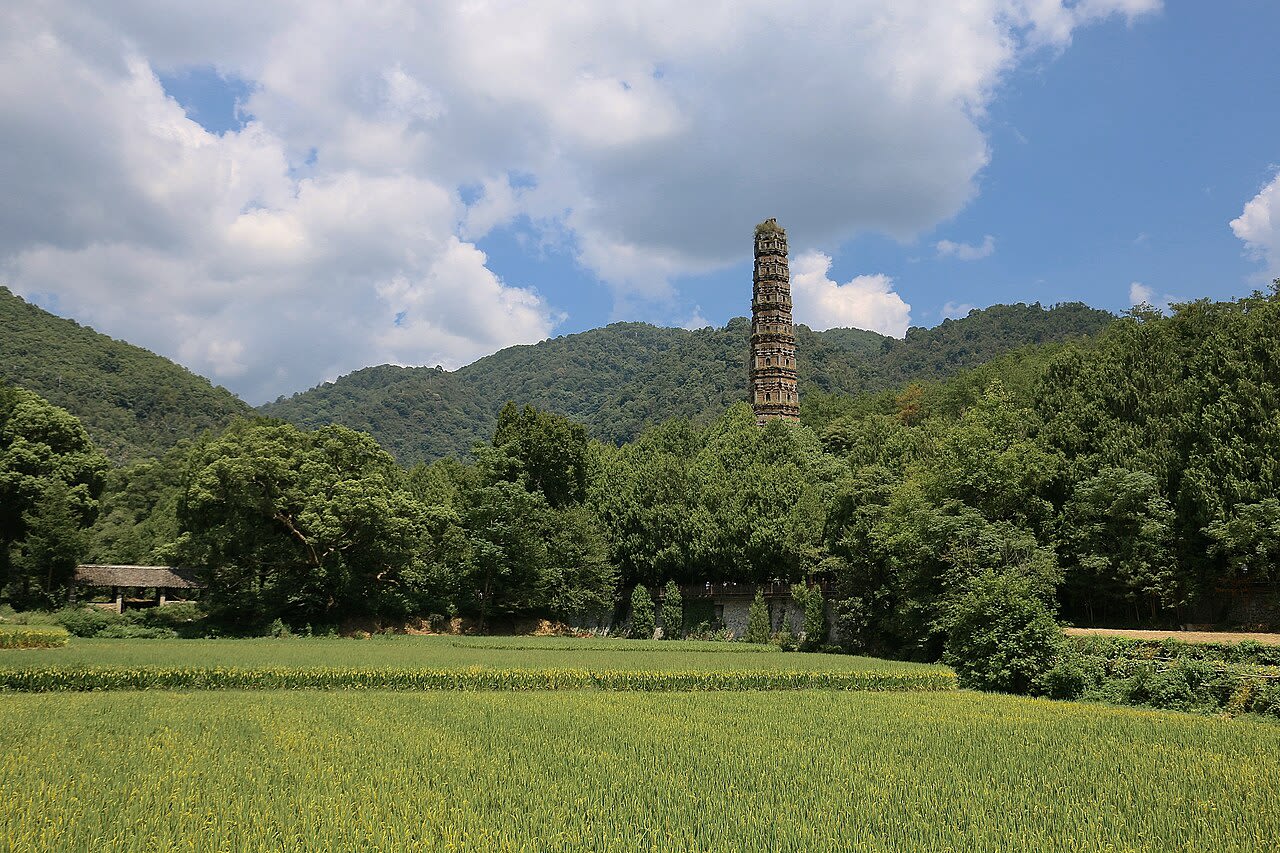
"Where Chinese Buddhism found its own voice, and a hermit poet wrote on rocks what monasteries could not contain"
Mt. Tiantai Shan
Tiantai County, Zhejiang, China
Mount Tiantai is the birthplace of Tiantai Buddhism, the first purely Chinese school of Buddhist philosophy. Here Zhiyi systematized the Lotus Sutra into a comprehensive path that influenced every subsequent Buddhist tradition in East Asia. When Saicho carried these teachings to Japan in 805 CE, Tendai Buddhism became the foundation from which Zen, Pure Land, and Nichiren all eventually emerged. The Cold Mountain poet Hanshan, whose eccentric verse was written on cliffs and tree bark, lived somewhere on these mist-shrouded slopes.
Weather & Best Time
Plan Your Visit
Save this site and start planning your journey.
Quick Facts
Location
Tiantai County, Zhejiang, China
Coordinates
29.1500, 121.0427
Last Updated
Mar 29, 2026
Learn More
Mount Tiantai is the birthplace of the Tiantai school, the first Chinese school of Buddhist philosophy. Zhiyi's systematization of the Lotus Sutra here between 575 and 597 CE influenced virtually every subsequent Buddhist tradition in East Asia. The mountain also hosts Tongbai Monastery, the cradle of Southern Taoism.
Origin Story
Zhiyi, drawn by a vision, came to Mount Tiantai and established himself on Huading Peak. There he developed his comprehensive system of Buddhist philosophy, using the Lotus Sutra as the key to organizing all Buddhist teachings into a single coherent framework. His central insight was that all beings possess Buddha-nature and all paths lead ultimately to Buddhahood. Before he died in 597 CE, he had created the most sophisticated Buddhist philosophical system in Chinese history. Emperor Yang of the Sui Dynasty, honoring Zhiyi's achievement, built Guoqing Temple the following year.
Hanshan was a hermit who lived in a cave on the Cold Cliff of Mount Tiantai, writing poems on rocks, trees, and walls. His friend Shide worked in the kitchen of Guoqing Temple. Together they embodied a wild, laughing wisdom that defied convention. When the official Luqiu Yin came to honor them on the emperor's instructions, they laughed and ran into the mountains, never to be seen again.
Key Figures
Zhiyi
智顗 (also known as Tiantai Dashi)
founder
Founder of the Tiantai school and systematizer of Chinese Buddhist philosophy. His Great Calming and Contemplation (Mohe Zhiguan) remains one of the most important works in Chinese Buddhist literature.
Saicho
最澄
transmitter
Japanese monk who studied at Guoqing Temple in 805 CE and founded Japanese Tendai Buddhism on Mount Hiei. His transmission made Tiantai the mother tradition of most Japanese Buddhist schools.
Hanshan (Cold Mountain)
寒山
poet_hermit
Eccentric poet-hermit who lived on Mount Tiantai, writing poems on rocks and walls. His verse became foundational in Chan literature and inspired the Beat Generation a millennium later. Whether he was a single historical person or a composite literary persona is debated.
Shide
拾得
poet_hermit
Kitchen worker at Guoqing Temple and companion of Hanshan. Together they embody the tradition of crazy wisdom, enlightenment expressed through laughter and freedom rather than propriety.
Spiritual Lineage
The Tiantai lineage runs from Zhiyi through successive patriarchs to the present monastic community at Guoqing Temple. The Japanese Tendai lineage traces from Saicho's 805 CE visit. Korean Cheontae holds the same connection. The Cold Mountain literary tradition runs from Hanshan through centuries of Chinese poetry to Gary Snyder and the Beat Generation. The Taoist lineage at Tongbai Monastery traces the Shangqing tradition of Southern Taoism.
Know a Sacred Site We Should Include?
Help us expand our collection of sacred sites. Share your knowledge and contribute to preserving the world's spiritual heritage.