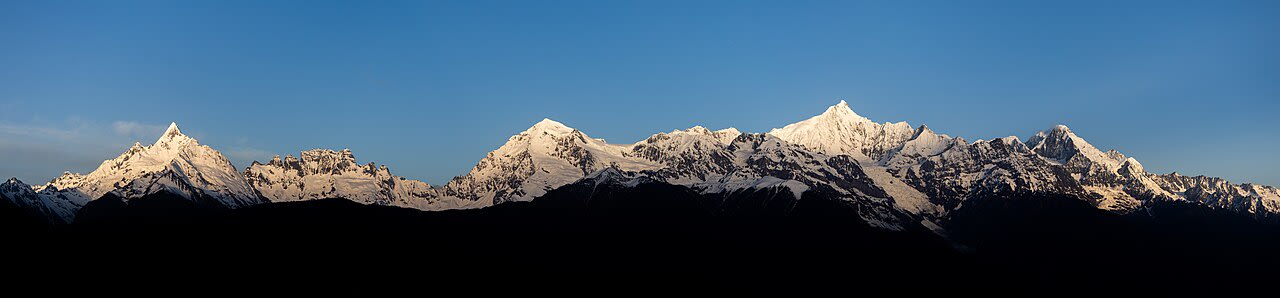
"The highest unclimbed peak over 6,000 meters, where a warrior god remains undisturbed"
Mt. Meili Xue
Zogang County, Tibet, China
Kawagebo, the 6,740-meter summit of the Meili Snow Mountains on the Yunnan-Tibet border, is the highest unclimbed peak over 6,000 meters in the world. This is not a failure of mountaineering ambition but a deliberate act of reverence. After an avalanche killed seventeen climbers in 1991, Yunnan Province permanently banned all climbing attempts, honoring Tibetan belief that the mountain is the dwelling of a warrior god whose summit must remain inviolate.
Weather & Best Time
Plan Your Visit
Save this site and start planning your journey.
Quick Facts
Location
Zogang County, Tibet, China
Coordinates
28.4399, 98.6845
Last Updated
Mar 29, 2026
Learn More
Kawagebo is one of the eight great sacred mountains of the Khampa Tibetan region, home to a warrior god converted to Buddhism by Padmasambhava. The 1991 climbing disaster and subsequent permanent ban confirmed the mountain's inviolate status.
Origin Story
When Padmasambhava — Guru Rinpoche, the master who brought Buddhism to Tibet — arrived in the Khampa region, the warrior deity Kawagebo resisted violently. A fierce spiritual battle ensued. Padmasambhava subdued Kawagebo and converted him to a protector of the Buddhist Dharma. The mountain became his palace and the entire massif his sacred domain.
This conversion narrative is characteristic of Tibetan Buddhism's relationship with the pre-Buddhist landscape. The mountain deities were not destroyed or denied. They were incorporated — their power acknowledged and redirected in service of the Dharma. Kawagebo's warrior nature was preserved, making him both protector and threat: he defends the faithful and punishes the sacrilegious.
Key Figures
Padmasambhava (Guru Rinpoche)
The master who brought Buddhism to Tibet in the eighth century and, in the founding legend, subdued and converted the warrior deity Kawagebo from a hostile mountain god to a Buddhist Dharma protector.
Kawagebo (deity)
The warrior god who resides on the mountain — chief of the sacred mountains of the Khampa region and one of the most powerful mountain deities in the Tibetan Buddhist pantheon.
The seventeen climbers of 1991
The joint Sino-Japanese expedition whose death in an avalanche on the northwest face confirmed, for the Tibetan community, the mountain god's power and led to the permanent climbing ban.
Spiritual Lineage
The mountain's sacred lineage extends from pre-Buddhist Tibetan mountain deity worship through Padmasambhava's conversion of Kawagebo to the living Tibetan Buddhist tradition that maintains the kora pilgrimage today. The 1991 disaster and the 2001 climbing ban represent the most recent chapter in the mountain's ongoing assertion of sacred sovereignty.
Know a Sacred Site We Should Include?
Help us expand our collection of sacred sites. Share your knowledge and contribute to preserving the world's spiritual heritage.