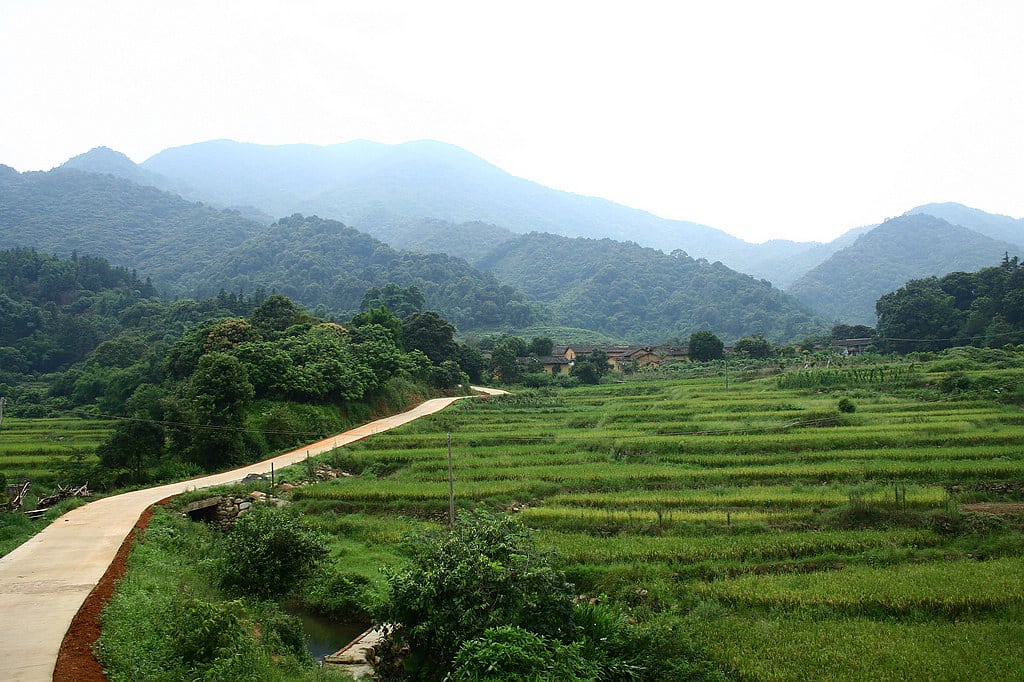
"The alchemist's mountain, where Ge Hong sought immortality among medicinal forests"
Mt. Luo Fu Shan
Huizhou, Guangdong Province, China
Luofu Shan in Guangdong Province is one of the Ten Great Cave Heavens of Taoist sacred geography — a classification that places it among the most spiritually significant sites in China. The mountain owes its identity to Ge Hong, the fourth-century alchemist-philosopher who spent his final years here practicing alchemy, studying medicinal herbs, and writing one of the foundational texts of Chinese civilization. His legacy persists in active Taoist temples, a tradition of herbal medicine, and a landscape of extraordinary biodiversity.
Weather & Best Time
Plan Your Visit
Save this site and start planning your journey.
Quick Facts
Location
Huizhou, Guangdong Province, China
Coordinates
23.3002, 113.9991
Last Updated
Mar 29, 2026
Learn More
Ge Hong, the fourth-century alchemist-philosopher, spent his final seventeen years at Luofu Shan pursuing the transmutation of matter and the achievement of immortality. His work laid foundations for Chinese alchemy, pharmacology, and natural philosophy.
Origin Story
According to Taoist legend, Luofu Shan was formed when two mountains merged — Mount Luo, a terrestrial peak, and Mount Fu, a floating immortals' island from the South China Sea that drifted and attached itself to Mount Luo. The mountain thus carries the combined spiritual power of both earth and heaven.
Ge Hong chose the mountain with the precision of a scientist selecting a laboratory. His research required specific conditions: cinnabar deposits for alchemical operations, a diversity of medicinal plants for pharmacological study, and the concentrated qi that Taoist theory predicted at a site of such geological and ecological richness. He found all of these at Luofu Shan.
When Ge Hong died in 343 CE, Taoist accounts record that his coffin was as light as if empty — his body had been transformed. The Chongxu Temple was founded to mark this event, and the mountain's identity as a place where the boundary between mortal and immortal had been crossed was established.
Key Figures
Ge Hong (葛洪, 283-343 CE)
Taoist philosopher, alchemist, and pharmacologist whose seventeen years of practice at Luofu Shan produced the Baopuzi and established the mountain's sacred identity. His work contributed to the foundations of Chinese chemistry, pharmacology, and natural philosophy.
Su Shi (Su Dongpo, 1037-1101)
Song Dynasty poet and statesman who visited Luofu Shan and wrote about its lychees. His literary attention added cultural significance to the mountain's sacred and natural identity.
Joseph Needham
British scholar whose monumental Science and Civilisation in China extensively discussed Ge Hong's contributions and their setting at Luofu Shan, bringing the mountain's significance to international scholarly attention.
Spiritual Lineage
The religious lineage at Luofu Shan flows from Ge Hong's individual alchemical practice to an institutional Taoist presence maintained through imperial patronage across multiple dynasties. The tradition of herbal medicine connected to Ge Hong's pharmacological research has continued in parallel with formal Taoist practice, creating an unusual site where spiritual cultivation and practical healing have always been intertwined.
Know a Sacred Site We Should Include?
Help us expand our collection of sacred sites. Share your knowledge and contribute to preserving the world's spiritual heritage.