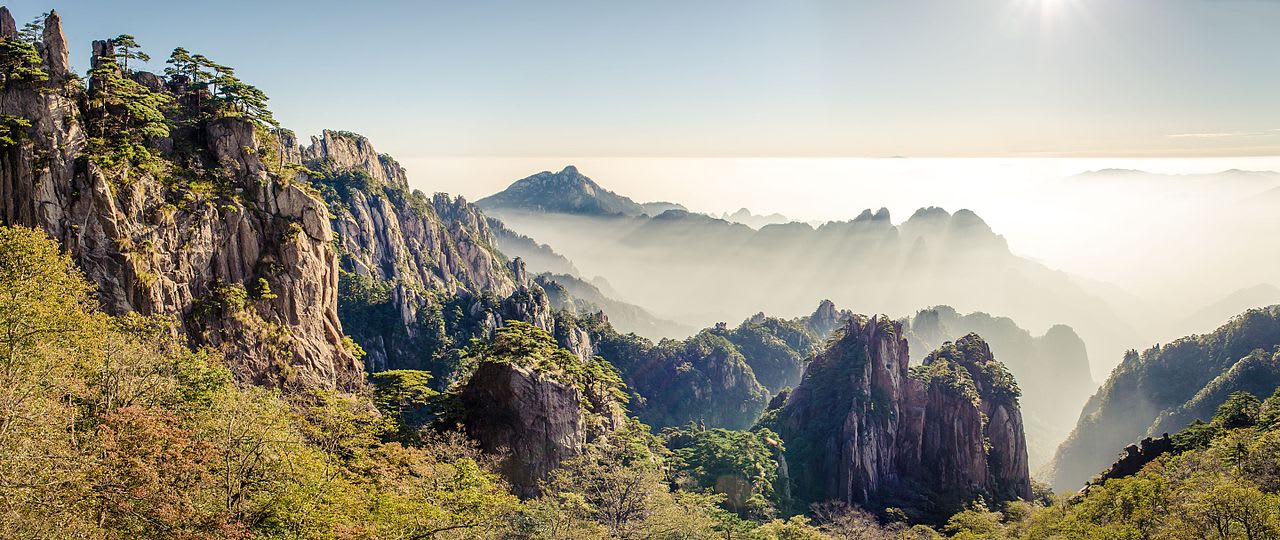
"The mountain that taught China to paint, where the Yellow Emperor sought immortality above a sea of clouds"
Mt. Huang Shan
Huangshan District, Anhui, China
Huangshan rises from southern Anhui Province in a formation of granite peaks, ancient pines, and cloud phenomena that has defined the Chinese aesthetic imagination for over a millennium. Named for the Yellow Emperor who legendarily achieved immortality on its slopes, the mountain hosted 64 temples during its religious peak and inspired the Huangshan School of landscape painting whose masters produced some of the greatest works in Chinese art history. A UNESCO World Heritage Site since 1990, the mountain's 60,000 stone steps wind through a landscape where stone, tree, and cloud create compositions that centuries of painters have tried and failed to exhaust.
Weather & Best Time
Plan Your Visit
Save this site and start planning your journey.
Quick Facts
Location
Huangshan District, Anhui, China
Coordinates
30.1378, 118.1652
Last Updated
Mar 29, 2026
Learn More
Huangshan was renamed in honor of the Yellow Emperor in 747 CE and inspired the Huangshan School of landscape painting, one of the most important movements in Chinese art history. UNESCO inscription in 1990 recognized both cultural and natural significance.
Origin Story
The Yellow Emperor, the legendary progenitor of Chinese civilization, is said to have practiced alchemical self-cultivation on the mountain and achieved immortality, ascending to heaven from its peaks. The mountain was originally called Yishan until 747 CE, when Emperor Xuanzong of the Tang Dynasty renamed it Huangshan in the Yellow Emperor's honor. The hot springs were discovered, according to tradition, during the Yellow Emperor's practice, understood as the earth's own vital energy rising to the surface to sustain the seeker of immortality.
Key Figures
The Yellow Emperor (Huangdi)
The mythical progenitor of Chinese civilization, said to have achieved immortality through alchemical cultivation on the mountain. His legendary presence connects Huangshan to the deepest layer of Chinese cultural identity and the Taoist quest for transcendence.
Shitao (1642-1707)
One of the greatest Chinese landscape painters, whose work at Huangshan helped establish the mountain as the supreme subject of Chinese painting. Shitao's art treated painting not as representation but as communion with the creative force that shaped the mountain.
Hongren (1610-1664)
A founder of the Huangshan School whose austere, geometrically precise paintings of the mountain's granite peaks established a visual language for Huangshan that influenced all subsequent depictions.
Xu Xiake (1586-1641)
The Ming Dynasty travel writer whose declaration that after Huangshan no other mountain compares established the mountain's pre-eminence in Chinese literary and travel culture. His detailed accounts of the mountain's features and trails are still consulted.
Spiritual Lineage
Huangshan's cultural lineage connects the Yellow Emperor legend, Taoist hermit practice, Buddhist monasticism (64 temples at the Yuan Dynasty peak), the Huangshan School of painting, and the modern tradition of cultural and photographic pilgrimage. The thread running through all periods is the understanding that the mountain's beauty is not merely visual but revelatory: a direct expression of the underlying pattern of reality that each tradition, from Taoist alchemy to Buddhist meditation to landscape painting, has approached in its own way.
Know a Sacred Site We Should Include?
Help us expand our collection of sacred sites. Share your knowledge and contribute to preserving the world's spiritual heritage.