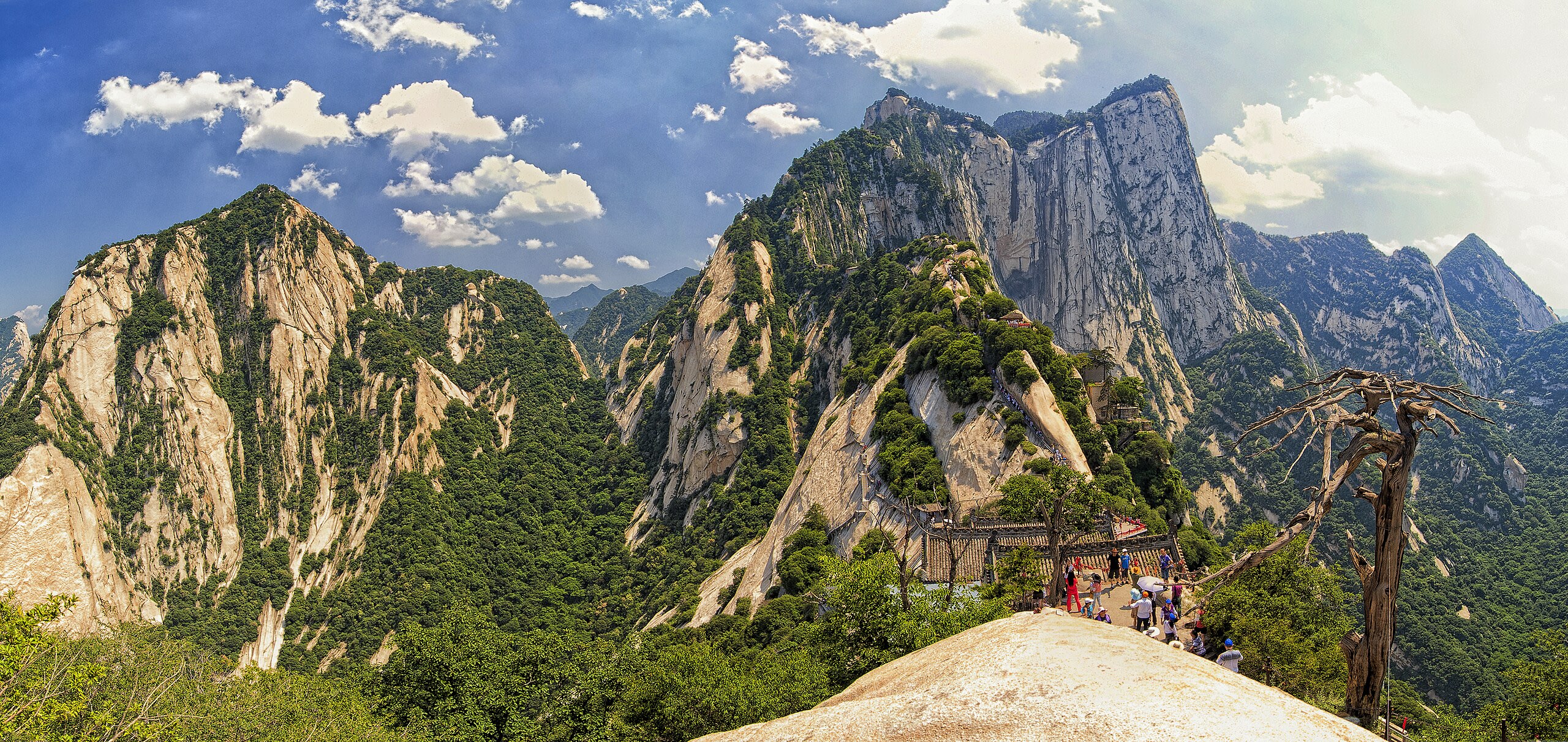
"The Western Peak, where Taoist hermits carved paths to enlightenment across sheer granite cliffs"
Mt. Hua Shan
Huayin City, Shaanxi, China
Hua Shan rises 2,155 meters from the Wei River plain in Shaanxi Province, the Western Peak of the Five Great Mountains and the most dramatically Taoist of the group. Its sheer granite cliffs, near-vertical ascent routes, and the infamous Plank Walk suspended over a thousand-meter void have made it both a center of Taoist hermit practice and one of the most physically confrontational sacred mountains on earth. Chen Tuan, one of Taoism's most celebrated sages, lived as a hermit on this mountain for over forty years.
Weather & Best Time
Plan Your Visit
Save this site and start planning your journey.
Quick Facts
Location
Huayin City, Shaanxi, China
Coordinates
34.4850, 110.0822
Last Updated
Mar 29, 2026
Learn More
Hua Shan is the Western Peak of the Five Great Mountains and the most predominantly Taoist of the group. Chen Tuan's forty-year hermitage in the 10th century established the mountain's identity as a center of Taoist cultivation through non-doing.
Origin Story
According to legend, the mountain was created when the giant Ju Ling used supernatural strength to split a single peak into five, creating the narrow passages between them. Chen Tuan is said to have defeated Emperor Taizu of Song in a game of chess atop East Peak, winning perpetual tax exemption for the mountain and establishing the principle that sacred mountains belong to the spiritual realm, not the state. The Jade Lady for whom Central Peak's temple is named was a daughter of the Duke of Qin who achieved immortality through Taoist cultivation on the mountain.
Key Figures
Chen Tuan
One of the most celebrated Taoist sages, who lived as a hermit on Hua Shan for over forty years in the 10th century. His practice of sleep cultivation (shui gong), his contributions to internal alchemy and the taijitu (yin-yang diagram), and his legendary chess match with the emperor established the mountain's philosophical identity and profoundly influenced both Taoism and Neo-Confucianism.
The Quanzhen school founders
The Complete Reality school of Taoism, founded in the 12th century, established the Jade Spring Temple as its regional center on Hua Shan. The Quanzhen emphasis on internal cultivation rather than external alchemy aligned with the mountain's hermit tradition.
The anonymous cave hermits
Generations of unnamed Taoist practitioners who carved caves into the mountain's 72 cliff faces and lived in solitary practice for periods ranging from years to lifetimes. Their existence is documented more through the caves they left than through written records.
Spiritual Lineage
Hua Shan's spiritual lineage is fundamentally Taoist, tracing from ancient mountain worship through the Shangqing school to the Quanzhen establishment that persists today. Chen Tuan stands at the center of this lineage as the figure who synthesized hermit practice, internal alchemy, and cosmological philosophy into a coherent tradition. His contributions to the taijitu diagram and to the understanding of the relationship between stillness and movement influenced both Taoist and Confucian thought for centuries after his death.
Know a Sacred Site We Should Include?
Help us expand our collection of sacred sites. Share your knowledge and contribute to preserving the world's spiritual heritage.