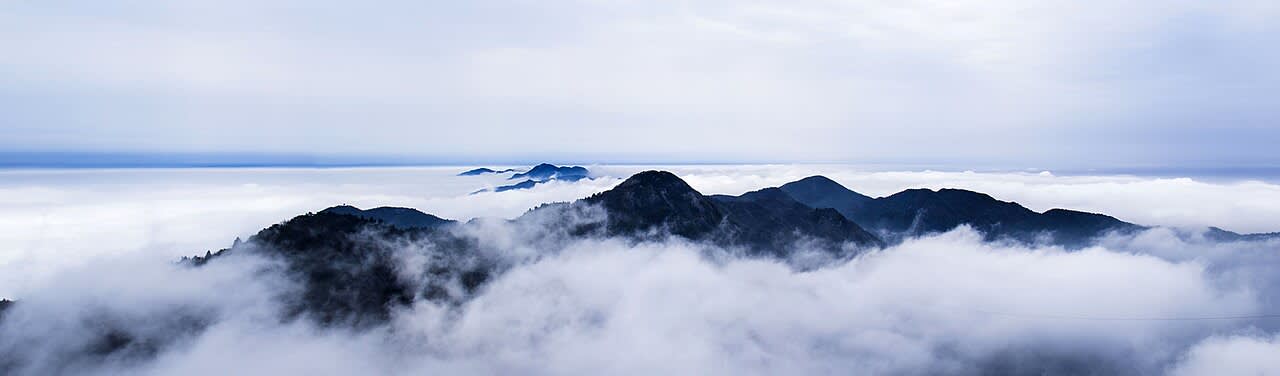
"The Southern Peak, where three teachings coexist beneath the fire god's summit"
Mt. Heng Shan Nan
Hengyang, Hunan, China
Heng Shan rises across 72 peaks in Hunan Province, the Southern Peak of the Five Great Mountains that have anchored Chinese cosmology for over three millennia. The mountain is distinguished by the harmonious coexistence of Taoism, Buddhism, and Confucianism at a single sacred site, with the Grand Temple of Nanyue at its base physically expressing this unity through imperial-palace architecture flanked by Taoist temples on one side and Buddhist temples on the other. Zhurong, the ancient fire god, is said to be buried at the 1,300-meter summit.
Weather & Best Time
Plan Your Visit
Save this site and start planning your journey.
Quick Facts
Location
Hengyang, Hunan, China
Coordinates
27.2775, 112.6456
Last Updated
Mar 29, 2026
Learn More
Heng Shan is the Southern Peak of the Five Great Mountains, one of the most ancient and important systems in Chinese cosmology. The mountain corresponds to fire, summer, and the south in the five elements framework and is the resting place of Zhurong, the fire god.
Origin Story
Zhurong, the fire god, is said to have been born on and buried at the summit of Heng Shan. The peak is named in his honor. He was one of the mythical Five Emperors who ruled in the dawn of Chinese civilization. In the ancient cosmological system, the Five Great Mountains were understood as pillars supporting heaven, with each mountain anchoring one of the five cardinal directions. Heng Shan as the Southern Peak holds the south, maintaining the cosmic balance. Emperor Shun, one of the legendary sage-kings, is said to have made sacrifices at Heng Shan during his tour of the realm, establishing the pattern of imperial worship that continued for over two millennia. The name Heng means balance or weighing, reflecting the mountain's cosmological role.
Key Figures
Zhurong
The fire god of Chinese mythology, one of the Five Emperors, said to be born on and buried at the summit. His presence connects the mountain to the most ancient layer of Chinese sacred geography, predating all three of the formal traditions that later established themselves on the slopes.
Emperor Qin Shi Huang
The first emperor of unified China, who performed state sacrifices at Heng Shan during the Qin Dynasty, establishing the mountain's role in the imperial ritual system that would continue for over two millennia.
The Shangqing Taoist masters
Practitioners of the Supreme Clarity school of Taoism who established a significant Taoist presence on the mountain from the Han Dynasty, making Heng Shan one of the important centers of Taoist practice in southern China.
Spiritual Lineage
Heng Shan's religious lineage spans the full history of Chinese organized religion. Ancient mountain worship and imperial state sacrifices represent the oldest layer. Taoist practice was established from the Han Dynasty. Buddhism arrived during the Southern and Northern Dynasties. The Three Teachings integration that characterizes the mountain's mature religious identity developed during the Song Dynasty and persists to the present. The Grand Temple's architectural expression of this pluralism, with its imperial central axis flanked by Taoist and Buddhist wings, is among the most tangible embodiments of Chinese religious syncretism.
Know a Sacred Site We Should Include?
Help us expand our collection of sacred sites. Share your knowledge and contribute to preserving the world's spiritual heritage.