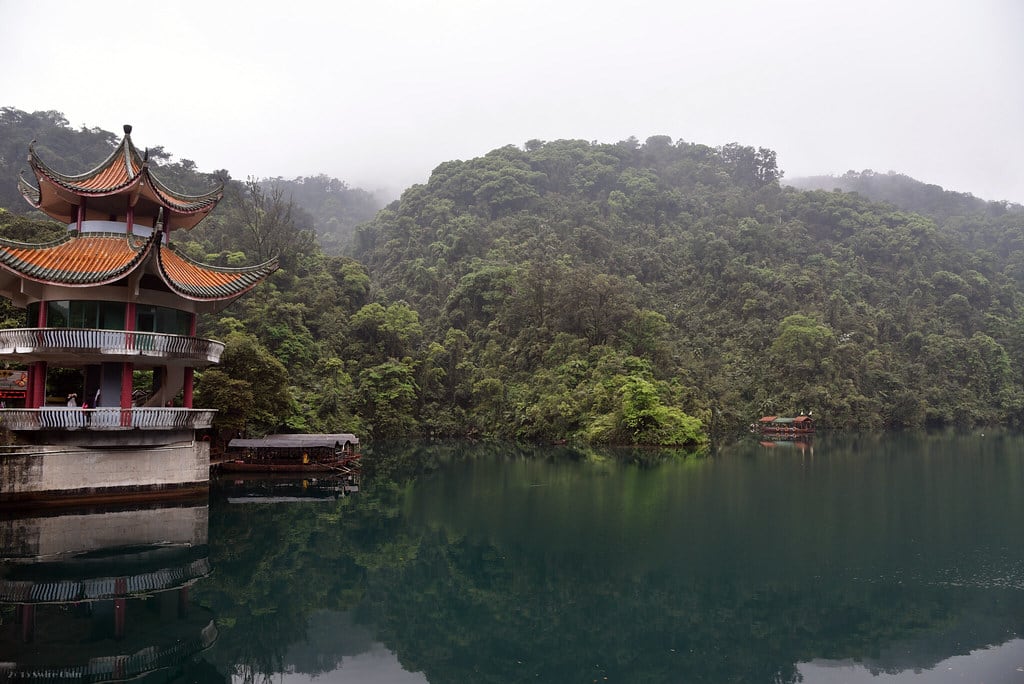
"An ancient forest temple in the Pearl River Delta where stillness resists the speed of southern China"
Mt. Dinghushan
Dinghu District, Guangdong Province, China
Dinghushan rises above the city of Zhaoqing in Guangdong Province, a mountain of ancient subtropical forest sheltering Qingyun Temple, one of the most important Buddhist institutions in southern China. Named for a legend connecting it to the Yellow Emperor's bronze tripod, the mountain was designated as one of China's first UNESCO Biosphere Reserves in 1979. Its primeval canopy, its running water, and its temple vegetarian cuisine draw visitors from the densely urbanized Pearl River Delta seeking something the surrounding region has largely forgotten: slowness.
Weather & Best Time
Plan Your Visit
Save this site and start planning your journey.
Quick Facts
Location
Dinghu District, Guangdong Province, China
Coordinates
23.1640, 112.5484
Last Updated
Mar 29, 2026
Learn More
Dinghushan combines mythological association with the Yellow Emperor, centuries of Buddhist and Taoist practice at Qingyun Temple, and UNESCO Biosphere Reserve status recognizing one of China's most important surviving subtropical forests.
Origin Story
The mountain's oldest story connects it to the Yellow Emperor, the mythical ancestor of the Chinese people. According to legend, Huangdi came to this mountain to cast a sacred bronze tripod. When the tripod was complete, a divine dragon descended from heaven. The tripod then sank into a lake at the summit, giving the mountain its name: Ding (tripod) Hu (lake) Shan (mountain). The event marked the Yellow Emperor's ascension to heaven.
The monk Zaihu sought a place of exceptional natural purity for meditation during the turbulent last years of the Ming Dynasty. Guided by the mountain's feng shui, its abundant water, ancient trees, and sheltered aspect, he founded Qingyun Temple, the Temple of Green Clouds, as a refuge where the Dharma could survive the dynasty's collapse. That the temple persists nearly four centuries later suggests he chose well.
Key Figures
The Yellow Emperor (Huangdi)
The mythical progenitor of Chinese civilization, said to have cast a sacred bronze tripod on the mountain and ascended to heaven when a divine dragon descended. This legend connects Dinghushan to the deepest layer of Chinese cultural identity.
Zaihu
The monk who founded Qingyun Temple during the Chongzhen reign of the late Ming Dynasty (circa 1633 to 1636 CE), establishing the Buddhist institution that has continued for nearly four centuries. His choice of location, guided by feng shui principles, created a temple that integrates seamlessly with its forest setting.
The sixth patriarch Huineng
While not directly associated with Dinghushan, Huineng's Nanhua Temple, the most important Chan Buddhist site in southern China, lies 200 km northeast. Dinghushan's Chan tradition exists within the lineage that Huineng established in Guangdong, connecting the mountain to the broader history of Chinese Buddhism in the south.
Spiritual Lineage
Dinghushan's religious lineage begins with the Taoist association of the mountain with the Yellow Emperor and Taoist cultivation practices. The Buddhist establishment in the late Ming Dynasty layered Chan practice onto a landscape already understood as sacred. The temple's Chan tradition connects to the broader lineage of southern Chinese Buddhism established by the sixth patriarch Huineng at Nanhua Temple. The 1979 UNESCO Biosphere Reserve designation added a scientific framework of ecological significance to the mountain's spiritual identity.
Know a Sacred Site We Should Include?
Help us expand our collection of sacred sites. Share your knowledge and contribute to preserving the world's spiritual heritage.