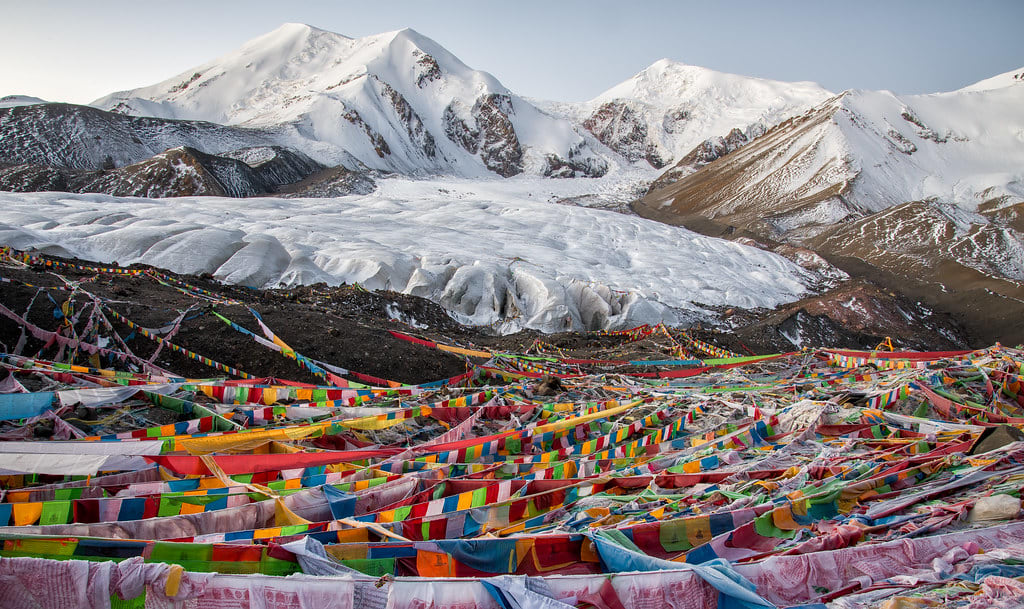
"Grandfather mountain of the Golok Tibetans, where the Yellow River bends around an ancestor deity"
Mt. Amnye Machen
Maqên, Qinghai, China
Amnye Machen rises to 6,282 meters from the grasslands of the Golok Tibetan Autonomous Prefecture in Qinghai Province, an entire mountain range wrapped in the great bend of the Yellow River. For the Golok people, this is not a sacred mountain in the ordinary sense but their ancestral grandfather, the deity Machen Pomra, manifested as ice and rock. The kora circumambulation takes eight to ten days through one of the most remote landscapes on the Tibetan Plateau.
Weather & Best Time
Plan Your Visit
Save this site and start planning your journey.
Quick Facts
Location
Maqên, Qinghai, China
Coordinates
34.7983, 99.4625
Last Updated
Mar 29, 2026
Learn More
Amnye Machen is one of the four most sacred mountains in the Tibetan world, uniquely identified as the ancestral grandfather of the Golok Tibetan people. The mountain deity Machen Pomra is venerated across Buddhist, Bon, and tribal traditions as a warrior protector whose presence is inseparable from Golok identity.
Origin Story
The Golok tradition holds that Machen Pomra was a great warrior deity who chose to manifest as a mountain to protect the Golok people forever. His white peak is his helmet, the glaciers are his armor, and the storms that lash the mountain are his battle cries. The 360 lesser peaks surrounding the main summit are his army of attendant deities, one for each day of the year.
The Tibetan Buddhist tradition recounts that Guru Rinpoche visited the mountain during his journey through eastern Tibet and bound Machen Pomra as a protector of the Dharma. The deity agreed to use his warrior power in service of the Buddhist teachings rather than against them. The kora route was established as the path by which devotees honor this covenant.
The Bon tradition holds that the mountain is one of the great soul mountains that anchor the Tibetan world. When the mountain stands strong, Tibet is strong. When glaciers recede or storms rage, it is a sign that the world's balance is disturbed. The Yellow River's bend around the mountain traces the protective coils of a cosmic serpent.
Key Figures
Machen Pomra
The warrior deity manifested as the mountain itself. Described as riding a white horse, wearing armor, and carrying a spear, accompanied by 360 lesser deities. He is simultaneously the Golok people's ancestor, a protector of the Buddhist Dharma, and the sovereign of the eastern Tibetan Plateau's greatest mountain range.
Joseph F. Rock
Austrian-American explorer whose expeditions between 1926 and 1929 produced the first extensive Western documentation of Amnye Machen and the Golok people. His 1956 monograph on the mountain and surrounding region remains a foundational reference. Rock's work also inadvertently contributed to the brief 1930s controversy when early elevation estimates suggested the mountain might be taller than Everest.
The Golok people
The Tibetan tribal community for whom Amnye Machen is not merely sacred but ancestral. Historically the most independent and martial of Tibetan tribes, the Golok's fierce resistance to both Chinese and central Tibetan authority is understood as inseparable from their devotion to their grandfather mountain.
Guru Rinpoche (Padmasambhava)
The 8th-century Indian master credited with binding Machen Pomra as a protector of the Dharma during his journey through eastern Tibet, incorporating the pre-Buddhist mountain deity into the Buddhist cosmological framework.
Spiritual Lineage
The religious lineage at Amnye Machen is distinctively layered. The oldest layer is the Golok tribal identification with the mountain as their ancestral deity, a tradition that predates organized religion. The Bon tradition, which venerates the mountain as one of Tibet's great soul mountains, adds a second layer with its own cosmology and its distinctive counter-clockwise circumambulation. The Buddhist layer, attributed to Guru Rinpoche's binding of the mountain deity as a dharma protector, provides the framework within which most contemporary pilgrims understand their kora. Small monasteries around the mountain's base maintain various Buddhist lineages. These three traditions coexist at the mountain without resolution into a single narrative.
Know a Sacred Site We Should Include?
Help us expand our collection of sacred sites. Share your knowledge and contribute to preserving the world's spiritual heritage.