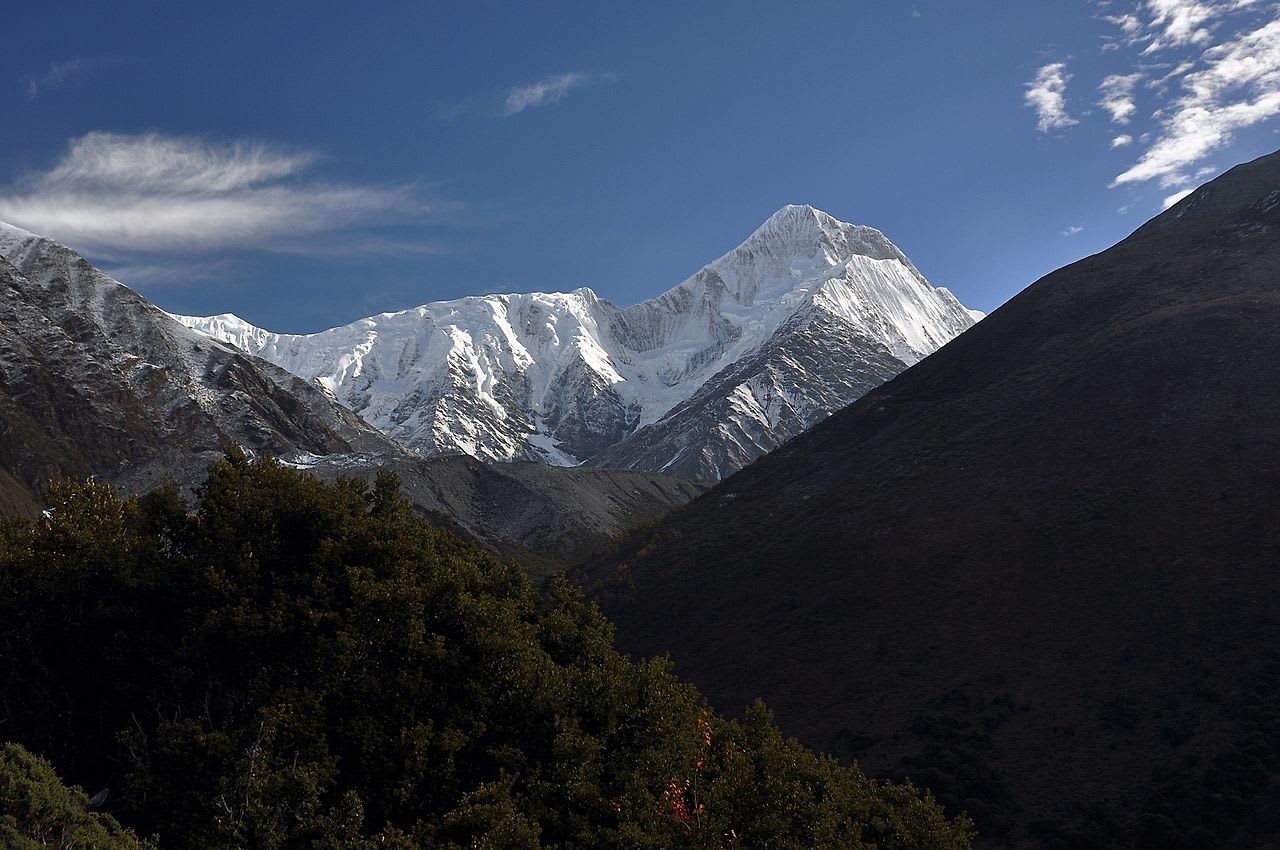
"The king of Sichuan's mountains, where Tibetan pilgrims circle a deity made of ice and stone"
Mount Gongga
Kangding, Sichuan, China
Mount Gongga rises 7,556 meters above the eastern edge of the Tibetan Plateau in Sichuan Province, the highest peak in the region by thousands of meters. Known to Tibetans as Minya Gangkar, the mountain is venerated as the embodiment of the deity Dordjelutru. Gongga Monastery, founded in the 13th century by a Kagyu lama, sits at its western foot. Tibetan pilgrims perform the kora circumambulation through high passes reaching above 4,800 meters, a journey of seven to ten days through every ecological zone on the planet.
Weather & Best Time
Plan Your Visit
Save this site and start planning your journey.
Quick Facts
Location
Kangding, Sichuan, China
Coordinates
29.5950, 101.8767
Last Updated
Mar 29, 2026
Learn More
Mount Gongga is one of the four most sacred mountains in the Tibetan Buddhist world, venerated as the embodiment of the deity Dordjelutru. Gongga Monastery, a Kagyu establishment from the 13th century, has maintained the institutional relationship between Buddhist practice and mountain worship for over seven centuries.
Origin Story
In Tibetan Buddhist teaching, the mountain deity Dordjelutru was bound as a protector of the Dharma by Guru Rinpoche during his journey through the eastern Tibetan regions. The deity agreed to protect the Dharma and its practitioners in exchange for veneration and offerings. The founding of Gongga Monastery formalized this covenant, creating a permanent human community dedicated to maintaining the relationship between the Buddhist sangha and the mountain.
The Kham Tibetan folk tradition holds an older story. Gongga is the king of the mountains in the Kham region, who defeated and subdued the lesser peaks in a primordial contest. His white snow crown is a sign of his sovereignty. The surrounding peaks are his court, and the glaciers are his robes. Those who circle the mountain with respect receive his protection. Those who attempt to stand on his head are punished. The mountain's extreme difficulty for climbers, and its unusually high ratio of fatalities to summit attempts, reinforces this understanding.
Key Figures
Dordjelutru (the mountain deity)
The protector deity who IS the mountain. In Tibetan understanding, Dordjelutru does not inhabit Gongga but manifests as Gongga. The deity's moods are the mountain's weather, and the mountain's resistance to climbers is the deity's defense of his body from desecration.
Joseph F. Rock
National Geographic explorer whose 1929 to 1930 expeditions produced the first extensive Western documentation of Mount Gongga and its surrounding cultural landscape. Rock's photographs and writings provide a baseline record of the monastery, the kora route, and the Kham Tibetan communities before modernization transformed the region.
Terris Moore and Richard Burdsall
American mountaineers who made the first confirmed ascent of the summit in 1932, the highest point reached by Americans at that time. The climb was accomplished with rudimentary equipment. Their account documented both the mountain's extreme difficulty and the local community's ambivalence about their enterprise.
The founding Kagyu lama
A master of the Kagyu school who established Gongga Monastery circa 1270 to 1285 CE, reportedly on the instruction of the second Karmapa or his associates. By founding a permanent monastic community at the mountain's foot, this lama formalized seven centuries of continuous religious practice in the deity's presence.
Spiritual Lineage
The religious lineage of Mount Gongga begins with pre-Buddhist mountain deity worship in the Kham region, a tradition likely as old as Tibetan habitation of the area. The Buddhist incorporation of local deities as dharma protectors, attributed to Guru Rinpoche's journeys through eastern Tibet, layered Buddhist meaning onto an existing sacred landscape. The Kagyu school's emphasis on meditation practice in remote mountain settings aligned naturally with Gongga's character. The monastery has maintained the Kagyu connection for over seven centuries, though the broader Kham Tibetan community venerates the mountain across sectarian lines.
Know a Sacred Site We Should Include?
Help us expand our collection of sacred sites. Share your knowledge and contribute to preserving the world's spiritual heritage.