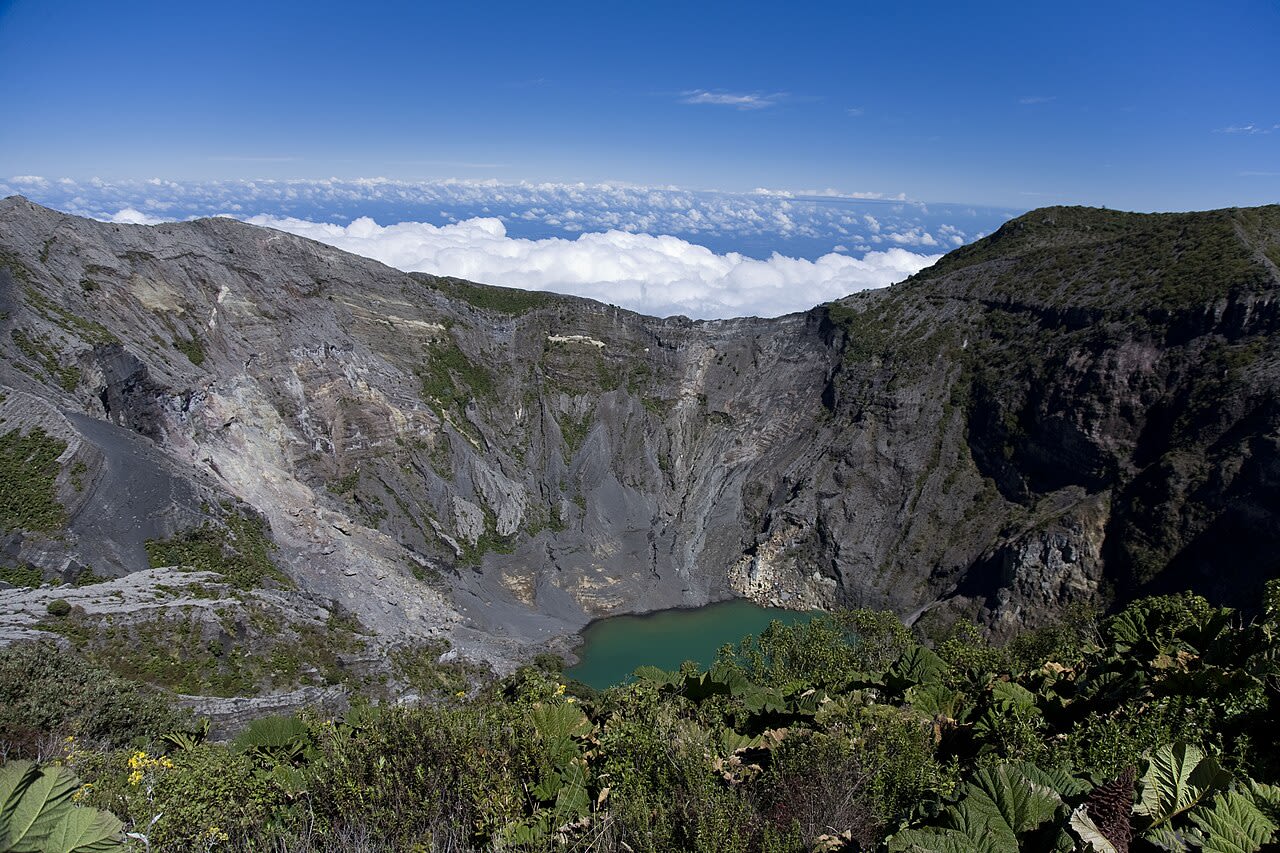
"Costa Rica's highest volcano, where indigenous peoples heard the earth speak in tremor and thunder"
Irazu Volcano
Santa Rosa, Cartago Province, Costa Rica
At 3,432 meters, Irazu is the tallest active volcano in Costa Rica and one of the few places in the Americas where both the Atlantic and Pacific Oceans are theoretically visible from a single point. The indigenous name Iztaru, meaning hill of tremor and thunder, preserves a relationship with this mountain that precedes written history. Five craters scar its summit, including one holding an olive-green acidic lake that shifts color with the geology beneath it.
Weather & Best Time
Plan Your Visit
Save this site and start planning your journey.
Quick Facts
Location
Santa Rosa, Cartago Province, Costa Rica
Site Type
Coordinates
9.9768, -83.8462
Last Updated
Mar 29, 2026
Learn More
Irazu Volcano has been an active geological presence for approximately 300,000 years and a significant feature of human consciousness in the Central Valley for millennia. The national park, established in 1955, was one of Costa Rica's first protected areas. The 1963-1965 eruption, which began during President Kennedy's visit, became a defining event in Costa Rican national identity.
Origin Story
The indigenous name Iztaru, from which Irazu derives, translates approximately as hill of tremor and thunder. While the exact linguistic origin and meaning are debated, the name preserves an understanding of the volcano as a living, speaking entity. For the Huetar and related peoples of the Central Valley, volcanic mountains were not inert geological features but powerful presences, their eruptions and earthquakes expressions of spiritual agency. To name the mountain was to acknowledge its capacity to act, to tremble, to speak in thunder.
The 1963 eruption added a modern origin story. On March 19, 1963, the day President John F. Kennedy arrived in Costa Rica for a state visit, Irazu erupted. For two years, ash fell on San Jose and the Central Valley, destroying crops, contaminating water supplies, and darkening the sky. The coincidence of the presidential visit and the eruption entered national mythology as a dramatic assertion of natural power at a moment of political significance.
Key Figures
The Huetar People
Indigenous inhabitants of Costa Rica's Central Valley who named the mountain Iztaru and understood it as a spiritual entity. Their specific practices at Irazu are poorly documented, but they belong to the broader Central American tradition of volcanic reverence.
Diego de la Haya Fernandez
Colonial governor of Costa Rica who documented the 1723 eruption, creating one of the earliest written records of volcanic activity in the region.
SINAC (Sistema Nacional de Areas de Conservacion)
Costa Rica's national conservation system that manages the volcano as a national park, established in 1955 as one of the country's earliest protected areas.
Spiritual Lineage
Irazu belongs to no single tradition but has been claimed by several. The indigenous Huetar understood it as a spiritual entity. The Spanish colonists documented it as a natural hazard. The modern Costa Rican state protects it as a national park. Scientists study it as a stratovolcano. Visitors experience it as a landscape of primal beauty. Each of these relationships is real, and none fully captures what this mountain is.
Know a Sacred Site We Should Include?
Help us expand our collection of sacred sites. Share your knowledge and contribute to preserving the world's spiritual heritage.