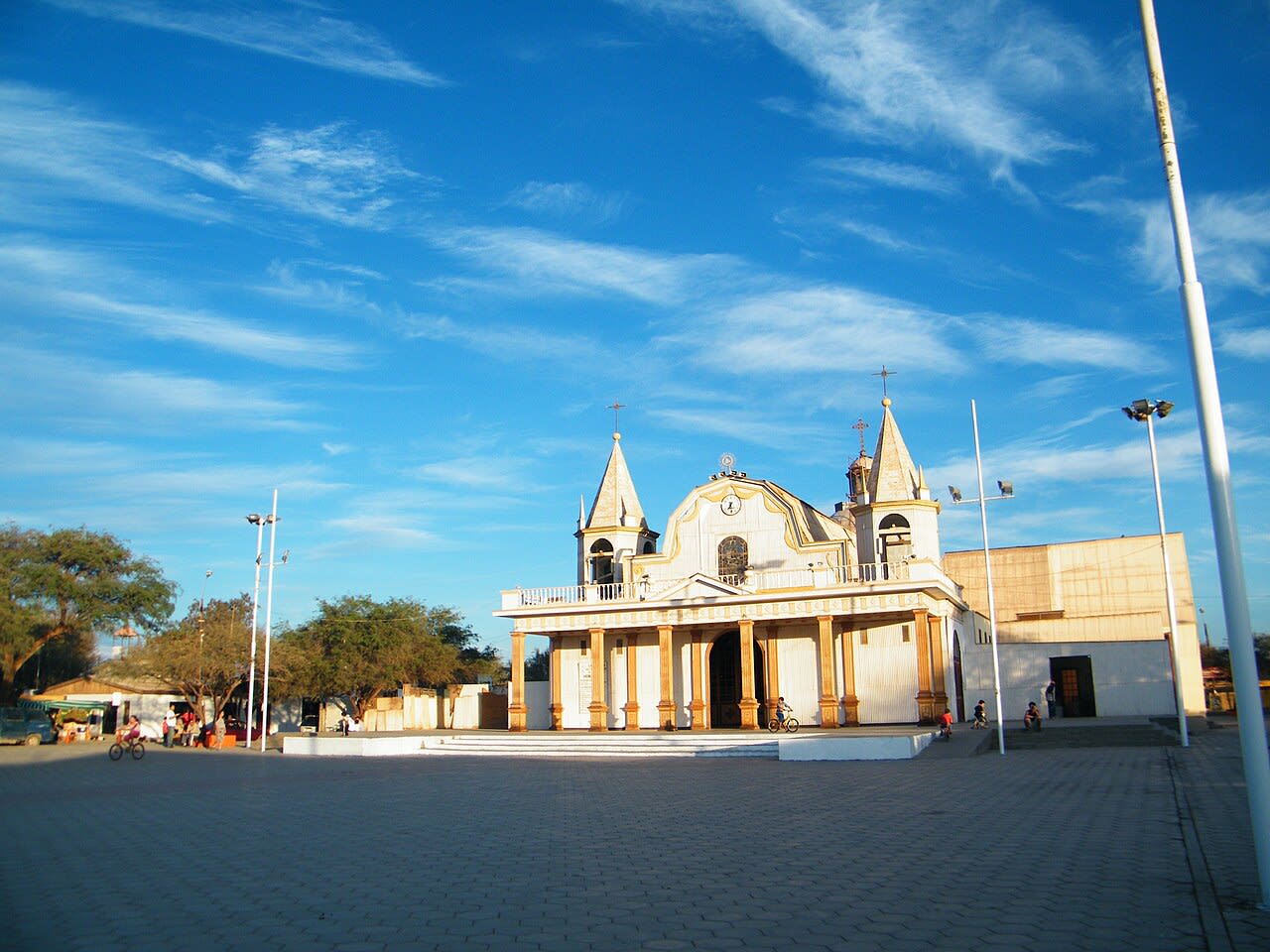
"Where the driest desert on earth erupts with two hundred thousand dancing pilgrims"
Iglesia de La Tirana
Pozo Almonte, Tarapacа Region, Chile
In the Atacama Desert of northern Chile, a village of eight hundred swells to a quarter million every July as pilgrims converge on the Santuario de La Tirana. Hundreds of religious dance societies perform elaborate choreographies in masks and costumes that fuse Andean, Aymara, and Catholic traditions. The Fiesta de La Tirana is Chile's largest religious festival and one of the most vivid expressions of syncretic devotion in the Americas.
Weather & Best Time
Plan Your Visit
Save this site and start planning your journey.
Quick Facts
Location
Pozo Almonte, Tarapacа Region, Chile
Tradition
Site Type
Coordinates
-20.3366, -69.6563
Last Updated
Mar 29, 2026
Learn More
La Tirana's origins lie in the colonial encounter between Inca resistance and Spanish Christianity, preserved in the legend of the princess who chose baptism and was killed for it.
Origin Story
The legend tells of Ñusta Huillac, an Inca princess among the captives of Diego de Almagro's expedition across the Atacama in the 1530s. She escaped into the Pampa del Tamarugal with a band of followers and became a guerrilla leader of such ferocity that the Spanish called her La Tirana — The Tyrant. For years she raided caravans and killed any indigenous person who had converted to Christianity. Then she fell in love with a Portuguese miner named Vasco de Almeyda, who taught her about his faith. When she asked to be baptized, her followers killed them both. A Spanish priest later found a cross on her body and built a chapel at the site.
Whether the legend has a historical kernel or is wholly mythological remains unclear. What is certain is that it provides the founding narrative for a sacred site whose power derives from the collision of worlds — indigenous and colonial, resistance and conversion, love and death. The church that grew around the chapel became the center of Marian devotion in northern Chile, its significance expanding as the saltpeter mining industry brought workers from across the region who adopted the Virgen del Carmen as their protector.
Key Figures
Ñusta Huillac (La Tirana)
Legendary Inca princess whose resistance, love affair, conversion, and death at the hands of her own followers established the sacred origin of the site. Whether historical or mythological, her story embodies the violent transformation at the root of Latin American Catholic culture.
Virgen del Carmen (Our Lady of Mount Carmel)
Patron saint of Chile and the object of devotion at La Tirana. Her image at the sanctuary is the focal point of the festival, and her feast day (July 16) structures the entire celebration. Declared patron of Chile's armed forces and later of the nation, she bridges sacred and civic identity.
Bailes Religiosos Cofradías
The hundreds of religious dance societies that perform at La Tirana represent a collective cultural institution. Each cofradía maintains its own traditions, costumes, music, and choreography, training year-round for the July festival. Membership often spans generations, making the societies repositories of syncretic religious knowledge.
Spiritual Lineage
La Tirana belongs to a network of Andean-Catholic syncretic festivals that stretches across Chile, Bolivia, and Peru. Its closest relative is the Carnival of Oruro in Bolivia, a UNESCO Masterpiece of Intangible Cultural Heritage, from which the Diablada dance was introduced to La Tirana in 1956. The festival also connects to the broader tradition of Marian pilgrimage in Latin America, from Guadalupe in Mexico to Aparecida in Brazil. What distinguishes La Tirana is the desert setting, the intensity of the dance tradition, and the depth of Andean-Catholic fusion in a nation that does not always acknowledge its indigenous spiritual inheritance.
Know a Sacred Site We Should Include?
Help us expand our collection of sacred sites. Share your knowledge and contribute to preserving the world's spiritual heritage.